Fernando Alonso’s Bold Ambition: McLaren Targets F1’s Elite After Australian Grand Prix Performance
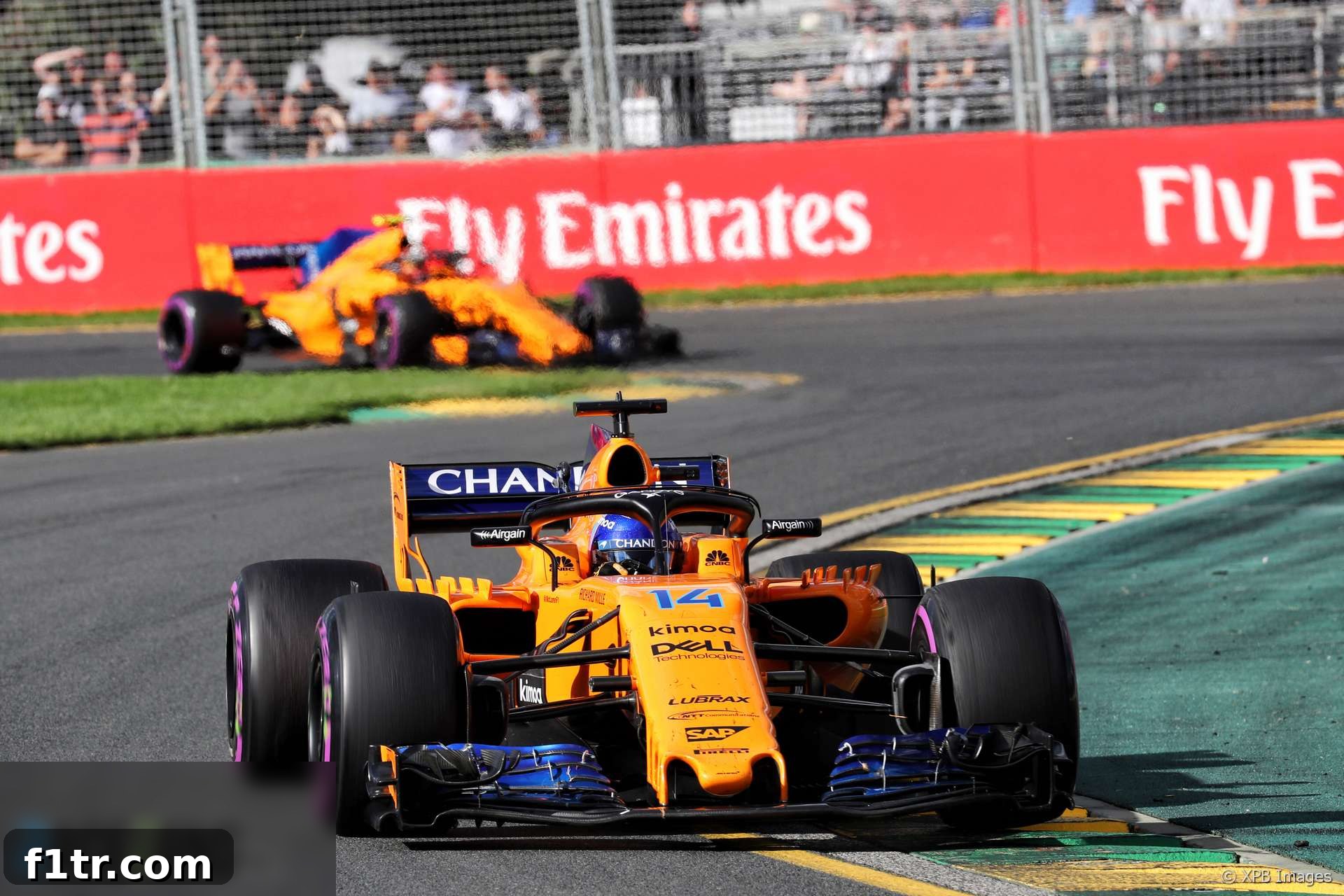
Following a commendable fifth-place finish at the season-opening Australian Grand Prix, two-time Formula 1 world champion Fernando Alonso has publicly set an ambitious target for McLaren: to challenge the sport’s established top three teams in the upcoming races. Alonso’s performance in Melbourne, where he skillfully managed to keep Max Verstappen’s potent Red Bull behind him for a significant period after a crucial Safety Car restart, has fueled optimism within the Woking-based outfit, despite acknowledging the considerable gap that still separates them from the front-runners.
The Australian Grand Prix provided a mixed bag of emotions and clear indicators for McLaren. While Alonso celebrated a strong points haul, it was evident that the pace disparity between McLaren and the leading teams remained substantial. Daniel Ricciardo, in the sister RB14, illustrated this gap starkly by pulling away from Alonso’s McLaren by a commanding 20 seconds over just 27 laps, underscoring the performance deficit that McLaren needs to overcome.
Alonso, ever the pragmatist, did not shy away from the harsh truth regarding the competitive order. “Right now, they are still clearly ahead of us,” Alonso admitted, referring to the sport’s dominant forces. “They are in that exclusive group, Mercedes, Ferrari, and Red Bull.” This candid assessment highlights the significant challenge facing McLaren as they strive to reclaim their former glory.
McLaren’s Newfound Resolve: Aiming for the Apex
Despite the current pecking order, there is an undeniable sense of renewed determination within the McLaren camp. Alonso articulated this ambition with conviction: “But McLaren is willing to enter that group, and I think in the next coming races we will forget the middle group and look forward to that privileged three top teams. There is potential in the car, so I cannot see any reason why we should not be there in the coming races.” This statement is not merely a display of confidence; it reflects a belief in the inherent design and developmental capabilities of the new McLaren challenger, the MCL33, and its new Renault power unit.
The transition from Honda to Renault power in 2018 was a significant gamble for McLaren, a move designed to unshackle the team from years of underperformance and reliability issues. While the Australian Grand Prix offered the first real test of this new partnership, Alonso’s comments suggest that the team is far from maximizing the car’s potential. The optimism stems from the understanding that the chassis itself, a traditional strength for McLaren, combined with a more competitive engine, provides a solid foundation for growth throughout the season.
The Nuances of a Fifth-Place Finish: Luck and Capitalization
Alonso’s fifth-place finish in Melbourne, behind one Mercedes, one Red Bull, and both Ferraris, was undoubtedly a strong start to the season in terms of points. However, the Spanish veteran was quick to temper expectations, admitting that the result might not fully reflect McLaren’s true position in the competitive order. His honest appraisal of the race conditions offers valuable insight into the dynamic nature of Formula 1 racing.
“Obviously today we got lucky with the two Haas retirements,” Fernando Alonso elaborated, referencing the double DNF of Kevin Magnussen and Romain Grosjean, which elevated several cars in the standings. He also pointed out that “Carlos [Sainz Jnr] had a problem in Turn 9, and then with the Safety Car we overtook Max Verstappen.” These incidents collectively contributed to what Alonso estimated as “four or five places” gained due to favorable circumstances. Yet, while fortune played a role, Alonso was also keen to emphasize the team’s impeccable execution: “But we did no mistakes, we capitalized on everything and perfect job from the team.” This ability to seize opportunities and extract maximum performance when conditions align is a hallmark of a well-drilled racing outfit and speaks volumes about McLaren’s operational efficiency.
A Season of Evolution: Expectations for the 2018 Campaign
Alonso’s forward-looking perspective suggests that the Australian Grand Prix was merely the opening chapter of what McLaren hopes will be a season of continuous improvement. “As I said on Thursday, this is probably our lowest performance of the year,” he reiterated, indicating a belief that the MCL33 possesses significant untapped potential. “I think it’s going to be better and better with the races.” This statement sets a clear trajectory for the season, implying that McLaren anticipates a steep development curve as they learn more about their new package and bring crucial updates to the car.
The journey from the midfield to challenging the likes of Mercedes, Ferrari, and Red Bull is arduous, requiring relentless innovation, flawless execution, and substantial investment. These top teams have well-established infrastructures, vast resources, and years of optimized development processes. McLaren’s challenge is not just to improve their car but to do so at a faster rate than their rivals, a task that is incredibly difficult in the cutthroat world of Formula 1.
However, McLaren’s rich history, its engineering prowess, and the sheer talent of its drivers, particularly Alonso, provide a solid foundation for this ambition. The team’s decision to switch to Renault engines signified a commitment to returning to the front, and the early signs, despite the caveats, are cautiously optimistic. The coming races will be crucial in demonstrating whether McLaren can indeed translate this potential into tangible gains on track and begin to close the performance gap that separates them from F1’s elite.
The Competitive Landscape: F1’s Exclusive Top Tier
In the 2018 Formula 1 season, the “exclusive group” comprising Mercedes, Ferrari, and Red Bull represented the pinnacle of engineering, performance, and strategic execution. Mercedes, with its dominant hybrid power unit, had set the benchmark for years. Ferrari, revitalized, was providing a strong challenge, showcasing impressive chassis development and engine power. Red Bull, known for its aero brilliance and aggressive racing strategy, consistently maximized its package, often punching above its weight even with a less powerful engine compared to Mercedes and Ferrari. Breaking into this tightly knit triumvirate requires not just incremental improvements but a fundamental leap in performance, reliability, and strategic acumen.
McLaren’s challenge involves not only extracting more speed from their MCL33 but also ensuring bulletproof reliability and flawless pit stop operations – areas where the top teams consistently excel. Alonso’s relentless pursuit of perfection and his ability to motivate a team will be instrumental in this endeavor. His experience, spanning multiple championship battles and different eras of F1, makes him uniquely qualified to guide McLaren through this challenging phase. His voice carries immense weight within the team, and his belief in the car’s potential will undoubtedly spur engineers and strategists to push the boundaries even further.
Road Ahead: Development and the Pursuit of Excellence
The focus for McLaren in the immediate future will be on understanding the MCL33’s characteristics thoroughly, particularly with the new Renault power unit integration. Key areas for development will include aerodynamic efficiency, especially in varying circuit conditions, and optimizing the power unit’s performance and reliability. Bringing timely and effective updates to each race will be paramount. F1 is a continuous development race, and the teams that can bring the most significant upgrades, most consistently, are often the ones that climb the ranks.
Fernando Alonso’s statement is more than just post-race commentary; it’s a declaration of intent. It serves as a rallying cry for the entire McLaren team, from the factory floor in Woking to the pit wall at every Grand Prix. The dream of challenging for podiums and victories might still be some way off, but the aspiration to join F1’s top three teams is now firmly articulated. The 2018 season promises to be a fascinating journey for McLaren, as they strive to turn potential into performance and fulfill the ambitious vision set forth by their most experienced driver.
Experience RaceFans Ad-Free: Support Independent F1 Journalism>> Discover how to support us and enjoy an ad-free experience
More on the 2018 F1 Season
- F1 feared “death knell” for Drive to Survive after Ferrari and Mercedes snub
- McLaren staff told us we were “totally crazy” to take Honda engines in 2018 – Tost
- ‘It doesn’t matter if we start last’: How Red Bull’s junior team aided Honda’s leap forward
- Honda’s jet division helped F1 engineers solve power unit problem
- McLaren Racing losses rise after Honda split
Browse all 2018 F1 season articles