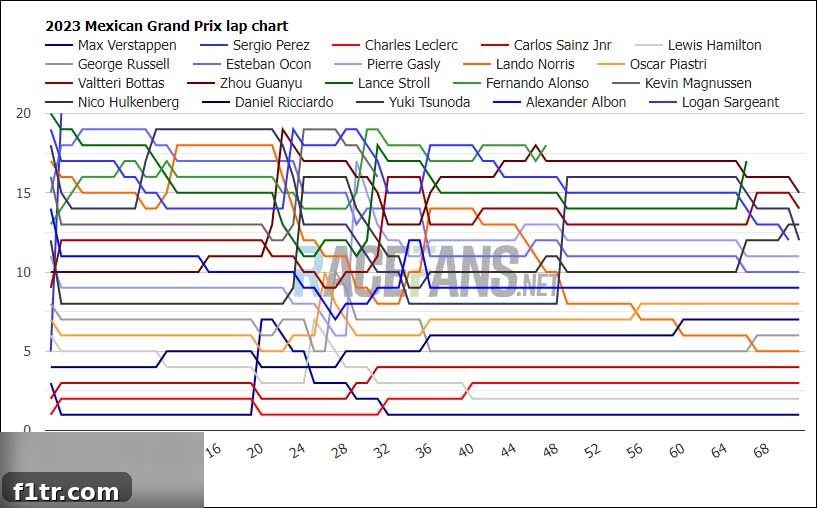
The 2023 Mexican Grand Prix delivered a captivating blend of strategic drama, high-stakes tire management, and unexpected twists, leaving Red Bull team principal Christian Horner “very surprised” by Ferrari’s seemingly conservative approach during a pivotal race restart. Max Verstappen ultimately secured a dominant victory, but the mid-race red flag triggered by Kevin Magnussen’s heavy crash on lap 34 reshaped the strategic landscape entirely, presenting both immense challenges and unforeseen opportunities for the leading contenders.
Before the red flag, the race at the Autódromo Hermanos Rodríguez was unfolding with a conventional one-stop strategy largely in play. However, the unexpected interruption forced teams to re-evaluate their plans under immense pressure. Verstappen, who had been leading comfortably, found himself in a precarious position for the standing restart. His initial stint had been relatively short, running his first set of medium tyres for just 19 laps before pitting. This meant that after the red flag, his only remaining new tire compound was the hard, setting the stage for a potentially vulnerable second half of the race.
Christian Horner articulated the team’s apprehension, stating, “That red flag was the worst possible time when you’re in the middle of a two-stop strategy. It neutralises the race, and of course, we’ve only got a hard set of tyres available.” The altitude of Mexico City, making tire degradation a constant concern, amplified these worries. A hard tire compound, while durable, typically offers less initial grip and slower warm-up compared to mediums or softs, crucial factors for a standing start where rivals could easily gain an advantage.
Ferrari, with Charles Leclerc, had adopted a different initial strategy, pushing their first set of medium tires much further, until lap 31. This longer stint meant Leclerc had potentially preserved a fresher set of softer tires for the latter stages, or at least had more flexibility. With 37 laps remaining at the restart, Horner fully expected Ferrari to seize this opportunity to launch an aggressive assault on Verstappen, betting on a softer, grippier compound for a strong initial getaway. This expectation, however, was met with surprise.
“We thought that Leclerc – after that long first stint, I was convinced – they’d take a set of mediums because it’s worth about five metres off the start line,” Horner revealed. “So I was very surprised that they went with the hard tyre. You saw the medium on Hamilton was okay.” Indeed, while Leclerc restarted on hard tires, Lewis Hamilton of Mercedes opted for the medium compound. This choice proved instrumental, as Hamilton was able to swiftly overtake the Ferrari driver shortly after the restart, solidifying his bid for a podium finish.
Leclerc himself admitted that his car’s performance plummeted on the hard rubber, a struggle that became painfully apparent only after the red flag incident and the subsequent tire cooldown. “I think it still confirms the weaknesses of our car; it’s a very peaky car,” Leclerc lamented after the race. “Whenever we get out of the optimal window of the car, we are losing too much time. And that’s exactly what happened on the hard.” The “peaky” nature describes a car that performs exceptionally well within a narrow operating window but suffers disproportionately outside it, making consistent performance across varying conditions a challenge.
The Ferrari driver elaborated on his post-red flag difficulties: “At first, I thought I could do quite a good job once we stopped. But then there was a red flag, the tyres cooled down, we went back out, and the feeling was just not the same, and I couldn’t find the feeling again with the tyres. So it’s a bit of a shame because before that, it was really good, especially on the medium.” This candid assessment highlighted how crucial tire temperature and the specific operating window were for the Ferrari SF-23, a characteristic that ultimately cost them dearly in the race’s second phase.
The contrast between Mercedes’ confidence and Ferrari’s caution was stark. Hamilton, despite not having a fresh set of medium tires available and having run his first set for a considerable number of laps, started the second race segment on used mediums. Mercedes engineers were confident in his ability to manage these tires to the checkered flag. Ferrari, however, held significant reservations. Their car had consistently shown poorer tire degradation throughout the season, leading team principal Frederic Vasseur to express concerns about completing the remaining 35 laps on anything softer than the hard compound.
“We had to restart for 35 laps, or something like this, and we were not expecting to be able to do 35 laps on a medium,” said Vasseur. He noted that the specific medium set they had available was also a “scrubbed” one, meaning it had been used for installation laps or earlier sessions, thus offering less longevity than a brand-new set. Vasseur hypothesized that the extensive tire and engine management tasks required from the drivers in the race’s demanding conditions ultimately played into Hamilton’s hands, allowing him to nurse his medium tires effectively until the very end. “But it was ambitious,” Vasseur conceded, underscoring the high-risk, high-reward nature of Hamilton’s strategy.
As the laps ticked down, Ferrari’s hopes of catching Hamilton briefly flickered when Leclerc began to match Hamilton’s lap times from around lap 51. This suggested a potential revival in their hard tire performance or a drop-off from Hamilton’s mediums. However, Hamilton, known for his exceptional tire management skills, proved capable of leaning more heavily on his medium tires in the closing stages. Demonstrating remarkable pace and control, he not only held his position but also set the fastest lap of the race on the final tour, a testament to his and Mercedes’ strategic prowess.
Beyond the leading battle, the Mexican Grand Prix also witnessed a sensational recovery drive from Lando Norris. The McLaren driver had shown immense promise during Friday practice sessions, hinting at strong pace. However, a calamitous qualifying session saw him fail to progress beyond Q1, relegating him to a starting position far down the grid. Despite this significant setback, Norris mounted an incredible charge through the field, ultimately crossing the finish line in a well-deserved fifth place.
His impressive climb was a product of both raw driving talent and an unconventional, yet inspired, strategy. Norris was the only driver throughout the entire race to utilize the soft tire compound. This aggressive strategy, combined with excellent execution, allowed him to unlock significant pace at crucial moments, making numerous overtakes and demonstrating the McLaren’s competitive potential. It was a race of “what might have been” for Norris, given his Friday pace, but his recovery drive was undoubtedly one of the highlights of the Mexican Grand Prix, solidifying his reputation as a tenacious competitor.
2023 Mexican Grand Prix Lap Information
The complexities of tire strategy and the impact of the red flag are best understood by analyzing the detailed lap data, showcasing each driver’s performance and strategic choices throughout the race. While interactive charts provide the most dynamic insight, a textual overview confirms the ebbs and flows of positions, gaps, and lap times that defined this thrilling event.
The gaps between each driver on every lap compared to the leader’s average lap time provide a crucial metric for understanding relative performance and the effectiveness of various strategies. Such data often highlights how drivers manage their tires, conserve fuel, or push for overtakes, with very large gaps sometimes omitted for clarity in a condensed view. The individual lap times by all drivers (excluding unusually slow laps due to incidents or pit stops) reveal the pure pace of each car and driver combination under different tire compounds and race conditions. This data often underlines the “peaky” nature of certain cars, like Ferrari’s, and the consistent performance of others.
Furthermore, the detailed tire strategies employed by each driver offer a comprehensive look into team decisions, highlighting the critical choices made before and during the race, especially in light of the red flag. This includes the number of pit stops, the compounds used for each stint (hard, medium, soft), and the duration of those stints, which together paint a full picture of the strategic battles on track.
2023 Mexican Grand Prix Fastest Laps
The fight for the fastest lap often showcases a driver’s raw speed and the ultimate performance ceiling of their car. In Mexico, Lewis Hamilton delivered a blistering final lap, underlining Mercedes’ strong late-race pace and optimal tire management. The list below details each driver’s fastest lap, providing insight into their maximum performance during the race.
| Rank | # | Driver | Car | Lap time | Gap | Avg. speed (kph) | Lap no. |
|---|---|---|---|---|---|---|---|
| 1 | 44 | Lewis Hamilton | Mercedes | 1’21.334 | 190.5 | 71 | |
| 2 | 1 | Max Verstappen | Red Bull-Honda RBPT | 1’21.644 | 0.310 | 189.78 | 40 |
| 3 | 4 | Lando Norris | McLaren-Mercedes | 1’21.944 | 0.610 | 189.09 | 71 |
| 4 | 16 | Charles Leclerc | Ferrari | 1’22.332 | 0.998 | 188.19 | 38 |
| 5 | 22 | Yuki Tsunoda | AlphaTauri-Honda RBPT | 1’22.501 | 1.167 | 187.81 | 11 |
| 6 | 55 | Carlos Sainz Jnr | Ferrari | 1’22.539 | 1.205 | 187.72 | 57 |
| 7 | 3 | Daniel Ricciardo | AlphaTauri-Honda RBPT | 1’22.679 | 1.345 | 187.4 | 66 |
| 8 | 81 | Oscar Piastri”>Oscar Piastri | McLaren-Mercedes | 1’22.760 | 1.426 | 187.22 | 53 |
| 9 | 23 | Alexander Albon | Williams-Mercedes | 1’22.773 | 1.439 | 187.19 | 65 |
| 10 | 63 | George Russell | Mercedes | 1’22.780 | 1.446 | 187.18 | 38 |
| 11 | 31 | Esteban Ocon | Alpine-Renault | 1’22.976 | 1.642 | 186.73 | 66 |
| 12 | 2 | Logan Sargeant | Williams-Mercedes | 1’23.003 | 1.669 | 186.67 | 24 |
| 13 | 20 | Kevin Magnussen | Haas-Ferrari | 1’23.146 | 1.812 | 186.35 | 25 |
| 14 | 77 | Valtteri Bottas | Alfa Romeo-Ferrari | 1’23.166 | 1.832 | 186.31 | 43 |
| 15 | 27 | Nico Hulkenberg | Haas-Ferrari | 1’23.222 | 1.888 | 186.18 | 43 |
| 16 | 10 | Pierre Gasly | Alpine-Renault | 1’23.230 | 1.896 | 186.16 | 43 |
| 17 | 18 | Lance Stroll | Aston Martin-Mercedes | 1’23.257 | 1.923 | 186.1 | 43 |
| 18 | 14 | Fernando Alonso | Aston Martin-Mercedes | 1’23.531 | 2.197 | 185.49 | 40 |
| 19 | 24 | Zhou Guanyu | Alfa Romeo-Ferrari | 1’23.567 | 2.233 | 185.41 | 39 |
| 20 | 11 | Sergio Perez | Red Bull-Honda RBPT | 1’43.446 | 22.112 | 149.78 | 1 |
2023 Mexican Grand Prix Pit Stop Times
Pit stops are a critical element of Formula 1 strategy, and even fractions of a second can make a significant difference to a driver’s track position. The table below details the complete stop times for each driver during the 2023 Mexican Grand Prix, including the lap on which the stop occurred, offering a comprehensive overview of team efficiency under pressure.
| Rank | # | Driver | Team | Complete stop time (s) | Gap to best (s) | Stop no. | Lap no. |
|---|---|---|---|---|---|---|---|
| 1 | 55 | Carlos Sainz Jnr | Ferrari | 22.067 | 1 | 30 | |
| 2 | 44 | Lewis Hamilton | Mercedes | 22.21 | 0.143 | 1 | 24 |
| 3 | 16 | Charles Leclerc | Ferrari | 22.248 | 0.181 | 1 | 31 |
| 4 | 63 | George Russell | Mercedes | 22.311 | 0.244 | 1 | 26 |
| 5 | 1 | Max Verstappen | Red Bull | 22.372 | 0.305 | 2 | 33 |
| 6 | 3 | Daniel Ricciardo | AlphaTauri | 22.406 | 0.339 | 1 | 27 |
| 7 | 1 | Max Verstappen | Red Bull | 22.427 | 0.36 | 1 | 19 |
| 8 | 4 | Lando Norris | McLaren | 22.563 | 0.496 | 2 | 33 |
| 9 | 18 | Lance Stroll | Aston Martin | 22.582 | 0.515 | 1 | 30 |
| 10 | 10 | Pierre Gasly | Alpine | 22.627 | 0.56 | 1 | 28 |
| 11 | 24 | Zhou Guanyu | Alfa Romeo | 22.817 | 0.75 | 1 | 21 |
| 12 | 14 | Fernando Alonso | Aston Martin | 22.844 | 0.777 | 1 | 29 |
| 13 | 27 | Nico Hulkenberg | Haas | 23.144 | 1.077 | 1 | 23 |
| 14 | 4 | Lando Norris | McLaren | 23.408 | 1.341 | 1 | 11 |
| 15 | 77 | Valtteri Bottas | Alfa Romeo | 23.638 | 1.571 | 1 | 31 |
| 16 | 20 | Kevin Magnussen | Haas | 23.642 | 1.575 | 1 | 23 |
| 17 | 23 | Alexander Albon | Williams | 23.68 | 1.613 | 1 | 33 |
| 18 | 81 | Oscar Piastri | McLaren | 23.734 | 1.667 | 1 | 25 |
| 19 | 2 | Logan Sargeant | Williams | 23.945 | 1.878 | 1 | 22 |
| 20 | 22 | Yuki Tsunoda | AlphaTauri | 30.121 | 8.054 | 1 | 9 |
Related Articles from the 2023 Mexican Grand Prix
- ‘I’m so s*** in qualifying’: Norris berates himself despite pole-winning lap
- Ferrari reaping the benefits of having F1’s most closely-matched team mates
- Norris had “no chance” to beat Verstappen in Mexico even without Q1 exit
- Transcript: How Ricciardo’s race went awry soon after he was told to “bring it home”
- Mercedes see “very encouraging signs” from Austin floor update
Browse all 2023 Mexican Grand Prix articles