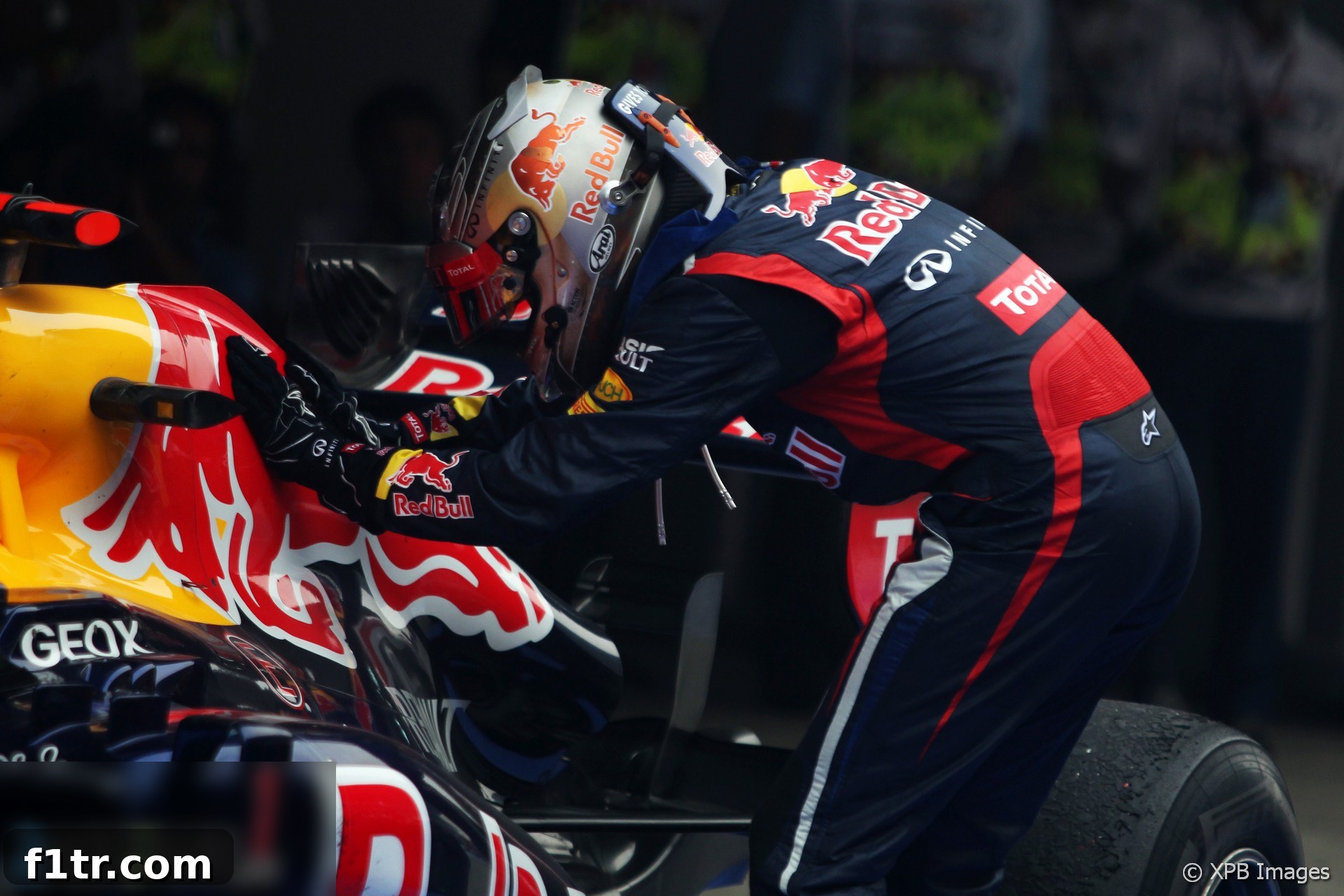
The 2012 Formula 1 season delivered an electrifying championship battle, and the Indian Grand Prix served as a pivotal chapter in this high-stakes narrative. Sebastian Vettel, demonstrating masterful control and the sheer dominance of his Red Bull Racing RB8, clinched his fourth consecutive victory, extending his lead in the drivers’ championship over rival Fernando Alonso. The win at the Buddh International Circuit marked a significant stride for Vettel, further solidifying his position as the man to beat in what was becoming an increasingly intense title fight.
From the moment the lights went out, Vettel was in a league of his own. Having secured pole position, he converted it into a textbook lead, flawlessly navigating the opening corners and establishing a comfortable gap to the chasing pack. For the second year running at this circuit, the German maestro led every single lap, showcasing a performance of unparalleled consistency and speed that left his competitors with little hope of challenging for the top spot. His drive was a testament to both his skill and the exceptional engineering prowess of the Red Bull Racing team.
Fernando Alonso, in his Ferrari F2012, was acutely aware of the damage Vettel was inflicting on his championship hopes. While a direct challenge for victory seemed out of reach, the Spaniard’s primary objective was to limit the points difference. He executed a determined race, battling his way through the field to secure a crucial second place. This podium finish was a testament to Alonso’s relentless fighting spirit and Ferrari’s ability to extract every ounce of performance from their package, even when lacking the outright pace of their Austrian rivals. However, even his valiant efforts couldn’t prevent Vettel from celebrating his fifth win of the season, a statistic that painted a clear picture of Red Bull’s surging momentum.
The Ferocious Fight for Third: Alonso Takes on the McLarens
The start of the Indian Grand Prix was a critical juncture, particularly for the drivers vying for positions behind the dominant Red Bulls. Sebastian Vettel and Mark Webber, starting from a commanding front-row lockout, made a clean getaway, preserving their advantage. The real fireworks, however, ignited just behind them, as a furious three-way battle erupted for third place. The McLaren drivers, Lewis Hamilton and Jenson Button, found themselves side-by-side down the long run to Turn Four, a high-speed section of the track that demanded bravery and precision. Amidst this McLaren skirmish, Fernando Alonso strategically positioned his Ferrari alongside them, creating a tense three-abreast approach into the notoriously tight Turn Four.
Lewis Hamilton, always an aggressive racer, attempted a daring move by diving down the inside of Alonso at Turn Four. It was a bold maneuver, but one that didn’t quite pay off. Hamilton ran wide, losing precious momentum and allowing the ever-opportunistic Alonso to reclaim the position. This early exchange highlighted Alonso’s tenacity and his ability to capitalize on even the smallest of opportunities, crucial traits in his pursuit of the championship.
While the Red Bulls were busy extending their lead at the front, Jenson Button initially held onto third place. However, his tenure there was short-lived. Both Fernando Alonso and Lewis Hamilton, driving cars with superior straight-line speed in the DRS zone, swiftly out-gunned the McLaren driver. Alonso, now firmly ensconced in third, set his sights on Mark Webber, who was running in second. The gap between the Ferrari and the Red Bull remained fairly consistent for the majority of the first stint, hovering around the four-second mark, indicating a challenging but not insurmountable chase for Alonso.
Early Trouble and Strategic Gambles
A significant aspect of the 2012 Indian Grand Prix strategy revolved around tyre management, with most teams aiming for a single pit stop to maximize track position. However, some drivers faced unforeseen challenges early in the race. Sergio Perez, driving for Sauber, was among the first to encounter tyre degradation issues. His struggles became apparent when Nico Hulkenberg, in his Force India, managed to pass him comfortably in the DRS zone, a clear indicator of Perez’s loss of pace.
The tyre trouble forced Perez into an early pit stop on lap 14, a move that dropped him significantly down the running order. His misfortunes compounded when, while attempting to recover positions, he picked up a puncture after an incident with Daniel Ricciardo. The resulting car damage proved too severe, forcing a premature retirement from the race – a significant blow for the promising Mexican driver.
Meanwhile, Kimi Raikkonen found himself embroiled in a frustrating battle behind Felipe Massa. The Lotus E20, while strong in corners, suffered from a noticeable lack of straight-line speed. This deficiency left Raikkonen unable to launch an effective attack on the Ferrari, even when Massa made a minor error late in the first stint. Recognizing this tactical stalemate, Lotus opted for an aggressive strategy: the ‘undercut’.
On lap 27, Raikkonen was instructed to pit if Massa didn’t. The Ferrari chose to stay out for another lap, prompting Lotus to execute their plan. After Massa eventually made his own pit stop, the two drivers emerged side-by-side, creating a thrilling sprint down the pit lane exit and into Turn Three. In a bizarre but crucial moment, both drivers appeared to deliberately slow down, vying to be the last to cross the DRS activation line. Massa, with clever positioning, won this unusual contest. Despite following Raikkonen onto the straight, his activated DRS allowed him to effortlessly re-pass the Lotus, nullifying the undercut and leaving Raikkonen fuming.
Romain Grosjean, in the other Lotus, started on the harder compound tyres, a strategy designed for a longer first stint. He briefly ran as high as fifth place before being passed by Lewis Hamilton following the McLaren driver’s pit stop. Later in the race, after switching to soft tyres, Grosjean closed in on Hulkenberg, but he faced the exact same problem that had plagued his teammate Raikkonen: the Force India’s superior straight-line speed meant Grosjean was simply unable to get close enough to launch a meaningful attack, highlighting a key weakness of the Lotus package on this circuit.
Webber’s KERS Woes and Hamilton’s Late Charge
The single round of pit stops, a common strategy across the grid, initially brought no significant changes to the running order at the front. However, it did allow Fernando Alonso to close the gap to Mark Webber, bringing him briefly within striking distance in the DRS zone before the Red Bull pulled away slightly. The pressure was mounting, and the stage was set for a dramatic turning point.
Lewis Hamilton, meanwhile, maintained his fourth position after an impressively slick pit stop from the McLaren crew. The stop was a masterclass in efficiency, with the team not only changing all four wheels but also replacing Hamilton’s defective steering wheel with remarkable speed, incurring no loss of position or significant time. Back on track, Hamilton began to steadily reel in the battle for second place between Webber and Alonso, adding another layer of intrigue to the front-running contest.
The decisive moment in the fight for second came when Mark Webber suffered a critical KERS (Kinetic Energy Recovery System) glitch. This sudden loss of power proved fatal to his defense, allowing Fernando Alonso to sweep past him with relative ease in the DRS zone. It was a devastating blow for Webber, robbing him of a hard-earned second place and handing a crucial advantage to Alonso in the championship hunt. This incident underscored the fragility of modern F1 machinery and how quickly fortunes can change.
With Webber now struggling, Hamilton unleashed a series of blistering laps, rapidly closing the gap to the ailing Red Bull RB8. He pushed relentlessly, demonstrating the formidable pace of his McLaren. However, despite his heroic efforts, he only managed to get within DRS range of Webber in the final two laps. By then, it was simply too little, too late, and Hamilton had to settle for a frustrating fourth place, just missing out on a podium finish.
Further up the track, there was a brief moment of concern on the Red Bull pit wall as sparks began to appear from beneath the front of Sebastian Vettel’s car. This potential issue was immediately relayed to Fernando Alonso, who, sensing an opportunity, redoubled his efforts to reduce Vettel’s then 11-second lead. The Ferrari driver pushed his car to its absolute limit, managing to shave the gap down to under ten seconds. However, his charge was briefly interrupted when he went off track at Turn 14. The extensive tarmac run-off at the Buddh International Circuit meant he only lost about a second to Vettel. While minimal in terms of time, this small excursion effectively extinguished any lingering hopes he had of catching the only driver ahead of him, and the one he most desperately needed to beat for the title.
Midfield Action and Unfortunate Incidents
Away from the front-runners, the midfield provided its own share of drama and solid performances. Jenson Button enjoyed a relatively quiet but effective run to fifth place, securing valuable points for McLaren. Felipe Massa, despite running critically low on fuel in the closing stages, managed to hold off Kimi Raikkonen for sixth, showcasing his experience under pressure. Massa’s car, however, promptly pulled to a stop just after crossing the start/finish line, highlighting how close he was to not finishing.
Nico Hulkenberg, who finished eighth, experienced a similar fate, stopping his car after the checkered flag due to fuel issues, although he expressed surprise, unsure why his team had instructed him to stop. Romain Grosjean finished hot on his tail in ninth, while Bruno Senna delivered a battling drive to claim the final point in tenth, executing crucial overtakes on both Nico Rosberg and Pastor Maldonado along the way.
The race saw several unfortunate incidents involving punctures. Pastor Maldonado joined Sergio Perez in spinning off with a puncture, his caused by contact with Kamui Kobayashi. However, perhaps the most impactful puncture of the race befell Michael Schumacher on the very first lap, resulting from a collision with Jean-Eric Vergne. This early setback cost Schumacher almost a full lap, relegating him to the back of the field and causing him to be lapped by the leaders within minutes of the start. His slow response to blue flags later in the race drew complaints from several drivers, including Hamilton, prompting a review by the stewards post-race. Schumacher eventually retired with five laps remaining, a disappointing end to his Indian Grand Prix.
The other Mercedes of Nico Rosberg finished outside the points in eleventh, followed by an unhappy Paul di Resta, who had struggled with significant drag on his Force India early in the race. Toro Rosso’s recent run of points scores came to an end, with Daniel Ricciardo and Jean-Eric Vergne finishing 13th and 15th respectively, separated by Kamui Kobayashi. Maldonado’s puncture left him 16th, ahead of the Caterhams and Marussias, who consistently brought up the rear of the field.
In his home race, Narain Karthikeyan was the last running driver for HRT. His teammate, Pedro de la Rosa, retired earlier in the race due to another brake failure, a recurring issue for the struggling Spanish outfit.
Championship Landscape: A Tense Conclusion Looms
Sebastian Vettel’s fourth consecutive victory in India significantly bolstered his championship position, increasing his lead over Fernando Alonso to a crucial 13 points. With only three races remaining in the 2012 season and a maximum of 75 points still up for grabs, the championship was far from decided. Vettel, despite his dominant run, knew that any slip-up could be exploited by his tenacious rival.
Fernando Alonso, ever the fighter, also understood the mathematical possibilities. He remained hopeful that Ferrari could unlock further performance from his F2012 in the final rounds, giving him a renewed chance to challenge Vettel and snatch the championship title. The intensity of their rivalry was palpable, and the Indian Grand Prix only served to heighten the anticipation for what promised to be an unforgettable climax to the 2012 Formula 1 season. The battle lines were drawn, and the world waited to see which of these two titans would ultimately prevail.
2012 Indian Grand Prix
- Third Driver of the Weekend win for Alonso in India
- Fans’ videos from the 2012 Indian Grand Prix
- India joins Korean GP at bottom of 2012 rankings
- DRS “seemed particularly ineffective” in India
- Top ten pictures from the 2012 Indian Grand Prix
Browse all 2012 Indian Grand Prix articles