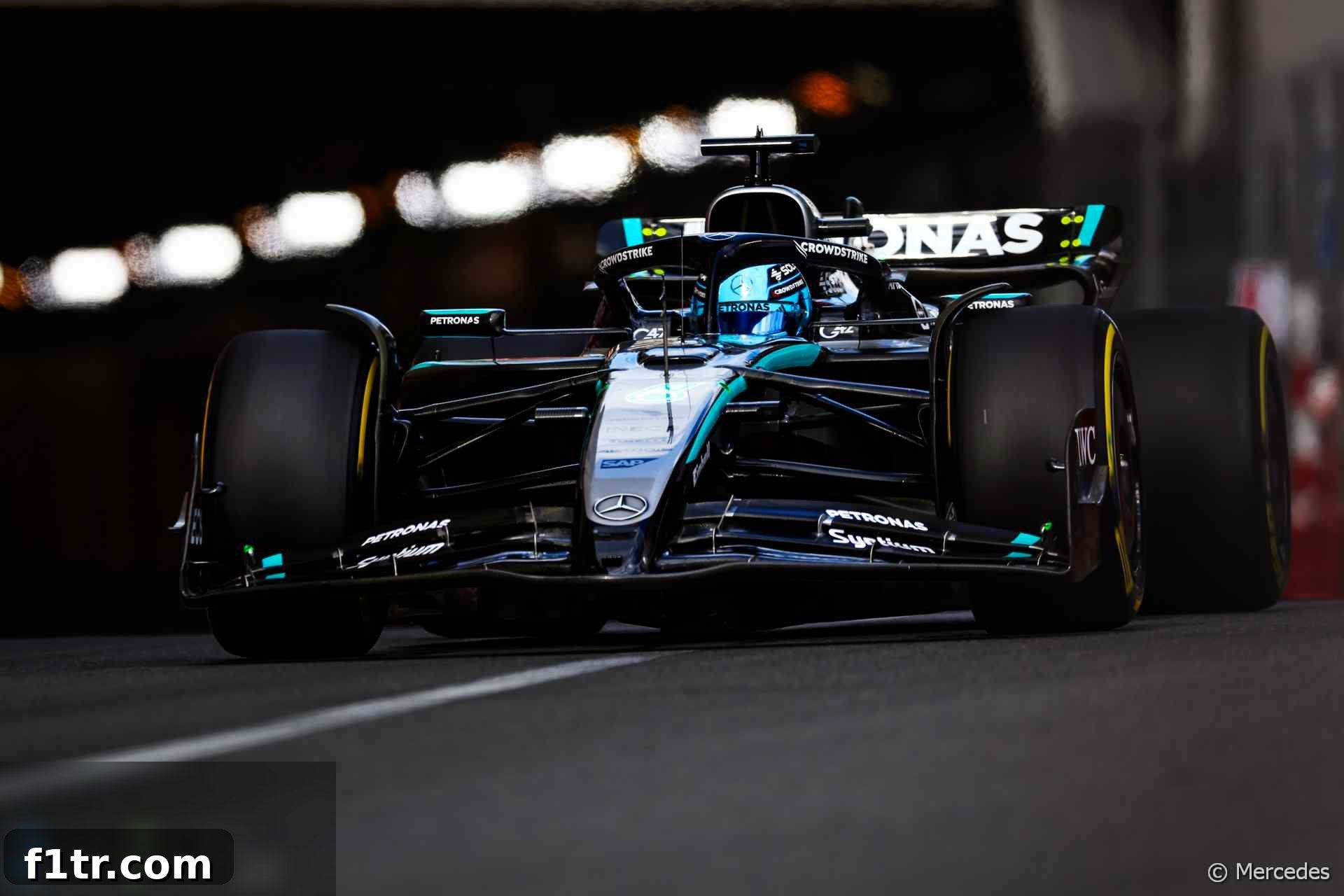
George Russell’s Monaco Grand Prix Penalty: Unpacking the Stewards’ Deliberate Action Ruling
The Monaco Grand Prix is renowned for its unique challenges, tight street circuit, and often controversial moments. One such incident that sparked significant debate among fans, drivers, and pundits alike was the penalty handed to Mercedes driver George Russell. Stewards issued a drive-through penalty, a far harsher sanction than typically applied for similar infringements, leading many to question the decision. This article delves into the official explanation provided by the stewards, Russell’s controversial radio message, and the broader implications for Formula 1’s penalty system.
The Incident: Cutting the Nouvelle Chicane to Gain an Advantage
During the intense racing at the iconic Monaco street circuit, George Russell found himself battling with Alexander Albon. In a crucial moment, Russell left the track at Turn 10, specifically cutting across the Nouvelle Chicane. This maneuver allowed him to overtake Albon and maintain a position he would not have otherwise held. While leaving the track and gaining an advantage is a clear violation of sporting regulations, the subsequent penalty often comes with varying degrees of severity, typically ranging from a five-second time penalty to a ten-second time penalty. However, Russell’s infraction was deemed to warrant a drive-through penalty, a significantly more impactful sanction requiring the driver to pass through the pit lane without stopping, effectively costing more time than a static time penalty.
Stewards’ Rationale: A Deliberate Act and Pre-Race Warning
The stewards’ decision to impose a drive-through penalty, rather than the more common 5 or 10-second time penalty, was rooted in their belief that Russell’s action was deliberate. This crucial distinction separated his case from more standard track-limit infringements. Their justification was explicitly outlined in their official notes, citing specific evidence to support their conclusion.
The key piece of evidence that swayed the stewards’ judgment was a radio message from George Russell to his race engineer, Marcus Dudley. In this communication, Russell stated, “I will take the penalty.” This phrase was interpreted by the stewards as clear premeditation, indicating that Russell consciously decided to gain an advantage by cutting the chicane, fully aware that a penalty would likely follow. They viewed this as a calculated risk, rather than an accidental excursion off track. The stewards noted, “It was clear from the radio message where he said that he would ‘take the penalty’ that the overtake was done deliberately as he felt that he was being held up by car 23 driving erratically.” This message painted a picture of a driver making a strategic choice to break the rules, gambling on the severity of the sanction.
Furthermore, the stewards revealed that teams had been explicitly warned about this specific type of infringement at Turn 10 before the race. “Anticipating that situations such as this might happen at this Monaco Grand Prix, all the teams were informed before the race by the race director (at the [stewards’] request) that the stewards would look carefully at a deliberate leaving of the track at turn 10 to overtake a car or a train of slow cars.” This pre-race directive underscored the FIA’s intention to crack down on deliberate attempts to gain advantage at this critical section of the circuit. The communication also made it unequivocally clear that “the guideline penalty of 10 seconds may be insufficient for this deliberate infringement and that the penalty applied may be a greater penalty than 10 seconds.” This forewarning served as a strong basis for the stewards to issue a harsher penalty, ensuring that drivers and teams were fully aware of the potential consequences of such actions.
Given the deliberate nature of the infringement, as evidenced by Russell’s radio communication, and the clear pre-race warning issued to all teams, the stewards concluded that a standard time penalty would not suffice. They stated, “We therefore considered that car 63’s deliberate infringement warranted a drive through penalty and we so imposed.” This ruling aimed to set a precedent, emphasizing that premeditated rule-breaking, particularly when explicitly warned against, would be met with severe consequences to uphold sporting integrity.
George Russell’s “Flawed System” Critique
Following the race and the imposition of the drive-through penalty, George Russell did not shy away from expressing his views on the situation. While acknowledging the stewards’ decision, he controversially suggested that the system itself was “a bit of a flawed system.” His reasoning stemmed from the observation that even with the drive-through penalty, which is designed to be a significant deterrent, he ultimately finished the race in a higher position than he would have had he stayed behind Albon without the illegal overtake. This outcome, in Russell’s eyes, highlighted a critical loophole: if a deliberate infraction, even with a penalty, results in a net positive outcome for the driver, does the penalty truly serve its purpose as a deterrent?
Russell’s comments ignited a broader discussion within the Formula 1 community about the efficacy of current penalty structures. Drivers are constantly making split-second strategic decisions under immense pressure. If the perceived gain from an illegal move outweighs the potential time loss from a penalty, it creates a moral and strategic dilemma. This scenario raises questions about whether certain penalties, even drive-throughs, are severe enough to truly dissuade drivers from attempting such deliberate infringements, especially on tracks like Monaco where overtaking opportunities are scarce and track position is paramount.
The core of Russell’s argument points to the need for a penalty system that is not only fair and consistent but also robust enough to ensure that no driver benefits from breaking the rules, regardless of how strategically they might attempt to mitigate the damage. This ongoing debate underscores the delicate balance the FIA stewards must strike between enforcing regulations and allowing for competitive, hard-fought racing, particularly when a driver’s actions are deemed “deliberate.”
The Broader Implications for F1 Penalties and Sporting Integrity
The incident involving George Russell and the subsequent drive-through penalty at the Monaco Grand Prix has significant implications for how Formula 1 approaches penalties and maintains sporting integrity. The FIA’s emphasis on “deliberate infringement” and the enforcement of pre-race warnings signal a stricter stance against strategic rule-breaking. This approach is vital for ensuring fairness and preventing a scenario where drivers might routinely calculate whether the benefit of an illegal move outweighs its penalty.
Formula 1 stewards face the unenviable task of interpreting complex incidents in real-time and applying consistent penalties across a diverse range of racing situations and circuits. The Monaco Grand Prix, with its unique characteristics, often presents scenarios where the line between aggressive racing and illegal advantage can become blurred. The Russell case, however, was deemed distinct due to the explicit radio communication indicating a premeditated act. This sets a precedent, suggesting that future instances of clear, intentional rule violations, particularly when specific warnings have been issued, will likely face similar or even harsher sanctions.
The debate sparked by Russell’s “flawed system” comments is healthy for the sport. It forces a re-evaluation of whether current penalty guidelines are always sufficient to act as genuine deterrents. While a drive-through penalty is certainly impactful, the discussion about whether any driver should ultimately benefit from breaking a rule, even inadvertently, will continue. This could lead to further refinements in the penalty system, potentially including more severe sanctions for deliberate acts, such as stop-and-go penalties or even retrospective grid drops for future races, to truly eliminate any incentive for drivers to ‘take the penalty’ for a strategic gain.
Ultimately, the FIA’s commitment to upholding the integrity of the sport is paramount. Incidents like Russell’s penalty at Monaco serve as critical test cases that shape the future of F1’s regulatory framework, striving for a system that is transparent, consistently applied, and effectively deters any form of intentional rule-breaking.
Engaging with the Fan Community
Incidents such as George Russell’s penalty invariably spark intense discussions among Formula 1 fans. The varying perspectives on whether the penalty was appropriate, too lenient, or too harsh reflect the passion and diverse interpretations within the sport’s global community. These debates are a vital part of the F1 experience, allowing fans to engage with the intricacies of racing regulations and stewarding decisions. Community discussions often highlight the complexity of balancing strict adherence to rules with the high-stakes, competitive nature of motorsport.
2025 Monaco Grand Prix Insights
Stay informed on the latest developments and analyses surrounding future Monaco Grand Prix events and related F1 topics:
- Norris predicts his Monaco pole record should stand “for a very long time”
- Bearman is right: Formula 1 should let Monaco be Monaco
- Wurz’s proposed Monaco track changes would make ‘1 to 5%’ difference – Sainz
- Bortoleto claims his “put him in the wall” radio message was taken out of context
- I deserved penalty, deliberate rule breaking ‘should never be allowed’ – Russell
Browse all 2025 Monaco Grand Prix articles