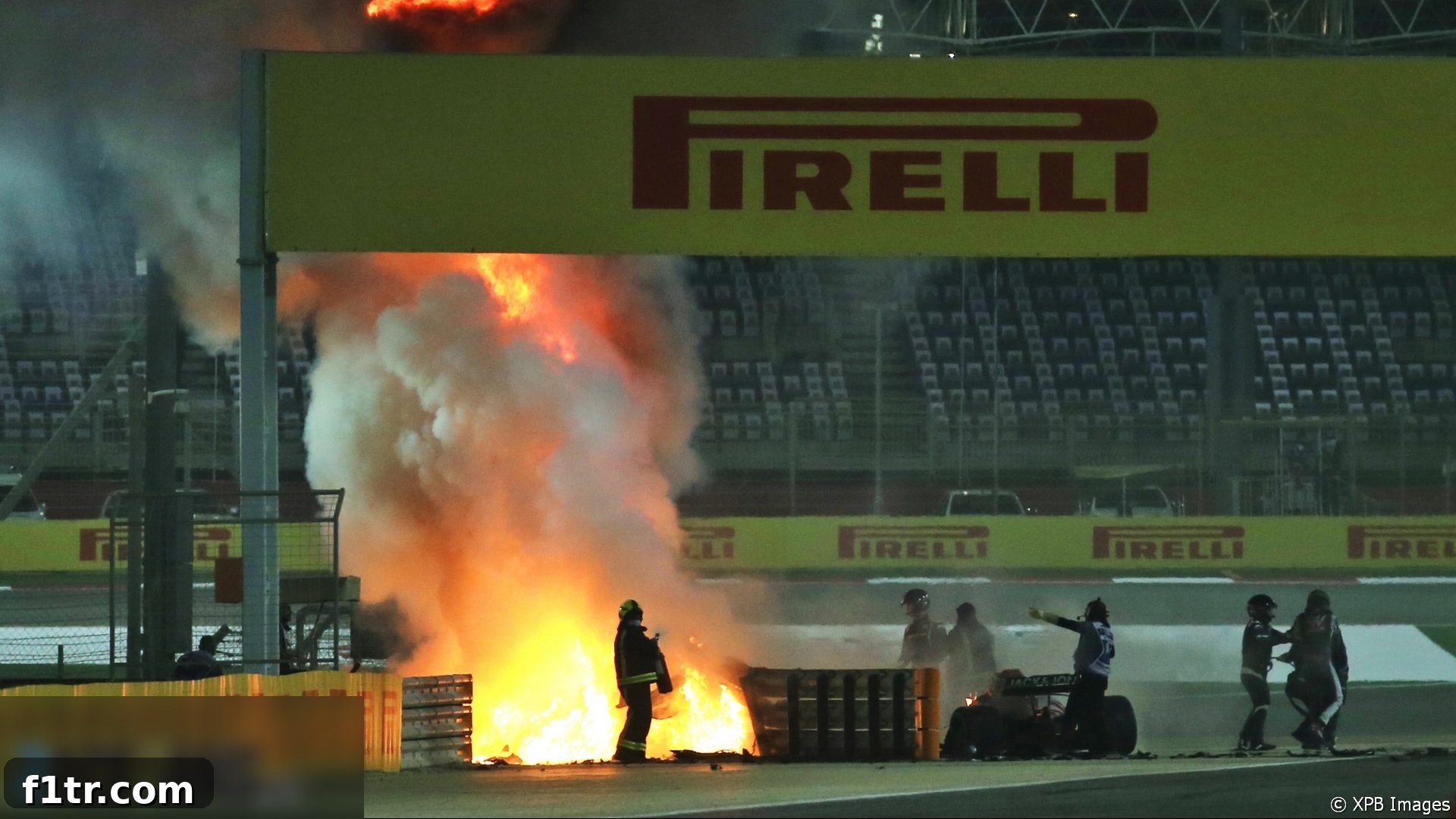
The harrowing events of last weekend, which saw Haas driver Romain Grosjean engulfed in a fiery crash, sent shockwaves through the Formula 1 community and motorsport enthusiasts worldwide. Following the incident, Daniil Kvyat, the AlphaTauri driver whose car was involved in the initial contact, has confirmed that he has spoken with Grosjean, expressing immense relief at his rival’s recovery and good spirits. The collision between the two drivers precipitated Grosjean’s terrifying impact with a guardrail, a crash that registered an astonishing 53G and caused his car to explode into flames, leaving him with burns to his hands.
The sheer ferocity of the accident and Grosjean’s miraculous escape have inevitably thrust the spotlight back onto Formula 1 safety, prompting intense discussion and introspection within the sport. While the immediate focus was on Grosjean’s well-being, the broader conversation quickly shifted to the lessons to be learned and the further safety enhancements that might be implemented to prevent similar incidents in the future. Kvyat’s observations, stemming from his direct involvement and subsequent interaction with Grosjean, offer a poignant perspective on an incident that could have had a far more tragic outcome.
Advert | Become a Supporter & go ad-free
Grosjean’s Miraculous Escape: A Deep Dive into F1 Safety After Sakhir
Romain Grosjean’s crash at the Bahrain International Circuit during the 2020 Sakhir Grand Prix will undoubtedly be remembered as one of the most terrifying yet ultimately triumphant moments in recent Formula 1 history. The French driver, who suffered an impact of 53G, became trapped in his burning Haas VF-20 for a harrowing 28 seconds before miraculously extracting himself with the assistance of medical teams. His survival, attributed to a combination of cutting-edge safety features and his own remarkable resilience, has ignited crucial conversations about the continuous evolution of safety standards in motorsport.
Daniil Kvyat, who was involved in the preceding contact with Grosjean’s car, shared his profound relief after meeting with the Haas driver. “We exchanged a couple of words,” Kvyat recounted, highlighting the immediate human connection that transcends the competitive nature of the sport. “We are in the same hotel and I saw him, and we spoke a bit briefly about that he’s alright and he showed me his boxing gloves.” This anecdote of Grosjean’s “boxing gloves” – referring to his bandaged hands – underscored his incredible spirit despite the trauma. Kvyat further added, “It’s good, I also texted him – everyone, I think, texted him after the race, and it was just great to see him in a good state, good spirits also. Of course, I hope he realises that this was a very good escape and that everyone’s happy for him here.” This sentiment reflects the collective relief and support from the entire paddock for Grosjean’s astonishing escape.
The Unforeseen Inferno: A Call for Enhanced Fire Safety
While the structural integrity of modern Formula 1 cars and the efficacy of components like the Halo system have rightly received widespread praise, the inferno that engulfed Grosjean’s car has highlighted a critical area demanding renewed attention: fire safety. Kvyat explicitly stated his belief that the fire, which trapped Grosjean for nearly half a minute, is the “biggest priority for the FIA to address” following the crash. “What’s been spoken about, like the car – the car safety will be always developed, we know we are in good hands. We saw the Halo has been so strong in helping Romain in this crash, it was amazing,” Kvyat remarked, acknowledging the existing strengths. However, he swiftly pivoted to the next frontier: “We need to look into fire. I think they will look into fire for sure because that was a very dangerous one.”
The incident served as a stark reminder that despite decades of advancements, the risk of fire remains a potent threat in motorsport. Historically, fire has been a formidable and often fatal adversary in racing. While fuel cell technology, fire suppression systems, and fire-retardant driver gear have significantly mitigated these risks, Grosjean’s crash demonstrated that extreme impacts can still breach these defenses. The FIA, as the sport’s governing body, is expected to meticulously analyze every aspect of the fire, from the integrity of the fuel cell under such a violent impact to the speed and effectiveness of fire suppression and rescue efforts. Discussions are likely to encompass potential enhancements to fire-resistant materials, further improvements to fuel cell design, and even innovations in rapid driver extraction protocols, ensuring that no stone is left unturned in safeguarding drivers against such catastrophic events.
The Halo: A Life-Saving Innovation Vindicated
Among the multitude of safety discussions sparked by Grosjean’s crash, the role of the Halo device stands out as a definitive vindication of a controversial innovation. Introduced in 2018, the Halo was met with skepticism and criticism from some drivers and fans alike, who argued it compromised the aesthetics of the cars and obstructed visibility. However, its performance in Bahrain left no room for doubt: it saved Grosjean’s life. The strength of the Halo prevented the guardrail from decapitating him or causing even more severe head trauma, effectively acting as a protective cage in the most extreme circumstances. Kvyat’s observation that “the Halo has been so strong in helping Romain in this crash, it was amazing,” echoes the universal sentiment within the F1 community.
The Halo’s success story is a testament to the FIA’s unwavering commitment to driver safety, even in the face of initial resistance. Its design, a robust titanium structure capable of withstanding immense forces, proved its worth by deflecting the barrier away from Grosjean’s helmet, allowing him to survive an impact that would have been unthinkable just a few years prior. This incident has solidified the Halo’s place as an indispensable safety feature in Formula 1 and other open-wheel categories, silencing its critics and reaffirming the continuous pursuit of safety advancements, however radical they may initially appear. The data gathered from this particular incident will also be invaluable, allowing engineers and safety experts to further refine and perhaps even evolve the design for future generations of racing vehicles.
Deconstructing the “Perfect Storm”: Barrier Design and Impact Factors
Beyond fire safety and driver protection systems, Daniil Kvyat highlighted another critical aspect contributing to the severity of Grosjean’s crash: the design and inclination of the barrier itself. He described the incident as a “perfect storm” of factors. “The impact was just crazy,” said Kvyat, “it seemed like a perfect storm for that impact because of how the barrier was inclined, the type of barrier and so on.” This nuanced observation points towards the complex interplay of various elements that determine the outcome of a high-speed collision. The angle at which Grosjean’s car struck the barrier, combined with the specific type of barrier in place at that section of the track, led to the catastrophic result of the car splitting in two and penetrating the barrier, igniting the fuel.
In the immediate aftermath, track officials and the FIA acted swiftly, implementing changes to the barrier configuration at that precise location for the subsequent Sakhir Grand Prix. Kvyat noted, “If you look at this weekend, they changed the kind of barrier to [absorb] the impact, and I think it’s good that we will look into these things even more, with that anticipation, in the future.” This proactive response demonstrates the dynamic nature of F1 safety, where every incident provides crucial data for continuous improvement. The investigation will undoubtedly scrutinize barrier materials, energy absorption capabilities, and track layouts to identify areas where passive safety measures can be enhanced. The goal is to ensure that future impacts, however severe, do not result in cars breaching barriers or causing such explosive fires, thereby mitigating the secondary risks of a primary collision.
FIA’s Unwavering Commitment to Continuous Safety Improvement
The Grosjean crash, while horrifying, serves as a powerful testament to the FIA’s long-standing and unwavering commitment to continuous safety improvement in motorsport. From the tragic deaths of Ayrton Senna and Roland Ratzenberger in 1994, which catalyzed a safety revolution, to ongoing research and development, the FIA has consistently pushed the boundaries of what is possible in driver protection and track design. Kvyat’s comments reflect this appreciation: “I know that the guys in the FIA are doing a great job, they will keep pushing, but there will always be something that can be improved.” This statement encapsulates the philosophical cornerstone of F1 safety: it is an endless journey, not a destination.
The rigorous post-incident analysis conducted by the FIA’s safety department is a fundamental part of this process. Every crash, regardless of severity, is meticulously investigated to understand its mechanics, identify contributing factors, and draw lessons that can inform future regulations, car design, and track modifications. This iterative approach has led to advancements such as stronger chassis, improved cockpit protection, sophisticated head and neck support systems (HANS device), and increasingly resilient crash structures. The Grosjean incident will contribute invaluable data to this ongoing research, influencing everything from fuel tank specifications to barrier placement and marshal training. The ultimate objective is to create an environment where the thrill of high-speed racing is balanced with the highest possible level of safety for all participants.
Advert | Become a RaceFans supporter andgo ad-free
The Broader Implications for Motorsport
Romain Grosjean’s miraculous escape from his fiery crash at Sakhir extends its implications far beyond the confines of Formula 1. The incident serves as a crucial case study for all tiers of motorsport, reinforcing the vital importance of safety research, investment, and strict adherence to evolving standards. The global attention garnered by the crash means that the lessons learned and the subsequent actions taken by the FIA will resonate across various racing disciplines, from junior single-seater categories to endurance racing and touring car series. Every form of motorsport operates with inherent risks, and incidents like Grosjean’s provide a stark reminder that safety can never be taken for granted.
The validation of the Halo, the renewed focus on fire suppression, and the re-evaluation of barrier designs are not just F1-specific concerns; they represent universal principles applicable to any high-speed racing environment. As technology advances and cars become faster and more powerful, the need for equally robust and intelligent safety solutions becomes paramount. The collaboration between the FIA, teams, drivers, and circuit operators is essential in this continuous quest for safer racing. Grosjean’s experience, terrifying as it was, ultimately serves as a powerful catalyst for further innovation and a reaffirmation of motorsport’s collective commitment to protect its most valuable assets: its competitors. His quick recovery and positive attitude in the face of such adversity are a testament not only to his personal strength but also to the safety advancements that allowed him to walk away from what could have been a fatal accident.
2020 Sakhir Grand Prix: Related Articles
For more insights and developments surrounding the 2020 Sakhir Grand Prix and its aftermath, explore the following articles:
- Leclerc will choose his fights better to avoid more “silly” first-lap crashes
- 2020 Bahrain and Sakhir Grand Prix Star Performers
- Sakhir performance risked making me look a fool, admits Bottas
- Perez makes his case for 2021 chance with masterful recovery drive for first win
- Perez breaks Webber’s record with 190-race wait for first win
Browse all 2020 Sakhir Grand Prix articles