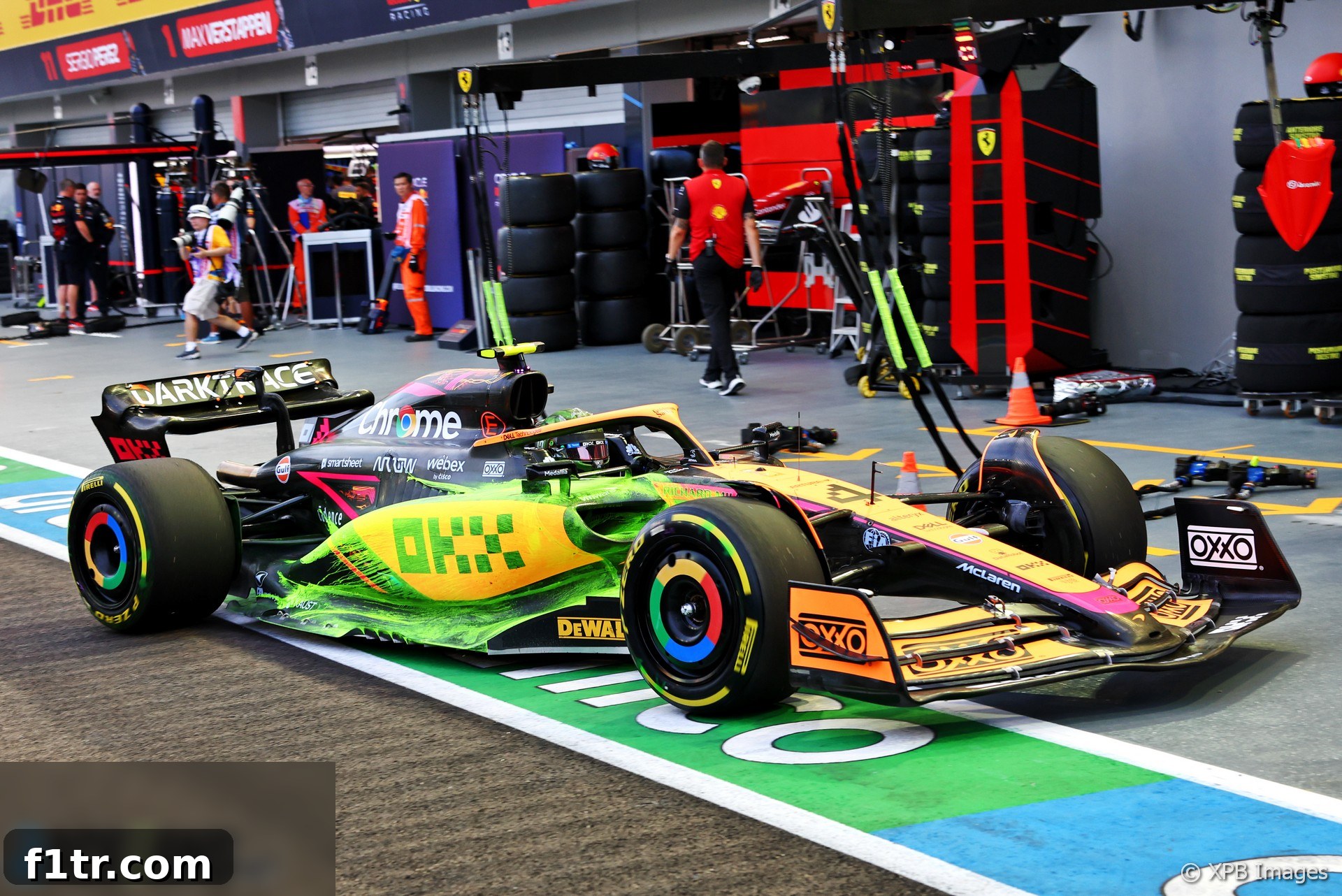
The Formula 1 Singapore Grand Prix, a spectacular night race under the city lights, is renowned not just for its demanding street circuit but also as a crucial battleground for car development. As teams arrive at Marina Bay, the spotlight is often on who brings what new parts to gain a competitive edge. For the 2022 edition, McLaren stands out as the only team to have introduced a significant, multi-component upgrade package for their car, the MCL36, signaling a determined push in their fight for championship position.
Advert | Become a Supporter & go ad-free
F1 Singapore Grand Prix: McLaren Leads the Charge with Extensive Car Updates
The Marina Bay Street Circuit presents a unique set of challenges for Formula 1 cars and their drivers. Its tight corners, bumpy surfaces, high humidity, and demanding braking zones push machinery to its absolute limits. Consequently, any aerodynamic or mechanical advantage can significantly influence lap times and race performance. This makes the introduction of car updates particularly strategic, as teams must balance performance gains with reliability risks on such an unforgiving track.
McLaren’s Ambitious Six-Part Upgrade for the MCL36
McLaren arrived in Singapore with a bold statement of intent, rolling out what they describe as a “comprehensive update to the bodywork and floor” – a six-part upgrade package. This extensive overhaul focuses primarily on the critical sidepod and floor areas of the MCL36, components that are fundamental to modern F1 car performance, dictating how air flows over, around, and under the car to generate downforce. The team also announced they would be testing an updated diffuser, indicating a meticulous approach to fine-tuning the car’s aerodynamic efficiency.
Beyond aerodynamics, McLaren has also targeted a specific weakness that has plagued them previously: front brake cooling. Singapore’s circuit is notoriously tough on brakes, with numerous heavy braking zones. McLaren faced significant issues with their front brakes during pre-season testing, leading to extensive modifications. This latest update, enhancing the cooling of the front brakes, is a direct response to both the track’s demands and their past struggles, aiming to ensure optimal performance and reliability throughout the race weekend.
The decision to bring such a substantial upgrade package to a street circuit is a testament to McLaren’s confidence in their development process and their ambition to secure fourth place in the Constructors’ Championship against their fierce rivals, Alpine. Implementing multiple new parts on a tight, demanding circuit like Singapore can be risky, as it leaves less time to understand and optimize their behavior. However, the potential rewards in terms of performance gains are equally high.
Unpacking McLaren’s MCL36 Enhancements: A Detailed Look
The detailed technical descriptions provided by McLaren to the FIA offer invaluable insights into the specific objectives and workings of each new component. This multifaceted approach suggests a holistic understanding of how different aerodynamic elements interact to boost overall car performance.
Sidepod Inlet
Updated component: Sidepod Inlet
Primary reason for update: Performance – Local load
Geometric differences compared to previous version: At this event, we are introducing a comprehensive update to the bodywork and floor. The main sidepod changes are a revised inlet and forward coke line.
Brief description of how the update works: This upgrade is a continuation of the development steps that we introduced in Barcelona, then France. The bodywork and floor have been developed together to increase downforce through a range of conditions.
The sidepod inlet redesign, along with the “forward coke line” (referring to the contouring of the sidepod’s top surface), indicates a major airflow management strategy. By optimizing how air enters the sidepod and flows along its flanks, McLaren aims to improve the efficiency of cooling radiators while also conditioning the airflow downstream to the rear of the car and the diffuser, ultimately enhancing overall downforce and reducing drag.
Floor Body
Updated component: Floor Body
Primary reason for update: Performance – Local load
Geometric differences compared to previous version: The updated floor geometry features revisions to the floor inlet and the underfloor tunnels.
Brief description of how the update works: The revisions to the floor inlet and tunnels, together with the floor fences are aimed at increasing the overall floor load without a drag penalty, increasing aerodynamic efficiency.
The floor is perhaps the most critical aerodynamic component under the current regulations. Revisions to the floor inlet and underfloor tunnels are designed to improve the Venturi effect, creating more efficient low-pressure zones underneath the car. This directly translates to increased downforce without incurring a significant penalty in terms of aerodynamic drag, which is crucial for maximizing performance on both straights and in corners.
Advert | Become a RaceFans supporter andgo ad-free
Floor Fences
Updated component: Floor Fences
Primary reason for update: Performance – Local load
Geometric differences compared to previous version: All of the forward floor fences have been redesigned.
Brief description of how the update works: In order to extract performance from the main floor body changes, all of the fences have seen revisions.
Floor fences are small, strategically placed aerodynamic elements that help manage airflow under the car, particularly controlling the vortices that contribute to the Venturi effect. The redesign of all forward floor fences indicates a meticulous effort to work in conjunction with the main floor body changes, ensuring optimal airflow and maximizing the downforce generated by the underbody.
Diffuser
Updated component: Diffuser
Primary reason for update: Performance – Local load
Geometric differences compared to previous version: We have an option of a centre diffuser boat tail for the updated floor, which we may test at this event.
Brief description of how the update works: The change to the centre diffuser, which is a test item, changes the local flow behaviour seen with changes in ride heights.
The diffuser, located at the very rear of the underfloor, is crucial for extracting air from beneath the car efficiently and generating downforce. The “centre diffuser boat tail” update is an intriguing test item, suggesting McLaren is exploring ways to optimize the diffuser’s performance across different ride heights. This is particularly important on bumpy street circuits where ride height consistency can be challenging.
Advert | Become a Supporter & go ad-free
Cooling Louvres
Updated component: Cooling Louvres
Primary reason for update: Circuit specific – Cooling range
Geometric differences compared to previous version: The change in bodywork requires revised bodywork cooling louvres, which are also in line with the expected high ambient temperatures for this event.
Brief description of how the update works: The louvres allow us to tune the PU cooling for different tracks and ambient conditions, and are designed to minimise losses in the flow seen at the rear of the car, which in turn reduces the effect on rear downforce when we increase cooling.
Cooling is a delicate balance in F1. While optimal engine performance requires effective heat dissipation, large cooling outlets can disrupt airflow and reduce downforce. The revised cooling louvres are tailored for Singapore’s high ambient temperatures, allowing McLaren to precisely manage engine (PU) cooling. Crucially, they are designed to minimize aerodynamic losses, ensuring that increased cooling doesn’t compromise rear downforce – a testament to integrated aerodynamic design.
Front Corner (Brake Duct)
Updated component: Front Corner
Primary reason for update: Circuit specific – Cooling range
Geometric differences compared to previous version: We have brought a larger front brake duct to this event.
Brief description of how the update works: Singapore is one of the highest braking demand tracks this year, so to increase front brake cooling we have brought a new brake duct with a larger inlet, increasing the cooling airflow to the discs.
As mentioned, Singapore is incredibly demanding on brakes. The introduction of a larger front brake duct with an increased inlet is a direct, circuit-specific response to prevent overheating and maintain brake performance throughout the race. This is vital for driver confidence and consistent lap times, directly addressing a vulnerability McLaren identified earlier in the season.
Advert | Become a RaceFans supporter andgo ad-free
Rivals Respond: Alpine, Red Bull, and Others Bring Their A-Game
While McLaren’s package was the most extensive, several other teams also brought crucial updates to Singapore, reflecting the relentless development race in Formula 1. These improvements, though varying in scale, highlight targeted efforts to boost performance or reliability.
Alpine’s Pursuit of Fourth Place
Alpine, McLaren’s closest championship rivals in the battle for fourth in the Constructors’ standings, also brought significant revisions to their car. Both Fernando Alonso and Esteban Ocon were set to run an updated floor, which sporting director Alan Permane confidently predicted would deliver a “massive” increase in downforce. This upgrade is a clear statement of Alpine’s intent to consolidate their position against McLaren.
Updated component: Floor Body
Primary reason for update: Performance – Flow conditioning
Geometric differences compared to previous version: Addition of an underfloor ridge and revised floor edge geometry.
Brief description of how the update works: Improved vortex management under the floor and from the floor edge as well as improved tyre squirt control. Both cars will run the new floor during the weekend.
Alpine’s focus on “improved vortex management” and “tyre squirt control” through an underfloor ridge and revised floor edge geometry is highly technical. By better managing the turbulent air generated by the spinning tires (“tyre squirt”), teams can improve the stability and consistency of the underfloor airflow, which directly impacts downforce generation. A “massive” increase in downforce from this area could be a game-changer for Alpine.
Red Bull’s Refinements for Dominance
Despite their already dominant package, Red Bull Racing continues to pursue marginal gains. Their update in Singapore was subtle but strategically important.
Updated component: Floor Fences
Primary reason for update: Performance – Local load
Geometric differences compared to previous version: Subtly reprofiled floor fences
Brief description of how the update works: The changes are aimed at improving the aerodynamic stability of the floor fences in all operating conditions to gain and maintain aerodynamically generated loads.
Red Bull’s reprofiled floor fences are about maintaining absolute aerodynamic stability, especially critical on bumpy street circuits. Even small improvements in how floor fences manage airflow contribute to more consistent downforce across varying speeds and car attitudes, ensuring their already potent car remains predictable and fast.
Advert | Become a RaceFans supporter andgo ad-free
AlphaTauri’s Front Wing Focus
AlphaTauri brought a targeted front wing update, aiming to improve airflow management at the very front of the car.
Updated component: Front Wing
Primary reason for update: Performance – Flow conditioning
Geometric differences compared to previous version: The lower surface of the first element of the front wing inboard now runs through smoothly to form the lower surface of the nose. The chord of the first element has also been increased outboard.
Brief description of how the update works: The changes to the inboard part of the wing are designed to increase the loading in this region and provide better flow conditioning to the forward floor. The outboard changes improve the control of the front wheel wakes.
The front wing is the first point of contact for air, shaping how it flows over and around the rest of the car. AlphaTauri’s update focuses on both increasing local loading and improving “flow conditioning” for the crucial forward floor area. Additionally, controlling the turbulent air generated by the front wheels (“front wheel wakes”) is vital for ensuring clean airflow to the sensitive mid-section of the car.
Aston Martin’s Floor Edge Refinements
Aston Martin introduced subtle changes to their floor edge, demonstrating that even minor modifications can yield performance benefits.
Updated component: Floor Edge
Primary reason for update: Performance – Flow conditioning
Geometric differences compared to previous version: Subtle changes to the geometry along the edge of the floor, with an addition of a notch towards the rear.
Brief description of how the update works: The revised geometry makes local improvements to the flow management and hence improves local load as well as downstream performance.
The “notch towards the rear” and subtle geometry changes to the floor edge are designed to enhance local flow management. This helps seal the underfloor from external air, maximizing the efficiency of the Venturi tunnels. Even seemingly small details in this area can have a cascade effect, improving not only local downforce but also downstream aerodynamic performance.
Williams Prioritizes Reliability
Williams’ update was focused purely on reliability rather than outright performance, a common strategy for teams operating within tight budgets.
Updated component: Rear Corner
Primary reason for update: Reliability
Geometric differences compared to previous version: None
Brief description of how the update works: Update to the material and construction of the rear brake duct winglets to improve durability. The geometry is identical to the previous version.
Improving the durability of components like rear brake duct winglets is crucial for completing races without issues, especially on a demanding track where components are subjected to high stresses and temperatures. This kind of reliability upgrade, while not directly increasing speed, prevents costly DNF’s and ensures consistent running.
Advert | Become a RaceFans supporter andgo ad-free
Teams Opting Out: Mercedes, Ferrari, Alfa Romeo, Haas
Notably, front-running teams like Mercedes and Ferrari, alongside Alfa Romeo and Haas, did not bring any documented updates to Singapore. There can be several strategic reasons for this. It might indicate that these teams are content with their current car performance on this specific track, or perhaps they have shifted their development resources entirely towards the following season’s car, particularly given the cost cap restrictions. Introducing new parts also incurs a cost, and teams must carefully decide where to allocate their budget for the maximum return on investment.
The Broader Impact of F1 Development and the Cost Cap Era
The stream of updates observed at the Singapore Grand Prix underscores the continuous development philosophy inherent in Formula 1. Every race weekend is an opportunity for teams to refine their cars, chasing performance gains that can be measured in milliseconds. The current era of budget caps, however, adds another layer of complexity to this process. Teams must be incredibly efficient and strategic with their spending, prioritizing updates that offer the most significant performance benefits or address critical weaknesses. This has led to more thoughtful, and sometimes less frequent, major upgrade packages compared to previous seasons.
Conclusion: The Singapore Showdown and Beyond
The 2022 Singapore Grand Prix promised to be a fascinating technical spectacle, not just a driving challenge. McLaren’s extensive upgrade package represented a significant gamble, demonstrating their determination to climb the Constructors’ Championship ladder. Its success or failure provided crucial insights into their development capabilities and strategic decisions. Similarly, the targeted updates from Alpine, Red Bull, AlphaTauri, and Aston Martin highlighted the diverse approaches teams take to optimize their cars for specific circuits and overall season performance. As the season progresses, the impact of these updates will ripple through the remaining races, shaping the final standings and setting the stage for future Formula 1 innovations.
2022 Singapore Grand Prix Related Articles
- How many victory chances did Hamilton have in his first winless F1 season?
- Alfa Romeo expect another step from Zhou after confirming 2023 deal
- Closest three-team pole fight for almost 20 years in Singapore
- F1 teams back race control’s decisions on delayed start and DRS activation
- It’s “game over” if F1 fails first “vital test” of budget cap rules – Ferrari
Browse all 2022 Singapore Grand Prix articles