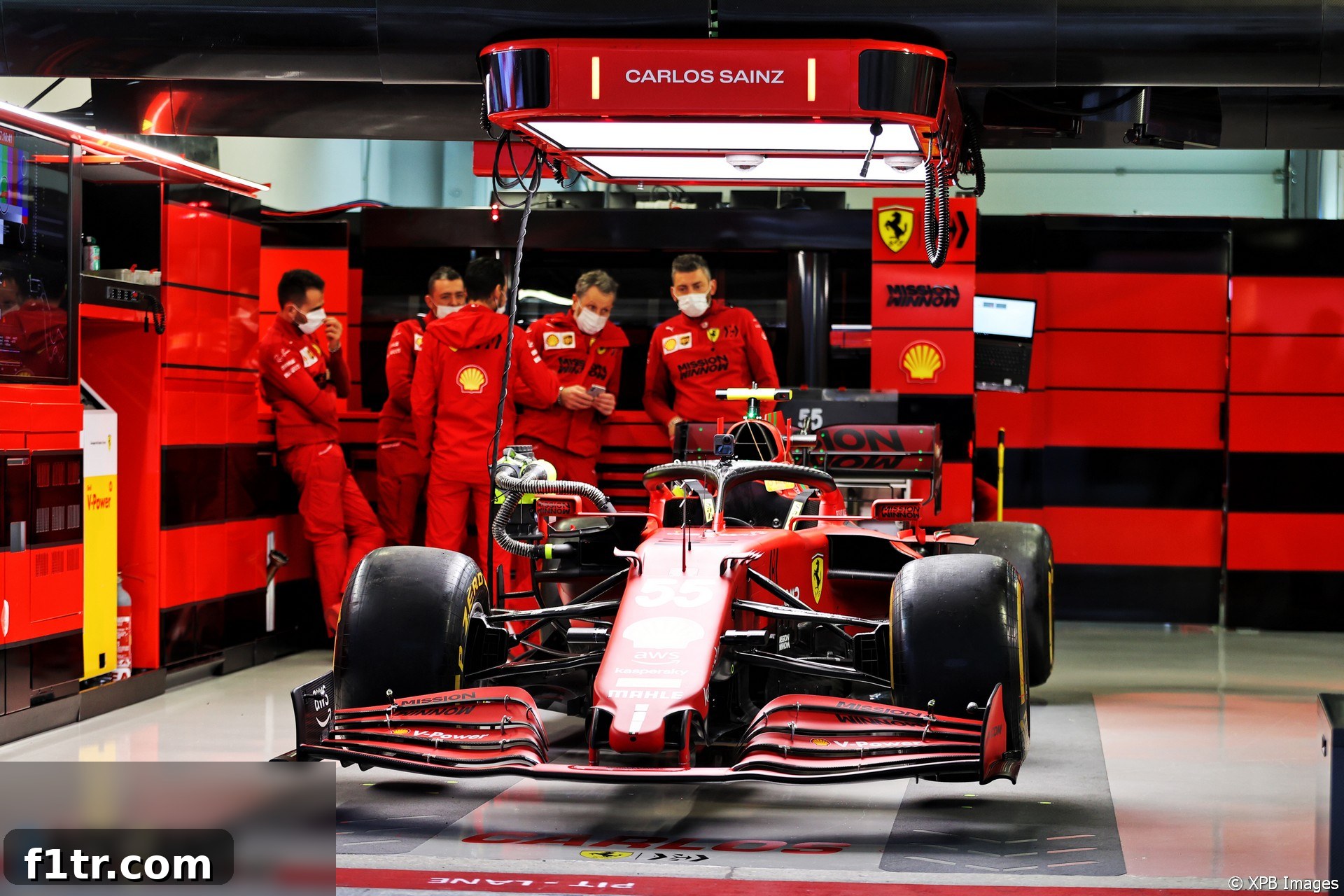
Carlos Sainz Explains Ferrari’s Strategic Power Unit Upgrade Decision for Charles Leclerc Ahead of Russian Grand Prix
Ferrari driver Carlos Sainz Jnr has openly discussed and expressed his full understanding of why his teammate, Charles Leclerc, is the sole recipient of Ferrari’s newly upgraded power unit for this weekend’s pivotal race. The strategic move will see Leclerc start from the very back of the grid, a necessary consequence of exceeding his maximum allocation of power unit components to integrate the advanced upgrade.
The Rationale: Damage, Urgency, and Strategic Part Allocation
Sainz elaborated on the intricate decision-making process behind giving Leclerc the first taste of the new power unit. He revealed that a significant factor was the damage sustained by Leclerc’s existing unit during the Hungarian Grand Prix, where he was involved in a collision with Lance Stroll on the opening lap. This incident severely impacted Leclerc’s pool of available parts, making an upgrade not just beneficial, but urgent.
“There’s been a substantial amount of thought invested into precisely when and how to introduce this new power unit,” Sainz explained. “Upon reviewing the inventory of components we have across our three power units, it became evident that Charles’ unit had suffered damage in Hungary when he was unfortunately collected by another car. Consequently, he found himself in a far more constrained position regarding available parts than I am.”
He continued, “For Charles, it was quite pressing to get the fourth power unit prepared and ready for deployment. The team, I must say, put in an immense effort to accelerate the development and delivery of this new component. I’m genuinely pleased that he will be the first to test it, providing us with invaluable real-world data on its performance characteristics.”
A Crucial Experiment for Ferrari’s Future: Eyeing 2022 Development
Beyond the immediate competitive implications for the 2021 season, the deployment of this upgraded power unit carries significant weight for Ferrari’s long-term aspirations. Sainz highlighted its role as a critical development test bed for the upcoming 2022 regulations, which will see a completely new generation of cars and a renewed emphasis on power unit efficiency and performance.
“This opportunity will serve as a crucial experiment for us, particularly with an eye towards next year’s engine development,” Sainz affirmed. “It represents a specific development path that we are keen to pursue and integrate into our 2022 engine design. We certainly have some considerable homework to do in that area, and this upgrade provides a fantastic platform for learning and refinement.” The insights gained from Leclerc’s running will directly inform Ferrari’s ongoing efforts to optimize their power unit architecture for the new technical era, a period where engine development will be largely frozen, making early progress absolutely vital.
Sainz’s Own Upgrade Timeline: A Balancing Act
While Leclerc benefits from the upgrade this weekend, Sainz confirmed that he too expects to receive the updated power unit before the season concludes. However, his deployment will be a carefully calculated decision, balancing immediate performance gains against potential grid penalties and their impact on his championship standing and the team’s constructors’ battle.
“I will install it on my car as soon as the strategic compromise between incurring a grid penalty and starting from the back, its impact on the championship, and the suitability of the circuit allows me to, considering the parts I have available,” Sainz stated. This indicates a sophisticated tactical approach from Ferrari, ensuring that any grid penalties are taken at tracks where their car can more easily recover positions, maximizing points accumulation for both drivers.
Ferrari’s Resurgence: From 2020 Struggles to 2021 Progress
The introduction of this power unit upgrade underscores Ferrari’s impressive strides since the challenging 2020 season, where their engine performance lagged significantly behind their rivals. The team has made substantial progress throughout 2021, and this new component is a testament to their continuous development efforts.
Sainz pointed to their unexpected performance at the Italian Grand Prix in Monza – a circuit notoriously demanding on power units and often considered Ferrari’s Achilles’ heel due to their car’s inherent characteristics – as a clear indicator of their improvement.
Monza: A Demanding Test Surpassed
“Before arriving in Monza, we were acutely aware that it would be a particularly challenging circuit for us,” he reflected. “Our simulations had predicted that we would likely be three or even four tenths of a second behind McLaren, and potentially even trailing AlphaTauri and other teams. We possess a deep understanding of our car’s characteristics, and we know that Monza, with its long straights and minimal downforce requirements, is arguably one of the worst possible venues for our package.”
Despite these pessimistic forecasts, Ferrari delivered a respectable showing. “Ultimately, it evolved into a decent weekend in terms of the final outcome, primarily because we managed to secure a fair amount of valuable points. However, the struggle was real, just as we had anticipated. There’s only so much you can do against the intrinsic nature of your own car’s design and philosophy,” Sainz acknowledged, highlighting the team’s ability to extract performance even on tracks that don’t naturally suit their machinery.
Looking Ahead: Sochi’s Prospects and the Battle for P3
With Monza behind them, attention now shifts to the Russian Grand Prix in Sochi, a circuit with a very different character that Sainz believes should play more favorably into Ferrari’s hands compared to its Italian counterpart. The fight for third place in the constructors’ championship against McLaren remains incredibly tight, making every race and every point crucial.
“Sochi should undoubtedly be a better track for us when compared to the unique demands of Monza,” Sainz predicted with cautious optimism. “While Sector One, with its lengthy straights and fast corners, might still pose a challenge where McLaren could hold an advantage, our car’s characteristics should allow us to be significantly stronger in the final sector, which is more technical and flowing. This should help to balance out the overall performance profile a bit more.”
The Spanish driver expressed hope for a strong showing to close the gap to their rivals. “Hopefully, we can once again piece together a robust weekend performance and begin to cut back on the points deficit we currently face against McLaren.” The ongoing development, exemplified by Leclerc’s power unit upgrade, is a clear sign of Ferrari’s determination to reclaim a top-tier position in Formula 1, not just for the remainder of 2021 but as a springboard for future success.
As the season progresses, Ferrari’s strategic decisions regarding power unit deployment, combined with their continuous development efforts, will be critical in their pursuit of stronger results and their battle for a coveted third place in the Constructors’ Championship.
Do you enjoy our in-depth F1 analysis? Become a RaceFans supporter and go ad-free.
2021 Russian Grand Prix Related Articles
- Norris says he missed few chances to win in 110-race wait for first F1 victory
- Sochi disappointment will make Norris and McLaren stronger, says Seidl
- F1 race start times could be brought forward to avoid Spa-style wash-outs
- New technology in Ferrari’s power unit update vital for 2022 – Binotto
- Mercedes have left too many points on the table, admits Wolff
Browse all 2021 Russian Grand Prix articles