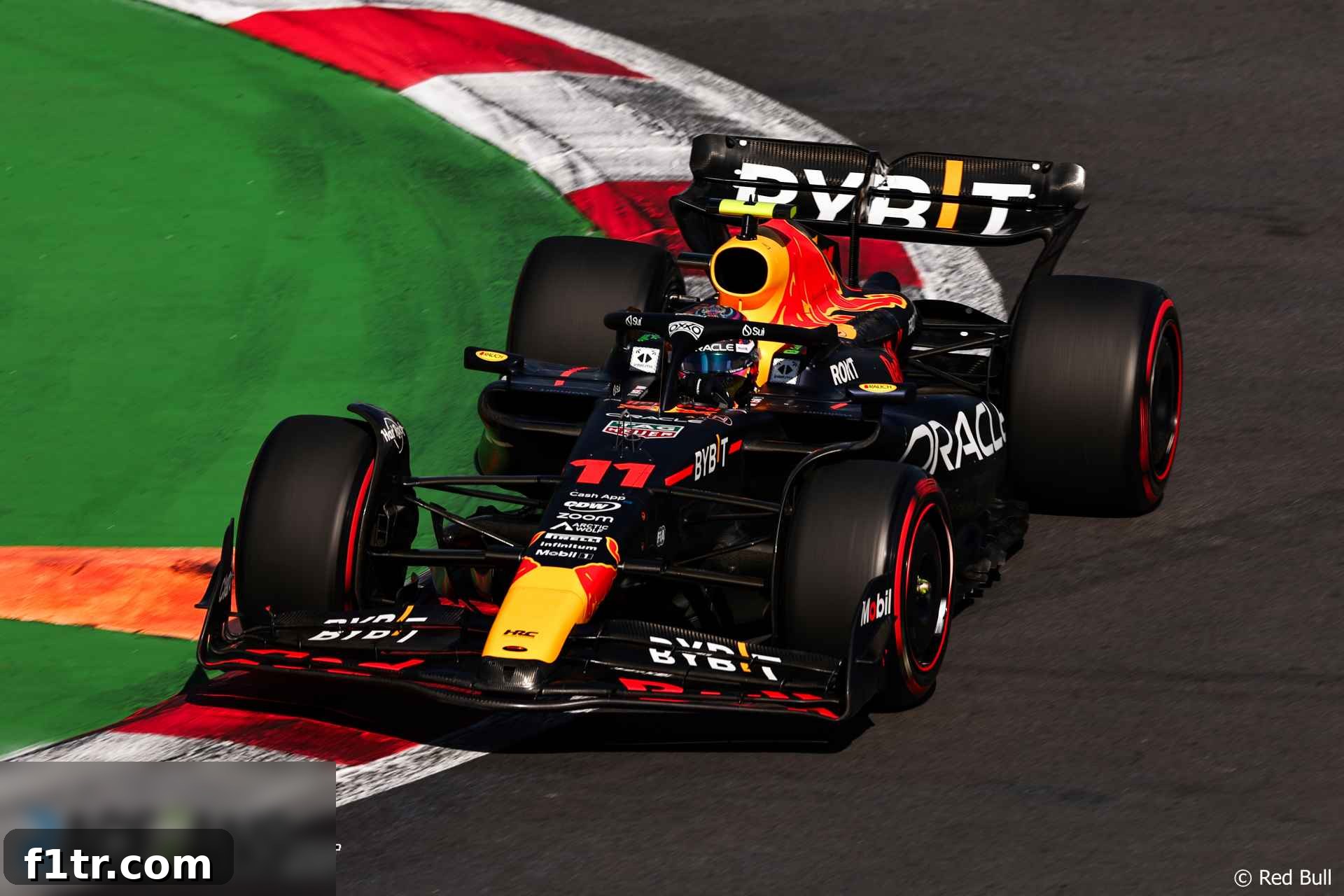
The roar of the crowd, the vibrant atmosphere, and the immense pressure of a home Grand Prix create a unique challenge for any Formula 1 driver. For Sergio Perez, the 2023 Mexican Grand Prix qualifying session brought a mixed bag of emotions. While he secured a starting position on the third row, P5, it was clear that tyre troubles significantly hampered his performance, leaving him short of the optimal outcome he and his passionate supporters had envisioned for his home race at the Autódromo Hermanos Rodríguez.
Sergio Perez’s Qualifying Struggle: A Battle Against the Tyres
The qualifying session for the Mexican Grand Prix is always a highly anticipated event, especially for local hero Sergio ‘Checo’ Perez. Driving for Red Bull Racing, expectations were naturally high for the Mexican driver to perform strongly in front of his adoring fans. However, the session unfolded with an air of frustration for Perez, as he found himself battling not just the clock and his rivals, but also the unpredictable behaviour of his Pirelli tyres.
Perez ultimately qualified fifth, a full two-tenths of a second behind his formidable Red Bull teammate, Max Verstappen, who secured third place. Even more telling was the gap to pole-sitter Charles Leclerc, a further tenth of a second ahead, demonstrating the tightly packed nature of the front runners. This fifth-place grid slot, while not a disaster, was certainly “not where we wanted to be,” as Perez candidly admitted post-session. His initial run in Q3 on a used set of soft tyres saw him languishing in seventh. Although a final push on fresh rubber propelled him to fifth, the underlying issues with tyre management throughout the session had already taken their toll.
The Crucial Tyre Strategy Misstep: A Costly Q2 Decision
Central to Perez’s qualifying woes was a strategic decision made earlier in the session, specifically in Q2. The Red Bull driver revealed that he had used an extra set of new tyres during this phase, a move he later regretted, describing it as “quite costly.” This seemingly minor tactical error had a cascading effect, directly impacting his performance in the decisive Q3 segment.
“I think we were missing a lot on that set of tyres, that second set of tyres for Q3,” Perez explained to Sky Sports. “In Q2, we really didn’t need it. That was quite costly because the progression that we had in Q3 wasn’t ideal during that first run then going into the new.” This highlights a fundamental aspect of modern Formula 1 qualifying: judicious tyre allocation. Having fewer new sets for the final, most critical runs in Q3 means less opportunity to find that crucial extra tenth of a second when it matters most. For a driver like Perez, whose qualifying form has been under intense scrutiny, such a miscalculation proved particularly damaging, leaving him with a sense of “undershot” performance and the painful realization that “a tenth or two would have changed completely our lives today.”
Navigating the Unique Challenges of the Autódromo Hermanos Rodríguez
The Autódromo Hermanos Rodríguez, with its unique characteristics, played a significant role in exacerbating Perez’s tyre-related challenges. The circuit, situated at a dizzying altitude of over 2,200 meters above sea level, presents an array of difficulties for both cars and tyres. The thin air reduces downforce, making grip levels notoriously low, and puts extra strain on engines and cooling systems. Moreover, the asphalt itself can be abrasive, contributing to faster tyre degradation.
Perez emphasized the extreme variability he experienced with each set of tyres, a testament to the circuit’s demanding nature. “There is a changing temperature of two, three degrees,” he noted, “You feel it whereas somewhere else you don’t really feel it. Every single set I had today felt differently, so the grip is extremely low.” This profound sensitivity to minute temperature fluctuations means that what works for one lap might not work for the next, making it incredibly difficult for drivers and engineers to extract consistent performance. The inherent lack of grip forces drivers to be precise and gentle, yet aggressive enough to generate temperature in the tyres, a delicate balance that Perez struggled to consistently achieve across different stints.
Competitive Landscape: Verstappen, Leclerc, and Ferrari’s Strong Showing
While Perez grappled with his Red Bull, the front of the grid saw a fierce battle unfold. Charles Leclerc snatched a surprising pole position, leading a Carlos Sainz Jnr-Ferrari one-two, much to the astonishment of many, including Red Bull. Max Verstappen, despite his P3, was not entirely comfortable with the car’s balance throughout the weekend, indicating that the RB19 was not in its usual dominant form on this particular track. Adding to the intrigue, AlphaTauri’s Daniel Ricciardo put in a stellar performance, joining Verstappen on the second row, a remarkable result for the Australian and his team, highlighting the unpredictable nature of the Mexico City circuit.
The gap between Perez and his teammate, Verstappen, was a stark reminder of the missed opportunity. Two-tenths of a second might seem minor in isolation, but in the cutthroat world of Formula 1 qualifying, it can mean several grid positions. Ferrari’s unexpected surge to the front, particularly after recent struggles, also added another layer of complexity to the race prospects. For Perez, overtaking both Ferraris and potentially Ricciardo will be a formidable task, given the circuit’s characteristics.
Advert | Become a RaceFans supporter andgo ad-free
Optimism and Strategic Outlook for Race Day
Despite the disappointment of qualifying, Sergio Perez remained remarkably pragmatic and cautiously optimistic about his chances on race day. The Mexican Grand Prix is renowned for its thrilling starts and strategic battles, offering numerous opportunities for drivers to move up the field. “There’s a long race ahead of us, there’s a long way into turn one,” he stated, highlighting the extensive run down to the first corner, a notorious hotspot for overtakes and drama.
This long run often provides a crucial chance for drivers starting further back to gain positions immediately, leveraging slipstreams and late braking. Perez, known for his race craft and tyre management skills, believes he can attack the cars ahead. However, he also tempered his optimism with a dose of realism regarding the challenges. “I would have liked to be in the first two rows at least, but I think from where we are there is a race ahead of us because you never know what the Ferrari is going to be like.” The unpredictability of rivals’ race pace and tyre degradation profiles adds another layer of strategic complexity to Sunday’s event.
The Race of Tyre Management: One-Stop vs. Two-Stop
The Mexican Grand Prix is notoriously tough on tyres, and this year promises to be no different. The high altitude and low downforce lead to increased sliding, which in turn causes significant tyre degradation. This makes tyre management a critical factor, potentially dictating the entire race outcome. Perez emphasized this point, stating, “It’s going to be very difficult to overtake.” This implies that track position and strategic prowess will be paramount.
Consequently, “doing it with the strategy, trying to get some free air will be key tomorrow,” he added. ‘Free air’ refers to running without being closely followed by another car, which allows the tyres to operate in cleaner airflow, managing their temperature and degradation more effectively. The choice between a one-stop and a two-stop strategy will be finely balanced. “But I think the most important is to be good on the deg because once the tyre goes, it really goes and it doesn’t matter if you go for two or a one [pit-stop strategy]. So, it’s going to be really close tomorrow I think within the one and the two stop.” This suggests that even if a team opts for two stops, if their tyre degradation is poor, the advantage could be negated. The ability to preserve the Pirelli compounds and manage their performance cliff will be the defining characteristic of the eventual winner, turning the Mexican Grand Prix into a chess match of speed, precision, and tactical foresight.
The Road Ahead for Red Bull and Perez
For Red Bull Racing, the challenge is now to convert their strong, albeit not dominant, qualifying positions into a commanding race performance. With Max Verstappen starting P3 and Sergio Perez in P5, the team has multiple strategic options. They will undoubtedly analyze the data meticulously overnight to understand the subtle differences in tyre performance and temperature sensitivity that plagued Perez. For Perez himself, the goal will be to avoid early contact, make clean overtakes, and execute a flawless strategy. The support of the home crowd will be an immense psychological boost, and he will be pushing hard to deliver a memorable drive, hoping to convert the disappointment of qualifying into the triumph of race day. The path to the podium, or even a victory, will be arduous, but Perez’s resilience and understanding of tyre dynamics could still see him climb through the field.
Conclusion: High Stakes in Mexico City
Sergio Perez’s qualifying session for his home Grand Prix was undeniably fraught with challenges, primarily stemming from a strategic misstep with his tyre allocation and the unique, demanding characteristics of the Autódromo Hermanos Rodríguez. While starting from P5 is not ideal, particularly compared to his teammate and the front-row Ferraris, the long run to Turn 1 and the inherently strategic nature of the Mexican Grand Prix offer glimmers of hope. The race on Sunday promises to be an enthralling battle of pace, tyre management, and tactical ingenuity. All eyes will be on Checo Perez as he aims to overcome his qualifying difficulties and deliver a powerful performance for his home crowd, proving that even from the third row, a podium finish, or perhaps even more, remains within reach in the unpredictable world of Formula 1.
2023 Mexican Grand Prix: Related Articles
- ‘I’m so s*** in qualifying’: Norris berates himself despite pole-winning lap
- Ferrari reaping the benefits of having F1’s most closely-matched team mates
- Norris had “no chance” to beat Verstappen in Mexico even without Q1 exit
- Transcript: How Ricciardo’s race went awry soon after he was told to “bring it home”
- Mercedes see “very encouraging signs” from Austin floor update
Browse all 2023 Mexican Grand Prix articles