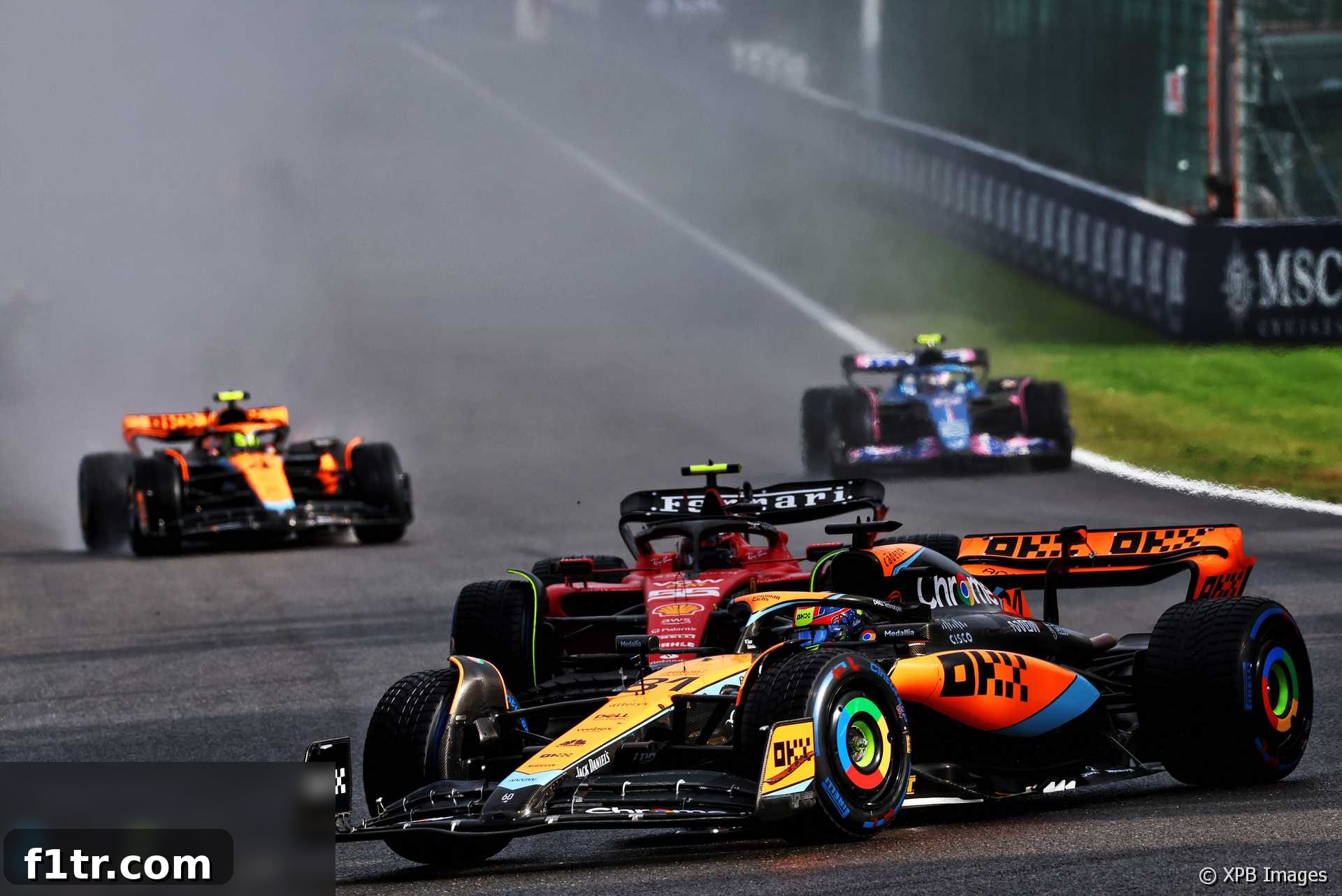
The thrilling world of Formula 1 often delivers unforgettable moments, but recent events, particularly the rain-affected Belgian Grand Prix sprint race, have reignited a long-standing debate concerning the efficacy and safety of the sport’s full wet weather tyres. Top drivers across the grid have once again voiced their profound dissatisfaction with these crucial components, highlighting performance deficits and safety implications that demand urgent attention from both Pirelli, F1’s sole tyre supplier, and the sport’s governing bodies.
The Persistent Challenge of F1 Wet Weather Tyres
The Belgian Grand Prix sprint race at Spa-Francorchamps unfolded amidst torrential downpours, leading to a delayed start behind the Safety Car. Under such challenging conditions, Formula 1 regulations mandate the use of the full wet weather tyre, often colloquially termed the ‘extreme wet’ due to its design for maximum water displacement. However, the subsequent events demonstrated a glaring disparity in performance: as soon as racing commenced, a significant portion of the field, recognizing the limitations of the full wets, immediately pitted to switch to intermediate tyres. The remaining drivers followed suit on the subsequent lap, many indicating they would have changed earlier had it not been for the anticipated congestion in the pit lane. This rapid, almost universal abandonment of the full wet tyre speaks volumes about the current state of these crucial compounds.
The core issue, as articulated by the drivers, revolves around a critical imbalance. While the full wet tyres are theoretically designed to cope with vast quantities of standing water and mitigate aquaplaning, their performance window is remarkably narrow. Once track conditions improve even slightly, or when visibility becomes the primary limiting factor rather than water depth, the intermediate tyre becomes overwhelmingly superior in terms of lap time and driver confidence. This creates a frustrating dilemma for teams and drivers, who are forced to compromise between ultimate safety in extreme conditions and competitive pace.
Drivers United: A Call for Improvement
The chorus of driver complaints was led by some of the sport’s most experienced and respected figures. Fernando Alonso, the two-time world champion, was among those particularly vocal about his discontent. He pointed out a surprising and concerning issue: “Even behind the Safety Car they were overheating.” This observation is particularly damning, as the full wet tyres are specifically engineered to operate in cool, wet conditions. Overheating at reduced speeds suggests fundamental issues with their compound or construction, leading to accelerated degradation and diminished grip even before racing properly begins. This phenomenon not only compromises performance but also raises questions about their longevity and consistency over a full race distance.
Charles Leclerc of Ferrari offered a more nuanced, yet equally critical, assessment. He acknowledged that the full wet weather tyres are indeed effective at preventing aquaplaning in extremely wet conditions. However, he quickly highlighted their major drawback: “There’s some work that needs to be done there because we’ve got extreme tyres that are really slow, but that are really good for aquaplaning, but we never drive in those conditions because of visibility.” Leclerc’s statement encapsulates the current paradox. While the tyres might technically manage the water, the spray generated by modern F1 cars renders such conditions virtually unraceable due to severely impaired visibility. Consequently, by the time conditions are deemed safe enough to race, the full wet tyres are already significantly slower than the intermediates, compelling an immediate switch. “It’s quite tricky at the moment. I think the extreme should be faster and closer to the inters so we run more on the extreme than inters,” Leclerc concluded, advocating for a redesign that bridges the performance gap and allows for more actual racing on the designated wet weather compound.
The Performance Gap: Extreme Wet vs. Intermediate
George Russell, a director of the Grand Prix Drivers’ Association (GPDA), delivered perhaps the most scathing critique, branding the extreme wet tyre “a pretty pointless tyre.” His assessment was unequivocal: “It’s really, really bad. It’s probably six, seven seconds a lap slower than the intermediate. The only reason you’d ever run the extreme wet is because you’d aquaplane on an intermediate. So that needs to be substantially improved.” This significant performance differential of several seconds per lap effectively renders the full wet tyre uncompetitive the moment conditions allow for intermediates. The immense gain from switching to intermediates creates a critical strategic imperative, often overriding other considerations and compressing the racing action into a short window. This not only detracts from the spectacle but also places additional pressure on teams and drivers in already perilous conditions.
The drivers’ consensus is clear: the current generation of F1 wet weather tyres, particularly the full wets, are failing to meet the demands of modern Formula 1. They are too slow for anything but the most extreme conditions, and even then, visibility issues often prevent their optimal use in competitive racing. This situation necessitates a comprehensive review and substantial improvements to ensure both driver safety and the quality of racing in wet conditions.
Pirelli’s Mandate and the Historical Context
Pirelli has served as F1’s official tyre supplier since 2011, operating under a strict mandate from the FIA to design tyres that meet specific performance criteria, often including planned degradation to promote strategic variability. However, the consistent criticism regarding their wet weather compounds suggests a fundamental challenge in balancing these requirements with practical racing needs. Russell’s remarks touched upon the perceived regression in wet tyre performance over the years. He drew comparisons to tyres from previous eras, specifically recalling the superior performance of full wet weather tyres produced by Bridgestone, F1’s previous supplier, and even other manufacturers in junior categories.
“The aquaplaning with fairly little water is really substantial,” Russell lamented, reflecting on past experiences. “I remember watching the old onboard videos of 2007 with Massa and Kubica in Fuji, so much water, they were still pushing flat out.” He further elaborated on his personal experience: “I remember doing test days here in Formula 3 and Formula Renault on Michelin and Hankook and aquaplaning wasn’t really a thing to appreciate.” While acknowledging the inherent challenges of managing high-speed aquaplaning at over 200 miles an hour, Russell firmly believes that “there needs to be a significant improvement.” This historical perspective underscores the drivers’ argument that better wet weather tyre performance has been achieved in the past, suggesting that current limitations are not insurmountable and that the technology exists to develop more effective Pirelli wet tyres for Formula 1.
The design of Formula 1 extreme wets is a complex engineering task. They must evacuate vast amounts of water (up to 65 litres per second per tyre at full speed) while also generating sufficient grip, managing temperature, and providing adequate durability. The evolving nature of F1 cars – with increasing downforce, wider tyres, and more powerful engines – further complicates this challenge, as these factors also contribute to the amount of spray generated and the car’s interaction with standing water.
Navigating the Dangers: Visibility and Safety
Beyond the pure performance aspect, driver safety, particularly in terms of visibility, remains a paramount concern. Russell appreciated the efforts of race control at Spa to reduce the water volume on the track by running laps behind the Safety Car before the official start. However, he felt these efforts made little tangible difference to visibility levels. “I think they did a good job with the circumstances,” he conceded, “It’s very challenging.”
He painted a stark picture of the dangers involved: “It’s still incredibly dangerous conditions. You’re going 300 kilometres an hour on the straight and you can’t see 50 metres in front of you. I don’t know what it is, it seems to be particularly bad at this circuit. I don’t know if it’s the humidity or what, but the spray just doesn’t seem to disperse. It’s like you’re driving into a cloud, it really is.” The sheer volume of spray generated by modern F1 cars, especially at a high-speed circuit like Spa, creates an opaque wall of water that can completely obscure vision for trailing cars. This lack of visibility is arguably the single biggest threat to driver safety F1 faces in wet conditions, often leading to race stoppages or prolonged periods behind the Safety Car, much to the frustration of fans.
Russell also questioned the effectiveness of extended Safety Car periods in clearing water and improving visibility. “But I felt like those four laps under the Safety Car didn’t really give us a lot. It was the same in Japan, we were doing lots of laps under the Safety Car, it didn’t improve things.” He offered a provocative alternative: “Maybe the solution for the future is if they allow us to do two, three, four laps at full racing speed and then bring the Safety Car out to neutralise the pack and go again, because after two laps of racing things were much better.” This suggestion highlights a crucial observation: the cars themselves, when driven at racing speeds, are far more effective at dispersing standing water than simply circulating behind a Safety Car. While seemingly counter-intuitive from a safety perspective, a controlled period of racing could potentially clear the track more efficiently and allow for safer, more competitive racing to resume sooner. This innovative approach warrants further investigation and simulation to address the persistent issues of aquaplaning F1 and poor visibility.
Towards a Safer and More Thrilling Wet Weather Future
The recurrent complaints from Formula 1 drivers about wet weather tyres are not merely grievances; they are a critical call to action for the sport to enhance safety, improve the quality of racing, and deliver the excitement fans crave, even in challenging conditions. The current disparity between the full wet and intermediate tyres, coupled with the persistent issue of visibility, is limiting the sport’s ability to conduct competitive wet races effectively.
Solutions will likely involve a multi-pronged approach. Pirelli has already reportedly proposed a “super-intermediate” tyre, as mentioned in related articles from the 2023 Belgian Grand Prix. This new compound could potentially bridge the performance gap between the current intermediates and extreme wets, offering better grip in very wet conditions without the dramatic speed deficit of the existing full wet. Such an innovation could make wet racing more dynamic and less reliant on immediate tyre changes.
Furthermore, discussions around car design, particularly how to reduce spray generation, are ongoing. While the drivers’ suggestion of short bursts of racing might seem radical, it underscores the need for creative solutions to ensure F1 cars can race safely and competitively in a wider range of wet conditions. The dialogue between drivers, Pirelli, the FIA, and teams must continue to evolve, aiming for a future where wet races are celebrated for their skill and unpredictability, rather than being marred by safety concerns and a lack of effective equipment. Ultimately, the goal is to make F1 wet weather tyres a reliable tool that empowers drivers to push the limits, enhancing the spectacle for millions of fans worldwide.
Bringing the F1 news from the source
RaceFans strives to bring its readers news directly from the key players in Formula 1. We are able to do this thanks in part to the generous backing of our RaceFans Supporters.
By contributing £1 per month or £12 per year (or the equivalent in other currencies) you can help cover the costs involved in producing original journalism: Travelling, writing, creating, hosting, contacting and developing.
We have been proudly supported by our readers for over 10 years. If you enjoy our independent coverage, please consider becoming a RaceFans Supporter today. As a bonus, all our Supporters can also browse the site ad-free. Sign up or find out more via the links below:
- Become a RaceFans Supporter
- RaceFans Supporter FAQ
2023 Belgian Grand Prix Insights
- Haas drivers fear losing battle for seventh after “grim weekend” in Spa
- Mercedes optimistic they’re “in the right place for winter” with development plan
- Ferrari not convinced by call to equalise engines: ‘Renault is not so far away’
- Ferrari staying “calm” amid swings in performance from race to race
- Pirelli proposes a “super-intermediate” to address wet weather tyre problems
Browse all 2023 Belgian Grand Prix articles