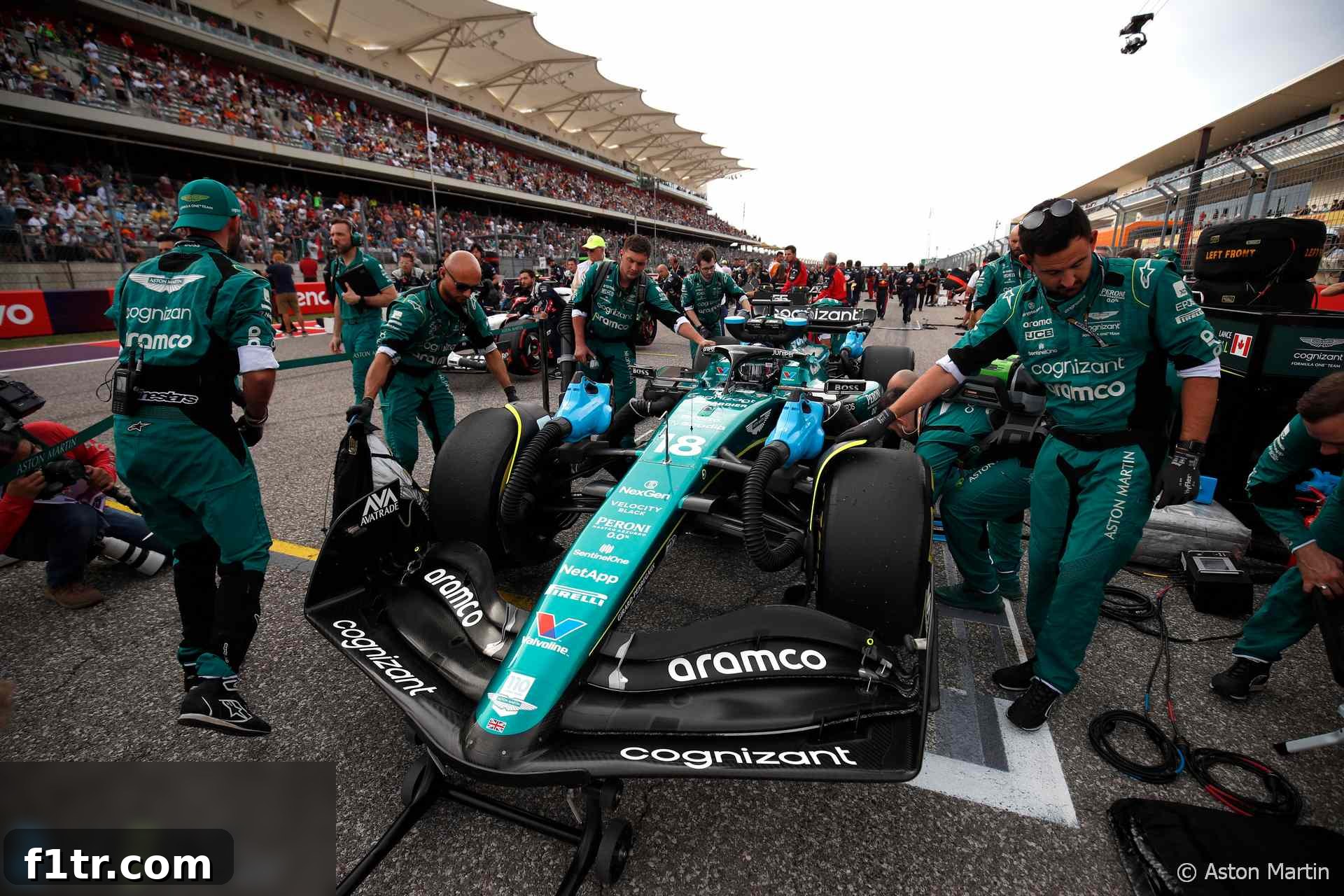
Aston Martin Takes Bold Pit Lane Start for US Grand Prix Following Upgrade Struggles
In a surprising turn of events at the Circuit of the Americas, both Aston Martin drivers, Lance Stroll and Fernando Alonso, commenced the United States Grand Prix from the pit lane. This strategic decision, confirmed by the team, came after a challenging weekend marred by performance issues stemming from a new upgrade package for their AMR23 cars. The move allowed the Silverstone-based squad to make significant setup changes outside of parc ferme conditions, a crucial step in their bid to unlock performance and salvage their weekend.
The decision by Aston Martin, mirrored by the Haas F1 Team for their own cars, reduced the starting grid to just 16 cars, adding an unusual dynamic to the highly anticipated race in Austin, Texas. For Aston Martin, who had entered the US Grand Prix weekend with high hopes for their comprehensive upgrade, the situation was a clear indication of the difficulties they encountered.
A Weekend Plagued by Technical Hiccups and Performance Puzzles
Aston Martin’s woes began almost immediately in Friday’s first practice session. The team’s initial attempts to run the updated AMR23 revealed critical problems, particularly with the braking system. Lance Stroll’s FP1 session was cut short after experiencing a severe brake issue in the opening minutes, forcing his car back into the garage. While Fernando Alonso was able to continue circulating, his car suffered from a similar, albeit less critical, fault, hindering his ability to gather meaningful data and optimize the new package.
Eric Blandin, Aston Martin’s Deputy Technical Director, shed light on the initial technical misstep. “In FP1, we effectively, because of a mistake on the simulation, put too much blanking on the front brakes, so they caught fire,” Blandin explained. “That’s the reason why we couldn’t run more than two laps with Lance in the morning. And that really put us on the back foot for the work we’ve done.” This fundamental error in preparation cost the team valuable track time, which is paramount for understanding and fine-tuning new components.
Qualifying and Sprint Race Disappointments
The repercussions of the troubled practice session carried directly into Friday’s qualifying for the main Grand Prix. Both Aston Martin drivers were eliminated in Q1, a stark contrast to their usual competitive form and a significant blow to their hopes for a strong race. This early exit underscored the profound difficulties the team was facing in adapting the new package and finding an optimal setup.
Saturday offered a glimmer of improvement during qualifying for the Sprint Race, with both drivers managing to advance to Q2. However, the Sprint Race itself brought little relief. Fernando Alonso finished outside the points in 13th, while Lance Stroll was forced to retire early after reporting persistent problems with his braking system. These ongoing issues suggested a deeper, more complex challenge than just the initial brake blanking error.
Blandin elaborated on Stroll’s difficulties during the Sprint: “With the new package, you have to effectively optimise the brake balance, it’s a very different characteristic. He struggled a bit, more or less since the beginning, to really optimise his brake balance shaping et cetera.” This indicates that the new aerodynamics or suspension components drastically altered the car’s braking dynamics, requiring a significant re-calibration that the team simply hadn’t had enough time to achieve within the constraints of a race weekend.
Compounding Stroll’s brake struggles, the team ultimately retired his car due to a separate mechanical issue. Blandin confirmed, “So he struggled a lot with the braking in the race yesterday, but we retired the car because we had an issue with the water pressure and that’s the reason why we had to retire the car.” This cascade of problems painted a grim picture for Aston Martin ahead of the main event.
The Pit Lane Strategy: A Pragmatic Approach to Performance Recovery
Faced with a lack of performance and understanding of their new upgrade package, Aston Martin made the bold decision to start both cars from the pit lane. This unusual move allowed them to break the restrictive parc ferme conditions, which typically lock in car specifications and setups after qualifying. Breaking parc ferme rules invariably results in a pit lane start, but for Aston Martin, the potential gains from significant setup changes outweighed the disadvantage of starting from the very back.
“We learned that the package is actually performing as we were expecting,” Blandin stated, maintaining faith in the underlying potential of their upgrades. “But we haven’t been able to optimise the set-up so one thing we have decided to do is to start both cars from the pit lane.” This clarification is vital: the problem wasn’t necessarily with the new parts themselves, but with the team’s inability to integrate and optimize them effectively under intense race weekend pressure.
The team’s strategy went a step further, adopting a unique approach to data gathering and performance validation. Instead of committing both cars to the new package, they opted to run different specifications for each driver. “We are effectively changing the set-up because we think there is a lot more performance to come from the car,” Blandin explained. “But we have took the pragmatic approach to start both car one with the Qatar spec and the other one with the new package.”
This split strategy is a calculated risk. By running Fernando Alonso in the familiar “Qatar spec” (referring to the configuration used in the preceding Qatar Grand Prix) and Lance Stroll with the new upgrade package, Aston Martin aimed to achieve two key objectives. Firstly, it provides a direct comparison, allowing them to isolate the performance characteristics of the new parts against a known baseline. Secondly, it offers a fallback, ensuring at least one car operates with a well-understood setup, potentially increasing its chances of battling for points from the pit lane.
The decision highlights the immense pressure on Formula 1 teams to constantly innovate while ensuring reliability and optimal performance. For Aston Martin, who have been battling for a strong constructors’ championship position, understanding these upgrades is crucial for their long-term development trajectory. The data gathered from running two different specifications in race conditions will be invaluable, regardless of the immediate race result.
Implications and the Road Ahead
Starting from the pit lane is always an uphill battle in Formula 1. It places immense pressure on drivers to make swift progress through the field while managing tires and fuel. For Aston Martin, the hope was that a meticulously optimized setup, even from the pit lane, would allow their cars to showcase their true potential and make a charge for championship points. The COTA circuit, with its challenging mix of high-speed corners and heavy braking zones, demands a balanced and stable car – precisely what Aston Martin had struggled to achieve.
The parallels with Haas’s similar decision underscore the severity of the challenge teams face when new upgrades do not immediately deliver expected performance. It’s a testament to the competitive nature of F1 that teams are willing to sacrifice grid position for the chance to improve their car’s fundamental setup.
This challenging United States Grand Prix weekend serves as a critical learning experience for Aston Martin. It highlights the complexities of F1 development, where simulation errors, track conditions, and the intricate interaction of new components can drastically alter a team’s fortunes. The insights gained from running a split specification will undoubtedly inform their approach to future upgrade deployments and help them refine their optimization processes. While the immediate goal was to salvage points, the broader objective was to unlock the full potential of their AMR23 and prepare effectively for the remaining races of the season and beyond.
Ultimately, Aston Martin’s pit lane gamble at the US Grand Prix was a bold move born out of necessity, driven by the relentless pursuit of performance in the highly competitive world of Formula 1. It demonstrated the team’s willingness to take decisive action to overcome technical hurdles and ensure their ambitious development plans stay on track.
- 2023 United States Grand Prix sprint race grid
More from the 2023 United States Grand Prix
- US GP was Mercedes’ best race of 2023 despite disqualification – Wolff
- Singapore and Austin retirements cost me top 10 championship place – Ocon
- United States Grand Prix result unchanged as FIA rejects Haas’ call for review
- Sargeant admits he’s ‘struggled to use all the downforce at times’ in F1
- Mercedes’ Brazilian GP set-up was “conservative” after US GP disqualification
Browse all 2023 United States Grand Prix articles