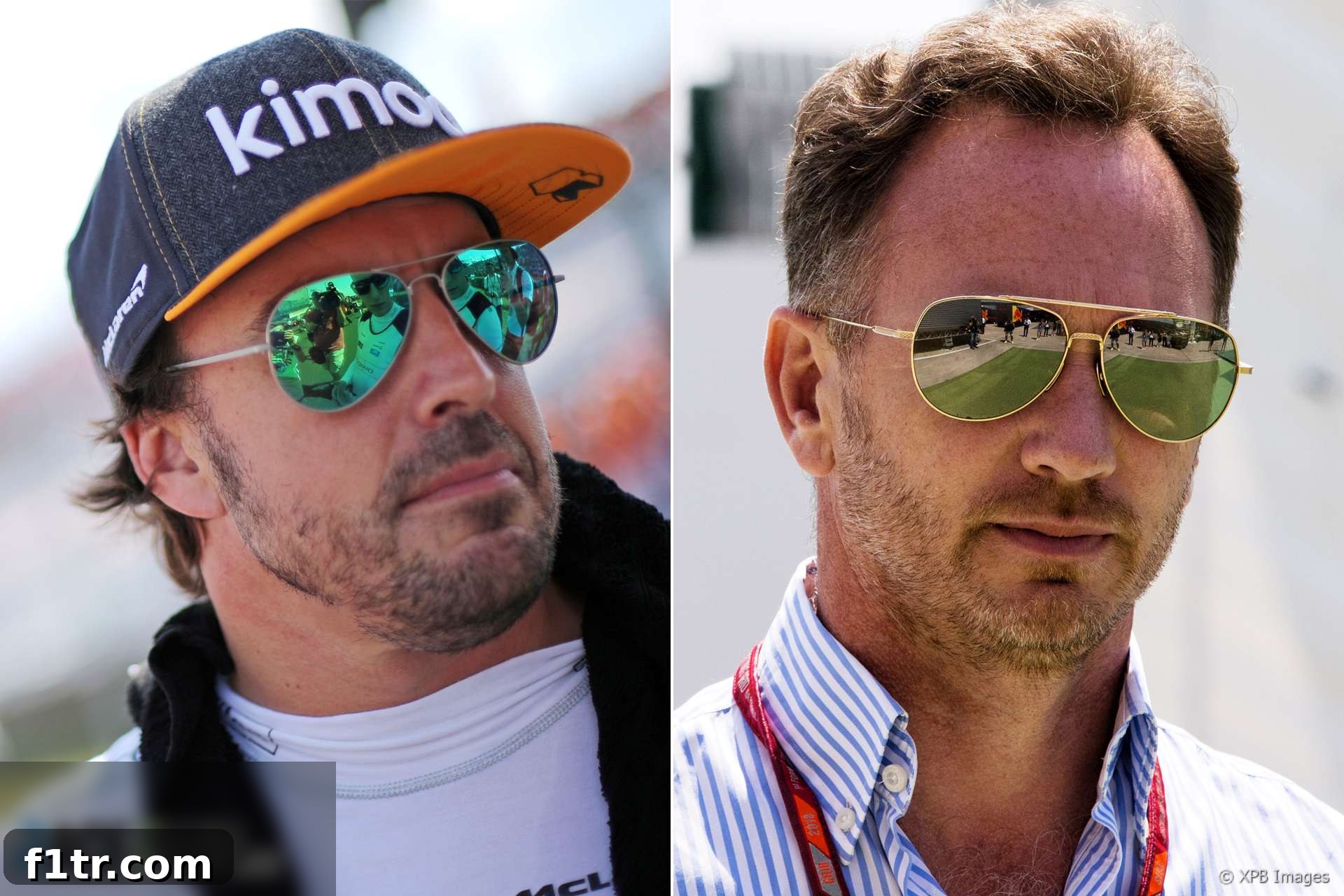
The highly competitive and often dramatic world of Formula 1 recently saw a public war of words erupt between two of its most prominent figures: Christian Horner, Team Principal of Red Bull Racing, and two-time world champion Fernando Alonso. At the heart of the dispute were conflicting claims regarding potential offers for a coveted seat at the energy drink giant’s F1 team. This controversy not only captivated fans but also shed light on Red Bull’s unique driver philosophy and the complex dynamics of the F1 driver market.
The saga began with Alonso’s assertion that Red Bull had, on multiple occasions, extended an invitation for him to join their ranks, specifically as a replacement for Daniel Ricciardo following the Australian’s decision to depart for Renault. Alonso claimed these discussions weren’t isolated incidents but part of a long-standing pattern, with alleged offers dating back as far as 2007. The Spanish driver, known for his fiery personality and unwavering self-belief, even went as far as to demand an apology from Horner for previous remarks that characterized Alonso as a driver prone to “causing chaos” within his teams. Such a demand underscored the deep-seated tension and differing perspectives between the two F1 heavyweights.
However, Christian Horner vehemently denied Alonso’s claims, particularly regarding any offer for the 2019 season. Speaking to Sky Sports, Horner presented a steadfast and consistent rebuttal, suggesting that if any offer was made, it certainly didn’t originate from Red Bull Racing itself. “I’m not quite sure, maybe [Toro Rosso team principal] Franz [Tost] has made him an offer,” Horner quipped, subtly shifting any potential responsibility away from the main Red Bull outfit while still acknowledging Alonso’s undeniable talent. This immediate and resolute denial set the stage for a compelling public debate, highlighting the contrasting narratives and the high stakes involved in F1 driver negotiations.
Horner elaborated on Red Bull’s long-established and unique driver acquisition strategy, which fundamentally excludes a driver of Alonso’s profile. “Fernando Alonso is a great driver, he is one of the best grand prix drivers out there,” Horner conceded, acknowledging the Spaniard’s formidable skill and illustrious career. Yet, he quickly followed with a crucial caveat: “But he just doesn’t fit the profile of our team, the investment we have in youth, in a junior team with Toro Rosso.” This statement succinctly encapsulates Red Bull’s philosophy: a commitment to nurturing young talent through their extensive junior driver program, bringing them up through Toro Rosso (now Visa Cash App RB) before promoting them to the senior team. This internal pipeline has been the bedrock of Red Bull’s success, producing champions like Sebastian Vettel and Max Verstappen, alongside numerous other Grand Prix winners.
The Red Bull Team Principal further clarified that while there were indeed “conversations,” these did not constitute a formal offer. Horner confirmed that he had engaged in discussions with Flavio Briatore, Alonso’s long-time manager, who was “obviously looking around” for opportunities for his star client. Furthermore, an “enquiry that came from FOM immediately following Daniel’s announcement” was also acknowledged. This inquiry from Formula One Management might have been an attempt to retain a high-profile driver like Alonso in the sport, especially given the unexpected departure of Ricciardo and the potential impact on viewer interest. However, Horner stressed that despite these discussions and inquiries, Red Bull’s position remained unequivocal: “the situation was always very clear that Fernando doesn’t fit in our thoughts and our future so there was never any offer.”
The departure of Daniel Ricciardo at the end of the 2018 season created a significant void at Red Bull Racing. Ricciardo, a charismatic and highly skilled driver, had been a cornerstone of the team for several years. His decision to move to Renault left Red Bull with a crucial seat to fill, sparking widespread speculation across the paddock. Given Alonso’s status as a proven race-winner and a world champion, it was natural for his name to be linked with any top team vacancy. However, Red Bull’s commitment to its distinctive driver development program meant that external, veteran drivers, regardless of their pedigree, were rarely considered for the senior team. The focus instead shifted to talent within their own ranks, such as Pierre Gasly, who was eventually promoted from Toro Rosso for the 2019 season.
This episode also brought to light Horner’s earlier “chaos” comments regarding Alonso. While details of the original remarks and subsequent apology remain somewhat opaque, the fact that Alonso invoked them in his demand for a new apology suggests a lingering tension and a perception that Horner had previously acknowledged concerns about Alonso’s team dynamics. Alonso’s career, while brilliant in terms of individual performance, has often been marked by high-profile disputes and departures from teams like McLaren and Ferrari, fueling the narrative of a driver who can be challenging to manage despite his immense talent. Red Bull, a team that values stability and a cohesive team environment around its young proteges, might have seen this as a potential risk factor that contradicted their established philosophy.
The differing accounts from Alonso and Horner ultimately paint a vivid picture of the complex world of F1 driver negotiations. Alonso, perhaps seeking to bolster his own market value or provide a public explanation for his eventual departure from F1 (at that time, before his return with Alpine and Aston Martin), may have genuinely believed that informal discussions constituted an offer. For Red Bull, however, the distinction between a manager “sounding out” opportunities and a formal team offer is crucial, especially when it contradicts their fundamental driver strategy. Horner’s firm denials underscored Red Bull’s steadfast commitment to its unique approach of developing talent from within, a strategy that has consistently proven successful for the team over many years.
In conclusion, the public exchange between Fernando Alonso and Christian Horner served as more than just a disagreement over a potential F1 seat. It was a reaffirmation of Red Bull Racing’s unshakeable identity as a team built on youth development, a philosophy that prioritizes nurturing talent from within its junior program over signing established, albeit world-class, veteran drivers. While Alonso’s claims ignited a brief but intense debate, Horner’s consistent denial firmly established Red Bull’s position, illustrating how team ethos and long-term strategy often dictate decisions in the highly competitive and cutthroat environment of Formula 1. The saga ended with both parties holding firm to their narratives, leaving fans to ponder the true nature of the discussions and the road not taken.
2018 F1 season
- F1 feared “death knell” for Drive to Survive after Ferrari and Mercedes snub
- McLaren staff told us we were “totally crazy” to take Honda engines in 2018 – Tost
- ‘It doesn’t matter if we start last’: How Red Bull’s junior team aided Honda’s leap forward
- Honda’s jet division helped F1 engineers solve power unit problem
- McLaren Racing losses rise after Honda split
Browse all 2018 F1 season articles