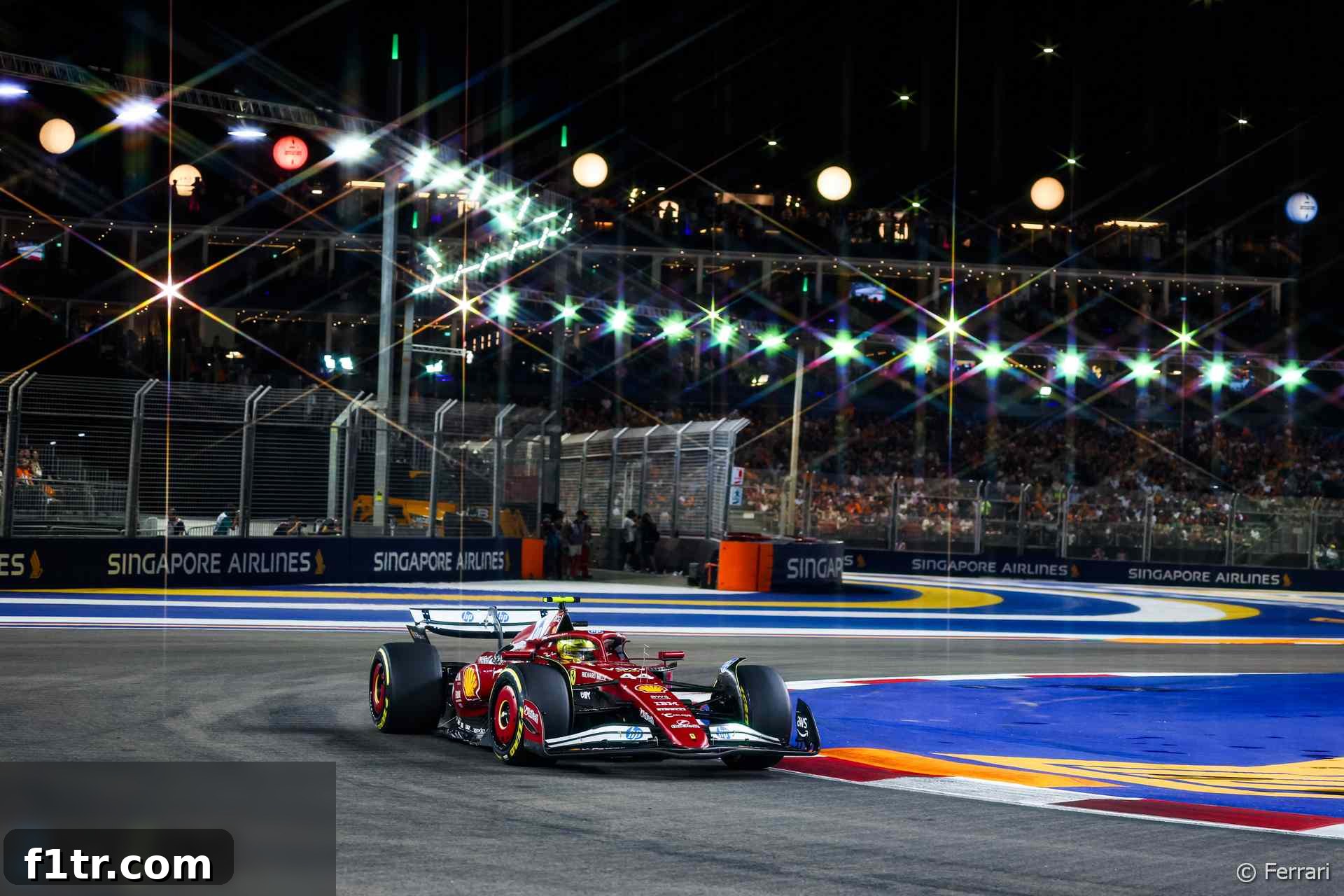
The unforgiving street circuit of the Singapore Grand Prix is renowned for its demanding nature, pushing both drivers and machinery to their absolute limits. In a dramatic conclusion to the 2025 race, it was none other than Lewis Hamilton, driving for Ferrari, who found himself at the heart of an intense controversy. As the final laps unfolded under the dazzling night lights, a critical mechanical failure forced Hamilton into a series of evasive maneuvers that would ignite a fierce debate among fans, pundits, and race stewards alike. Hamilton adamantly maintained that he was left with no alternative but to navigate several corners by cutting them, a direct consequence of a catastrophic brake failure that jeopardized his race and safety.
This incident, which saw the seasoned champion battling not just his competitors but also a failing car, brought to the forefront crucial questions about driver safety, the strict application of track limits, and the rarely invoked concept of “force majeure” in the high-octane world of Formula 1. What initially seemed like a brilliant feat of evasive driving quickly escalated into a contentious dispute that ultimately reshaped the final standings of one of the season’s most anticipated races, embedding itself into the annals of dramatic motorsport moments.
Advert | Become a Supporter & go ad-free
The drama intensified dramatically during the closing stages of the race. Lewis Hamilton, piloting his Ferrari, experienced a catastrophic front-left brake failure. The sudden and complete loss of braking power on one wheel sent shockwaves through the cockpit and the Ferrari pit wall. Hamilton’s car, normally a precision instrument, became incredibly difficult to control. His pace dropped precipitously, transforming what was a comfortable margin into a precarious lead as the chasing Fernando Alonso, in peak form, rapidly closed the gap, sensing an unexpected opportunity.
Facing an imminent collision or a complete loss of control, Hamilton was left with mere milliseconds to react. Unable to decelerate sufficiently for the fast-approaching turns, he was compelled to take evasive action. This manifested as repeatedly cutting the insides of several corners across the circuit. Specifically, Hamilton veered off track at Turns Two, Five, Sixteen, and Seventeen. These forced excursions, though controversial, allowed him to maintain some semblance of speed and direction, crucial for preventing a full-blown accident and crucially, for crossing the finish line. In a testament to his sheer skill and quick thinking under pressure, he managed to cross the chequered flag just under half a second ahead of the charging Alonso, a truly astonishing feat given the circumstances.
The tension was palpable even over the team radio. As Hamilton’s car repeatedly strayed beyond the white lines, his race engineer, Ricardo Adami, urgently advised him to cease leaving the track. Hamilton’s immediate response was resolute, reflecting the dire circumstances he faced: “I’m not trying to cut the course, mate.” His tone conveyed a mix of frustration and necessity, underscoring his belief that these were not deliberate attempts to gain an unfair advantage, but rather a direct consequence of a severe mechanical malfunction. Post-race, the question of intent and circumstance became central to the unfolding debate, as Hamilton openly queried the applicability of penalties in such extreme situations, asking: “Surely there’s no penalty when it’s force majeure?”
Despite Hamilton’s passionate plea of “force majeure” – a legal term referring to unforeseeable circumstances that prevent someone from fulfilling a contract or obligation – the race stewards held a different view. After a thorough review of the telemetry, onboard footage, and driver testimony, they concluded that while the brake failure was undeniable, it did not entirely absolve him of responsibility for his repeated infringements of track limits. The stewards ultimately issued a five-second time penalty for consistently leaving the track, a decision that had immediate and significant repercussions for the final race classification. This penalty demoted Hamilton from his provisional finishing position to a revised eighth place, placing him directly behind Fernando Alonso in the official results.
The stewards’ official statement clarified their reasoning, asserting that Hamilton’s brake problem, while severe, was “not a justifiable reason” for the frequency and manner in which he left the track. Crucially, their report noted that this interpretation was “not contested by the team representative nor the driver” during the hearing, suggesting an understanding, if not full agreement, of the regulatory stance. However, Hamilton, speaking to the media in the lead-up to the next Grand Prix weekend, reiterated his conviction that his actions were born out of absolute necessity. He stood firm on his assertion that cutting the track was, in that moment, his singular viable option to avoid a more dangerous incident.
Reflecting on the harrowing experience, Hamilton vividly described the final laps as “definitely nerve-wracking.” He drew a striking parallel to previous career challenges, stating, “I’ve finished races before with three tyres and now I’ve finished one with three brakes. It’s not something I want to experience again.” This analogy powerfully conveyed the extreme conditions he was operating under, highlighting the perilous balance between pushing for a result and ensuring personal safety when a critical component of the car fails unexpectedly. The incident served as a stark reminder of the fine margins and inherent dangers that persist even at the pinnacle of motorsport, emphasizing the relentless demand for perfection and quick thinking.
Advert | Become a RaceFans supporter andgo ad-free
Elaborating further on the technical challenges, Hamilton explained that with the compromised braking system, he was fundamentally “unable to slow sufficiently for the corners.” This critical deficiency left him with only one course of action: to utilize the designated exit roads and run-off areas, effectively “cutting” the track. While he acknowledged momentarily running wide at Turn One at one instance, he emphasized the specific, more severe instances where he cut the insides of Turns Five and Seventeen once each, and Turn Sixteen twice. These were not opportunistic shortcuts but desperate attempts to navigate the circuit safely with a malfunctioning vehicle, showcasing the incredible instinct required from an F1 driver.
Hamilton vividly described the terrifying sensation of his brake pedal going “straight to the floor,” signifying a complete loss of function. “I had no choice but to go onto those exit roads – I wouldn’t have made the corner otherwise,” he asserted, painting a clear picture of the no-win scenario he faced. Despite the profound impact on his race and his strong belief in his actions being justifiable, Hamilton demonstrated his characteristic pragmatism regarding the stewards’ ruling. He stated, “The FIA penalty was fine,” and surprisingly added, “It doesn’t really make a big difference to me anyway.” This seemingly nonchalant acceptance, coming from a fiercely competitive driver, hinted at a deeper understanding of the rules, even when they seemed to contradict the extraordinary circumstances he endured, indicating a focus on the bigger championship picture.
Meanwhile, on the track, the immediate aftermath of the race was charged with raw emotion, particularly from Hamilton’s closest rival. Before the official penalty was announced, Fernando Alonso had crossed the line just behind Hamilton, completely unaware of the mechanical drama that had unfolded. His frustration and disbelief were palpable as he reacted furiously over his team radio to Hamilton’s provisional victory. Alonso repeatedly exclaimed, with unfiltered intensity, “I don’t fucking believe it,” conveying his profound conviction that Hamilton’s track limit breaches were intentional and had unjustly cost him a position. This outburst underscored the intense rivalry between the two champions and the high stakes of every position in Formula 1.
The post-race narrative took an unexpected turn when Hamilton chose to address Alonso’s fiery radio message through a social media post, injecting a touch of levity into the heated situation. He light-heartedly mocked Alonso’s frustrated exclamation, drawing a humorous parallel to a well-known British comedy character whose catchphrase bore a striking resemblance. Hamilton defended his playful jab, explaining, “It was just a bit of fun. It reminded me of that show – I hadn’t seen it in 20-plus years. I thought it was funny, so I posted it. What is life if you can’t have a little fun?” This playful exchange, though perhaps adding fuel to the long-standing rivalry between the two champions, underscored Hamilton’s ability to find humor amidst controversy, even when facing scrutiny.
For Fernando Alonso, the stewards’ decision brought a sense of vindication. Speaking after the ruling, a much calmer and satisfied Alonso expressed his contentment, stating he was “happy with the penalty” meted out to Hamilton. He acknowledged the significance of gaining the position, emphasizing that “Even one second was enough – [it was] not needed, the extra four.” This sentiment highlighted his belief that justice had been served, reaffirming the importance of strictly adhering to the sporting regulations, regardless of the circumstances. The incident served as a powerful testament to the unwavering commitment of Formula 1 to uphold its rules, even when faced with compelling narratives of mechanical misfortune and driver heroism.
Ultimately, the 2025 Singapore Grand Prix will be remembered not just for its thrilling racing under the lights, but for the complex ethical and sporting dilemma it presented. Hamilton’s brake failure and subsequent track limit breaches ignited a debate that touched upon the very essence of motorsport: the balance between safety, fair play, and the interpretation of rules in extreme situations. While Hamilton’s actions were undeniably forced by a severe mechanical fault, the stewards’ firm stance underscored the principle that drivers are ultimately responsible for controlling their cars within the designated boundaries, even when facing unexpected challenges. This memorable race underscored the thin line between triumph and controversy, solidifying its place as a dramatic chapter in the annals of Formula 1 history and providing valuable lessons for future race control decisions.
Advert | Become a RaceFans supporter andgo ad-free
Miss nothing from RaceFans
Get a daily email with all our latest stories – and nothing else. No marketing, no ads. Sign up here:
2025 Singapore Grand Prix
- What are McLaren’s “repercussions” for Norris and why did they wait to apply them?
- Hamilton “had no choice” about cutting corners when brakes failed in Singapore
- Norris reveals he faces ‘repercussions to the end of the season’ over Piastri clash
- Russell denies Verstappen a ‘full set’ of wins, Hamilton breaks Schumacher record
- ‘Good shout on staying out’: Did Verstappen consider a second pit stop in Singapore?
Browse all 2025 Singapore Grand Prix articles