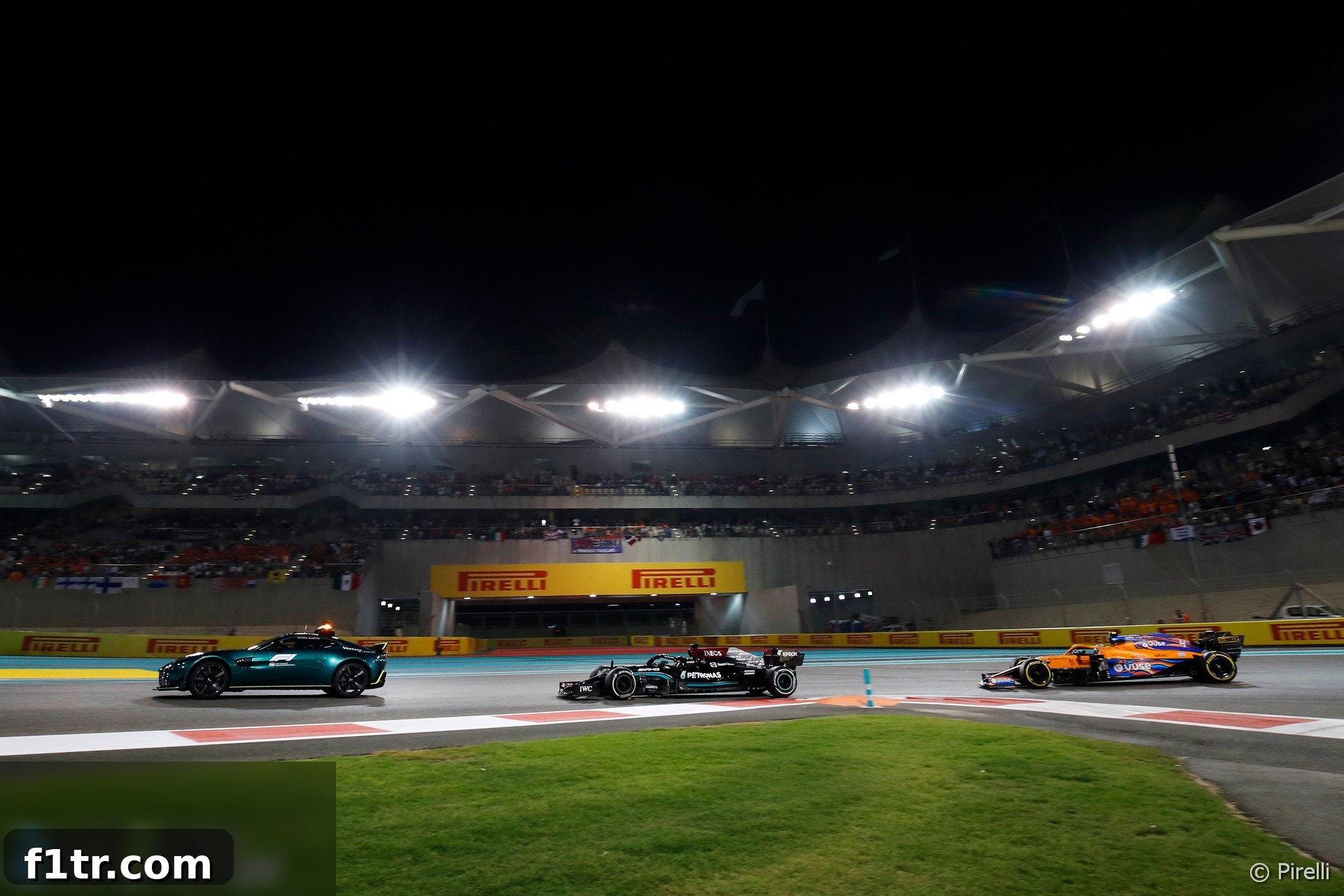
The 2021 Formula 1 Abu Dhabi Grand Prix remains one of the most contentious and unforgettable season finales in motorsport history. In a mere four-minute window towards the climax of this pivotal race, FIA Formula 1 Race Director Michael Masi made a series of decisions regarding the Safety Car procedure that would ultimately determine the outcome of the Drivers’ World Championship. This article delves into the intricate details of those crucial moments, analyzing the on-track events, the regulatory interpretations, and the profound impact on both Lewis Hamilton and Max Verstappen’s championship aspirations.
Advert | Become a Supporter & go ad-free
Following a crash involving Nicholas Latifi in the closing stages, the deployment of the Safety Car instantly transformed the complexion of the title fight. Race leader Lewis Hamilton, driving for Mercedes, was on course to secure a record-breaking eighth world championship. Behind him, Red Bull’s Max Verstappen, who had just pitted for fresh soft tires during the Safety Car period, found himself with five lapped cars separating him from his championship rival. The handling of this restart, therefore, was destined to be scrutinized, as it held the key to who would emerge as the 2021 Formula 1 World Champion.
Typically, during Safety Car periods in Formula 1, lapped drivers are given the opportunity to un-lap themselves. This procedure allows them to rejoin the back of the queue, ensuring a clean restart with only cars on the lead lap between the front-runners. The instruction for drivers to un-lap themselves is usually communicated through the digital messaging system available to all teams. However, in Abu Dhabi, after the initial Safety Car deployment, drivers observed a conspicuous absence of this instruction. Many enquired with their engineers, prompting Race Control to issue an official communication stating unequivocally that no un-lapping would take place. This decision, in line with certain interpretations of the regulations, immediately set the strategic landscape for the final laps, influencing how teams perceived their chances and made critical choices regarding tire compounds and track position.
Yet, a mere four minutes after this definitive communication, Race Control reversed its stance. A green light was suddenly given to the five specific lapped cars positioned between Hamilton and Verstappen, permitting them to un-lap themselves. As these cars sped past the Safety Car and Hamilton, Verstappen found himself with an unobstructed path to his title rival, with only clear air ahead. Crucially, the other lapped cars behind Verstappen were instructed to retain their positions, thus ensuring that he had a direct, unhindered shot at Hamilton. This left the two championship contenders separated only by the asphalt, dramatically setting the stage for a final-lap showdown. The decision instantly sparked controversy, with implications not only for the drivers directly involved but for the perceived fairness of the competition.
A significant factor complicating Michael Masi’s decision-making process was the unexpected time taken to clear Latifi’s stricken Williams from the track. Although it was a single-car collision, a series of minor snags and unforeseen circumstances progressively prolonged the recovery operation. This delay ate into the precious laps remaining, intensifying the pressure on Race Control to conclude the championship-deciding event under racing conditions. The initial response saw yellow flags waved at Turn 14, where Latifi had impacted the barrier, while green flags signaled clear track on the subsequent straight. The car’s precarious position meant it could only be retrieved once the track was fully under Safety Car conditions, prioritizing marshals’ safety above all else.
Once marshals were permitted onto the scene, their immediate priority was to clear the significant amount of debris scattered around Latifi’s car. This crucial task aimed to minimize the risk of further incidents and ultimately prevented the necessity of a red flag, an option that would have halted the race and potentially offered an entirely different championship scenario. Latifi’s car had struck the barriers rear-first, leaving carbon components strewn across the exit of the corner, along with his entire front wing. While his car was opposite an opening in the barriers, moving it directly across the track would have been far too time-consuming and would have further obstructed the circuit. Instead, a mobile crane vehicle was strategically deployed to carefully lift Latifi’s car and transport it back to the apex of Turn 14, where another, safer opening was available for its removal. Each minute spent on this recovery chipped away at the rapidly diminishing number of laps.
Advert | Become a RaceFans supporter andgo ad-free
The recovery effort faced a series of unforeseen setbacks. It took a full minute for Latifi to safely shut down his car, a vital safety protocol to prevent any risk of electric shock for the marshals, despite them being equipped with insulating gloves as a precaution against potential ERS failures. Following this, Latifi had to extract himself from the cockpit and move to a secure position off-track, providing essential details of the crash to the nearby marshals. Concurrently, a new drama unfolded: his front brakes spontaneously caught fire, demanding the immediate attention of the corner workers. The visible flames further delayed the clear-up, necessitating several marshals without fire protection to retreat over the barriers for their safety. Almost another minute passed before the majority of the remaining debris could be meticulously picked up and removed from the racing line.
The first marshal to attend to the flaming car did so from a position off-track, utilizing a fire extinguisher. The dense clouds of spray produced by the canister significantly reduced visibility around the car, creating another temporary impediment. Another minute elapsed as marshals patiently waited for this cloud to disperse, while persistent smoke continued to billow from the front wheels, maintaining a hazardous haze around the incident area. Once visibility improved, marshals had to communicate via radio to ascertain the gaps to the next approaching cars in the final sector, ensuring they had sufficient time to safely re-enter the circuit to collect any remaining debris. A distinct group of marshals, accompanied by the mobile crane vehicle, then arrived to complete the recovery. Approximately four minutes after the initial crash, Latifi’s car was finally lifted clear of the track and ready for removal. When the incident occurred, five laps remained in the race; however, by the time Race Control’s initial “no un-lapping” message had been broadcast to all drivers and displayed on television screens, the field was already on its penultimate lap, highlighting the extreme time constraints.
Advert | Become a RaceFans supporter andgo ad-free
After Latifi’s car was successfully removed from the track and craned away, it remained suspended off-camera for another minute at the crane’s parking spot. This lingering presence could potentially have still been a consideration for Race Control, albeit out of sight. Once the entire area was deemed unequivocally clear and all marshals were accounted for and available for further incidents, with clear radio communication channels, the possibility of returning the cars to racing speed became viable. It was precisely halfway around the subsequent lap that Race Control issued the instruction for the five specific drivers positioned between Hamilton and Verstappen in the Safety Car queue to un-lap themselves. This decision represented a significant departure from conventional F1 Safety Car protocols in several crucial aspects.
Race Control Messages: A Timeline of Decisions
| Time | Message |
|---|---|
| 18:21 | Safety Car deployed |
| 18:23 | Double yellow in track sector 15 |
| 18:27 | Lapped cars will not be allowed to overtake |
| 18:31 | Lapped cars 4 (NOR) – 14 (ALO) – 31 (OCO) – 16 (LEC) – 5 (VET) to overtake Safety Car |
| 18:31 | Safety Car in this lap |
| 18:31 | Clear in track sector 17 |
| 18:31 | Clear in track sector 15 |
| 18:32 | Track clear |
The standard procedure dictates that at least one full lap should be provided for lapped cars to circulate, overtake the Safety Car, and then rejoin the rear of the queue if conditions permit. However, in this instance, the five designated cars were granted just over a minute to sprint away under non-racing conditions – the race was still officially under Safety Car, meaning they couldn’t race each other and had to maintain a reduced pace – before Hamilton was instructed to lead the field away. McLaren’s Lando Norris openly remarked that bringing Hamilton and Verstappen together for a final-lap restart appeared to be “made for TV,” implying a prioritization of spectacle over established sporting principles. This highly controversial decision also disregarded the strategic choices made by various teams based on the FIA’s initial communication that no un-lapping would occur, effectively penalizing those who had acted in good faith according to the earlier directive.
One such driver affected was McLaren’s Daniel Ricciardo, a lapped driver who, much like Verstappen, had pitted behind the Safety Car for fresh tires. Expecting the conventional un-lapping procedure, Ricciardo lost two crucial positions to Charles Leclerc and Sebastian Vettel during his pit stop. He anticipated that he would quickly regain these positions once blue flags were shown for him to get out of Verstappen’s way on the restart lap. However, Masi’s revised decision meant Ricciardo, along with the other lapped cars not directly between the two championship contenders, was explicitly told to hold position. This effectively granted Leclerc and Vettel a 70-second head start on Verstappen and Ricciardo, fundamentally altering their race. Masi later justified his actions by stating that the motivation was to ensure the race concluded under a green flag, an outcome he claimed teams had previously agreed was “highly desirable.”
Mercedes, feeling aggrieved by the race outcome, lodged a protest citing a breach of Article 48.12 of the FIA Formula 1 Sporting Regulations. The penultimate paragraph of this pivotal article states: “Having overtaken the cars on the lead lap and the Safety Car these cars should then proceed around the track at an appropriate speed, without overtaking, and make every effort to take up position at the back of the line of cars behind the Safety Car.” The paragraph concludes with a critical caveat: “Unless the clerk of the course considers the presence of the Safety Car is still necessary, once the last lapped car has passed the leader the Safety Car will return to the pits at the end of the following lap.” Mercedes argued that not all lapped cars were permitted to un-lap themselves, and the Safety Car did not return to the pits at the end of the following lap after the “last lapped car” passed the leader, thereby violating both the letter and spirit of the regulation.
These very rules surrounding Safety Car procedures and lapped cars had previously been subject to considerable debate and varying interpretations under Masi’s directorship. A notable precedent occurred during the 2020 Eifel Grand Prix at the Nürburgring, which featured a lengthy Safety Car period. That incident also bunched up the field and created another intense Hamilton versus Verstappen battle. At that time, Masi had stated, “There’s a requirement in the sporting regulations to wave all the lapped cars past,” when questioned on why five laps under Safety Car had been deemed necessary to clear a smoking car next to a barrier opening. This statement directly contradicted his later actions in Abu Dhabi. Verstappen, after the Eifel GP, had even speculated that the Safety Car period was extended “because they just wanted to make it more exciting again because of the gaps,” foreshadowing the criticisms that would emerge a year later.
During the hearing for Mercedes’ Abu Dhabi protest, Red Bull’s representative presented a counter-argument, suggesting that the regulation could be interpreted as *not* explicitly requiring all lapped cars to un-lap themselves. The stewards ultimately rejected Mercedes’ protest, but their explanation contained a crucial concession: they admitted that “Article 48.12 may not have been applied fully.” This acknowledgment underscored the ambiguity within the regulations. The outcome of the appeal, therefore, suggested that while the FIA might not have overtly strayed from its own rules, the highly unexpected nature of the decision – particularly the timing of the Safety Car return moments after the five drivers were permitted to un-lap themselves – highlighted that the rules were far too open to interpretation. To many observers, this flexibility created a scenario where the spectacle of a final-lap race was prioritized at the expense of unwavering sporting integrity.
Race directors are perpetually tasked with making swift, on-the-spot decisions under immense pressure. The clear-up of Latifi’s car undoubtedly presented more complexities than might have been immediately apparent to television viewers or even to the Red Bull pit wall, who voiced frustrations about the prolonged Safety Car period. The marshals’ rapid, yet careful, work prevented the ultimate resort of a total race stoppage via a red flag. However, the cumulative delays simultaneously left insufficient time to clear all lapped cars out of the way in strict accordance with past practices and established protocols. This unique confluence of events ultimately created the unpalatable prospect of the Formula 1 World Championship concluding behind Bernd Maylander’s Aston Martin Vantage Safety Car. This outcome was clearly considered undesirable by Race Control, leading directly to the contentious decision to orchestrate a final-lap restart, even if it meant bending the established norms.
The stewards’ official account of Michael Masi’s evidence during the protest hearing revealed his rationale: he decided “to remove those lapped cars that would ‘interfere’ in the racing between the leaders.” This statement perfectly encapsulates the race director’s intention to create a direct battle for the title. However, whether this specific decision was truly consistent with the FIA’s broader rules and Masi’s own previous interpretations of them remains a subject of intense debate. This very question undoubtedly formed a central focus of Mercedes’ subsequent appeal, if they chose to proceed, shaping the discourse around race direction and fairness in Formula 1 for years to come. The legacy of the 2021 Abu Dhabi Grand Prix continues to fuel discussions about the clarity and application of sporting regulations, emphasizing the critical importance of transparent and consistently applied rules in the highest echelons of motorsport.
2021 Abu Dhabi Grand Prix: Further Insights and Analysis
- Masi ‘basically gifted the championship’ to Verstappen says 2021 FIA steward Sullivan
- Norris called out F1 over its farcical 2021 finale. Will it get it right this time?
- Why Mercedes put ‘a reminder of joy and pain’ on display in their factory lobby
- Hamilton would be an eight-time champion if Whiting was still alive – Steiner
- Verdict on error in GT race suggests Mercedes would have lost 2021 Abu Dhabi GP appeal
Browse all 2021 Abu Dhabi Grand Prix articles