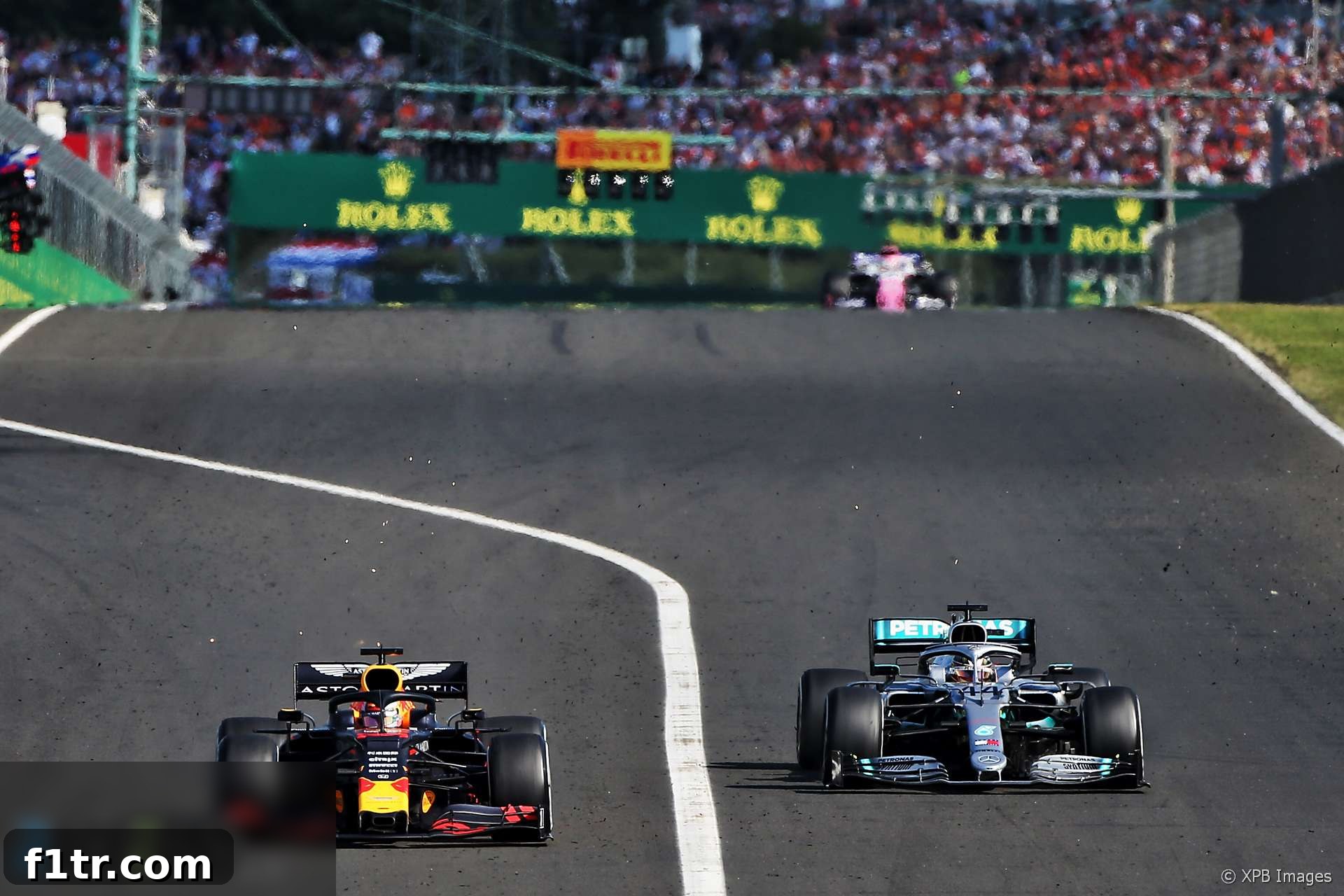
Max Verstappen offered a candid assessment of the 2019 Hungarian Grand Prix, admitting he harbored no disappointment when Lewis Hamilton ultimately surged past him to claim victory. For the Dutch Red Bull driver, the outcome felt less like a defeat and more like an unavoidable consequence of the race’s evolving dynamics, a strategic chess match where his opponent held the final, decisive move. “I wasn’t disappointed,” Verstappen stated, reflecting on the moment Hamilton took the lead, “because I knew it was inevitable.”
The Battle at Hungaroring: A Strategic Showdown
The Hungarian Grand Prix is renowned for its tight, twisty layout, a circuit where track position is often king, and overtaking notoriously difficult. Yet, it also demands exceptional tyre management and precise strategic calls, making it a thrilling test for drivers and teams alike. In this particular race, Verstappen had initially impressed, securing pole position and leading much of the Grand Prix with a commanding performance that seemed to put Red Bull in a strong winning position. However, the relentless pressure from Lewis Hamilton and the Mercedes team would eventually force a strategic dilemma that tipped the scales.
As the race progressed, the F1 world watched a classic confrontation unfold. Hamilton, in his Mercedes, began to gain rapidly on Verstappen, whose Red Bull was struggling on significantly older tyres. The pace differential grew exponentially, culminating in Hamilton making a decisive move with just three laps remaining. This critical pass, born out of a bold strategic gamble by Mercedes, left Verstappen to contend with a P2 finish, a result he viewed with a pragmatism born of deep understanding of Formula 1 racing.
The Tyre Strategy Conundrum: One-Stop vs. Two-Stop
The turning point of the race was undoubtedly Mercedes’ decision to pit Hamilton for a second set of fresh medium tyres. This move, made relatively late in the race, immediately put Verstappen and Red Bull on the back foot. For Verstappen, the options were stark and limited. Pitting for a second time would have meant relinquishing track position, a cardinal sin on the Hungaroring circuit.
Verstappen elaborated on the team’s rationale for not mirroring Hamilton’s pit stop. “It wouldn’t have made sense because I would have been behind him,” he explained. “So then you know the race is lost anyway.” This highlights the critical importance of track position, especially when facing a car and driver combination as potent as Hamilton and Mercedes. Once Hamilton had made his stop and returned to the track on fresher, faster tyres, the mathematical advantage was squarely with him.
For Verstappen, his “only option” at that point was to remain on track and attempt to manage his aging tyres, trying to maintain a pace sufficient to keep Hamilton from closing the gap by the crucial one second needed for an overtake. This was a monumental task, bordering on the impossible, against a Mercedes armed with superior grip and outright speed from fresh rubber. “Of course at one point I started to run out of tyres, trying to keep up with Lewis’s pace on those medium tyres, trying to keep it within a second was almost impossible,” Verstappen recounted. The fight against tyre degradation became an increasingly losing battle.
Accepting the Inevitable: A Driver’s Pragmatism
The inevitability of the situation became clear to Verstappen as the laps wound down. He could feel the performance draining from his tyres, the car becoming more challenging to control with each corner. The visual confirmation came as Hamilton’s Mercedes loomed larger in his mirrors, closing the gap with alarming speed. “I ran out of tyres and of course you can see it coming,” he said. This deep understanding of race dynamics and car performance meant that the actual overtake, when it occurred, carried no sting of surprise or disappointment.
“So for me it was not a big disappointment once he passed me because it was just a normal thing to happen,” Verstappen added, showcasing a mature and realistic perspective. It was not a failure of driving, but rather a consequence of a superior strategic play and raw pace advantage on the day. He recognized the undeniable truth: “But anyway we have to be realistic, he was just clearly faster today.”
The Red Bull driver also highlighted the subtle differences in car performance and feel throughout the race. “Always I think I was struggling a little bit more for grip than him,” he observed. This subtle deficit in grip, combined with Hamilton’s relentless pressure, allowed the Mercedes driver to maintain a consistent threat.
The Strategic Advantage of Being Second
One key strategic aspect Verstappen pointed out was the advantage Mercedes held by being in second position for a significant portion of the race. “Of course when you are in second you can gamble to do a two-stop,” he explained. Being the car behind allows for a reactive strategy, watching what the leader does and then making a contrasting, potentially race-winning move. For the leading car, the primary objective is to cover the opponent, which often restricts strategic flexibility.
“For me it was about trying to cover him or stay ahead. With a two-stop, worst case scenario you stay second and best-case you overtake me so that’s what they did today,” Verstappen articulated. This perfectly encapsulates the strategic dilemma faced by the leading car. To pit and cover Hamilton would have meant surrendering the lead and emerging behind him, effectively losing the race. To stay out was to gamble on his tyres lasting, a gamble that ultimately did not pay off against the fresh mediums of Hamilton.
Hypotheticals and Race Realities
Verstappen couldn’t help but ponder the “what if” scenario: what if Hamilton had not made that second pit stop? He believes the outcome might have been different. “I think on the first tyre he never really had a shot. We were still competitive in the last sector,” he posited. On their initial tyre strategies, Verstappen felt his Red Bull had the measure of the Mercedes.
The race became more complex when they switched to hard tyres. Traffic played a role, creating opportunities for Hamilton to close in. “Then when we got onto the hard tyre, also with the traffic, because of that he had a few goes at me because I couldn’t do my normal lines in the last few corners and he caught up with that,” Verstappen recounted. Despite the challenges, he managed to defend resolutely, employing all his skill to keep Hamilton behind. “Then of course with the defending I tried to do it as good as I could. Luckily I could stay ahead and then he had to manage his brakes and engine a bit.”
However, once Hamilton had managed his car’s components and was able to push again, the gap began to shrink once more. This demonstrated the underlying pace advantage the Mercedes often held, even when not on optimal tyres. “But he could see clearly once that was sorted he closed the gap again,” Verstappen noted.
Ultimately, the decision to opt for the two-stop strategy proved to be the masterstroke for Mercedes. “I think if he would have stayed on that one-stop I could have kept him behind. But once he’s on the medium then you know it’s going to be really hard,” Verstappen concluded, acknowledging the sheer performance boost provided by the fresh, softer compound. It was a testament to Mercedes’ aggressive strategy and Hamilton’s ability to maximize its potential.
A Masterclass in F1 Strategy and Execution
The 2019 Hungarian Grand Prix stands as a prime example of how Formula 1 races are not just won on track by raw speed, but also through meticulous strategy and the psychological battle between teams. Max Verstappen’s acceptance of the “inevitable” reflects a deep understanding of the sport’s complex interplay of driver skill, car performance, and strategic gambles. While the result was not a win for Red Bull, it was a race that highlighted Verstappen’s incredible talent and resilience, even when faced with overwhelming strategic odds. It also cemented Lewis Hamilton’s reputation as a driver capable of executing brilliant comeback drives under immense pressure, making the 2019 Hungarian Grand Prix a memorable chapter in F1 history.
2019 F1 season
- Crying in the Melbourne car park at 2019 grand prix was my career low – Ocon
- McLaren Racing reports reduced £71 million loss in 2019
- Kvyat: Hockenheim podium last year was “my biggest achievement” so far
- How the FIA’s new encrypted fuel flow meter targets Ferrari’s suspected ‘aliasing’ trick
- “He smashed my office door”: 23 must-see moments from ‘Drive to Survive’ season two
Browse all 2019 F1 season articles