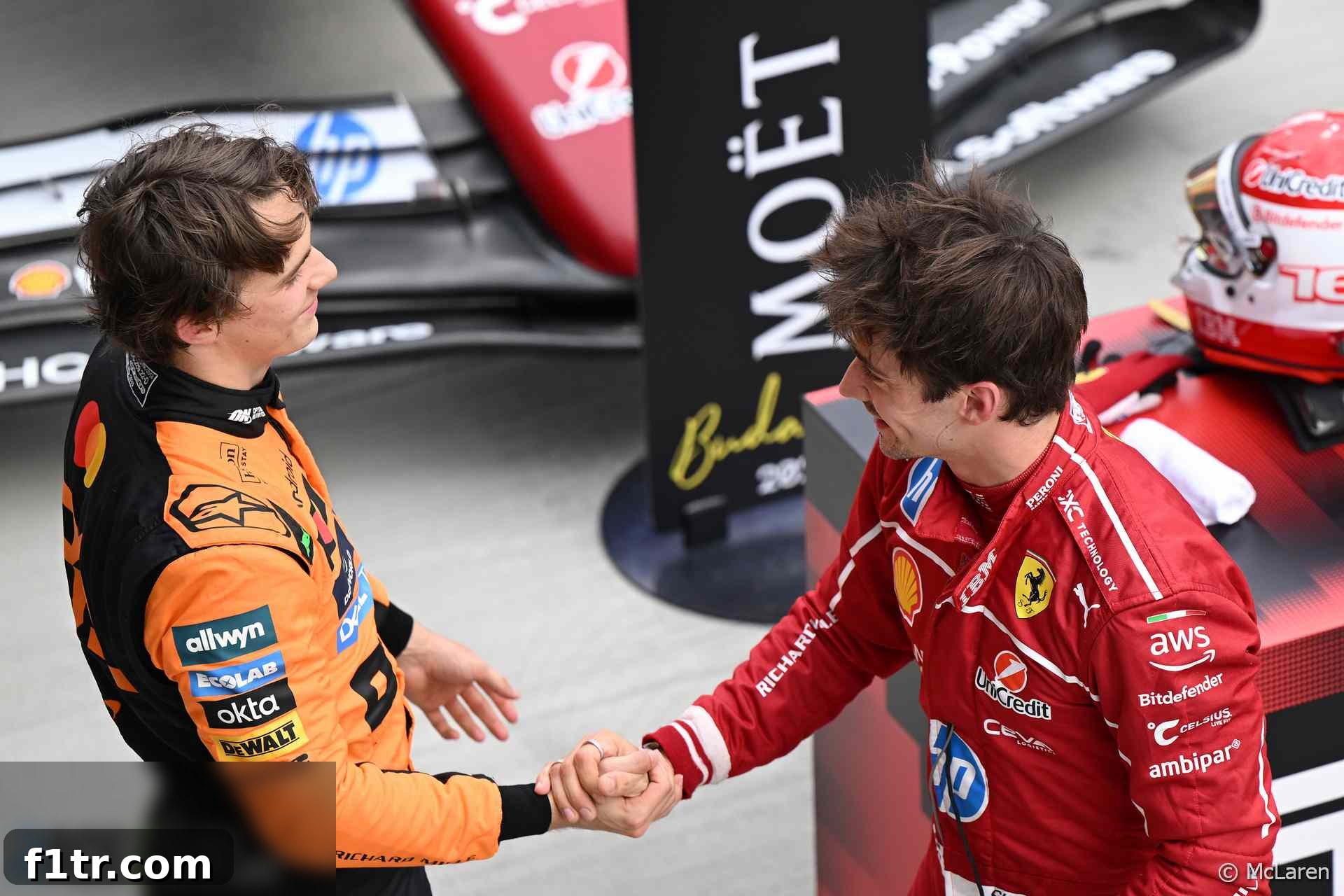
Oscar Piastri expressed profound surprise and frustration after a dramatic shift in track conditions during the final stages of qualifying saw him lose a potential pole position. What began as a promising session for McLaren quickly devolved into a challenging and somewhat baffling experience for both their drivers.
The Unforeseen Challenge: McLaren’s Q3 Meltdown
For much of the qualifying session, McLaren’s rising star, Oscar Piastri, appeared locked in a direct battle for the top spot with his experienced teammate, Lando Norris. Both drivers showcased impressive pace, with Piastri setting a formidable fastest time during their initial runs in Q3, hinting at a potential McLaren lockout of the front row. The team, known for its consistent improvements throughout the season, seemed poised for a dominant Saturday afternoon.
However, the capricious nature of Formula 1 track conditions, especially during critical moments, proved to be a formidable adversary. Between Q2 and Q3, a significant change swept across the circuit: the wind unexpectedly picked up intensity, and track surface temperatures registered a noticeable drop. These seemingly subtle environmental shifts had a disproportionately large impact on the delicate balance and aerodynamic performance of the MCL60.
Piastri vividly described the sudden deterioration in his car’s handling, admitting that its balance felt “much worse.” Despite his best efforts to adjust his driving style and approach for his crucial final run, the young Australian found himself grappling with a severe lack of grip. This unexpected turn of events left him bewildered, as the car he had felt so confident in just moments earlier had seemingly transformed into a much more challenging machine.
Piastri’s Perplexing Struggle: Adjusting to the Unknown
Reflecting on his Q3 performance, Piastri articulated his dismay, particularly regarding his inability to improve on his second attempt. “My first lap in Q3, I wasn’t that surprised that it was half a second off because of some – ‘mistakes’ is probably harsh on myself – but just not predicting what the wind was going to do in certain corners as well as I could have,” he explained. This initial dip in performance was understandable, a consequence of misjudging the new, unseen variables.
What truly perplexed Piastri was his second run. Despite consciously adapting his strategy and recalibrating his expectations based on the first challenging lap, he found no improvement. “But on the second lap, I thought I did a better job of adjusting my expectations, and I didn’t go any faster,” he added, conveying a sense of frustration. “So it was a bit strange, one for us to look through, but it wasn’t very fun losing that half a second.”
The time sheets told a stark story of his struggle. Piastri had delivered a commendable 1’14.941 in Q2, a lap that demonstrated the McLaren’s underlying potential. Yet, in Q3, under the revised conditions, he could only manage a 1’15.398. This regression of nearly half a second underscored the severity of the challenge he faced. He candidly labeled the session “bizarre and somewhat frustrating,” a sentiment echoed by many within the McLaren garage.
“The conditions completely changed and it was just weird,” Piastri elaborated. “My first lap felt terrible because I was pushing too much, with the wind direction from the first two sessions in mind.” This highlights the mental battle drivers face, trying to unlearn previous track data and adapt to a constantly evolving environment. “Then I felt like I did a better job on the second lap of managing expectations, and it was even worse. So it was a bizarre session.”
Despite his personal struggle, Piastri maintained a pragmatic view. “I need to look back and see what differences it made. Things definitely felt more tricky for myself as well in Q3, but I think for everybody it would have been difficult so that’s not our excuse,” he concluded, acknowledging that while conditions were tough for all, McLaren’s particular vulnerability to these changes needed to be understood and addressed.
Norris Also Hits a Wall: Wind’s Dominance
Oscar Piastri was not alone in his predicament. His teammate, Lando Norris, also found himself battling the elements and the clock in Q3. Norris, who had felt supremely confident after a strong Q2 performance, was equally surprised and disappointed not to improve on his final attempt. His experience further solidified the notion that McLaren was disproportionately affected by the sudden atmospheric changes.
“Q2 felt very good, I felt confident to improve,” Norris stated, reflecting on his pre-Q3 mindset. “So into Q3 I was aiming for a similar lap time [at] similar limits and it just felt pretty dreadful.” The stark contrast between his expectations and the actual car behaviour was a clear indicator of the scale of the challenge. “I wasn’t surprised that I did a 15.4 in the first run. But in the second lap, it’s just hard to know how much more to push or not push. And I [thought] it was a much better lap and I was 15.4 again.”
Norris pinpointed the gusty wind conditions as the primary culprit behind his car’s erratic handling. He emphasized the profound effect such changes can have on a highly tuned Formula 1 machine. “The wind has such big effects on the car when you’re driving,” said Norris. “It’s quite easy for it to be half-a-second swing.” This explanation sheds light on how seemingly minor meteorological shifts can drastically alter the aerodynamic balance and grip levels, leading to significant lap time losses.
The shared experience of both drivers underscored a concerning pattern for McLaren. “So it’s frustrating because we definitely seem to have a good gap, but in Q3 it seemed to drift away from us as a team more than it did for others,” Norris lamented. This observation is crucial, suggesting that while all teams faced the same conditions, McLaren’s car might have a specific characteristic or setup that makes it particularly sensitive to such environmental variables. This sensitivity ultimately cost them a golden opportunity for pole position, opening the door for rivals.
The Rise of Leclerc: A Surprise Pole Position
While McLaren grappled with their unexpected struggles, another team found an advantage in the chaos. The dramatic shift in conditions ultimately allowed Charles Leclerc of Ferrari to snatch a surprise pole position, beating both McLaren drivers. Leclerc’s ability to adapt, or perhaps his car’s inherent robustness to the changing wind and temperature, highlighted the fine margins that define success in Formula 1 qualifying.
Leclerc’s performance served as a stark contrast, transforming what could have been a McLaren front-row lockout into a moment of unexpected triumph for Ferrari. It underscored the unpredictable nature of top-tier motorsport, where the smallest variables can completely reshape the competitive landscape. For McLaren, it was a bitter pill to swallow, watching a hard-earned advantage evaporate in the blink of an eye.
Understanding the Impact of Track Conditions in F1 Qualifying
The qualifying session, presumably for the Hungarian Grand Prix given the context of related articles, vividly demonstrated why track conditions are such a critical factor in Formula 1. Wind speed and direction can dramatically alter a car’s aerodynamic performance, especially with highly sensitive ground-effect machinery. A headwind might provide stability into a corner but reduce top speed, while a tailwind could aid acceleration but make braking zones treacherous. Crosswinds, as suggested by Piastri and Norris, are particularly challenging, impacting balance mid-corner and through high-speed sections.
Similarly, track surface temperature has a direct correlation with tire grip. Cooler track temperatures often lead to less grip, making it harder for tires to reach their optimal operating window. This requires drivers to adjust their braking points, cornering speeds, and throttle application with extreme precision. The combination of increased wind and decreased temperature created a perfect storm of variables that evidently unsettled McLaren’s setup more than their competitors, leading to a significant loss of performance precisely when it mattered most.
For teams and engineers, understanding and anticipating these microclimatic changes is an ongoing challenge. While sophisticated meteorological data is available, real-time adjustments and accurate predictions in high-pressure scenarios remain incredibly complex. Simulation tools and driver feedback are crucial, but ultimately, it’s the driver’s ability to adapt on the fly and the car’s inherent flexibility to handle diverse conditions that often determine success.
Lessons Learned and Future Outlook for McLaren
The qualifying session served as a crucial learning experience for McLaren. While securing a strong grid position is always paramount, understanding why their car struggled more than others under these specific conditions will be key to their ongoing development. It raises questions about car setup sensitivity, aerodynamic stability in variable winds, and perhaps the optimal tire management strategies for fluctuating track temperatures.
For Piastri, a relatively new face in Formula 1, this experience adds another layer to his learning curve. Navigating such unpredictable challenges and maintaining composure under pressure are hallmarks of a world-class driver. For Norris, a veteran of several seasons, it reinforces the relentless pursuit of perfection and the need to constantly refine the car’s characteristics to be effective in all scenarios.
Ultimately, this qualifying session highlighted the razor-thin margins that separate victory from disappointment in Formula 1. A mere fraction of a second, influenced by elements as intangible as the wind, can dictate the starting order and significantly impact race strategy. McLaren will undoubtedly delve deep into the data, seeking to understand the root causes of their Q3 struggles to ensure they are better prepared for similar challenges in future Grand Prix events.
The pursuit of perfection in Formula 1 is never-ending, and every challenging session, no matter how frustrating, provides invaluable data and insights for teams aiming to reach the pinnacle of motorsport.
Related Articles
- Leclerc admits problem which struck Ferrari in Hungary is likely to recur
- Permane impressed by Lawson’s progress after “breakthrough” in Austria
- Albon expects “dogfight” as Williams aim to hold fifth place
- Mercedes eye more wins post-break after dropping revised rear suspension
- McLaren pair equal Senna and Prost’s run in second-fastest ever Hungarian GP
Browse all 2025 Hungarian Grand Prix articles