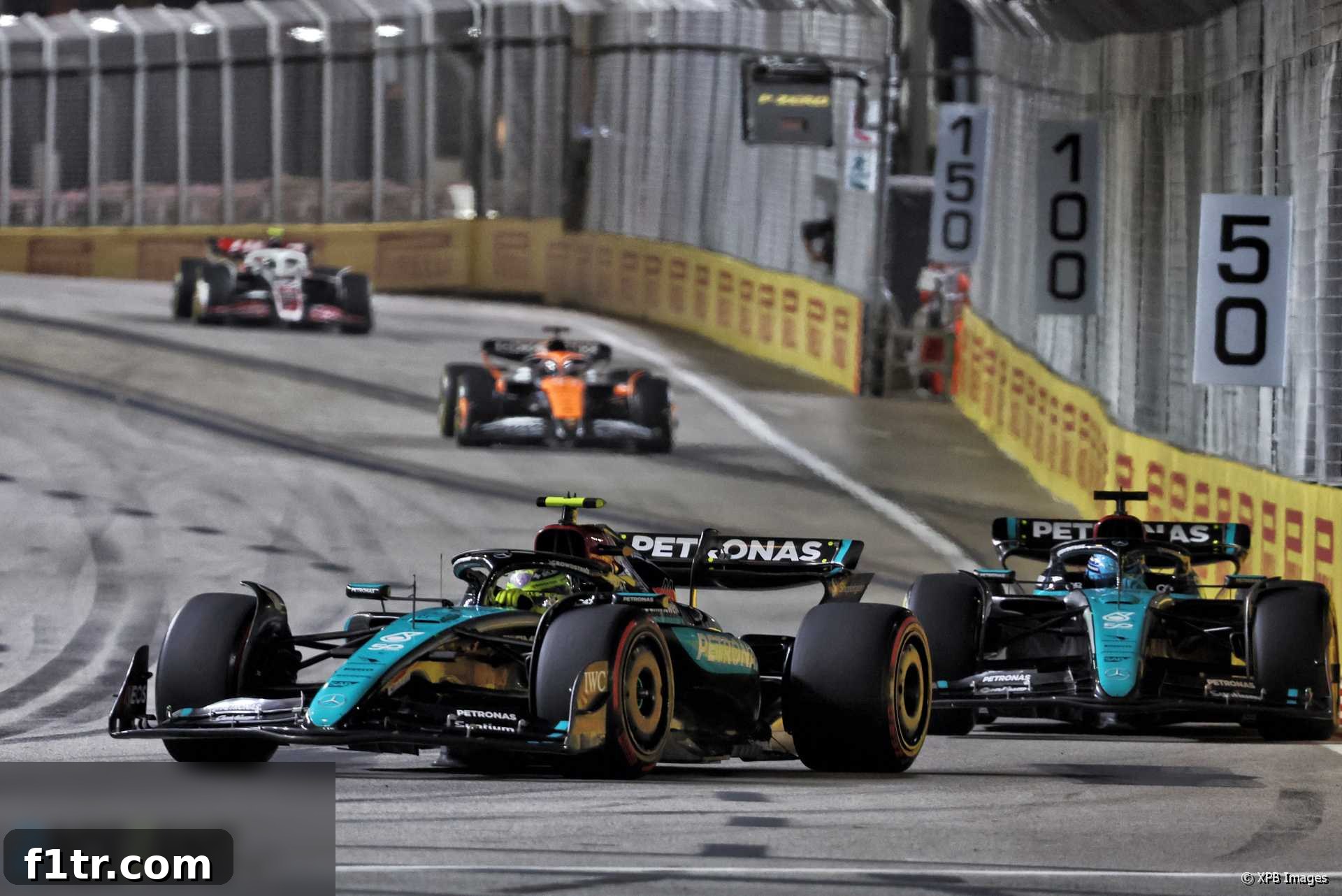
The recent Formula 1 Grand Prix weekend left Lewis Hamilton expressing profound frustration, revealing he was “so angry” with his Mercedes-AMG Petronas Formula 1 Team’s strategic decision to commence the race on soft compound tyres. This controversial choice, made at the start of last weekend’s highly anticipated event, significantly impacted Hamilton’s performance, leading to a considerable drop from his strong qualifying position.
Advert | Become a Supporter & go ad-free
The seven-time world champion, starting an encouraging third on the grid, saw his race unravel as he ultimately crossed the finish line in a disappointing sixth position. In stark contrast, his teammate George Russell, who began the race directly alongside Hamilton on the more durable medium compound tyres, was one of three drivers who managed to gain crucial track positions during the demanding Grand Prix. This immediate disparity highlighted the critical impact of the tyre choice and sparked an intense debate within the F1 community regarding Mercedes’ strategic execution.
Hamilton recounted the internal discussions leading up to the race, detailing how the Mercedes team had initially proposed the idea of splitting tyre strategies between their two drivers. This suggestion came after both Hamilton and Russell secured a formidable lock-out of the second row on the grid during Saturday’s qualifying session, setting the stage for what should have been a strong team performance. However, Hamilton openly admitted that he vehemently argued against such a divisive approach, firmly believing that a unified strategy would best serve the team’s collective interests. Despite his strong objections and reasoned arguments, his perspective was ultimately overruled by the team’s strategists, a decision that would later prove to be a source of immense dissatisfaction for the veteran driver.
“We sat in our meeting in the morning of the race – actually the night before they already mentioned that they would like to split the cars – and for me, I was a bit perplexed by it,” Hamilton explained during an event in Kuala Lumpur, hosted by Mercedes’ long-standing title sponsor, Petronas. His candid remarks shed light on the pre-race tensions and the fundamental disagreement over the optimal race strategy. Hamilton’s perplexity stemmed from his understanding of past team strategies, particularly when both cars were performing at a similar level and starting in close proximity on the grid.
He further elaborated on his confusion: “In the past when we’ve been in that position, normally, if George has qualified well like he normally does that and I’m out of the top 10 or something then we will split the strategies. But when we were so close, it didn’t make sense to me.” This insight reveals a perceived inconsistency in the team’s strategic philosophy, especially considering that both drivers had demonstrated strong pace in qualifying and were positioned favorably to maximize their collective points haul. The decision to diverge on tyre compounds, under these specific circumstances, appeared counterintuitive to Hamilton, who prioritizes cohesion and mutual support when competitive.
“So I battled as hard as I could to fight to go on the medium tyre but the team continued to suggest that I start on the soft. And then they took the tyre blankets off and everyone was on mediums.” This vivid recollection paints a picture of a driver making a passionate case for what he believed was the correct approach, only to be met with steadfast resistance from the team. The moment the tyre blankets were removed and Hamilton realized he was almost an anomaly on the starting grid, surrounded by competitors predominantly on medium tyres, undoubtedly amplified his initial frustration. This immediate visual confirmation of the strategic divergence set a challenging tone for the entire race, foreshadowing the difficulties that lay ahead for the British driver.
Indeed, Lewis Hamilton found himself in a solitary position as the only driver within the top thirteen qualifiers to opt for a tyre compound other than the popular medium rubber at the race start. This unusual circumstance immediately put him at a significant disadvantage, a fact that was not lost on the seasoned racer. He candidly expressed that he was “so angry” over the decision, a raw emotion stemming from a deep-seated belief that the chosen strategy fundamentally compromised his potential for a strong finish. His frustration wasn’t merely about a poor outcome; it was about the lack of alignment and the sense of being sidelined in a crucial strategic decision that directly impacted his performance and the team’s overall race prospects. The initial laps of the race served only to underscore these fears, as the soft tyres proved challenging to manage under race conditions.
Advert | Become a RaceFans supporter andgo ad-free
“Already from that moment I’m frustrated,” Hamilton stated, emphasizing how quickly his mood deteriorated after the contentious tyre choice. The initial phase of the race was a difficult balancing act, as he tried his utmost to keep pace with the frontrunners. However, the inherent characteristics of the soft tyres, combined with the blistering pace of his rivals on mediums, meant that maintaining position was an uphill battle. “Then I tried my best to keep up with the guys ahead, they were too fast. And then I just tried to make that tyre last as long as I could.” This quote perfectly encapsulates the struggle: an immediate disadvantage leading to a defensive drive, trying to mitigate the inevitable tyre degradation rather than aggressively attacking for positions.
The consequence of starting on soft tyres was an early pit stop, forcing Hamilton into the pits on a mere lap 17. This early stop was a clear indication that the initial strategy had backfired, putting him onto the hard compound tyres far sooner than ideal. “I had to [pit] on lap 17. I knew from that moment that the race was done for me because the hard tyre was going to be a struggle in that heat.” His experienced assessment proved accurate; the challenging conditions of the circuit, coupled with the characteristics of the hard tyres, made the remainder of the race a grueling test of endurance and car management. The hot track temperatures exacerbated the difficulties, preventing him from extracting optimal performance from the harder compound, thus confirming his pre-race anxieties.
Compounding the tyre strategy woes were persistent issues with the car’s balance throughout the entire Grand Prix weekend. Hamilton revealed, “We’ve been struggling with the balance of the car all weekend, so we’ve been changing so many different things. We got a good qualifying but unfortunately the race was a bit too much of a struggle for us.” This highlights a broader underlying issue for Mercedes, suggesting that the team might not have fully optimized the W15 chassis for the specific demands of the circuit. While a strong qualifying performance might mask some of these fundamental balance problems over a single lap, the full race distance mercilessly exposes any deficiencies, especially when coupled with a sub-optimal tyre strategy. This combination of factors turned what could have been a strong points finish into a damage limitation exercise for Hamilton.
Advert | Become a RaceFans supporter andgo ad-free
Adding another layer to the strategic fallout, George Russell admitted he anticipated Lewis Hamilton’s displeasure with the team’s strategy choice. “When I saw that, I was thinking, ‘Lewis won’t be happy’,” Russell commented, indicating a shared understanding among the drivers regarding the potential pitfalls of starting on soft tyres in those specific conditions. Russell’s statement underscores the general consensus that the soft tyre choice was an aggressive, high-risk gamble that ultimately failed to pay off for Hamilton. It also suggests that, from a driver’s perspective, the decision carried inherent risks that were likely to lead to dissatisfaction if the gamble didn’t yield positive results.
This incident marks the sixth instance this year where Mercedes has deployed differing tyre compound strategies for their drivers at the start of a race. The team’s tendency to split strategies is often seen as an attempt to cover multiple scenarios or gather varied data, but this particular occasion raised more questions than answers. On the one previous occasion this season where both Mercedes drivers started in consecutive positions on different compounds, in Miami, the driver ahead also started on softer rubber. Interestingly, on that occasion, it was Russell who was on the softer, more aggressive compound. While past instances have seen mixed results, the Singapore Grand Prix proved to be a critical misjudgment, especially given the tight competition and the demanding nature of the circuit. The pattern of split strategies, particularly when both cars are competitive, warrants further scrutiny regarding its effectiveness and its impact on driver morale and race outcomes.
Mercedes’ Divergent Starting Tyre Strategies in the 2024 Season
A closer look at Mercedes’ approach to starting tyre compounds in the 2024 season reveals a recurring theme of strategic divergence. This table illustrates the instances where Lewis Hamilton and George Russell began races on different tyre choices, highlighting the team’s willingness to experiment, often with varying degrees of success and driver satisfaction.
| Lewis Hamilton | George Russell | |||
|---|---|---|---|---|
| Race | Position | Compound | Position | Compound |
| Australian Grand Prix | 11th | Soft | 7th | Medium |
| Chinese Grand Prix | 18th | Soft | 8th | Medium |
| Miami Grand Prix | 8th | Hard | 7th | Medium |
| Hungarian Grand Prix | 5th | Medium | 17th | Hard |
| Dutch Grand Prix | 14th | Soft | 4th | Medium |
| Singapore Grand Prix | 3rd | Soft | 4th | Medium |
Each of these instances represents a strategic gamble by Mercedes, aiming to optimize performance or react to specific qualifying results. However, the Singapore Grand Prix stands out due to the immediate and pronounced negative impact on Hamilton’s race, despite a strong qualifying effort. The unique challenges of the Marina Bay Street Circuit, known for its high temperatures, humidity, and demands on tyre management, made the soft tyre choice particularly risky. Tyre degradation is a critical factor on this circuit, and an early pit stop on softs inevitably compromises the ability to execute a flexible strategy later in the race, often leading to a slower and more challenging final stint on harder compounds. For a team vying for championship points, such miscalculations can be incredibly costly, both in terms of standings and driver confidence. This latest strategic misstep is likely to prompt a comprehensive review within the Mercedes camp as they seek to avoid similar issues in the remainder of the 2024 Formula 1 season and beyond.
Advert | Become a RaceFans supporter andgo ad-free
Miss nothing from RaceFans
Get a daily email with all our latest stories – and nothing else. No marketing, no ads. Sign up here:
2024 Singapore Grand Prix: Related Content and Analysis
The 2024 Singapore Grand Prix proved to be a race rich with talking points, tactical decisions, and moments of high drama. Beyond Lewis Hamilton’s strategic frustrations, the event offered a multitude of insights into team performance, driver resilience, and the ever-evolving nature of Formula 1 regulations. The intricate Marina Bay Street Circuit, with its demanding layout and challenging environmental conditions, often serves as a crucible for strategic prowess and mechanical reliability. Dive deeper into the various facets of this memorable race with the following related articles, offering further analysis on pivotal moments, team radio exchanges, and the broader implications for the championship battle. These pieces provide additional context, expert commentary, and behind-the-scenes glimpses into the decisions that shaped the outcome of one of the most physically demanding races on the F1 calendar.
- Ricciardo’s brake woe and why Perez thought he had an engine problem: Singapore GP radio
- ‘Perez is only quicker when he has DRS’: How Hulkenberg’s Haas beat a Red Bull – again
- Mercedes explain “clear mistake” strategy call which left Hamilton “so angry”
- “Sometimes I wonder why I do this”: How Hamilton endured a slog to sixth in Singapore
- F1’s rules need surgery as well as sticking plaster after fastest lap controversy
Browse all 2024 Singapore Grand Prix articles