The Flawed Rationale Behind Formula 1’s Fastest Lap Point Proposal
Formula 1, a sport constantly seeking to enhance its spectacle, often debates new regulations aimed at injecting more excitement into Grand Prix weekends. Among the proposals frequently discussed, the idea of awarding a championship point for the fastest lap of a race resurfaces from time to time. However, a deeper examination reveals that this concept, while seemingly simple, carries significant practical and philosophical flaws that could undermine, rather than improve, the sport’s integrity and fan experience.
The core assumption behind this proposal is that offering a singular point would encourage drivers to push harder in the closing stages, creating thrilling last-lap heroics. Yet, this perspective overlooks the complex strategic considerations that govern Formula 1 racing. Teams operate with a meticulous balance of risk and reward, where championship points, car preservation, and overall race strategy take precedence over individual lap times that offer minimal gain.
The Practical Hurdles: Why a Fastest Lap Point Won’t Deliver Excitement
To truly understand the potential impact of a fastest lap point, one must look beyond simple statistics and consider how teams would strategically adapt. Historically, teams have discouraged drivers from pushing for the fastest lap in the race’s dying moments due to the inherent risks. There’s no value in sacrificing a strong finishing position or risking mechanical failure for a fastest lap trophy that holds little championship weight. The potential for damaging an engine, gearbox, or critical aerodynamic components by pushing a car to its absolute limit for one final, non-essential flying lap is a genuine concern that far outweighs the prestige of a fastest lap.
With a championship point now on the table, team tactics would undoubtedly shift. However, the reality of modern F1 racing dictates that only a very specific set of circumstances allows for a genuine fastest lap attempt. In a typical dry race, the optimal conditions for setting a fastest lap occur on the final lap when the car is at its lightest due to fuel consumption. Crucially, any driver aiming for this point would almost certainly need to make a late-race pit stop for a fresh set of the softest available tyres. These fresh tyres provide a performance advantage of several seconds over older, worn rubber, making it virtually impossible to achieve the fastest lap on degraded compounds.
Consequently, the closing stages of a Grand Prix would transform into a calculation of which front-running drivers possess a sufficient time gap behind them to execute a ‘free’ pit stop. A ‘free’ pit stop is one where a driver can pit, change tyres, and rejoin the track without losing a position. This strategic window is often limited to only a handful of drivers in any given race, typically those with a significant lead over the car behind them.
Let’s revisit recent races to illustrate this point. Consider the Mexican Grand Prix. Max Verstappen led Sebastian Vettel by 15 seconds at the end, a margin insufficient for a free pit stop. However, Vettel held a substantial 30-second lead over Kimi Räikkönen. This gap would have allowed Vettel to pit, don a fresh set of Pirelli tyres, and launch a bid for the bonus point. While this scenario might sound exciting on paper, it likely would have been a solitary effort, not a multi-car battle. Valtteri Bottas, another driver in the top 10, was already a lap behind and might have deemed his car’s pace insufficient to challenge a fresh-tyred Ferrari, making his own pit stop attempt improbable.
Drivers outside the top 10, with no realistic chance of scoring points, might theoretically consider pitting for a fastest lap attempt. However, this strategy becomes entirely futile if a front-running team is also making a similar attempt. Why risk a pit stop and potential issues for a point that is almost certainly out of reach? In such a scenario, holding track position and hoping for retirements ahead remains the more rational approach. Furthermore, it is highly probable that any fastest lap point rule would include a caveat, awarding the point only to drivers finishing within the top 10, mirroring regulations in other championships and preventing opportunistic, qualifying-style runs from drivers who have effectively retired from the points race.
The Brazilian Grand Prix presented a slightly different dynamic. The leading drivers from the three fastest teams were too closely bunched to afford a free pit stop without losing track position. Only Kevin Magnussen (ninth) and Sergio Perez (10th) had sufficient gaps behind them to potentially pit for fresh tyres. While their qualifying pace might suggest they were capable of a quick lap, teams possess far more accurate real-time data to assess their chances against faster machinery. The likely outcome would be post-race interviews where drivers explain, “We didn’t try for the fastest lap point because we knew [Ferrari/Mercedes/Red Bull] could go quicker on old tyres, let alone fresh ones.”
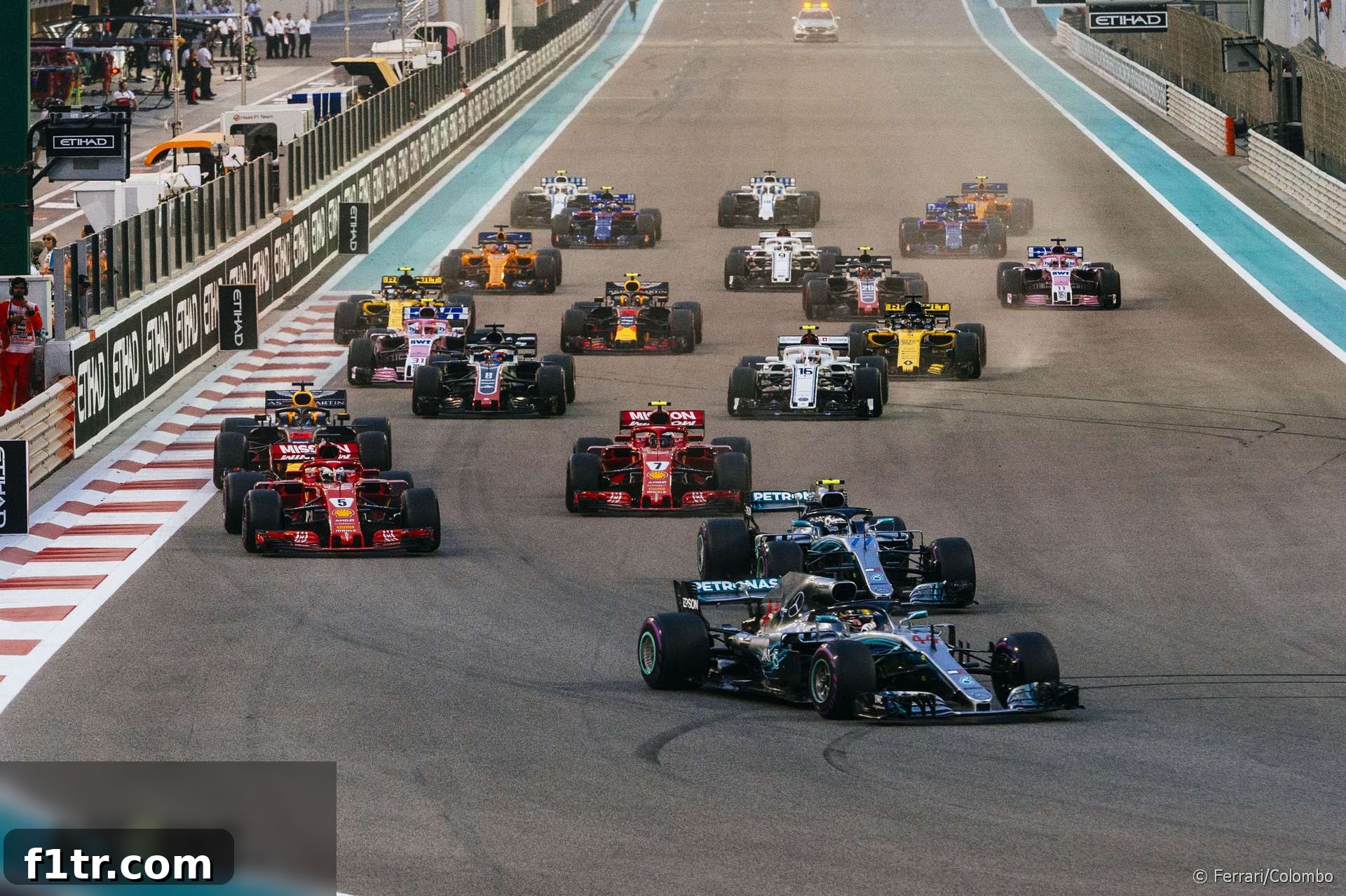
Even in an anti-climactic season finale like Abu Dhabi, the impact would be minimal. Daniel Ricciardo, with a large gap behind him, could have easily pitted for a straightforward shot at the bonus point. Sergio Perez, in eighth, might have done the same, but again, the knowledge that a significantly faster Red Bull was also aiming for it would have likely deterred him. This illustrates that the fastest lap point rarely fosters genuine, multi-car competition for the extra point; it typically rewards the fastest car with the most strategic freedom, leading to predictable outcomes rather than added suspense.
The Philosophical Concerns: Undermining Sporting Integrity and Fan Understanding
Beyond the practical difficulties, the principle of awarding a point for the fastest lap introduces deeper philosophical concerns that risk eroding the fundamental tenets of Formula 1. Firstly, it needlessly complicates the scoring system. For decades, F1 has operated on a simple, easily understandable premise: points are awarded based on a driver’s finishing position in the race. Adding an extra point for a fastest lap disrupts this clarity, moving championship arithmetic further from the ready grasp of the casual follower. A maximum haul of 25 points from a race is far simpler to track and multiply across a season than a potential 26 points, requiring constant mental adjustments. Simplicity in scoring is crucial for attracting and retaining new fans who might otherwise be intimidated by overly complex rules.
Secondly, and perhaps more alarmingly, such a rule creates another avenue for championships to be decided in the stewards’ room rather than purely on the track. The sport has already faced criticism for contentious decisions impacting championship outcomes. Introducing a fastest lap point could lead to scenarios where a driver’s fastest lap is invalidated due to track limits infringements, dangerous driving while attempting the lap, or other technicalities, potentially altering championship standings long after the chequered flag. This exact scenario played out dramatically in the 2006 GP2 title decider, where a fastest lap bonus point proved instrumental in shaping the championship, sparking controversy and demonstrating how such a rule can create unintended, undesirable consequences.
Furthermore, the incentive could pervert the very nature of Grand Prix racing, transforming the pursuit of victory into a compromised strategic game. As witnessed in Formula E’s 2016 title decider, a championship point for pole position led to drivers strategically backing off to secure the best grid slot, detracting from the purity of racing. A similar effect could occur in F1:
https://youtu.be/7EVK0Q9ZP7M?t=101
This YouTube clip illustrates how the quest for a bonus point can distort natural racecraft. F1 races should be about drivers pushing for victory and managing their tyres and fuel to achieve the best possible finish, not about making a last-gasp dash for an additional minor point that has little bearing on the main competition. This dilutes the essence of true racing where the primary objective is to cross the finish line first.
Lessons From History: Avoiding the Gimmick Trap
Formula 1 should draw lessons from its own recent past regarding hasty and ill-conceived rule changes. The proposal for a fastest lap point echoes the infamous “gimmick-up” era under previous management, marked by several hastily introduced and subsequently dropped sporting regulations. Who can forget the universally disliked double points finale in 2014, or the bewildering elimination qualifying format of 2016? Both were attempts to artificially inject excitement, and both failed spectacularly, garnering widespread criticism from fans, teams, and drivers alike.
Ironically, F1 CEO Chase Carey publicly vowed not to “gimmick-up” the sport in the pursuit of entertainment. Yet, awarding a point for fastest lap would be exactly that: a superficial, cosmetic change that addresses symptoms rather than root causes. Contrast this with the rigorously researched aerodynamic package introduced for 2019. This change was the result of extensive analysis and collaboration with teams, aimed at fundamentally improving the quality of racing and enabling closer competition. That process exemplifies a thoughtful, data-driven approach to rule-making.
Good rule changes in Formula 1 emerge from a thorough understanding of the sport, meticulous research, and a clear vision of what ‘should’ be done to enhance racing. Bad rule changes, conversely, often arise from a hasty seizing upon what ‘could’ be done – a quick fix or a novel idea with insufficient consideration for its practical implementation or wider implications. A point for the fastest lap falls squarely into the latter category: a product of flawed reasoning, superficial analysis, and a failure to learn from past mistakes.
Conclusion
While the intention behind awarding a point for the fastest lap might be noble – to foster more excitement – its execution is fraught with complications. It promises manufactured drama rather than genuine competition, risks undermining the clarity of the championship, and could introduce unnecessary controversies. Formula 1’s path to a more exciting future lies not in introducing minor, strategically compromised points, but in refining the core elements of racing through thoughtful, data-backed technical and sporting regulations that encourage closer, fairer, and more compelling on-track battles. The sport should prioritize substance over superficiality, ensuring that Grand Prix races remain a true test of speed, skill, and strategy, culminating in a clear and undisputed champion.