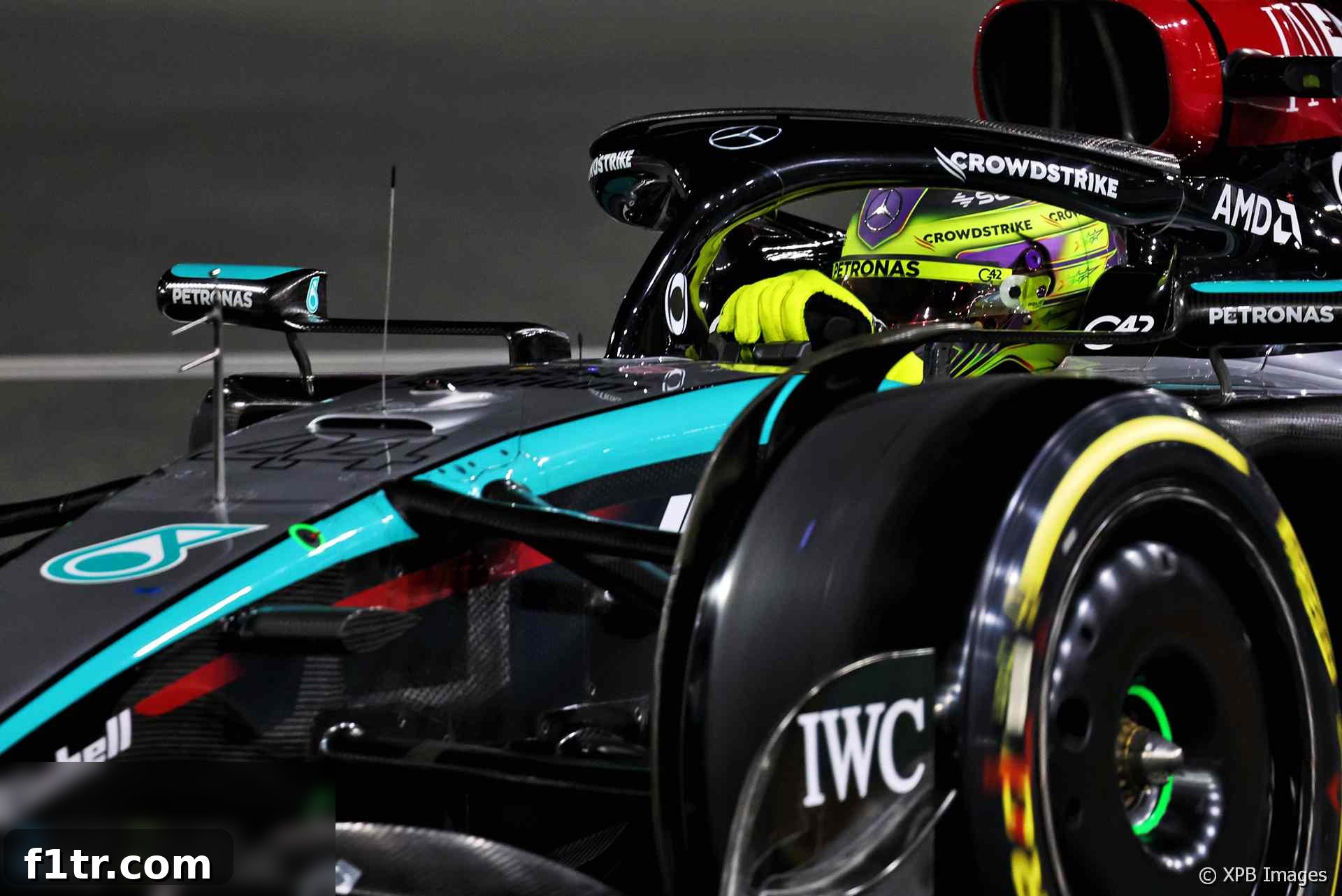
Lewis Hamilton Reveals Deep Discomfort with Mercedes W15 Amidst Persistent Bouncing Challenges
Lewis Hamilton has candidly admitted to a profound level of discomfort with Mercedes’ latest Formula 1 challenger, the W15, following a challenging qualifying session that saw him once again outpaced by his teammate, George Russell. The seven-time world champion’s struggles underscore a deeper, more entrenched issue within the Silver Arrows’ camp, echoing challenges that have plagued the team for the past two seasons.
Advert | Become a Supporter & go ad-free
Speaking after securing eighth position on the grid for the upcoming race, Hamilton detailed how extensive modifications to the W15’s design have regrettably failed to eliminate the car’s notorious high-speed bouncing. This issue, reminiscent of the “porpoising” phenomenon that heavily impacted Mercedes in the previous ground-effect era, appears to be particularly pronounced on the unforgiving Jeddah Corniche Circuit, a track known for its blisteringly fast and flowing corners.
The Lingering Spectre of Bouncing: A Frustrating Deja Vu for Mercedes
“It’s similar to previous years,” Hamilton told Sky Sports, expressing a sentiment of frustration that resonates deeply within the Mercedes garage. He acknowledged that while many elements of the new car represent a clear improvement, the team’s progress is fundamentally hampered by this pervasive aerodynamic instability. “There are so many elements of this car which are better, it’s just we’ve been hindered by the bouncing that we have through [turns] six, seven, eight, nine, ten, which I think probably affected George [too],” he elaborated, highlighting the specific sections of the track where the issue becomes most critical.
The Mercedes team, despite their relentless efforts, has been unable to consistently resolve the problem. Hamilton explained the maddening inconsistency of the bouncing, noting how it has appeared and disappeared throughout the practice sessions leading up to this weekend’s race. This unpredictability makes it incredibly difficult for drivers to build confidence and for engineers to pinpoint and eradicate the root cause.
“We made some changes overnight and this morning the car felt so much better, I was regaining this confidence again. And then when we get to qualifying, it disappears again,” Hamilton recounted, illustrating the exasperating cycle of hope and disappointment. This erratic behavior not only impacts performance but also poses a significant mental challenge for the drivers, forcing them to adapt to an ever-changing car balance.
Teammate Dynamics: Russell’s Adaptability vs. Hamilton’s Struggle
In stark contrast to Hamilton’s struggles, George Russell appears to be navigating the W15 with greater ease. “But George is doing a great job. He’s a lot more comfortable in the car. A bit similar to the past couple of years, I would say,” Hamilton conceded, drawing parallels to the preceding seasons where Russell occasionally seemed more at home with the temperamental Mercedes machines. This dynamic underscores the challenge for the team: designing a car that provides a consistent and predictable platform for both drivers, allowing them to extract maximum performance without battling fundamental instabilities.
Despite the adversity, Hamilton remains resolute. “But we will keep our heads down, we’ll keep working away. I got a bit of a better feeling as to where the issue is coming from so I will try and address it for the team,” he affirmed. His vast experience and deep understanding of car dynamics will be crucial as Mercedes strives to unlock the W15’s true potential. His commitment to identifying solutions, even amidst his personal discomfort, highlights his enduring dedication to the team’s success.
Jeddah’s High-Speed Crucible: Exacerbating the Aerodynamic Flaw
The unique characteristics of the Jeddah Corniche Circuit, with its consistently high-speed cornering sections, seem to amplify Mercedes’ bouncing problem. Hamilton elaborated on this phenomenon: “We’ve tried every set-up change. We can’t get rid of it. It’s difficult to explain it, we had some bouncing in Bahrain, but nowhere near as intense as here.” This suggests that the W15’s aerodynamic weaknesses are particularly exposed on tracks that demand maximum downforce and stability through rapid, sustained cornering, unlike the more varied demands of circuits like Bahrain.
The problem is not merely an aesthetic one; it has profound implications for car balance and driver control. “That first sector is super-high-speed, there’s a lot of yaw in the car and a lot of lateral load, and the bouncing really upsets the car quite a bit,” Hamilton explained. He went on to paint a vivid picture of the impact: “If you imagine when the car goes up and down at the back, your balance shifts forwards and rearwards. If you’re doing that at 160, 170 miles an hour, correcting that each time is really… the others that are going, for example Max [Verstappen] is flat through six, seven, eight and the balance is just stable.”
This comparison to rivals like Max Verstappen and Red Bull Racing’s RB20 is particularly telling. Red Bull’s dominance in recent years has been built on a foundation of exceptional aerodynamic stability, allowing their drivers to push the car to its absolute limit through high-speed sections without fear of unpredictable behavior. Mercedes, by contrast, is forced into a constant battle with an unstable platform, demanding significant effort from the driver just to maintain control, let alone extract peak performance.
Three Years On: The Urgency to Overcome a Persistent Hurdle
The gravity of the situation is not lost on Hamilton, who pointed out the frustrating longevity of the issue: “That’s what we’re working towards. We’ve got to fix it, it’s like three years in a row, we’ve got to get on top of it.” This sentiment reflects the immense pressure on Mercedes to rectify a fundamental flaw that has undermined their competitiveness since the introduction of the new ground-effect regulations in 2022. What was initially termed “porpoising” has evolved into a persistent bouncing characteristic, suggesting that while the most extreme form of the issue may have been mitigated, the underlying aerodynamic instability remains.
The team’s inability to consistently solve this problem raises significant questions about their design philosophy and development trajectory. With each passing race, the competitive gap to front-runners like Red Bull appears to widen, emphasizing the urgency for Mercedes to achieve a breakthrough. A stable and predictable car is the bedrock of performance in modern Formula 1, allowing drivers to exploit the car’s full potential and enabling engineers to optimize setups without battling fundamental aerodynamic limitations.
For Lewis Hamilton, entering his final season with Mercedes before a highly anticipated move to Ferrari, finding a solution to these persistent car issues is not just about immediate results; it’s about cementing his legacy and ensuring he leaves the team on a high note. His commitment to working with the engineers, sharing his invaluable feedback, and pushing for improvements underscores his role as a leader, even in challenging times. The quest to eliminate the W15’s bouncing woes is now a critical test for Mercedes, determining their ability to return to the front of the grid and provide their drivers with a championship-contending machine.
Advert | Become a RaceFans supporter andgo ad-free
2024 Saudi Arabian Grand Prix
- Bearman’s 2024 Jeddah debut performance makes him ‘feel like an absolute idiot’
- Vowles being patient with Sargeant but expects to see “progress”
- “So I’ve got nothing to worry about?” – The best unheard team radio from Jeddah
- “Shock” of poor start to season showed need for change at Alpine – Famin
- “My tyres are dying”: Stroll’s short-lived struggle until he hit the wall
Browse all 2024 Saudi Arabian Grand Prix articles