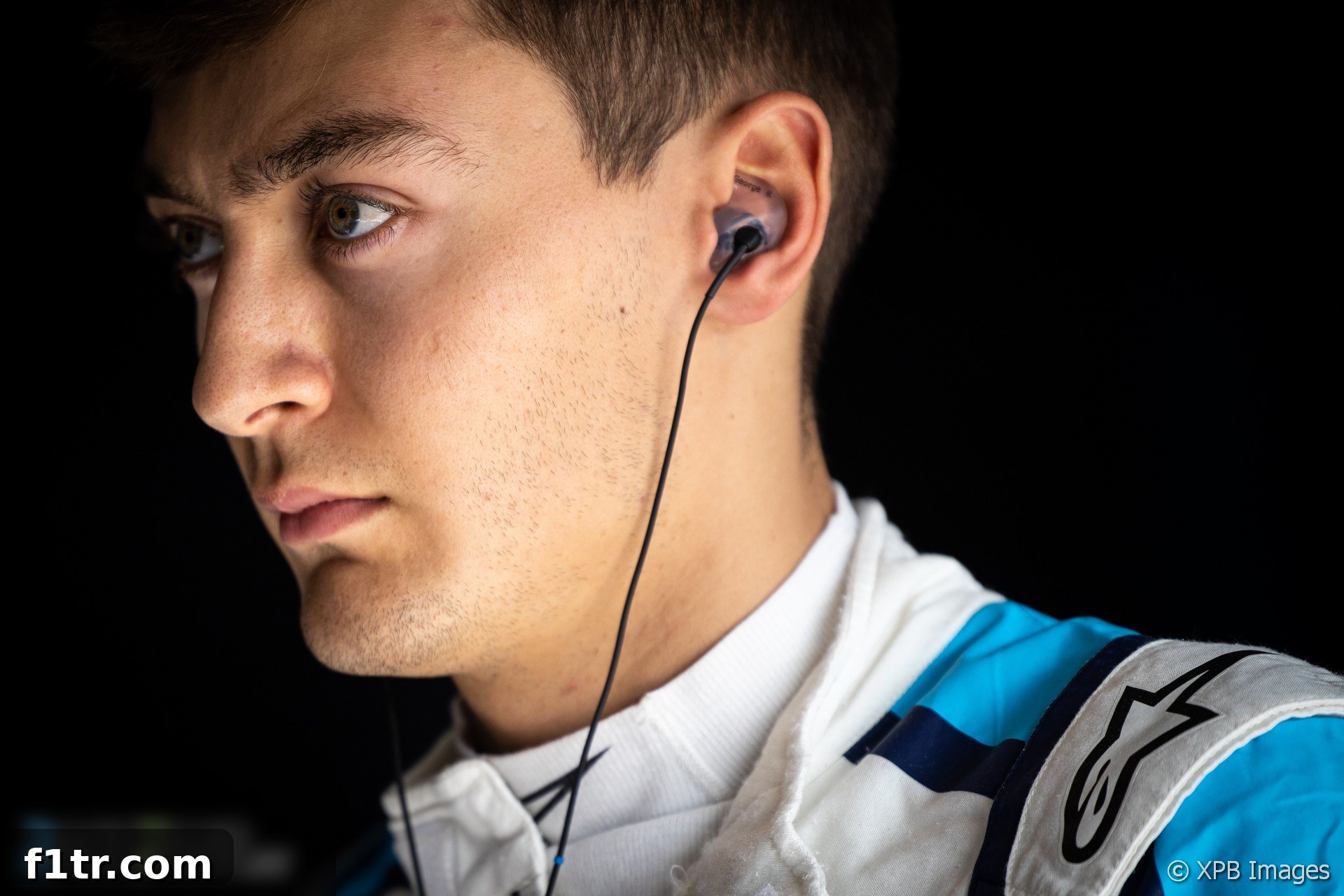
In the high-octane world of Formula 1, whispers often circulate about who might be the next generational talent, the one destined to fill the monumental shoes of legends. For Mercedes, the question of who might one day succeed the incomparable Lewis Hamilton has frequently turned into a discussion centered around a single name: George Russell. His trajectory through the junior ranks, crowned by an F2 championship, signaled a driver of immense promise, but it was his performance in the 2020 season that truly began to etch his name into the annals of future champions, providing an undeniable pointer to his extraordinary capabilities.
The Sakhir Grand Prix: A Glimpse into Stardom
The 2020 Sakhir Grand Prix offered a unique and utterly compelling audition for Russell, placing him directly under the most intense spotlight of his burgeoning career. Following Lewis Hamilton’s positive COVID-19 test, Russell was granted the unexpected and monumental opportunity to step into the seven-time world champion’s Mercedes W11. This was no ordinary substitute appearance; it was a direct comparison, a litmus test against the team’s other established driver, Valtteri Bottas, in the most dominant car on the grid.
The pressure was immense. Russell, accustomed to the challenging confines of his Williams, suddenly found himself in a machine engineered for victory, yet one that was entirely unfamiliar and, crucially, not perfectly tailored to his physical dimensions. Despite these significant hurdles, his performance was nothing short of breathtaking. In qualifying, he came within a mere few hundredths of a second of out-qualifying Bottas, a testament to his immediate adaptability and raw pace. This near-miss already sent shockwaves through the paddock, but it was on race day that Russell truly showcased his world-class potential.
The race itself was a masterclass in composure and aggression. Russell executed a superb start, immediately passing his more experienced teammate and confidently taking the lead. For a significant portion of the race, he controlled proceedings, demonstrating an uncanny ability to manage the tires and dictate the pace, all while fending off the very driver whose full-time seat he was, in essence, vying for. However, fate, in its cruelest form, intervened twice. A disastrous pit stop, where his tires were mistakenly swapped with Bottas’s, cost him precious time and positions. Undeterred, Russell mounted a spectacular recovery drive, carving his way back through the field with a blend of audacious overtakes and blistering lap times. Yet, just as he seemed poised to challenge for victory once more, a puncture forced another unscheduled pit stop. Despite these catastrophic setbacks, he still managed to finish ninth, a result that, while yielding his first career points, profoundly understated the brilliance and sheer effort he had invested throughout the weekend. That single performance at Sakhir redefined perceptions of George Russell, establishing him not just as a promising talent, but as a future champion in waiting.
‘Mr. Saturday’: Dominance at Williams
Beyond his defining Mercedes cameo, Russell’s consistent performances in his regular Williams car throughout the 2020 season cemented his reputation as one of F1’s brightest stars, earning him the affectionate moniker “Mr. Saturday.” While the Williams FW43 was undeniably one of the slowest cars on the grid, Russell consistently extracted every ounce of its limited potential, particularly in qualifying. He enjoyed the largest one-lap performance advantage over his teammate of any driver on the grid that year, a statistic that speaks volumes about his individual brilliance. More often than not, Russell dragged his Williams into Q2, a remarkable feat for a back-marker car. In stark contrast, his newcomer teammate, Nicholas Latifi, only progressed beyond the first qualifying round once all season. This consistent qualifying superiority wasn’t just about raw speed; it highlighted Russell’s exceptional ability to adapt, understand the car’s nuances, and push it to its absolute limit on a single flying lap, often on the ragged edge. His ability to deliver such commanding performances under the constraints of a less competitive package underscored a level of talent and mental fortitude rarely seen in young drivers.
While the Sakhir Grand Prix ultimately yielded his first career points, it’s hard to shake the impression that Russell deserved to score points for Williams as well, had circumstances been kinder. Indeed, Latifi, despite being consistently out-qualified, ironically bagged more 11th-place finishes than Russell. However, these finishing positions in an uncompetitive car were often heavily influenced by the misfortune or retirements of others rather than outright pace. For Russell, the challenge was often translating his qualifying heroics into race results in a car that lacked the sustained performance to defend positions or make significant progress, an enduring frustration for any ambitious driver.
The Crucible of Development: Learning from Mistakes
Despite his undeniable talent, Russell’s 2020 season wasn’t without its learning moments, offering glimpses of the inexperience inherent in any young driver pushing the absolute limits. These notable errors, however, can be viewed as crucial stepping stones in his development, forging a more complete and resilient competitor. A promising start in the Styrian Grand Prix, for instance, was unfortunately spoiled when he went off at Turn 6 just three laps into the race. In Turkey, he suffered a somewhat embarrassing moment by hitting the pit wall on his reconnaissance lap, a minor but visible misjudgment in challenging conditions.
Perhaps the most costly error of his season occurred at Imola. During a Safety Car period, while attempting to warm his tires, Russell lost control of his Williams and crashed out of a points-scoring position. This was particularly galling as Latifi finished that very race just a second outside of the points, highlighting the missed opportunity. Russell’s reaction to this incident, however, spoke volumes about his character and maturity. He was visibly mortified by the mistake and, in a rare display of humility and accountability, composed a heartfelt letter of apology to his team. This ability to acknowledge and learn from mistakes, rather than deflect blame, is a hallmark of truly great athletes and provides further evidence of his leadership qualities.
George Russell (2020 Season Stats) |
|
|---|---|
| Beat team mate in qualifying | 16/17 |
| Beat team mate in race | 8/11 |
| Races finished | 13/17 |
| Laps spent ahead of team mate | 632/833 |
| Qualifying margin | -0.52s |
| Points | 3 |
Another area of consistent weakness, despite his strong qualifying pace, was his race starts. This was likely, at least in part, a car-related issue, as evidenced by his much stronger getaways when he drove the Mercedes at Sakhir. While Latifi’s starts tended to be better in the Williams, his lower qualifying positions meant he often had less to lose and less pressure on the initial dash. This aspect of Russell’s race craft was clearly an area for development, though his performances in a more competitive car demonstrated that given the right machinery, he possessed the capability to rectify this.
Beyond His Control: Unfortunate Incidents and External Factors
Russell’s 2020 season also featured several instances where potential points finishes evaporated due to circumstances entirely beyond his control, adding to the narrative of a driver often unlucky despite his immense talent. At the Nurburgring, for example, his race was prematurely ended when he was unfortunately taken out by Kimi Raikkonen. Similarly, at Spa, he was blamelessly caught up in a multi-car collision involving the other Alfa Romeo driver, yet another promising outing curtailed by external factors. These incidents, while frustrating, highlight the often-unpredictable nature of Formula 1 and served to underscore how many more opportunities for points Russell might have had in a more reliable or competitive package.
Ultimately, while his time at Williams was a challenging proving ground, it was his unforgettable performance at the Sakhir Grand Prix that stands as the undeniable highlight of his 2020 season. That single race provided a definitive statement of intent, a powerful demonstration of his capability to not only compete but to dominate at the very pinnacle of the sport. It was a performance that undoubtedly gave him, and the wider F1 community, the confidence to expect that he would indeed get the opportunity to drive for a top team and challenge for championships in the not-too-distant future. His second season in Formula 1 left an indelible mark, leaving many eagerly anticipating what he could achieve with a full season in a truly competitive car, confirming his status as a prime candidate for the future of Mercedes and Formula 1 itself.
2020 F1 Season Review & Driver Rankings
- 2020 F1 season driver rankings #1: Lewis Hamilton
- 2020 F1 driver rankings #2: Max Verstappen
- 2020 F1 driver rankings #3: Charles Leclerc
- 2020 F1 driver rankings #4: Carlos Sainz Jnr
- 2020 F1 driver rankings #5: Daniel Ricciardo
Browse all 2020 F1 season review articles