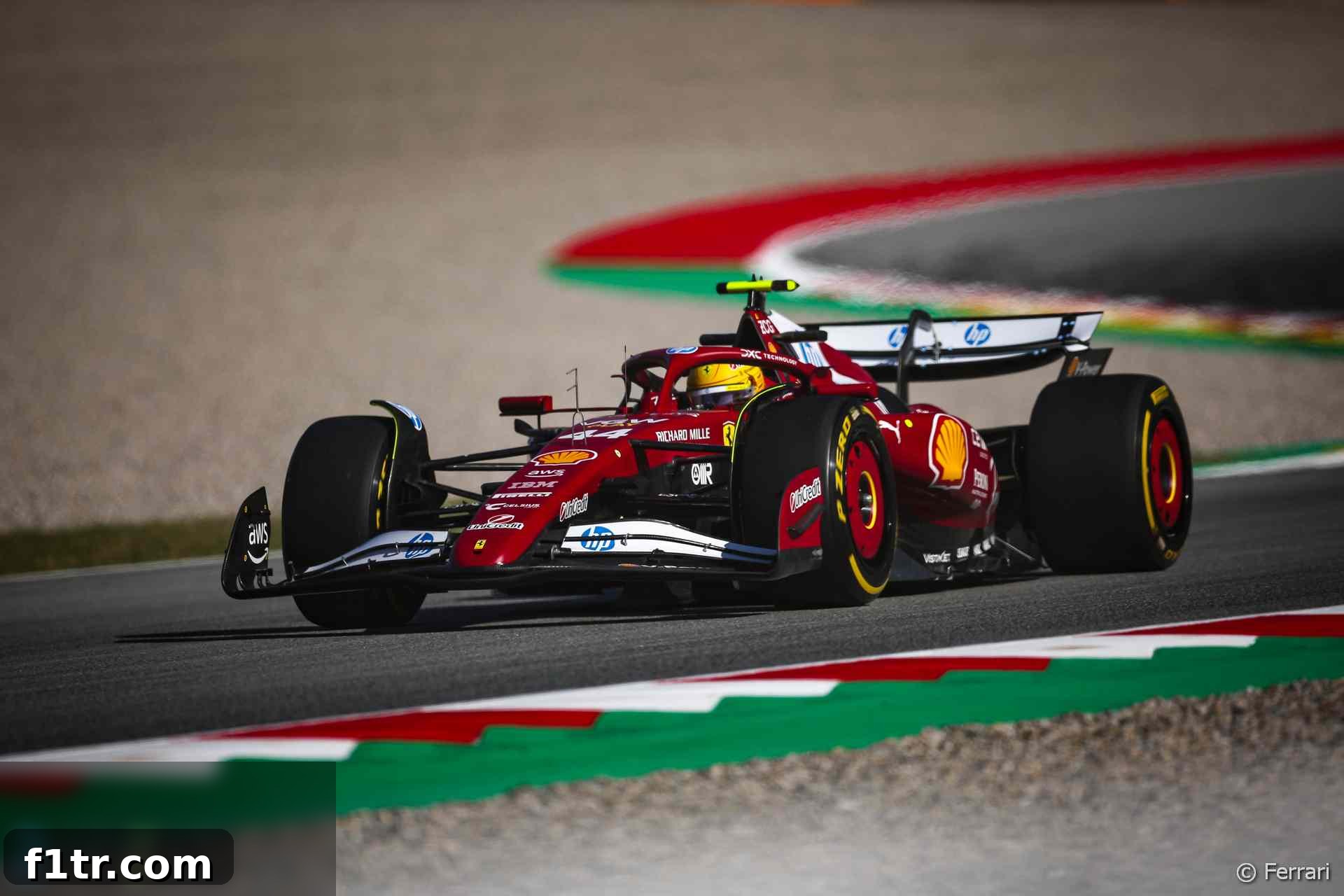
Lewis Hamilton, the esteemed seven-time Formula 1 World Champion, recently shed light on significant car performance issues that plagued Ferrari during the Spanish Grand Prix, impacting both himself and teammate Charles Leclerc. The Briton described the car’s handling as “the worst it’s ever been” during the race, a candid admission that has raised questions about Ferrari’s current development trajectory.
Advert | Become a Supporter & go ad-free
Despite the severity of the problem, Hamilton indicated that the Scuderia is keen to keep details under wraps, preventing their drivers from openly discussing the technical compromise that marred their performance at the Circuit de Catalunya. This directive from the team underscores the sensitive nature of the issues faced, hinting at deeper underlying challenges for the Italian outfit.
Hamilton’s race in Barcelona saw a noticeable deterioration in his car’s handling, causing him to slip to a disappointing sixth place by the chequered flag. The frustration was palpable as he communicated with his race engineer, Riccardo Adami, stating, “There’s something wrong with this car, it’s the worst it’s ever been.” This powerful statement from a driver with nearly two decades of F1 experience highlights the unusual and severe nature of the difficulties encountered.
Ahead of the subsequent race weekend, Hamilton elaborated on the Spanish Grand Prix’s challenges, confirming that the problem had affected both Ferrari drivers “massively.” However, he reiterated the team’s preference for discretion. “Unfortunately, they don’t want us really to talk too much about it, but we both had issues that were hindering us massively from halfway through the race already,” he disclosed, maintaining a professional front while still conveying the gravity of the situation.
The race saw Hamilton lose fifth place to Nico Hulkenberg, a result that left him visibly dejected. The disappointment was compounded by the uncertainty of whether the issue was driver-specific or a more systemic car problem. Hamilton admitted to a sense of relief upon learning that both cars were indeed suffering from similar afflictions. This shared experience provided a crucial psychological boost, confirming that his struggles were not purely down to his adaptation to the new car or driving style.
“What I didn’t know is whether or not we had that problem,” Hamilton explained, reflecting on his initial post-race thoughts. “Obviously I said on the radio that it was the worst-feeling car that I’d ever had, and it truly was with that issue.” His vivid description painted a clear picture of the profound impact the problem had on his ability to control and push the car to its limits. Experiencing such a prolonged and severe handling deficit during a race was, for Hamilton, an unprecedented event in his illustrious career.
Advert | Become a RaceFans supporter andgo ad-free
“At the end of the race, I was kind of like, jeez, I’ve never experienced something this bad for such a prolonged time through a race. It wasn’t until after the TV interviews that we got back to the engineers and we found out there was an issue. So it was a bit of a relief to hear that because it definitely didn’t feel so terrible afterwards,” he elaborated. This relief wasn’t born from schadenfreude, but rather from the clarity that came with understanding the root cause, allowing for a more constructive path forward for both driver and team.
Further corroboration of the car’s issues came from Charles Leclerc, who secured a third-place finish despite his own struggles. His radio message after the race subtly indicated his awareness of the problem: “I know why the last part of the race was poor,” he said. “I’ll explain, but there is an explanation.” Leclerc’s composed yet insightful comment reinforced the idea that Ferrari was battling a common, albeit mysterious, technical hindrance.
As Hamilton enters his tenth race weekend with Ferrari, he finds himself sixth in the championship standings. Despite a challenging start to his tenure with the Italian squad, he maintains a pragmatic outlook. He believes his current situation “looks a lot worse outside than it probably is on the inside” and asserts, “I don’t feel like I’m in desperate need” of a flawless weekend. This measured perspective reflects his vast experience and understanding that long-term success is built on consistent development rather than immediate, fleeting triumphs.
A significant part of Hamilton’s adaptation to Ferrari involves adjusting to their distinct approach to car preparation and setup for each Grand Prix. Having spent 17 seasons with McLaren and Mercedes, he is accustomed to a particular methodology. “Just coming from engineering now, how they set the car up compared to any other year that I’ve been here is completely different,” he noted. This difference isn’t merely stylistic; it represents a fundamental divergence in engineering philosophy that Hamilton is actively working to integrate with his own extensive feedback and insights.
His discussions with Ferrari engineers highlight a period of mutual learning and adjustment. Hamilton is advocating for certain changes, bringing his wealth of experience to the table: “And [I’m] having discussions with engineers to change things, there’s a certain way they like to work. To say, ‘hold on a second, that doesn’t actually make sense; this is what I’ve done for the last 17, 18 years here and it’s worked in a lot of them’.” This constructive dialogue is vital for bridging the gap between his established methods and Ferrari’s existing procedures, ultimately aiming to unlock the car’s full potential.
The concept of a “sweet spot” for the car, where all elements from aerodynamics to tyre performance converge for optimal handling, is a critical factor. Hamilton acknowledges that finding this elusive balance is a struggle for many teams on various tracks, and Ferrari is no exception. “The car very much has a real sweet spot and we’re trying to get it working at all those tracks which everyone’s having a struggle with,” he stated. Achieving this consistently is paramount for Ferrari to challenge at the front, especially given the fiercely competitive nature of modern Formula 1.
Despite the recent setbacks and ongoing adjustments, Hamilton remains optimistic. He concluded with a hopeful note for the upcoming race weekends, expressing his desire for a stronger performance: “I’m hoping this weekend can be strong.” His journey with Ferrari is still in its early stages, marked by both the excitement of a new chapter and the inherent challenges of integrating a legendary driver into a historic team with its own established culture and engineering practices. The “massive” problems in Spain serve as a stark reminder of the continuous development required to compete at the pinnacle of motorsport, but also as a catalyst for Hamilton and Ferrari to refine their collaboration and address their car’s shortcomings.
Advert | Become a RaceFans supporter andgo ad-free
Don’t Miss a Single Update from RaceFans
Stay connected with all the latest Formula 1 news, analysis, and exclusive content. Get our daily email digest, free from marketing and advertisements. Sign up below to ensure you’re always informed:
More on the 2025 Spanish Grand Prix
- Verstappen: Don’t blame Spanish GP penalty for hitting Russell if I narrowly lose title
- Russell’s radio comments influenced Red Bull’s decision to let him past Verstappen
- Verstappen says he won’t make any changes to his driving to avoid a ban
- ‘No issues’ with Verstappen but ‘it’d be different if he’d taken me out’ – Russell
- Ferrari “don’t want us to talk much” about “massive” Spanish GP problems – Hamilton
Browse all 2025 Spanish Grand Prix articles