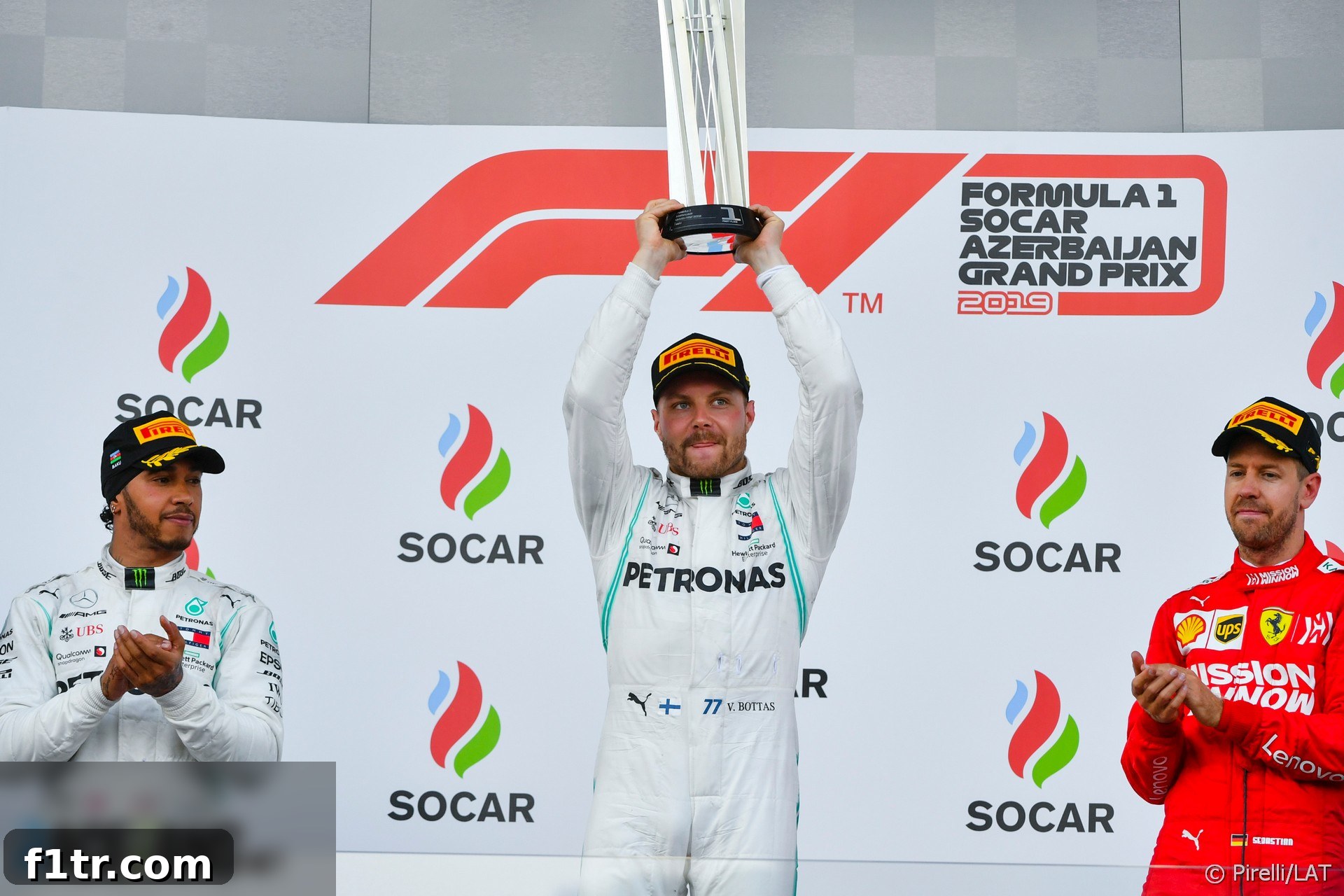
The 2019 Formula 1 season delivered an early, emphatic statement of intent from Mercedes, a narrative powerfully reinforced at the Azerbaijan Grand Prix. While Baku is globally recognized for its capacity to produce thrilling and often unpredictable races, the 2019 edition ultimately became a meticulous demonstration of strategic advantage and flawless execution. The defining moment arrived startlingly early, on lap seven, when it became unequivocally clear just how severely Charles Leclerc’s qualifying crash had undermined Ferrari’s chances of victory, fundamentally altering the trajectory of the race.
This particular Grand Prix pivoted on the wildly contrasting performances of Pirelli’s soft and medium tyre compounds. Leclerc’s unfortunate collision with the Turn 8 barrier during Q2 wasn’t merely a personal setback that cost him a shot at pole position; it profoundly compromised Ferrari’s entire race strategy. This unexpected turn of events created an undeniable opportunity for Mercedes, which they seized with characteristic precision, extending their near-faultless start to the 2019 F1 season by securing an extraordinary fourth consecutive one-two finish. The narrative of the weekend thus shifted from potential chaos to a strategic masterpiece orchestrated by the Silver Arrows.
Qualifying Catastrophe: Leclerc’s High-Stakes Gamble and Ferrari’s Strategic Fallout
From Dominant Pace to Grid Compromise
The preceding two races at the Baku City Circuit had been lively, punctuated by numerous shunts and Safety Car deployments. However, the 2019 event proved more absorbing in its strategic depth than electrifying in terms of on-track incidents. Crucially, staying clear of trouble on race day became almost a prerequisite, meaning the drama and consequences of qualifying held far greater weight for the ultimate outcome. Charles Leclerc’s weekend was a compelling blend of breathtaking talent and a touch too much youthful exuberance, drawing comparisons to Max Verstappen’s early, sometimes overly aggressive, outings at Monaco. Leclerc showcased phenomenal speed, topping all three practice sessions, yet consistently flirted dangerously close with the unforgiving barriers.
His dominance continued into Q1, where he was the fastest driver, save for Sebastian Vettel narrowly avoided a costly error at the notoriously tight Turn 8, famously the narrowest point on the entire F1 calendar, his car momentarily slithering sideways. Leclerc, pushing the limits even further, asked a fraction too much from his SF90 and paid a severe price. His Ferrari slammed into the TecPro wall, which had only just been painstakingly repaired following Race Day Revelations: Mercedes’ Strategic Prowess vs. Ferrari’s Pitwall ParadoxThe Start: Bottas’s Poise Under PressureValtteri Bottas and Lewis Hamilton engaged in a disciplined yet thrilling duel for the lead at the start.For the second race in succession,Valtteri Bottasstarted from pole position, and for the second consecutive time, his launch wasn’t optimal. However, the run to Turn 1 at Baku is considerably shorter than in Shanghai, enabling Bottas to effectively fend off Lewis Hamilton’s aggressive challenge through three exhilaratingly close corners. Bottas later admitted, “I could have done a better job at the start. I was a little bit on the cautious side. I didn’t want to get the wheel spin started, so I was rather smooth on getting on power, not to kind of mess it up.” He noted Hamilton’s strong start, placing him on the inside, leading to a side-by-side battle through Turn 1. Bottas maintained his speed on the outside, mirroring the move through Turn 2, ensuring ample space. He described the exchange as “nice and fair.” Hamilton, however, humorously remarked that he would “definitely” have fought harder had it been a driver from another team, emphasizing the inherent complexities of intra-team racing. He elaborated on the rationale: “Ultimately you always have to remember when you’re in a team as big as this that you are only one, and there are so many people that depend on us. Selfishly, I could have for sure pushed a lot harder and Valtteri would have lost position… we have to work together.”Once Bottas successfully navigated the opening laps, he began to pull away from Hamilton, particularly in the circuit’s twisty middle sector. It quickly became evident that none of the drivers on the soft compound tyres were finding adequate grip. Sebastian Vettel’s post-race confession to his team highlighted this struggle, revealing he had been“shitting myself a little bit” over the first stintdue to his car’s utterly poor traction on the softs. This candid admission from an experienced champion underscored the significant performance deficit of the soft compound in the prevailing conditions.Leclerc’s Resurgence and Ferrari’s Pit Wall PuzzlerSebastian Vettel openly expressed his discomfort and lack of confidence on the soft tyres during the challenging opening stint.Despite his destructive crash in Q2, Charles Leclerc’s initial lap time had been sufficiently quick to provisionally advance him to Q3. This twist of fate mandated that he start the race on his Q2 tyres; however, given the damage to that set, he was granted a fresh set of medium compound Pirelli tyres for the race start. This unforeseen development proved to be a blessing in disguise. Starting cautiously on the more durable mediums, Leclerc initially dropped a couple of places from the line. Yet, he soon unleashed an effortlessly quick charge, scything through the midfield with his DRS flap open. He effortlessly overtookMax Verstappen’sRed Bull for fourth place, and by lap seven, he was unequivocally the fastest driver on the entire track, a clear testament to the medium tyre’s superiority.By the following lap, the soft-tyred drivers were visibly beginning to struggle, their pace fading dramatically. Leclerc, meanwhile, was nearly a full second quicker than anyone else, maintaining his blistering pace as the Mercedes cars and Vettel loomed larger in his mirrors. By lap 10, Vettel was firmly in his sights, and race leader Bottas was only 13 seconds ahead. As the Mercedes and Vettel eventually pitted for medium tyres, they rapidly began to reel Leclerc in, closing the gap he had diligently built. Leclerc would inevitably need to pit for a set of soft tyres, and once the Mercedes had carved their way past him, there seemed little logical reason for Ferrari to keep him out any longer.However, in a baffling strategic decision, Ferrari waited until a full lap after Vettel had already passed Leclerc to finally call him into the pits. This delayed stop proved immensely costly, as Leclerc re-emerged behind Gasly’s yet-to-stop Red Bull, losing crucial track position and effectively extinguishing his fight for victory. This strategic oversight, combined with the inherently poor performance of the soft tyres in his subsequent stint, meant Leclerc never managed to lap quicker on his new softs than the leaders were on their worn mediums. It was only after a third pit stop, switching back to fresh tyres and engaging an aggressive ‘qualifying mode’ with a low fuel load, that he was able to pump in a blistering 1’43.0, securing the bonus point for the fastest lap. The race outcome unequivocally underscored that the medium tyres were the superior compound to start on. Had Ferrari successfully executed their original qualifying strategy, even from the second row, the 2019 Azerbaijan Grand Prix could very well have marked their long-awaited first victory of the season.Lewis Hamilton’s Trio of Near MissesLewis Hamilton gave valiant chase throughout the race but ultimately had to settle for a hard-fought second place.While Valtteri Bottas celebrated a deserved victory, Lewis Hamilton could pinpoint at least three distinct moments where the chance to win the race tantalizingly eluded him. His first missed opportunity occurred during qualifying. In Q3, it was Hamilton’s turn to choose whether he or Bottas would lead the queue for their final flying laps. Opting to run behind his teammate, he aimed to capitalize on the aerodynamic slipstream. However, after performing clever ‘dummy’ practice starts to ensure Sebastian Vettel ran ahead of them, the Mercedes drivers cut their timing too fine to initiate their final flying laps. Consequently, Hamilton’s first sector was compromised, forcing him into a recovery drive. Despite a masterful effort over the final two sectors, Bottas snatched pole position by less than a tenth of a second.His second missed chance transpired at the very start of the race. As previously discussed, Hamilton admitted to adopting a slightly more cautious approach against his teammate, a strategic choice made for the collective benefit of the team and to secure a Mercedes one-two. He emphatically stated that his approach would have been “a lot different” had a Ferrari been alongside him. The third, and arguably most frustrating, opportunity emerged on lap 40 when Pierre Gasly’s retirement necessitated a Virtual Safety Car (VSC) period. Hamilton, renowned for his lightning-fast reactions, did not respond to the VSC period ending as swiftly as Bottas. This critical lapse saw the gap between the two Mercedes drivers instantly widen from 1.6 seconds to 3.5 seconds.Hamilton candidly acknowledged afterwards that his reaction had been suboptimal, costing him crucial time and momentum.He then spent the subsequent laps relentlessly reeling Bottas back in. With only three laps remaining, he managed to get within DRS range, applying immense pressure to his teammate. However, as the final lap commenced, Hamilton ran slightly wide at Turn 16. This small, yet critical, error was enough to release Bottas from immediate threat, allowing his teammate to cross the finish line unchallenged. Bottas, who had suffered the agony of losing a likely victory with only a handful of laps remaining just 12 months prior in Baku, finally secured his well-deserved win, bringing his car home safely.Midfield Heroes and Backmarker Blues: A Look Beyond the LeadersPerez: Baku’s Unofficial King of the MidfieldSergio Perez cemented his reputation as a Baku specialist, securing a well-deserved ‘best of the rest’ finish.The Virtual Safety Car period, while impactful for the leading Mercedes, brought an abrupt end to Max Verstappen’s determined efforts to challenge Sebastian Vettel for third place. He had been steadily closing on the Ferrari but struggled significantly to bring his tyres back up to their optimal operating temperature after the VSC-induced slowdown. Furthermore, his Red Bull team instructed him to diligently avoid all kerbs over the final two laps, fearing a potential driveshaft problem, an issue that ultimately led to his teammate Gasly’s retirement. Despite these challenges, Verstappen secured a respectable fourth place, marking his third consecutive P4 finish of the season.Sergio Perezfurther solidified his burgeoning reputation as a Baku specialist, delivering another stellar performance to finish as the unequivocal ‘best of the rest’, mirroring his strong qualifying result. He endured race-long pressure from the McLarens, but this challenge eased considerably after the VSC period. McLaren, in a calculated move to apply strategic pressure on Racing Point, opted to pit Lando Norris. This gamble backfired dramatically. Norris suffered a sluggish pit stop, experienced a tardy VSC restart partly due to difficulties seeing his delta time, and then unfortunately clouted the wall as he struggled to extract pace from the unfancied soft tyres. Ultimately, the entire strategic maneuver achieved nothing more than costing him a position to his teammate. Meanwhile,Lance Strollmanaged to secure two valuable points for ninth place, despite another Q1 exit. This strong showing meant Racing Point matched McLaren’s haul of 10 points in Baku, catapulting both teams from seventh and eighth to fourth and fifth respectively in the constructors’ championship, with McLaren holding a slender one-point advantage.The final championship point went to the evergreenKimi Raikkonen. His race began from the pit lane after his Alfa Romeo failed a post-qualifying technical inspection. Raikkonen ingeniously discarded his soft tyres after only half a dozen laps, embarking on an epic and hugely successful long stint on medium tyres to snatch a well-deserved tenth place – a testament to his experience and the surprising durability of the medium compound.Unfortunate Incidents and Persistent WoesDaniel Ricciardo’s peculiar attempt to rejoin the track led to a bizarre collision with Daniil Kvyat.Alexander Albonnarrowly missed out on a third consecutive points finish, concluding the race in 11th. He hindered his own cause by clipping the Turn 1 barrier at the start and later expressed that he had stayed out too long on his soft tyres during the crucial opening lap. His Toro Rosso teammate,Daniil Kvyat, having reached Q3, was obligated to start on used soft rubber and consequently suffered even greater tyre degradation issues in his first stint. He was passed by several cars and later fell victim to an overly optimistic lunge by Daniel Ricciardo. In a truly bizarre sequence of events, Ricciardo then reversed his Renault directly into Kvyat’s car while attempting to rejoin the track, causing race-ending damage to both vehicles in a moment of utter perplexity.Elsewhere on the grid, Renault continued to struggle significantly, never truly getting on top of their car’s setup in Baku. Haas experienced similar difficulties, with both their drivers battling the team’s now customary poor race pace, a persistent and frustrating issue throughout the early season.Romain Grosjeanretired from the race due to brake trouble, extending his unfortunate streak of failing to score a single championship point this season.Williams capped another thoroughly miserable weekend with an entirely needless penalty forRobert Kubica. The team prematurely sent him to the pit lane exit, seemingly having overlooked the critical regulation change implemented since the beginning of the previous year, which stipulates that races now commence precisely at 10 minutes past the hour. Such a fundamental procedural error highlighted the deep-seated challenges and operational deficiencies the struggling team was facing.Championship Landscape: Bottas Takes Slim Lead as Mercedes’ Dominance Endures”So I guess the championships standings is now looking like it should again?” remarked Valtteri Bottas as he confidently drove back to the pits, a statement imbued with the satisfaction of a driver who had just seized the lead in the drivers’ championship by a single point. It’s highly doubtful his teammate, Lewis Hamilton, would entirely concur, given his own narrowly missed opportunities throughout the race. However, one irrefutable truth emerged from the Baku weekend: Mercedes’ ability to comprehensively dominate and effectively crush their opponents seemed an unstoppable force.The intense internal competition between their two drivers, vividly demonstrated throughout the Grand Prix, provided at least some compelling drama amidst their otherwise overwhelming start to the season. After the initial four “fly-away” races, Bottas held a narrow, yet significant, advantage in the championship standings. The overarching question that loomed large as the season prepared to resume its European leg in two weeks’ time was stark and challenging: would any rival team be capable of genuinely challenging Mercedes’ relentless march towards both the drivers’ and constructors’ titles?2019 Azerbaijan Grand Prix InsightsLeclerc Impressed by Binotto’s Handling of Baku CrashTop Ten Pictures from the 2019 Azerbaijan Grand Prix2019 Azerbaijan Grand Prix Star PerformersMercedes Start Season with Record-Breaking Fourth Consecutive One-TwoPaddock Diary: Azerbaijan Grand Prix Day FourBrowse All 2019 Azerbaijan Grand Prix ArticlesMore F1 Race ReviewsAntonelli Lucks in for Second Win and Becomes Youngest F1 Championship LeaderEmotional Antonelli Grabs First Formula 1 Victory in Chinese Grand PrixRussell Sees Off Ferrari Threat to Lead Mercedes One-Two in MelbourneNorris Clinches F1 Title by Two Points as Verstappen Wins Finale at Yas MarinaMcLaren Strategy Blunder in Losail Hands Verstappen Crucial Win and Shot at TitleRead All F1 Race Reviews