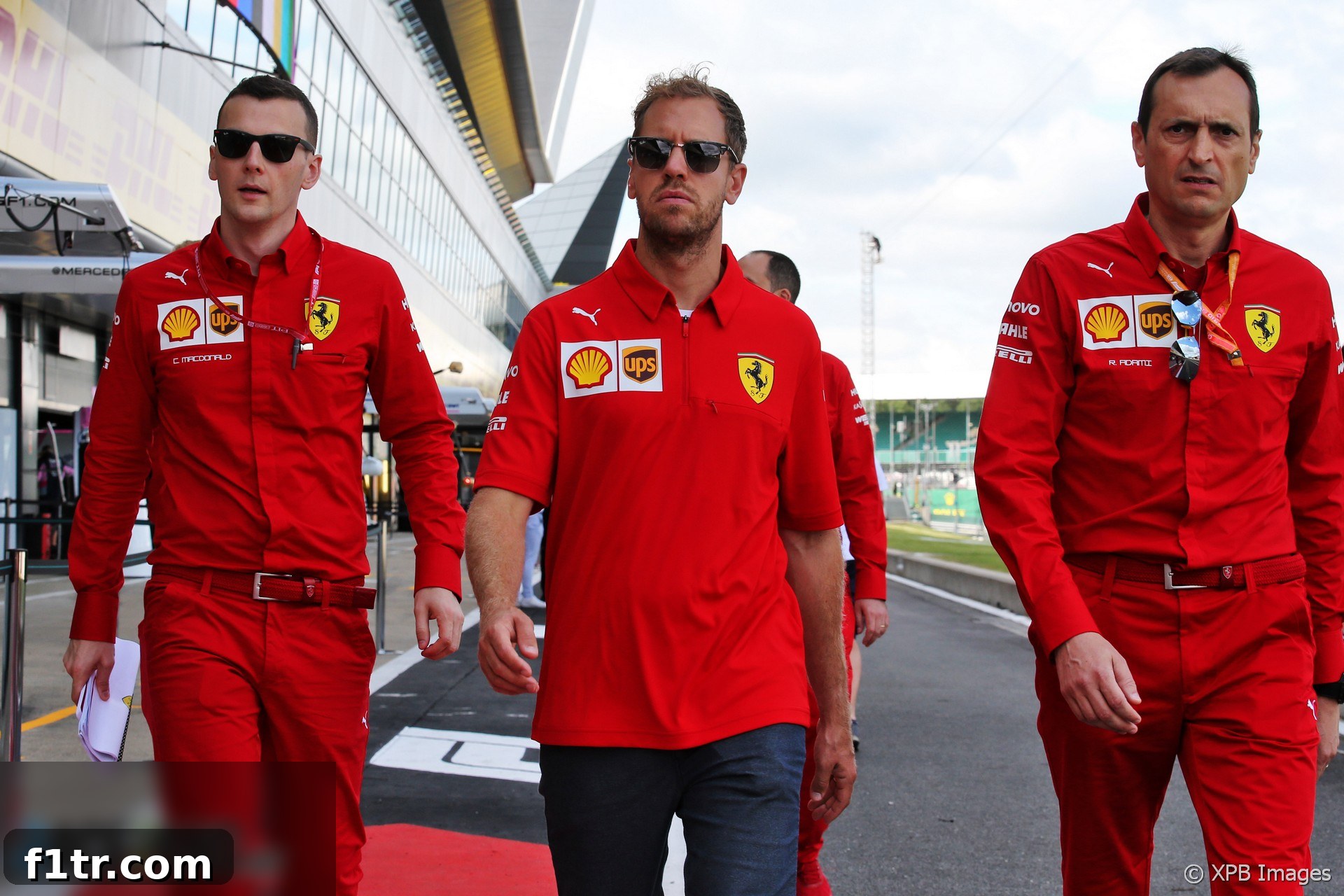
Despite a challenging start to the 2019 Formula 1 season where Scuderia Ferrari had yet to secure a single victory across nine races, Sebastian Vettel remained steadfast in his belief that the championship fight was far from over. The four-time world champion, known for his relentless determination and strategic prowess, articulated a defiant optimism even as the gap to championship leader Lewis Hamilton and his dominant Mercedes-AMG Petronas team widened significantly. This unwavering conviction underscored a resilient mindset within Ferrari, indicating a refusal to capitulate despite the monumental task ahead.
At the time of these remarks, following the Austrian Grand Prix, Vettel found himself positioned fourth in the drivers’ standings, a considerable 74 points adrift of Hamilton. This deficit, for many, would signal the effective end of a title challenge. However, Vettel insisted that Ferrari had been making tangible progress with their SF90 challenger in recent outings. He emphasized the critical importance of the upcoming rounds leading into the summer break, labeling them “crucial” for any realistic hope of turning the tide in the championship battle.
Advert | Become a Supporter & go ad-free
When directly confronted with the daunting question of whether a championship victory was still a plausible outcome, Vettel responded with characteristic resolve. “I don’t think I have a reason not to believe,” he stated, highlighting a deep-seated confidence that stemmed perhaps from his vast experience in the sport, or an insider’s view of Ferrari’s internal advancements. Yet, he also tempered this belief with pragmatism, acknowledging, “but it’s not my number one thought when I go to bed.” This distinction suggests a focus on the process rather than the ultimate outcome, emphasizing the immediate tasks at hand and the incremental steps required to bridge the performance gap.
Vettel’s perspective underscored a professional athlete’s approach to adversity: compartmentalizing the grand challenge into manageable, immediate objectives. “I am looking forward to this race and then looking forward to the next,” he explained, illustrating a race-by-race mentality crucial for maintaining morale and focus in a long, arduous season. He further articulated the extensive workload facing the Maranello squad, stating, “I think we have a lot of stuff on our list, a lot of work ahead of us and time will tell.” This acknowledgment of the sheer volume of development required painted a clear picture of Ferrari’s commitment to relentless pursuit of performance.
The strategic importance of the races leading up to the Formula 1 summer shutdown cannot be overstated, and Vettel clearly recognized this. “Obviously the next races until the summer break in general are very crucial,” he asserted. These pre-break races often serve as a decisive turning point, dictating momentum for the latter half of the season and indicating which teams have successfully accelerated their development curves. For Ferrari, these races represented a golden opportunity to demonstrate their capability for significant performance gains and to chip away at Mercedes’ seemingly insurmountable lead. However, Vettel was also realistic about the prerequisites for such a turnaround.
His assessment of Ferrari’s competitive needs was remarkably candid and insightful. “But in order to turn things around we need to have a stronger package overall otherwise it’s not enough to just challenge for victory,” Vettel explained. This wasn’t merely a call for marginal improvements; it was a demand for a comprehensive overhaul and a significant leap in performance. He emphasized, “I think we need to have a package strong enough to demand the victory.” The distinction between “challenging” and “demanding” victory is critical in Formula 1; it signifies the difference between merely being competitive and being truly dominant, capable of dictating race outcomes rather than reacting to them. A ‘stronger package’ encompasses a multitude of factors, including aerodynamic efficiency, engine power, chassis balance, tyre management, and strategic execution. For Ferrari, achieving this meant identifying and rectifying the core weaknesses of the SF90, transforming it into a machine that could consistently outperform its rivals on various circuit types.
One specific area of recent technical scrutiny for Ferrari revolved around an upgrade introduced at the French Grand Prix, particularly a new floor component, which had not delivered the anticipated performance benefits. Vettel confirmed that the team had gained a much clearer understanding of why this particular upgrade failed to meet expectations. “We learned a lot after [the] confusion or some bits that didn’t turn out the way we wanted to during the French Grand Prix,” he elaborated. This candid admission of initial confusion highlights the complex and often unpredictable nature of Formula 1 car development, where theoretical gains in the wind tunnel or CFD simulations do not always translate seamlessly to on-track performance.
The subsequent Austrian Grand Prix, according to Vettel, played a pivotal role in providing the necessary clarity. “I think Austria brought some clarity and I think we have a clear picture of what was wrong in terms of tuning and what needs to be changed,” he revealed. This indicates that the team used the data gathered and the performance characteristics observed in Austria to diagnose the specific issues with the French GP floor upgrade. Understanding whether the problem lay in the fundamental design, its integration with other aerodynamic elements, or merely in its setup and tuning for specific track conditions, is crucial for a development team. Such an understanding is the bedrock upon which future, more effective upgrades are built, preventing the replication of previous mistakes and ensuring a more efficient use of valuable development resources.
Vettel also offered a broader, more philosophical perspective on the continuous cycle of innovation and improvement in Formula 1. “Obviously the next couple of weeks then will tell where we go,” he mused, acknowledging the inherent uncertainty in racing development. He underscored the common reality that not all new components yield the desired results, stating, “I think it’s pretty normal that unfortunately not all the bits that you bring always bring you the step that you want or you expect. Sometimes parts over-deliver, which is great, and sometimes they under-deliver.” This phenomenon is a constant challenge for all F1 teams, necessitating extensive testing, rigorous data analysis, and a willingness to quickly adapt or even discard concepts that prove ineffective. The ultimate goal, as Vettel concluded, was to establish a clear and consistent development pathway. “I think overall we just need to make sure that we know a direction to go to and we keep going down that way,” he stressed, emphasizing the importance of strategic coherence and unwavering commitment to a defined technical philosophy.
For Ferrari, the path forward in the 2019 season, though fraught with challenges, was illuminated by this renewed clarity regarding their car’s performance and development direction. While the championship lead held by Lewis Hamilton and Mercedes appeared formidable, Sebastian Vettel’s enduring belief, coupled with Ferrari’s focused efforts on rectifying technical issues and enhancing their package, kept the flicker of hope alive. The upcoming races were indeed poised to be crucial, not just for the championship standings, but for defining the narrative of Ferrari’s season and the resilience of its most experienced driver. The fight for supremacy in Formula 1 is as much about technical brilliance as it is about psychological fortitude, and Vettel’s declarations served as a powerful testament to both.
Advert | Become a RaceFans supporter andgo ad-free
2019 F1 season
- Crying in the Melbourne car park at 2019 grand prix was my career low – Ocon
- McLaren Racing reports reduced £71 million loss in 2019
- Kvyat: Hockenheim podium last year was “my biggest achievement” so far
- How the FIA’s new encrypted fuel flow meter targets Ferrari’s suspected ‘aliasing’ trick
- “He smashed my office door”: 23 must-see moments from ‘Drive to Survive’ season two
Browse all 2019 F1 season articles