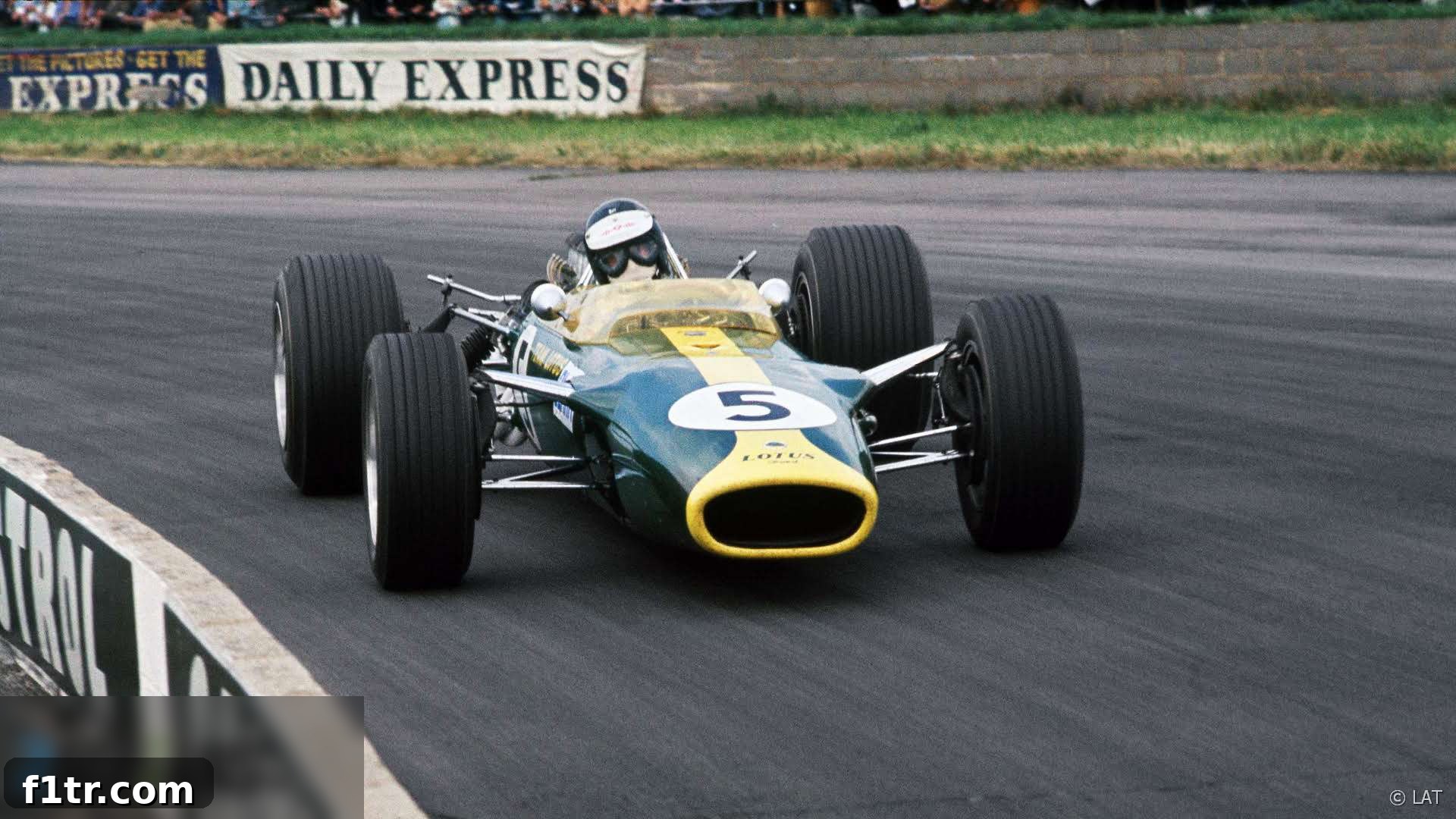
Fifty years ago, on April 7th, 1968, the world of motorsport was plunged into profound mourning. A tragic accident during a Formula Two race at the venerable Hockenheimring circuit claimed the life of James “Jim” Clark Jr., a name that had become synonymous with speed, precision, and an almost supernatural ability behind the wheel. The loss of Clark, at the tender age of 32, was not merely the passing of a driver but the sudden end of an era marked by his unparalleled dominance and an enchanting grace that redefined the limits of what was thought possible in racing.
Clark’s legacy, however, extended far beyond the devastating circumstances of his departure. He was a colossal figure in motor racing, having already secured two Formula One World Championships and the coveted Indianapolis 500, showcasing a breathtaking versatility that few could match across various racing disciplines. His quiet demeanor off the track belied a ferocious competitive spirit and an innate understanding of racing machinery that allowed him to bend cars to his will and consistently deliver performances that etched his name into the annals of history as one of the sport’s all-time greats.
In the golden age of Formula One, when racing teams operated on a remarkably intimate scale – often comprising little more than a handful of dedicated individuals – the bonds formed between drivers and mechanics were exceptionally strong. It was within this unique environment that Cedric Selzer, a seasoned racing mechanic, had the extraordinary privilege of working alongside Clark, forging a close professional relationship that offered him an unparalleled insight into the man behind the legend. Selzer, a former farmer turned racing ace’s confidant, has frequently recounted his invaluable experiences with Clark, sharing his memories in various interviews, including a poignant discussion with RaceFans.
Selzer, accustomed to the persistent curiosity surrounding his time with Lotus’s undisputed star of the 1960s, humorously summarizes Clark’s most defining attribute. “Everybody asks what Jim Clark was like, and I always say ‘he was bloody quick’,” Selzer often quips, a testament to the raw, undeniable speed that was Clark’s hallmark. Beyond the sheer pace, Selzer offers a more nuanced portrait, describing Clark as “a bit of an introvert,” a man of quiet intensity whose reserved nature belied a profound and rapidly evolving technical genius for driving a racing car.
Selzer vividly recalls Clark’s swift progression from pure instinct to sophisticated technical understanding. “When I first started working in ’61, he knew if the car understeered or oversteered, but he didn’t necessarily know why or how to articulate it,” Selzer explained. “However, by 1963, his comprehension had deepened dramatically. He could come in and precisely request, ‘I want another pound of pressure in the front tyre and a thicker roll bar on the back,’ and then go out and immediately shave half a second off his lap time. He developed an incredible understanding of the car’s dynamics and how to extract every last ounce of performance.” This evolution underscored Clark’s commitment to mastering not just the art of driving, but the science of setup, making him an invaluable asset to Colin Chapman’s innovative Lotus team.
Jim Clark’s ascent to global prominence perfectly coincided with a pivotal shift in Formula One’s technical landscape. The sport had introduced new engine regulations that drastically reduced engine capacity to one-and-a-half litres for the 1961 season. This monumental change profoundly altered the demands placed upon drivers and car design alike. The new generation of cars, while lighter, were significantly underpowered compared to their predecessors, requiring an extraordinarily delicate touch, immense precision, and a refined sense of mechanical empathy to coax the best performance from them.
“Stirling Moss, another legendary figure of that era, once shared a crucial observation about Jimmy’s unique driving style,” Selzer reminisces. “He said that Jimmy was remarkably light on the car, incredibly gentle with the steering. This attribute was absolutely vital with the 1,500cc engines, which typically produced a modest 180 to 210 horsepower. These cars weren’t powerful enough to allow drivers to scrub off speed aggressively through corners; instead, they demanded extreme precision and fluidity.” Clark’s innate ability to carry immense speed through corners with minimal braking and maximum momentum, all while being incredibly smooth, set him apart. “That’s precisely where Jimmy was so unbelievably quick,” Selzer concluded. “He possessed this absolute natural ability to dance with the car on the very edge of its limits, a talent that seemed almost effortless to him.”
Cedric Selzer’s own path to the pinnacle of motorsport was as circuitous as it was serendipitous. Hailing from Cape Town, South Africa, Selzer had already established himself as a proficient racing mechanic before setting his sights on the grand stage of Formula One. It was through the kindness and connections of none other than Stirling Moss himself that Selzer received his initial opportunity, with Moss putting him in touch with the British Racing Partnership team. Although a direct vacancy wasn’t available there at the time, fate intervened during a trip to Monaco, which proved to be the turning point Selzer had been searching for.
The glamorous Monaco Grand Prix circuit, unlike today’s heavily restricted venues, allowed for a more casual atmosphere in those days. “After the race, you could actually walk on the circuit back then,” Selzer recalls, painting a vivid picture of a different era. Following a friend’s advice on where the racing fraternity congregated, Selzer ventured to the famous Tip-Top bar, a renowned haunt for drivers and team personnel. “So I took myself off to the Tip-Top bar and simply stated, ‘I’m looking for a job.’ As luck would have it, Lotus was short of a mechanic.” This chance encounter at a bustling bar would ultimately lead to a partnership that would shape Formula One history.
Within a month, Selzer found himself on the Lotus payroll, embarking on what would become a legendary career. “My very first Grand Prix with Lotus was Spa in 1961,” he recounts, “where I worked alongside David Lazenby, a well-known figure in the IndyCar scene. Together, we meticulously looked after Jimmy’s car throughout the ’61 season.” The following year, Selzer took on even greater responsibility, tending to Trevor Taylor’s car virtually single-handedly. However, the dawn of 1963 brought a crucial decision point: the Lotus team was splitting its focus between Indy and Formula One endeavors, offering mechanics a choice. “I thought being stuck in America for months on end wouldn’t quite suit me,” Selzer mused, opting for Formula One. It was then that Colin Chapman, the visionary founder of Lotus, personally extended an invitation: “Colin Chapman asked if I would like to look after Jimmy Clark’s car this year. I told him that would be absolutely fantastic.” Thus began one of motorsport’s most iconic driver-mechanic pairings.
With Cedric Selzer now exclusively dedicated to his machine, and armed with Colin Chapman’s revolutionary Lotus 25 chassis, Jim Clark and Team Lotus were poised to unleash an unprecedented era of dominance on the Formula One world in 1963. The Lotus 25, with its groundbreaking monocoque design, offered unparalleled rigidity and a significant weight advantage over its competitors, marrying perfectly with Clark’s sublime driving style. Selzer recalls the season with immense pride: “We won seven out of ten Grands Prix that year.” This extraordinary performance secured Clark his first World Championship title with overwhelming authority.
What made Clark’s 1963 championship even more remarkable was his unique achievement of scoring the maximum possible points under the era’s scoring system, which allowed drivers to count only their best results. This feat, a testament to his consistent excellence, remains unparalleled in Formula One history. Yet, this absolute dominance could have been even more complete had it not been for the capricious nature of early 1960s machinery. Selzer vividly remembers the races where reliability issues cruelly denied Clark further victories, preventing a clean sweep of the season. A seized gearbox forced him out of the lead at Monaco, robbing him of a potential win. An engine problem at the formidable Nürburgring confined him to a still impressive second place. And at Watkins Glen, a dead battery meant he started a lap down, yet incredibly, he fought his way back to finish third, showcasing his relentless determination even when facing adversity.
By this pivotal period in 1963, Cedric Selzer was virtually single-handedly looking after Jim Clark’s car, a testament to the radically different scale of Formula One teams compared to the multi-hundred-person operations of today. “There were only five of us in total,” Selzer recounted, describing the entire core Team Lotus F1 crew. “There was Dick Scammell, who later went to Cosworth, a gearbox mechanic, and then three others who collectively looked after the two primary race cars and the spare. You quite literally built the car yourself, maintained it, and then raced it.” This level of hands-on involvement meant an intimate knowledge of every nut and bolt, fostering a deep understanding and trust between the mechanic and the driver, a far cry from the specialized, compartmentalized roles seen in modern F1 garages.
Clark’s crushing 1963 campaign, supported by Selzer’s tireless dedication, wasn’t limited to the World Championship rounds. “We won a lot of other races besides, non-championship events,” Selzer proudly adds, highlighting the packed racing calendars of the era. These additional victories, which further cemented Clark’s reputation as the man to beat, included triumphs at prestigious venues like Pau, Imola, Silverstone, Karlskoga, Oulton Park, and East London, showcasing his versatility and hunger for victory in every competitive outing.
Jim Clark repeated his World Championship success in 1965, marking the final year of the restrictive one-and-a-half litre engine regulations. This second title further solidified his status as an unparalleled talent, and in the same year, he achieved another monumental feat: conquering the Indianapolis 500. His victory at the Brickyard, driving a rear-engined Lotus-Ford, shattered the long-standing tradition of front-engined roadsters, forever changing the face of American open-wheel racing and demonstrating Clark’s extraordinary ability to adapt and win in completely different environments.
However, the significant doubling of engine capacities to three litres for the 1966 season presented Team Lotus with a formidable challenge. Lacking a suitable, competitive engine for the new regulations, they initially struggled. Although Clark, through sheer force of will and driving genius, miraculously conjured a victory from BRM’s notoriously heavy, underpowered, and unreliable H16 power plant at the United States Grand Prix, it was a season of immense frustration for the team. It wasn’t until the highly anticipated arrival of the revolutionary Cosworth DFV (Double Four Valve) engine in 1967 that Clark once again found himself regularly challenging for wins. The DFV, developed in partnership with Ford and specifically for Lotus, was a game-changer, perfectly complementing Colin Chapman’s chassis designs and allowing Clark to fully unleash his prodigious talent once more.
Jim Clark was at the zenith of his powers, just 32 years old, when his Lotus car inexplicably veered off the track and plunged into the dense Hockenheim forest on that fateful day of April 7th, 1968. The exact cause of the accident has been debated for decades, but the result was indisputable: motorsport had lost its shining star. His final Formula One appearance had seen him secure his 25th career Grand Prix victory from just 72 starts, a testament to his incredible strike rate and an achievement that, at the time, broke the long-standing wins record held by the legendary five-time World Champion, Juan Manuel Fangio.
The sheer impact of Clark’s career and his untimely demise resonated deeply throughout the racing community, and perhaps no tribute carried more weight than that from Fangio himself. Cedric Selzer recalls a poignant encounter: “I once attended a cocktail party where Fangio was the esteemed guest of honour. He specifically sought me out to speak about Jim Clark, naturally, through an interpreter. And what he said has stayed with me ever since: ‘In my opinion,’ Fangio declared, ‘Jim Clark was the greatest racing driver ever’.”
Coming from a driver of Juan Manuel Fangio’s unparalleled stature – a man widely considered the greatest of his own era and by many, the greatest of all time – such a declaration was the ultimate validation of Clark’s extraordinary talent. “And coming from Fangio,” Selzer concludes, his voice tinged with reverence, “what else can I possibly say?” It was a sentiment that perfectly encapsulated the universal respect and awe that Jim Clark commanded among his peers and rivals alike, cementing his place in the pantheon of motorsport legends.
Jim Clark’s story is one of breathtaking talent, quiet determination, and an enduring legacy that continues to inspire generations of racing enthusiasts. His gentle nature off the track, combined with his ruthless effectiveness on it, created a unique persona that captivated fans worldwide. He remains an icon whose life was tragically cut short, but whose contributions to Formula One and motorsport as a whole are immeasurable.
For those wishing to delve deeper into the personal recollections of Cedric Selzer and his time with Jim Clark, his memoir, “If you come second you have lost,” offers a unique perspective. The book is available for £13.65, with all proceeds dedicated to Marie Curie Cancer Care. RaceFans has also published a review of the memoir here. Additionally, further insights into Selzer’s vivid memories of Clark can be found in this interview conducted by Aleš from GPFacts.