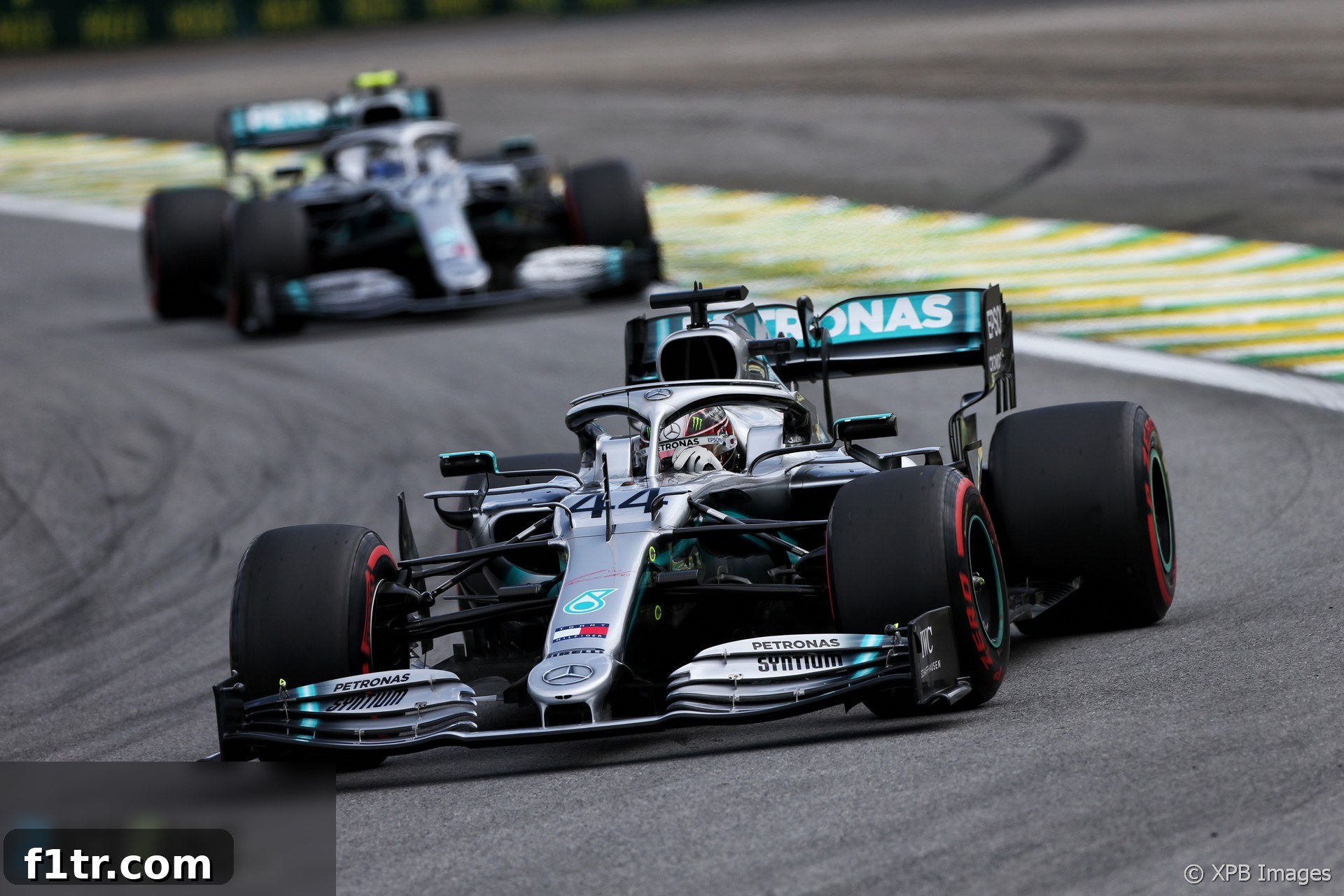
While Mercedes-AMG Petronas F1 Team may have clinched both the Constructors’ and Drivers’ championships with impressive authority this year, a persistent chink in the armour of their otherwise dominant W10 challenger was conspicuously highlighted during qualifying sessions at certain high-altitude venues. The Autódromo José Carlos Pace in Interlagos, Brazil, served as a stark reminder of this particular vulnerability: the W10’s performance in thinner air.
Advert | Become a Supporter & go ad-free
Interlagos stands as the second-highest track on the Formula 1 calendar, positioned significantly above the Red Bull Ring in Austria, though still considerably lower than the dizzying heights of Mexico City, which is over two kilometres above sea level. Yet, across all three of these elevated circuits, Mercedes found themselves outmanoeuvred in qualifying by their closest championship rivals, Ferrari and Red Bull Racing. This recurring pattern ignited discussions within the paddock and among fans about a potential Achilles’ heel for the Silver Arrows.
“This is still a bit higher [from] the sea level in terms of altitude and it is having an effect,” conceded Valtteri Bottas, Mercedes’ Finnish driver, after the qualifying session in Brazil. His comments echoed sentiments from previous high-altitude encounters. “Like we saw in Mexico, I think we are probably, [of] the top teams, the team that struggles more.” Bottas’s candid assessment highlighted the team’s ongoing struggle to extract optimal performance from their power unit in less dense atmospheric conditions, particularly when pushing for a single, flat-out lap.
Delving deeper into the specific areas of struggle, Bottas elaborated on the team’s deficit. “We see we’re still losing on the straight lines, that’s the biggest chunks,” he added, pointing directly to a power delivery issue. “Just that straight up the hill we’re losing too much time. I think that’s one of the biggest things.” The loss of straight-line speed at altitude is a critical disadvantage, especially on tracks like Interlagos, which feature significant climbs and long straights where raw engine power is paramount. This observation underscored that despite their overall package superiority, the W10’s power unit faced a unique challenge in these conditions.
Interestingly, this altitude-induced performance dip appeared to be more pronounced over a single qualifying lap than across a full race distance. This phenomenon suggests that while the raw, peak power output necessary for qualifying is compromised, Mercedes’ formidable race strategy, tire management, and driver talent can often mitigate these deficiencies over longer stints. Indeed, Mercedes managed to secure victory at the highest track on the calendar that year, the Mexican Grand Prix. However, this triumph was not without its share of external factors aligning in their favour, including a grid penalty for Max Verstappen, an early race collision involving Bottas, and a couple of questionable strategic decisions made by their rivals at Ferrari. These elements underscore that their Mexican victory was more a testament to their adaptability and external circumstances than a definitive overcoming of their inherent altitude weakness.
The problem was particularly acute earlier in the season at the Austrian Grand Prix, where unusually high air temperatures exacerbated the altitude effects. While Mercedes promptly introduced an update to address the latter, it was a solution targeted at heat management rather than the fundamental impact of altitude on their engine’s design. James Allison, the team’s technical director, provided crucial insight into why this remains a challenge that is not easily resolved. He explained that the effects of higher altitudes on their engine stem from fundamental design choices related to the turbo compressor unit, which are not simple to alter mid-season or even year-to-year.
“You try and design the turbo compressor unit to be good over the whole season,” Allison stated, highlighting the engineering tightrope walked by F1 teams. The core issue lies in the physics of internal combustion engines and turbocharging. At higher altitudes, the air density decreases, meaning there’s less oxygen available for combustion. A turbocharger’s job is to force more air into the engine to compensate for this. However, there are limits to how much a compressor can work, and increasing its capacity comes with inherent trade-offs. “We come to a couple of tracks a year – Mexico the most extreme example, Brazil less so – where the air is thinner and the compressor has to do more work to get the get charge up to sea level conditions,” he elaborated.
Advert | Become a RaceFans supporter andgo ad-free
“You can size your compressor to cope with Mexico, with here, but then you’re carrying around hardware that’s bigger there needs to be for the rest of the year. It’s always a compromise doing that.” This statement encapsulates the dilemma facing F1 engineers. Designing a turbocharger optimized for the extreme conditions of Mexico City would mean carrying larger, heavier, and potentially less efficient hardware for the majority of the season’s races, which are conducted closer to sea level. Mercedes, it appears, opted for a compromise that prioritizes performance at the majority of tracks, inadvertently leaving them slightly exposed at the handful of high-altitude venues.
“I think probably looking at the last few seasons when we’re in altitude we always tend to be just a little bit less on form. And I think that’s probably an indication that the position we have picked our compromise is slightly different to the others,” Allison concluded. This self-awareness from the Mercedes camp points to a deliberate engineering decision rooted in their overall design philosophy, suggesting that while they acknowledge the weakness, the benefits of their current compromise outweigh the costs for the vast majority of the calendar.
Conversely, while some teams struggle, others appear to thrive at higher tracks. Daniel Ricciardo, the charismatic Australian driver, openly suspected that this advantage holds true for his former team, Red Bull Racing. Their historical performance at altitude provides compelling evidence for this theory, often being a strong contender even when their engine partner might not have been the absolute benchmark.
“There is a trend where the Red Bull, I guess having a good aero package, they do seem better in these high altitude places. In Mexico the last few years they’re always been strong. Here as well. Austria,” Ricciardo observed. His analysis highlights a critical aspect of Red Bull’s design philosophy: their exceptional aerodynamic package, spearheaded by the legendary Adrian Newey. While engine power undeniably suffers at altitude due to thinner air, the reduced air density also translates to less aerodynamic drag. However, it simultaneously means less air for the wings to work with, resulting in reduced downforce. Red Bull’s uncanny ability to generate high levels of efficient downforce even in thinner air allows them to maintain a stronger grip and stability, compensating for some of the power loss experienced by all cars.
“Sure Honda have made progress but it seems the car is certainly working better. When maybe the others lose more, Red Bull can hang on to some of the downforce,” Ricciardo added. This insight suggests a synergistic effect where Honda’s improving power unit, combined with Red Bull’s aero prowess, creates a particularly potent package for high-altitude racing. While Mercedes might be losing outright engine power on the straights, Red Bull’s chassis can still find grip through corners, allowing them to carry more speed and mitigate overall lap time loss. This inherent characteristic gives them a distinct advantage over competitors who might rely more heavily on sheer engine power or whose aero packages are less efficient in such conditions.
With a playful jab at his former technical genius, Ricciardo light-heartedly quipped, “I’ll give Adrian [Newey] a call tonight.” This comment, while humorous, underscores the respect for Newey’s ability to extract performance from a car in various conditions, and particularly highlights the perceived aerodynamic edge Red Bull holds when the air gets thinner, making their cars incredibly nimble and effective even when engine power is compromised across the grid.
Advert | Become a RaceFans supporter andgo ad-free
The intricate engineering challenges presented by Formula 1 cars operating at varying altitudes offer a fascinating glimpse into the compromises and strategic decisions made by top teams. Mercedes’ consistent dominance demonstrates their mastery of most aspects of F1 car design, but their recurring struggles at elevated circuits reveal a specific area where their engineering philosophy diverges from others. This compromise, while costing them pole positions and occasionally making race wins harder-fought, speaks to the immense complexity of designing a racing machine that must perform optimally across a vast array of global conditions, from the humid lowlands to the rarefied air of the mountains. It’s a testament to the fact that even the most dominant teams face specific challenges, and that perfection in every single condition remains an elusive goal in the demanding world of Formula 1.
2019 F1 season
- Crying in the Melbourne car park at 2019 grand prix was my career low – Ocon
- McLaren Racing reports reduced £71 million loss in 2019
- Kvyat: Hockenheim podium last year was “my biggest achievement” so far
- How the FIA’s new encrypted fuel flow meter targets Ferrari’s suspected ‘aliasing’ trick
- “He smashed my office door”: 23 must-see moments from ‘Drive to Survive’ season two
Browse all 2019 F1 season articles