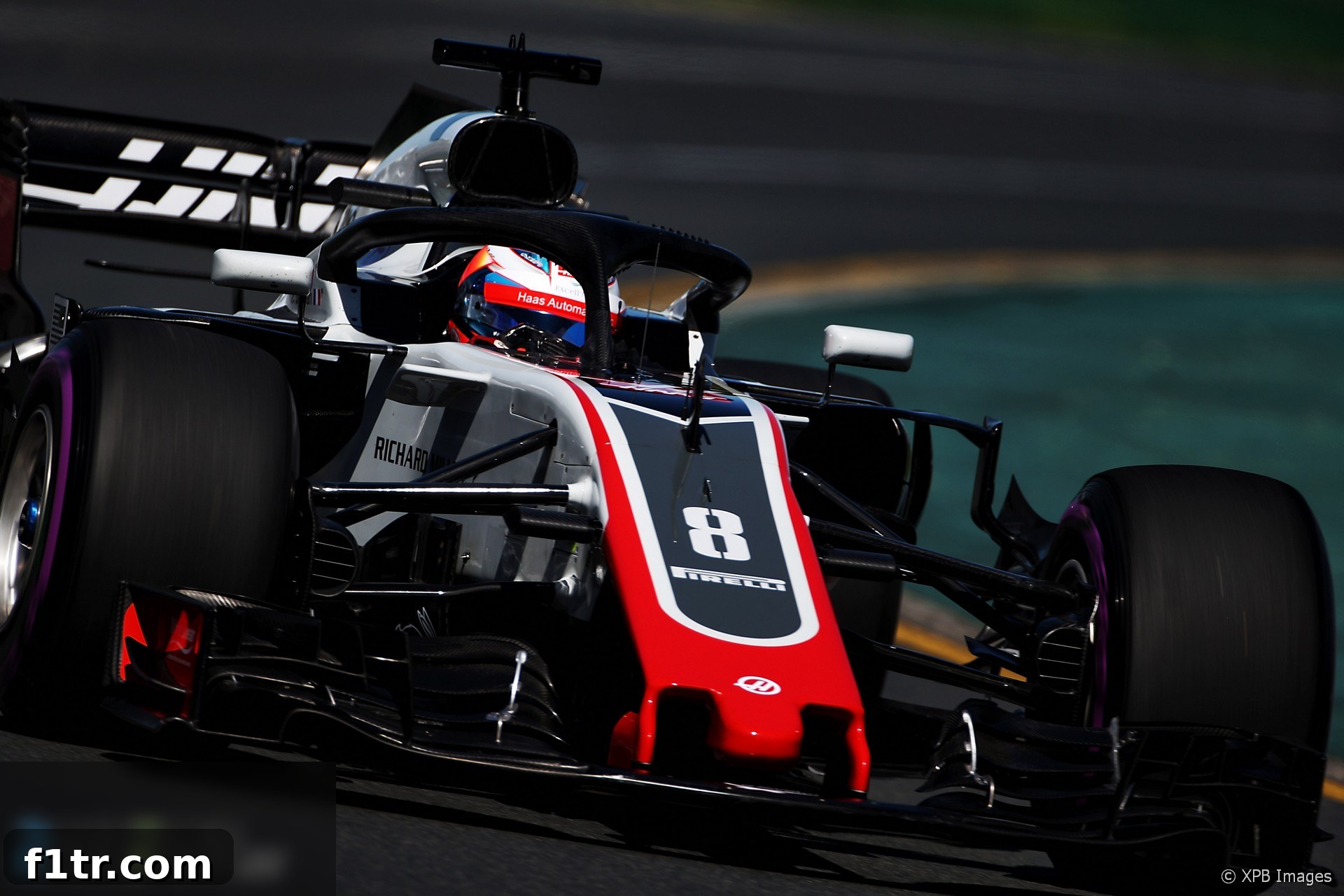
The dawn of a new Formula 1 season always brings with it a sense of anticipation and the promise of fresh rivalries, and the 2018 Australian Grand Prix at Albert Park was no exception. However, amidst the usual battle among the sport’s established titans, a formidable challenger emerged from the midfield, immediately turning heads and sparking conversations across the paddock. Haas F1 Team, a relatively young contender in the sport, delivered a performance that signaled their intent, with Romain Grosjean’s stellar sixth place in the second free practice session on Friday drawing significant attention from rivals and pundits alike.
Grosjean’s impressive lap time put him within a mere seven-tenths of a second of the day’s fastest overall time, a remarkably narrow margin considering the competitive landscape dominated by the ‘big three’ teams – Mercedes, Ferrari, and Red Bull. What truly underscored Haas’s pace was the fact that no other team outside of these top three was able to get within half a second of Grosjean’s benchmark. This wasn’t just a flash in the pan; it was a clear statement of intent, suggesting that Haas had truly unlocked a new level of performance for the 2018 campaign, positioning themselves as a serious contender for the coveted ‘best of the rest’ title right from the off.
The speed displayed by the American outfit did not go unnoticed, particularly among their midfield competitors who were left scrambling to understand the source of Haas’s newfound advantage. Pierre Gasly, a promising talent making his mark with Toro Rosso, openly acknowledged the threat. “Haas is really impressive, I must say,” admitted Gasly, whose team also utilizes Ferrari power units, albeit a year older specification. “They are really fast.” His comments resonated with many who had observed the team’s promising form during pre-season testing. “In Barcelona already we could see they had huge potential,” Gasly further elaborated, referring to the winter testing sessions where Haas frequently featured at the sharp end of the timing screens, consistently demonstrating strong long-run pace and single-lap speed. He concluded with a somewhat sobering assessment for his own team, which was striving to establish itself in the competitive midfield: “Grosjean proved it again today. To be fair I think they’re a bit out of our reach, objectively.” Such a candid admission from a direct competitor highlighted the genuine and unexpected gap Haas had managed to create in the early stages of the Australian Grand Prix weekend, signaling a potential shift in the midfield hierarchy.
The underlying reason for Haas’s sudden leap in performance quickly became a hot topic of discussion across the paddock, with many pointing towards the unique operational model employed by the team. Haas F1 takes maximum advantage of the opportunities offered under Formula 1’s complex technical regulations, specifically concerning the use of ‘non-listed parts’ designed and supplied by Ferrari. Unlike many independent constructors who design and manufacture nearly every component in-house, Haas benefits from an exceptionally close technical partnership with the Scuderia, leveraging their extensive research and development capabilities and resources. This strategic alliance allows them to essentially run a highly optimized package, integrating cutting-edge components developed by one of F1’s most successful and well-funded teams. This includes elements like the engine, gearbox, and various hydraulic systems, which are not mandated to be designed in-house by each constructor. By outsourcing these complex and expensive components, Haas can dedicate its more limited resources to the development of listed parts, such as the chassis and aerodynamic surfaces, thereby maximizing efficiency and performance per dollar spent.
Fernando Alonso, a two-time world champion and a fiercely competitive figure in the paddock, was quick to draw parallels, articulating what many were already thinking. “We knew Haas was the biggest surprise,” he commented. “They have obviously a Ferrari replica of last year. They were winning here the Ferrari [last year].” Alonso’s observation speaks volumes, suggesting that the VF-18 chassis, combined with the latest Ferrari power unit and non-listed components, bore a striking resemblance in performance characteristics to the SF70H, Ferrari’s highly competitive 2017 challenger. This model provides Haas with a significant advantage, allowing them to hit the ground running with a fundamentally strong design without the astronomical development costs typically associated with conceiving a new F1 car from scratch. This strategy has allowed Haas to punch significantly above its weight class, immediately placing them in contention for strong points finishes. Alonso, ever the realist, also offered a prediction for their immediate future: “I think [Haas] will be very strong in this first part of the season. Hopefully we can be close to them.” His hope highlights the underlying concern among other midfield teams that Haas might be setting an insurmountable pace early on, potentially dominating the midfield battle for the initial races of the F1 2018 season.
While the immediate pace and promise were undeniable, historical precedent offered a cautious note regarding Haas’s long-term sustainability throughout a demanding F1 season. The team has, in previous seasons, demonstrated a tendency to start its campaigns strongly, often surprising rivals with its initial speed, only to see its competitors gradually catch up and, in some cases, surpass them in terms of in-season development. This pattern was particularly evident in its debut 2016 season, where the team shocked the paddock by scoring points in its first two races with fifth and sixth places respectively – an unprecedented achievement for a new constructor in the modern era. However, as that season progressed, larger and more established teams with greater R&D budgets, larger engineering teams, and superior manufacturing capabilities began to pull ahead. The 2017 season followed a similar trajectory, with strong early performances giving way to a more challenging second half where the team struggled to consistently extract performance and update their car effectively. This recurring pattern led to questions about the team’s ability to sustain its initial performance advantage over an entire 21-race calendar, especially when pitted against rivals with far more extensive resources.
Esteban Ocon, driving for Force India – another strong midfield contender known for its efficient development – articulated this widely held view among rival teams. “They are always quick in the beginning of the season,” he observed. “They were last year, very fast, then we caught up during the season last year. So today they are quick, let’s see tomorrow, that’s when it counts. But at the moment they are very quick.” Ocon’s perspective reflects the mindset of many rival teams: acknowledging Haas’s raw speed and strong start but banking on their own robust in-season development programs to close the gap as the season progresses. The inherent challenge for a smaller, independent team like Haas will be to defy this historical trend and prove that their 2018 package not only has fundamental strength but also the underlying development capacity and strategic flexibility to remain competitive throughout the entire championship. The midfield fight for constructors’ championship points is often won by consistent development, not just initial speed.
Recognizing these historical development challenges and determined to overcome them, Haas had made a strategic decision very early in the previous year to divert a significant portion of its limited resources and engineering energies from its 2017 car to the development of this year’s model, the VF-18. This proactive approach was a calculated risk, essentially sacrificing potential gains in the latter half of 2017 for a stronger and more competitive start to the 2018 campaign. The early returns from Albert Park suggested this gamble had paid off handsomely, validating their strategic shift. Romain Grosjean himself exuded optimism about the team’s prospects, believing this forward-thinking strategy had put them in an exceptionally strong position for the year ahead, potentially enabling them to stay competitive within the tightly packed midfield throughout the season. This early focus meant that the VF-18 was a mature package from the outset, allowing them to extract maximum performance immediately.
“What’s really encouraging is we’re not too far from the Ferraris which is a good benchmark for us,” Grosjean stated, emphasizing the proximity in pace to their technical partner and a front-running team. This close comparison indicated the true potential of their package, suggesting that the VF-18 was not just ‘best of the rest’ but potentially knocking on the door of the top teams on certain track layouts. He also acknowledged the formidable competition behind them, recognizing the intensity of the midfield battle: “But again I think it’s pretty tight behind as well. It’ll be interesting and I think the midfield fight is going to be all year long.” Grosjean’s comments painted a picture of a midfield battle that would be intense and sustained, with several teams – including Renault, McLaren, Force India, and Toro Rosso – vying for the coveted positions and valuable constructors’ championship points. For Haas, the ability to consistently score points would be crucial for solidifying their position as a serious contender and demonstrating their long-term viability and ambition in the highly competitive world of Formula 1. The 2018 season was shaping up to be a pivotal year for the American team.
The Australian Grand Prix’s practice sessions served as a thrilling preamble to what promised to be an electrifying 2018 F1 season. Haas F1 Team, spearheaded by the impressive pace of Romain Grosjean, had firmly established itself as a significant player in the midfield equation. Their strategic partnership with Ferrari, meticulous preparation, and early focus on the VF-18 had undeniably delivered a potent package that surprised many. The question that lingered, however, and one that only time and race weekends would definitively answer, was whether Haas could maintain this blistering pace and development trajectory against well-resourced and equally ambitious rivals who would be working tirelessly to catch up. Their performance in Australia not only ignited excitement for the season ahead but also set a high bar for their own aspirations, challenging the established order of the midfield and adding another compelling narrative to the grand spectacle of Formula 1, making them one of the most intriguing teams to watch in the upcoming races.
2018 F1 season
- F1 feared “death knell” for Drive to Survive after Ferrari and Mercedes snub
- McLaren staff told us we were “totally crazy” to take Honda engines in 2018 – Tost
- ‘It doesn’t matter if we start last’: How Red Bull’s junior team aided Honda’s leap forward
- Honda’s jet division helped F1 engineers solve power unit problem
- McLaren Racing losses rise after Honda split
Browse all 2018 F1 season articles