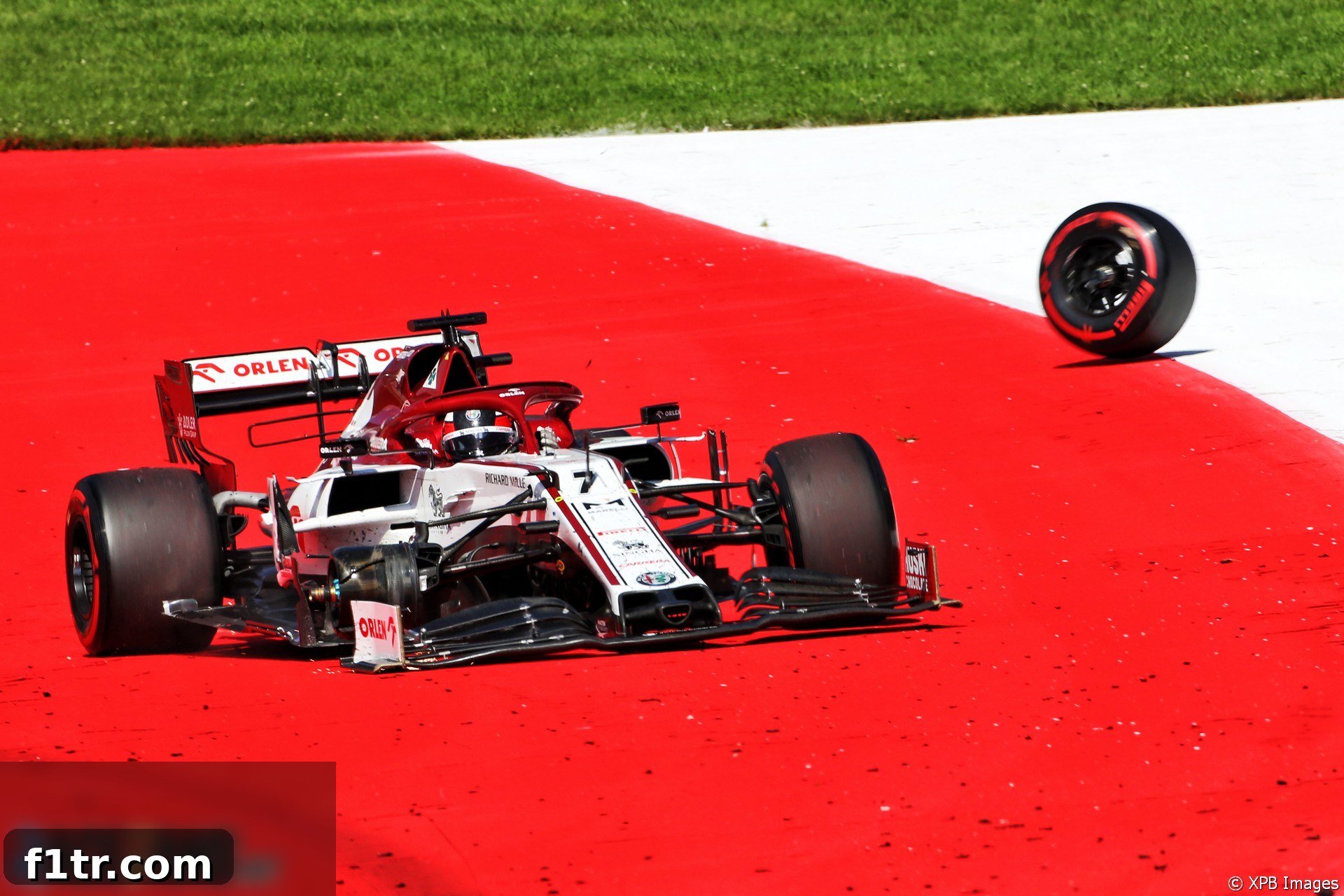
The high-stakes world of Formula 1 demands absolute precision, and even the smallest error can carry significant consequences. This was starkly demonstrated at the Austrian Grand Prix when Alfa Romeo Racing ORLEN was handed a €5,000 fine. The penalty came after a concerning incident saw veteran driver Kimi Raikkonen’s front-right wheel detach from his C39 car during the race, highlighting critical issues in pit stop procedures and vehicle safety. The event, which thankfully did not result in a major accident, prompted immediate investigation by the race stewards and served as a potent reminder of the constant pursuit of perfection required in top-tier motorsport.
A Race-Defining Incident: Raikkonen’s Wheel Comes Loose
The incident unfolded shortly after a Safety Car period, which had been deployed to clear debris from a previous incident on track. During this neutralised period, Raikkonen brought his Alfa Romeo into the pits for a scheduled tire change, a routine procedure that teams practice hundreds of times to achieve lightning-fast efficiency. However, what should have been a seamless stop turned problematic. As the race restarted and the field accelerated back to racing speeds, the front-right wheel of Raikkonen’s car dramatically broke free. The sight of a wheel rolling independently across the track is one of the most alarming in motorsport, presenting an immediate and grave danger to other competitors, marshals, and spectators.
Raikkonen, known for his calm demeanor, was fortunately able to bring his car to a safe stop without further incident, but the damage was done – his race was over prematurely. This unexpected retirement was a bitter pill for both the driver and the Alfa Romeo team, especially given that early signs suggested a potentially strong performance for the Finnish driver in what was shaping up to be an unpredictable race. The early exit meant missing out on valuable championship points and an opportunity to assess the car’s true potential in race conditions.
Stewards’ Findings: A Cross-Threaded Error and Official Reprimand
Following the race, the FIA stewards launched a thorough investigation into the cause of the detachment. Their meticulous examination involved scrutinizing telemetry data, reviewing video footage of the pit stop, and physically inspecting the damaged components. The findings pointed to a critical error during the pit stop: the wheel nut holding the front-right wheel in place had become “cross-threaded.” This occurs when the nut is not correctly aligned with the wheel stud before being tightened, leading to the threads stripping or not engaging properly. Consequently, despite appearing to be tight, the nut failed to secure the wheel adequately under the immense forces exerted during high-speed racing.
The stewards’ report explicitly stated, “Having examined photos of the damaged wheel and the axle shaft it is evident that the wheel nut of the RHS front wheel got cross threaded during the wheel change which was not identified by the wheel gun operator.” This highlights a fundamental human error during a high-pressure, time-sensitive operation. Pit stops are choreographed ballets of precision, with fractions of a second making a difference, yet they must also prioritize safety above all else.
Crucially, the stewards acknowledged a significant mitigating factor in their decision to issue a monetary penalty rather than a more severe sporting sanction. They understood that “neither the team nor the driver had the opportunity to realise that the car was in unsafe condition and therefore did not stop the car.” Once the car was released from the pit box, there was no immediate indication within the cockpit or via team telemetry that the wheel was improperly secured. Drivers often receive warnings for issues like tire pressure or loose components, but a cross-threaded nut that only fully gives way under racing load can be insidious and undetectable until it’s too late. This acceptance prevented a harsher penalty, such as a grid drop for the subsequent race, which is sometimes applied for unsafe releases in F1.
Kimi Raikkonen’s Disappointment and Team Implications
For Kimi Raikkonen, the incident was a source of considerable frustration. Known for his candid remarks, the ‘Iceman’ expressed his disappointment: “It’s a shame to end the race like this when things were looking good.” He further elaborated on the unexpected nature of the failure, stating, “The problem came as a surprise. I had no warning it would happen. We will need to investigate what happened. For now, we can take some positives from our pace in race conditions and keep improving the car.” Raikkonen’s comments underscore the unpredictable element of mechanical failures and the need for continuous improvement, even for highly experienced teams operating at the pinnacle of motorsport.
Beyond the immediate financial penalty, the incident carried broader implications for Alfa Romeo. Such errors can impact team morale, dent their reputation for reliability and operational excellence, and potentially influence future sponsorship deals. In a sport where every point counts, especially for midfield teams battling for constructor standings, an avoidable retirement due to a pit stop error is particularly costly. It necessitates an internal review of their pit stop procedures, equipment, and training protocols to prevent recurrence. Maintaining flawless operational standards is paramount, and any lapse can undermine months of engineering effort and driver skill, crucial factors in competitive Formula 1.
The Critical Importance of Pit Stop Safety in Formula 1
Pit stops in Formula 1 are a spectacle of speed and teamwork, often lasting less than two seconds. However, beneath the surface of this rapid operation lies an intricate web of safety protocols. The FIA, F1’s governing body, places immense emphasis on ensuring the safety of all participants, and wheel retention is a cornerstone of these regulations. A loose wheel at F1 speeds can become a dangerous projectile, capable of causing catastrophic damage or severe injury. This is why teams invest heavily in state-of-the-art equipment and rigorous training for their pit crew members, who must perform under incredible pressure and without error.
Over the years, F1 has introduced several measures to enhance pit stop safety. These include mandatory wheel retention tethers, designed to keep a wheel attached to the car even if the nut comes loose, and strict rules regarding unsafe releases from the pit box. While these measures significantly reduce risks, incidents like Raikkonen’s highlight that human error, combined with mechanical vulnerabilities, can still lead to unforeseen failures. The cross-threaded nut serves as a poignant reminder that even with advanced technology and strict rules, the human element remains a critical factor, demanding constant vigilance and perfection from every individual involved in a pit stop procedure.
The €5,000 fine, while seemingly modest for an F1 team, serves as an official reprimand and a clear deterrent. It underscores the FIA’s zero-tolerance policy for unsafe equipment and operational failures, reinforcing the message that all teams must adhere to the highest standards of safety and mechanical integrity. This incident will undoubtedly prompt Alfa Romeo to conduct a comprehensive internal audit of their pit stop procedures, equipment maintenance, and personnel training to identify and rectify any systemic weaknesses, ensuring such an incident is not repeated in the future.
The Road Ahead for Alfa Romeo and Kimi Raikkonen
Despite the unfortunate conclusion to his Austrian Grand Prix, Kimi Raikkonen’s overall assessment of the car’s pace in race conditions offered a glimmer of optimism. For Alfa Romeo, converting this promising pace into championship points is crucial for their standing in the Constructors’ Championship. The team’s focus will now shift to meticulously analysing the root cause of the cross-threaded nut, implementing robust corrective actions, and fine-tuning their pit stop operations. In a fiercely competitive season, reliability and operational excellence are just as important as outright speed.
The incident serves as a valuable, albeit costly, learning experience for Alfa Romeo Racing ORLEN. It reaffirms that in Formula 1, every component, every procedure, and every team member plays a vital role in the overall success and safety of the operation. As they move forward in the 2020 F1 season and beyond, the team will be striving to eliminate such fundamental errors, ensuring that their drivers can maximize their potential on track without the unexpected interruption of a detached wheel.
The continuous evolution of Formula 1 safety standards means that incidents like this are becoming rarer, but they are a potent reminder that the pursuit of perfection never ends in this demanding sport. Teams are constantly pushing the boundaries of engineering and human performance, and every failure, no matter how small, offers an opportunity for improvement and enhanced safety for all involved.
Related Articles: 2020 F1 Season Insights and More
- Grosjean to make F1 test return tomorrow for first time since Bahrain horror crash
- Pictures: Wrecked chassis from Grosjean’s Bahrain fireball crash to go on display
- Bottas vs Rosberg: Hamilton’s Mercedes team mates compared after 78 races each
- F1 revenues fell by $877 million in Covid-struck 2020 season
- Hamilton and Mercedes finally announce new deal for 2021 season
Browse all 2020 F1 season articles