Monaco F2 Feature Race Plunged into Controversy: Unpacking Race Control’s Costly Error
The iconic streets of Monaco, usually a backdrop for motorsport excellence, became the scene of significant controversy during the 2019 Formula Two (F2) feature race. An egregious error by race control during a critical restart procedure led to a staggering eleven drivers being unfairly penalised a lap, profoundly impacting the competitive integrity and the outcome of the event. This incident sparked immediate outrage and formal protests, bringing the crucial role of race control and the strict adherence to sporting regulations under intense scrutiny within the FIA F2 Championship.
Despite a comprehensive investigation that confirmed the procedural breach, the race stewards ultimately ruled that the results would stand unchanged. Their reasoning cited the absence of any “equitable method” to rectify such a widespread and complex error post-race, leaving many in the motorsport community to ponder the balance between procedural mistakes and the pursuit of fair competition for aspiring Formula 1 talents.
Advert | Become a Supporter & go ad-free
The Red Flag Incident and its Unintended Consequences
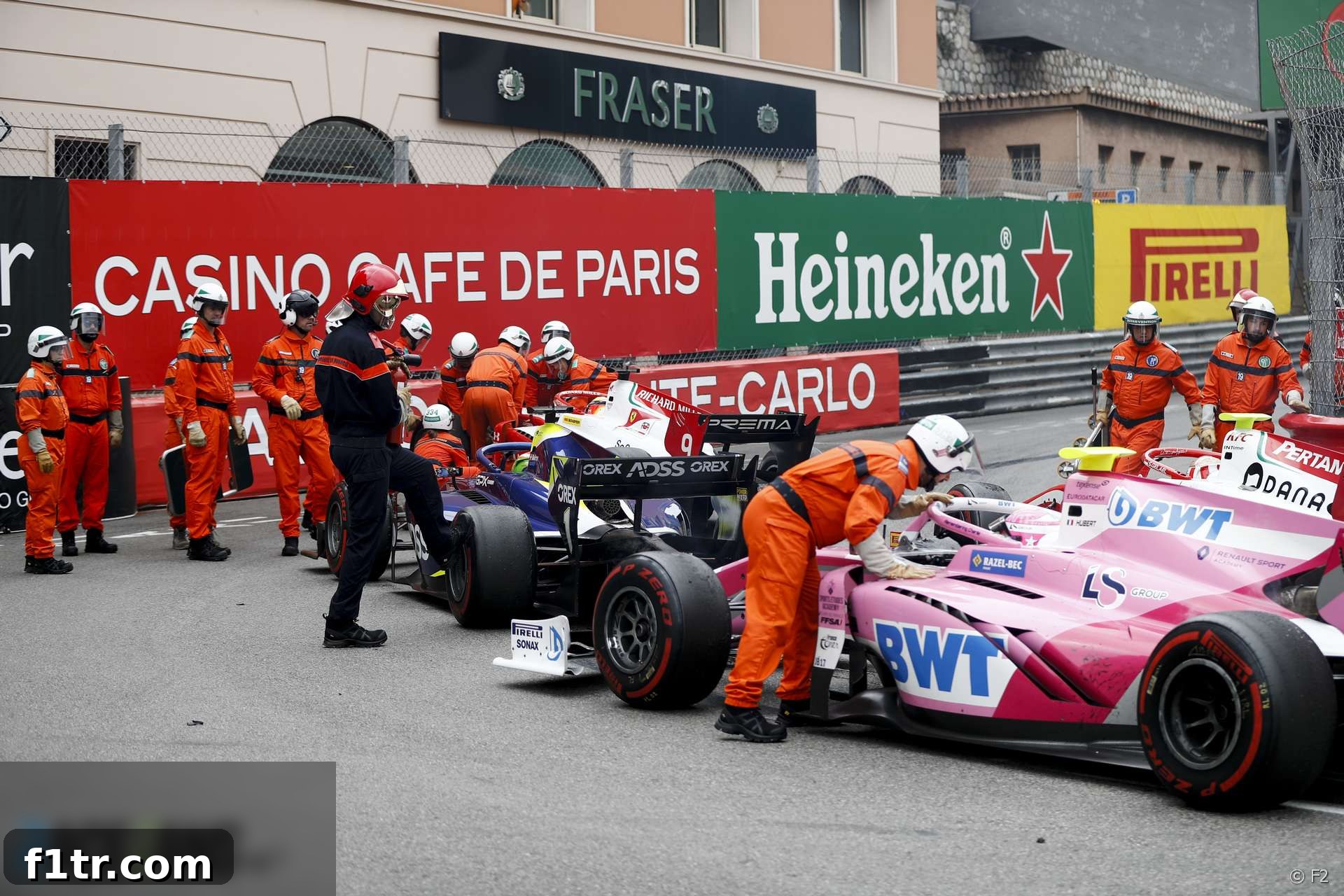
The sequence of events that led to the controversy began when the feature race was suspended under a red flag. This interruption was triggered by an incident at the challenging Rascasse corner, a notoriously tight and unforgiving section of the Monaco street circuit. Mick Schumacher, maneuvering through the demanding layout, spun Tatiana Calderon, causing a blockage on the track and making it unsafe for racing to continue. The immediate response was a red flag, bringing the race to a halt to allow marshals to safely clear the debris and ensure the circuit was safe for resumption.
Crucially, at the moment the red flag was deployed, all nineteen drivers competing in the race were still on the lead lap. This meant that, under normal circumstances, a restart would see all competitors on equal footing, battling for position and points. However, the subsequent restart procedure deviated significantly from protocol. When the race eventually resumed, a bewildering turn of events saw only eight drivers remaining on the lead lap. An astounding eleven drivers, through no fault of their own, had inexplicably lost an entire lap to the race leaders, effectively ending their hopes of a meaningful result in one of the most important races of the F2 calendar.
A Breach of Protocol: Unraveling the Flawed Restart
The heart of the problem lay in a direct failure to correctly implement Article 42.3 of the 2019 FIA F2 Sporting Regulations. This specific regulation governs the restart procedure after a red flag, particularly when a safety car is not deployed immediately preceding the suspension. The rule is meticulously crafted to ensure fairness and prevent drivers from being unjustly disadvantaged by their track position at the moment of a sudden race halt. Its purpose is to allow any cars that found themselves out of sequence or effectively ‘lapped’ due to the timing of the red flag to regain their position at the back of the field, thereby re-establishing a fair competitive order for the restart.
Article 42.3 precisely stipulates: “At the two minute point, any cars between the Safety Car and the leader, in addition to any cars that had been lapped by the leader at the time the race was suspended, will be allowed to leave the pit lane and complete a further lap, without overtaking, and join the line of cars behind the Safety Car which left the pit lane when the race was resumed.” This critical allowance ensures that all drivers can resume racing on the same lap as the leader, preserving the integrity of the competition. However, in the Monaco feature race, this vital transitional lap was not permitted, leading directly to the widespread penalisation.
The list of drivers who bore the brunt of this procedural oversight was extensive, comprising more than half the grid. These skilled competitors, many vying for championship points or their breakthrough moment, found their races effectively ruined by the arbitrary loss of a lap. The affected drivers included:
- Mick Schumacher
- Tatiana Calderon
- Louis Deletraz
- Sean Gelael
- Anthoine Hubert
- Ralph Boschung
- Nicholas Latifi
- Jack Aitken
- Nikita Mazepin
- Giuliano Alesi
- Mahaveer Raghunathan
For any driver, losing an entire lap in a championship as competitive as F2 is a monumental setback. In Monaco, where overtaking opportunities are scarce and track position is paramount, it became an almost insurmountable hurdle, relegating these drivers to the back of the classification and stripping them of any realistic chance to score points or compete for a strong finish.
The Stewards’ Verdict: Acknowledgment Without Rectification
Following the race, a formal protest was lodged, prompting the stewards to conduct a thorough and in-depth investigation. Their inquiry involved detailed discussions with the race director, race control personnel, and timing officials, meticulously reviewing the events leading up to and during the restart. The findings were unequivocal: race control had indeed failed to adhere to the prescribed restart procedure as per Article 42.3 of the FIA F2 Sporting Regulations.
The official statement from the championship confirmed this acknowledgment of error: “The protest is well founded and the protester did not act in bad faith… The protest deposit is returned to the competitor and the stewards take no further action.” This confirmation validated the grievances of the affected teams and drivers, affirming that a genuine mistake had occurred. The investigation clarified that while the cars were correctly assembled in the pit lane and re-ordered based on their last timing loop position before the red flag, the subsequent and crucial step – allowing incorrectly placed cars to complete a lap and rejoin the rear – was omitted.
However, despite identifying the clear procedural flaw, the stewards faced a significant dilemma regarding rectification. Their final ruling articulated the complexity of the situation: “While this procedure negatively impacted the remainder of the race by putting significantly more cars down a lap than would otherwise have been the case, the stewards find no equitable method to resolve this error and accordingly leave the results from race one as they stand.” This decision highlights the challenging realities of motorsport adjudication. While acknowledging the injustice, the stewards determined that attempting to reconstruct or alter the race results post-facto for so many drivers would introduce further complexities and potential unfairness to those who raced under the conditions presented, however flawed. The practical challenges of unwinding an entire segment of a race, especially given the dynamic nature of motorsport, were deemed insurmountable without creating new, equally problematic scenarios.
Broader Implications for Motorsport Integrity and Future Races
The Monaco F2 incident serves as a stark reminder of the immense pressure and responsibility placed upon race control teams in top-tier motorsport. The meticulous application of complex regulations is paramount, as even a single procedural misstep can have profound and lasting consequences for drivers, teams, and the integrity of a championship. For Formula Two, which serves as a vital proving ground for future Formula 1 stars, such controversies can undermine the perception of fair competition and potentially impact the careers of young talents striving for recognition.
This event underscores the necessity for continuous review and refinement of race procedures, as well as robust training for all personnel involved in race operations. While human error is an inevitable factor, systems and redundancies should be in place to minimize its impact and ensure that the spirit of fair play is always upheld. The stewards’ difficulty in finding an “equitable method” to correct the error also raises questions about whether clearer protocols or tools are needed to address such systemic failures when they occur, perhaps through more flexible post-race adjustment mechanisms in extraordinary circumstances. Ultimately, the Monaco F2 race became a case study in the fine line between acknowledging error and the practical challenges of delivering perfect justice in the fast-paced world of motor racing.
Advert | Become a RaceFans supporter andgo ad-free
Luca Ghiotto’s Disqualification: A Separate Technical Twist
Adding another layer of drama and consequence to the Monaco F2 feature race was the unrelated but equally significant disqualification of Luca Ghiotto. Ghiotto, who had initially impressed by finishing second, was stripped of his podium position following post-race scrutineering. The reason for his disqualification was a technical infringement: his team was found to have used steering rack stops that did not conform to the strict technical specifications outlined in the FIA F2 regulations. This decision highlights the unwavering commitment of motorsport governing bodies to technical compliance, ensuring that all teams adhere to the same rules to maintain a level playing field.
Ghiotto’s disqualification led to a significant reshuffle of the final standings. Nobuharu Matsushita was promoted to a well-deserved second place, inheriting valuable championship points. Sergio Sette Camara moved up to third, securing a podium finish he had not originally achieved. Further down the field, Louis Deletraz advanced from eighth to seventh. Crucially, this cascade of changes directly impacted the grid for the upcoming sprint race: Anthoine Hubert, who now inherited eighth place, was awarded pole position for the sprint race. This turn of events provided an unexpected opportunity for Hubert, demonstrating how technical infringements, even if seemingly minor, can have far-reaching consequences for multiple competitors.
Conclusion: A Complex Chapter in F2 History
The 2019 Formula Two feature race in Monaco will undoubtedly be remembered as one of the most contentious events in recent F2 history. From the race control error that unfairly jeopardized the races of eleven talented drivers to Luca Ghiotto’s technical disqualification, the day was a stark reminder of the multifaceted challenges and unforgiving nature of top-tier motorsport. It underscored the critical importance of human precision in race management and unwavering adherence to technical regulations.
While the stewards’ diligent investigation and their ultimate decision to uphold the original race results, despite acknowledging a significant error, provoked debate, it also reflected the complexities involved in adjudicating such incidents. The episode served as a crucial learning experience for the entire FIA F2 Championship, reinforcing the imperative of flawless execution of sporting protocols to ensure fair competition and protect the aspirations of every driver striving for success on their path to Formula 1.
Advert | Become a RaceFans supporter andgo ad-free
Explore More Formula Two Content
- Formula 2 to debut in Miami and Montreal after Iran war cancellations
- Ex-McLaren junior Dunne’s move to Alpine finally confirmed
- Schumacher says his IndyCar feels like ‘an F2 car, just with better tyres’
- The Formula 2 team with an older driver line-up than almost half the F1 grid
- FIA to award more F1 superlicence points to IndyCar drivers from 2026
Browse all Formula 2 articles