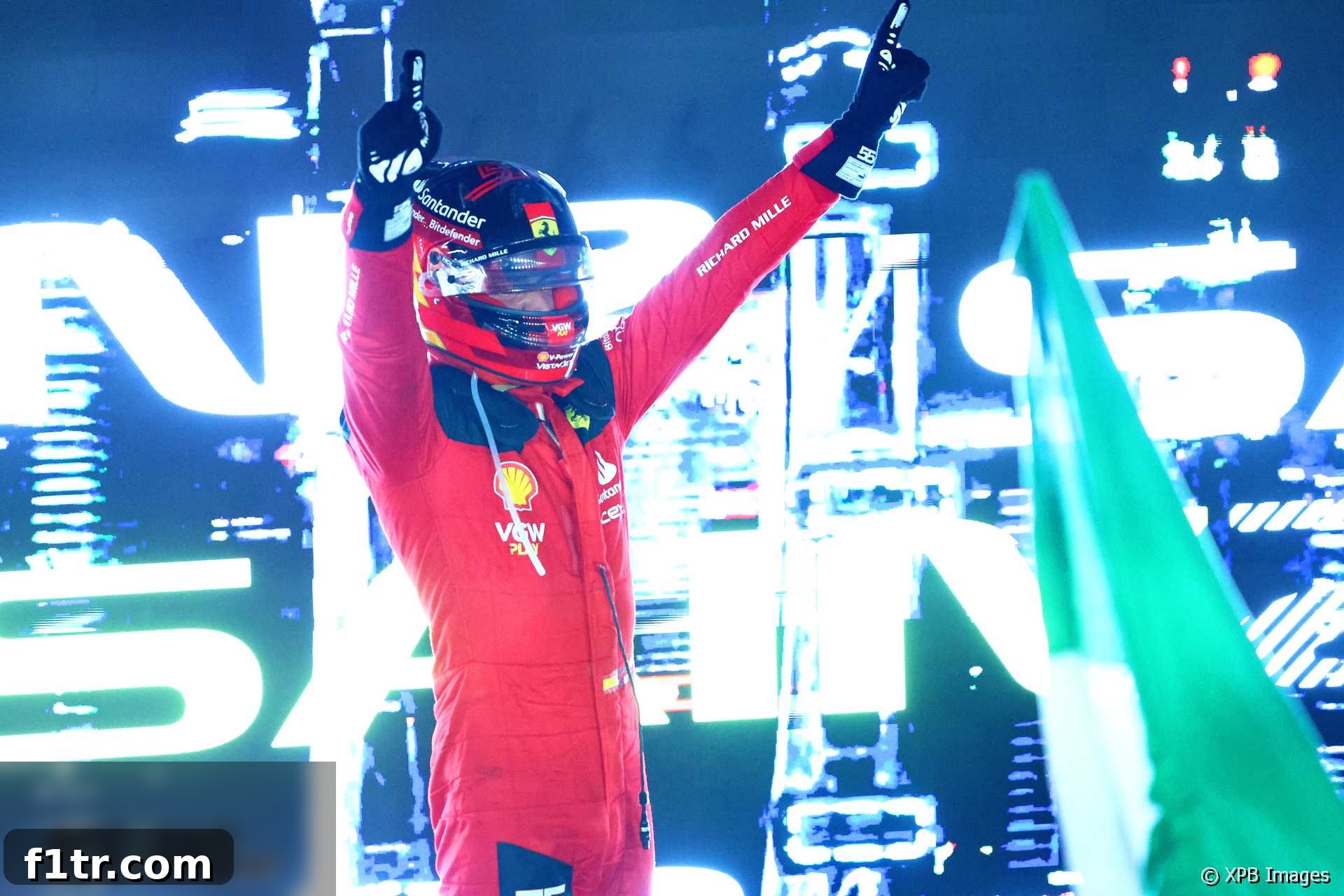
The 2023 Formula 1 season witnessed an unprecedented level of dominance from Red Bull Racing, with the team, and particularly Max Verstappen, sweeping nearly every Grand Prix. However, amidst this relentless march towards championship glory, one race stood out as a beacon of resistance, a thrilling testament to strategic brilliance and nail-biting finishes: the Singapore Grand Prix. It was here, under the dazzling night lights of the Marina Bay Street Circuit, that Carlos Sainz Jnr of Scuderia Ferrari delivered a masterclass performance, ending Red Bull’s seemingly unassailable unbeaten run and securing a memorable victory.
The Singapore Grand Prix is renowned for its demanding nature, a tight, twisty street circuit where precision, physical endurance, and exceptional tyre management are paramount. The sweltering heat and oppressive humidity amplify the challenge for drivers and engineers alike, often leading to unpredictable races punctuated by Safety Cars and strategic gambles. This year’s edition proved to be no exception, unfolding into one of the most enthralling contests of the season.
Sainz’s triumph was not just a personal milestone, marking his first victory of the year, but also a momentous occasion for Ferrari, securing their sole win of the 2023 campaign. The Spaniard held off a relentless challenge from Lando Norris in his McLaren, demonstrating immense composure and strategic acumen in the final laps. Adding to the drama, a late charge from the Mercedes duo, George Russell and Lewis Hamilton, on fresh tyres kept everyone on the edge of their seats. Tragically, Russell’s valiant effort ended with a crash on the very last lap, elevating Hamilton to a hard-fought third place. Meanwhile, championship leader Max Verstappen, who had started outside the top ten after a challenging qualifying session, recovered to finish fifth, just behind his struggling teammate Charles Leclerc, who managed fourth place despite severe tyre degradation.
The race began with a crucial strategic divergence in tyre choices. While all drivers within the top 10 opted for the durable medium compound for their initial stint, Charles Leclerc stood out, choosing a used set of soft tyres. This decision immediately paid dividends as the lights went out. Sainz, starting from a well-deserved pole position, held his lead into Turn 1, but Leclerc, leveraging the superior grip of his softs, rocketed past Russell into second place. The opening moments saw further jostling for position, with Hamilton going side-by-side with his teammate and Norris, briefly running off the circuit before rejoining ahead of Russell. Demonstrating fair play and adherence to racing rules, Hamilton swiftly yielded the position back to Russell on lap two, and then to Norris two laps later, settling into fifth.
In the early stages, Ferrari showcased impressive team cohesion. Leclerc, initially running within a second of his leading teammate, was instructed to manage his pace, creating a buffer of three seconds, which was later extended to five. Sainz, meanwhile, expertly controlled the race from the front, reporting to his team that he had ample pace in hand, skillfully preserving his medium tyres and dictating the tempo. This measured approach was a clear indication of Ferrari’s well-thought-out strategy, aiming to maximize their advantage on a track where tyre degradation is a constant concern.
The race dynamic shifted dramatically on lap 20 with the deployment of the Safety Car. Logan Sargeant, in an unfortunate incident, locked up his brakes into Turn 8, making contact with the wall and scattering debris across the circuit. This provided an immediate opportunity for a pit stop, and almost the entire field dove into the pits to switch to hard tyres, anticipating a long second stint. Notably, the Red Bulls of Verstappen and Sergio Perez, having started on hard tyres and out of sync with the front runners, remained out, hoping to gain track position. Sainz, executing a perfect pit stop, emerged ahead of Verstappen, maintaining his lead. Russell slotted into third, followed by Perez and Norris, while Leclerc dropped to sixth due to the congestion in the pit lane.
The Safety Car period ended on lap 23, and Sainz once again demonstrated his authority, pulling a second clear of the Red Bull almost immediately. The restart proved challenging for Verstappen, who, on older hard tyres, struggled for traction and soon came under intense pressure. Russell, sensing an opportunity, made a decisive move, passing the reigning champion into Turn 16. On the very next lap, Norris capitalized on Verstappen’s woes, slipping past to claim third. Hamilton, also on a charge, overtook both Leclerc and Perez to move up to fifth, setting the stage for a thrilling battle at the front.
As the race progressed, the top four cars – Sainz, Russell, Norris, and Hamilton – converged, separated by just over two seconds. This was a critical juncture, and Ferrari’s strategic brilliance truly shone through. Sainz was instructed to manage his pace, deliberately backing up Russell behind him. This ingenious tactic had a dual purpose: it kept Russell within striking distance but, crucially, also ensured that Norris, in third, benefited from Sainz’s DRS, thereby creating a ‘DRS train’. This meticulously executed strategy prevented Russell from attacking Sainz directly, as any move would put Norris in an even stronger defensive position, making it incredibly difficult for the Mercedes to find a way through. Hamilton, meanwhile, had displaced Verstappen for fourth, with Leclerc soon following suit, further highlighting Red Bull’s uncharacteristic struggles in Singapore.
The Red Bulls eventually made their pit stops on lap 40, with Verstappen rejoining the race in a distant 15th position on fresh medium tyres, a stark contrast to their usual front-running performance. The front four continued their tight procession until lap 43, when another incident brought out the Virtual Safety Car. Esteban Ocon’s Alpine suffered a gearbox problem, forcing him to pull off the circuit.
This VSC period presented a high-stakes gamble for Mercedes. As Ocon’s car was cleared, both Russell and Hamilton executed a daring double pit stop, bolting on a fresh set of medium tyres that Mercedes had strategically saved during practice. This bold move dropped them to fourth and fifth respectively, but armed them with significantly fresher rubber. The race resumed with just 17 laps remaining, and Russell faced a daunting 17-second gap to leader Sainz, a seemingly insurmountable challenge that underscored the audacious nature of Mercedes’ strategy.
What followed was a breathtaking demonstration of raw pace and unwavering determination from the Mercedes drivers. Russell, pushing his W14 to its absolute limits, began to carve through the deficit. With ten laps remaining, he caught and passed Leclerc into Turn 14, a move swiftly emulated by Hamilton. The two Mercedes were flying, their fresh tyres giving them a distinct advantage over the leaders, who were battling on significantly older hard compounds. With just five laps left, the Silver Arrows had remarkably closed the gap and were right on the tail of Sainz and Norris. However, Sainz’s brilliant DRS tactic remained effective, continuously giving Norris the advantage and preventing Russell from making a clean pass for second, which would have then given him DRS on Sainz. The tension was palpable, a classic cat-and-mouse game unfolding under the floodlights.
The drama reached its heartbreaking crescendo on the final lap. Russell, pushing relentlessly behind Norris on the run to Turn 10, clipped a barrier, losing control and sliding off the circuit, crashing out of the race in a gut-wrenching moment. It was a cruel end to a magnificent charge, highlighting the unforgiving nature of street circuits and the fine margins of Formula 1 racing.
Carlos Sainz, managing to navigate the final moments with extraordinary calm, took the chequered flag, securing a magnificent victory. It was a truly historic moment, bringing an end to Red Bull’s unprecedented unbeaten streak in the 2023 season and marking the first non-Red Bull victory since the 2022 Brazilian Grand Prix. Lando Norris finished a well-deserved second, having expertly defended his position, while Lewis Hamilton inherited third place following Russell’s unfortunate demise. Charles Leclerc was promoted to fourth, finishing a mere three-tenths of a second ahead of Max Verstappen in fifth, a strong recovery for the reigning champion after a difficult weekend.
The race also delivered exciting battles further down the field. Pierre Gasly secured a commendable sixth place for Alpine, ahead of Oscar Piastri in seventh. Sergio Perez salvaged an eighth-place finish, while Liam Lawson, impressing in his rookie appearances, clinched his first career points and AlphaTauri’s best finish of the season with a brilliant ninth. Russell’s last-lap retirement also promoted Kevin Magnussen into the final points-scoring position, adding to the unpredictable nature of the 2023 Singapore Grand Prix. This race will undoubtedly be remembered as a classic, a testament to strategic genius, intense racing, and the sheer unpredictability that makes Formula 1 so captivating.
2023 Singapore Grand Prix Insights and Analysis
- Sainz’s Singapore win made Leclerc focus on improving his race pace – Clear
- Singapore and Austin retirements cost me top 10 championship place – Ocon
- How Ocon’s “extreme” height for an F1 driver is helping other tall racers
- Steward’s admission Verstappen should have had penalty frustrates his rivals
- Drivers back Singapore qualifying tweak as rule changes again for Japanese GP
Browse all 2023 Singapore Grand Prix articles