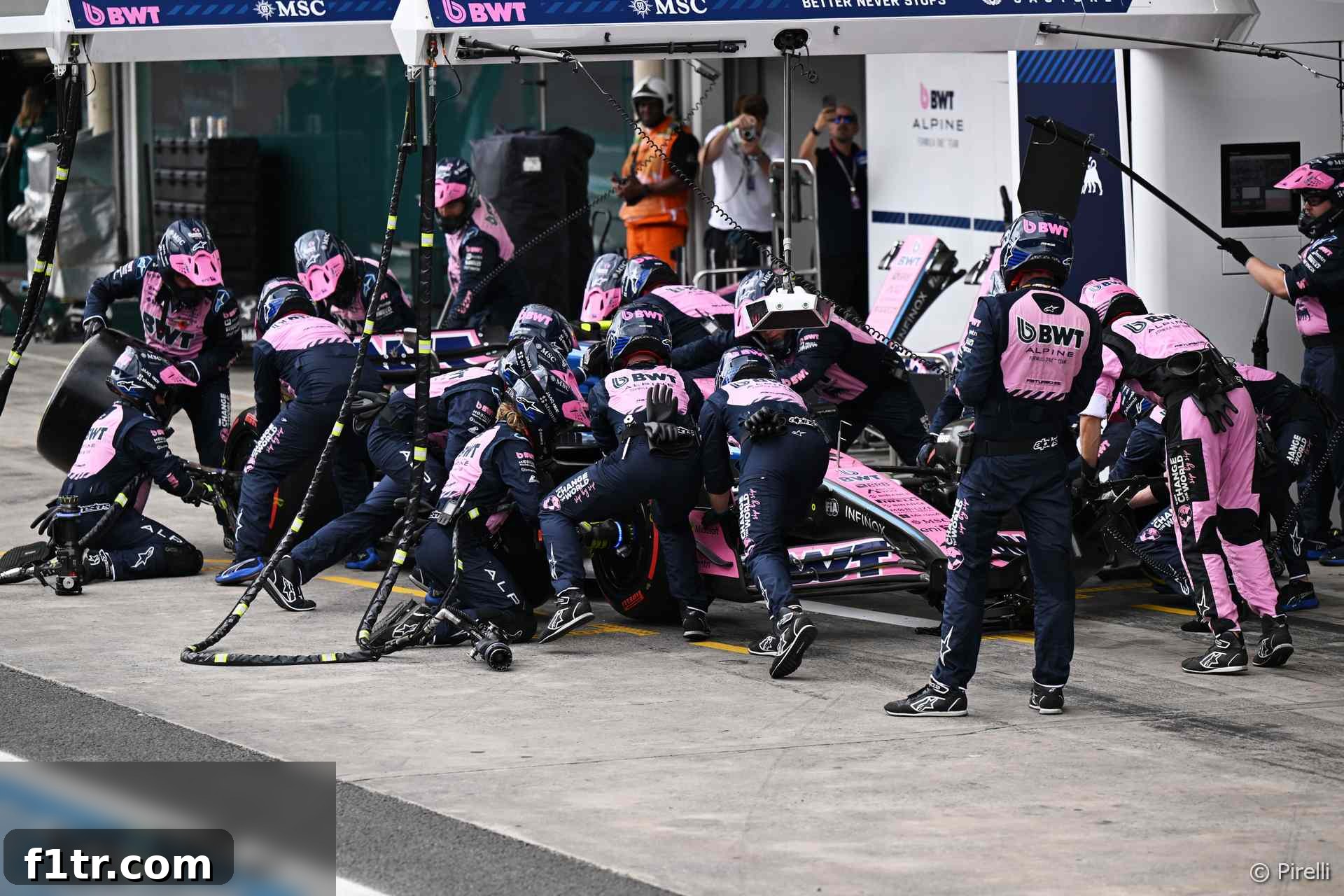
F1 Teams Warn Against Mandatory Two-Pit-Stop Rule: A Risky Gamble for Race Excitement
Formula 1 team principals have issued a strong warning regarding proposed changes aimed at enhancing race excitement by mandating a minimum of two pit stops per Grand Prix. While the intention is to inject more strategic intrigue and unpredictable outcomes, many fear such a prescriptive rule could backfire, leading to a reduction in strategic variety and ultimately, less thrilling racing.
Advert | Become a Supporter & go ad-free
The concept of forcing multiple pit stops has gained traction following a season where numerous races have been dominated by drivers successfully completing the Grand Prix with only the single mandatory tyre compound change required by current regulations. Critics argue that these single-stop races often lack dynamic strategic battles, as teams prioritize tyre conservation over aggressive driving or alternative strategies. The push for a two-stop mandate stems from a desire to compel teams into more complex strategic decisions, theoretically creating more opportunities for overtakes and shifts in race order.
The Paradox of Forced Strategy: Less Variety, Not More?
Despite the well-intentioned goals, several leading figures within the sport express skepticism about the efficacy of a forced two-stop rule. Racing Bulls team principal Alan Permane articulated a common concern: “I think everyone likes two stops or more, but we have to be careful.” He elaborated on the delicate balance required for truly engaging multi-stop races, highlighting that the intrinsic characteristics of the tyres play a more crucial role than artificial mandates.
“Our strategy and tyre guys are looking at it closely,” Permane continued. “I think one of the things that makes a two-stop race tricky is when the tyres aren’t really suited for two stops. So you need to have tyres that demand a two-stop race. If you force a two-stop, you can end up with everyone doing the same strategy and actually have the opposite effect.” This sentiment underscores a core principle of F1 strategy: genuine strategic divergence emerges from varying tyre degradation rates, compound performance differences, and the unique challenges presented by each circuit, rather than a top-down directive.
If tyre compounds are too durable or their performance windows too broad, teams will invariably converge on the optimal two-stop strategy, making the race a predictable procession rather than a strategic chess match. The subtle differences that currently allow a one-stop runner to be chased down by a two-stop contender, creating late-race drama, would vanish, replaced by a uniform approach across the grid.
McLaren and Williams Echo Concerns: Preserving Strategic Diversity
McLaren’s Andrea Stella mirrored Permane’s apprehension, emphasizing the current rules’ capacity to foster diverse and often unpredictable racing. “We’ve seen plenty of races with one guy on a one-stop and one guy on a two-stop, and then the guy on a one-stop being chased down by the two-stop – but that [would] obviously disappear,” Stella explained. This specific scenario, where contrasting strategies unfold and converge in the closing laps, is a hallmark of compelling F1 racing. Eliminating this possibility through a blanket two-stop rule would strip away a significant layer of strategic depth.
Stella stressed the need for thorough deliberation, asserting, “So I think we need to think very carefully, and we are. I’m sure the F1 Commission will debate it, and I’m sure we’ll come to the right answer.” The F1 Commission, responsible for major sporting and technical rule changes, faces the challenging task of balancing entertainment objectives with the integrity and strategic complexity of the sport.
Advert | Become a RaceFans supporter andgo ad-free
James Vowles, the Williams team principal and a former strategist at Mercedes, brought a wealth of tactical experience to the discussion. He concurred, stating, “my biggest worry would be that we end up, all of us, doing the same strategy to within a lap of each other because you’re forced that way because of the two stops.” Vowles’ insight highlights the practical implications for race engineers and strategists: if the window for pit stops becomes rigidly defined by regulation rather than tyre performance, the strategic advantage derived from clever planning and execution diminishes significantly.
Vowles further emphasized the foundational elements of compelling F1 racing: “Let’s get the key foundations right, which is tyre degradation and the gaps between the tyres.” He argued that if Pirelli designs tyres with appropriate degradation characteristics and meaningful performance differences between compounds, multi-stop races will naturally emerge. A forced rule, he believes, should only come into play once these fundamental tyre dynamics are established. His concern is palpable: “I have a worry that immediately where we are now, I think you’ll get less variability in next year’s races and that concerns me.” The essence of his argument is that organic strategic complexity is always preferable to an artificial one.
The 2026 Regulatory Tsunami: A Call for Prudence
Adding another layer of complexity to the debate is the impending overhaul of Formula 1’s technical regulations for the 2026 season. This represents one of the most significant changes in years, requiring teams to design entirely new power units and chassis. McLaren’s Andrea Stella highlighted why this makes the current timing for a tyre rule change particularly delicate.
“For 2026 we have so much change going on and I think we should observe also what kind of racing we are going to have before we change the technical side and also the rules of the game,” Stella wisely advised. Introducing sweeping tyre strategy changes concurrently with such a massive technical shift could obscure the true impact of either reform. It becomes incredibly difficult to isolate variables and understand what is genuinely improving or hindering the spectacle.
“So I would invoke a little bit of prudence from this point of view,” Stella concluded. “Let’s observe what happens in 2026, and then we can adapt from a sporting point of view to make sure that the entertainment and the racing is at the right level.” This “wait and see” approach advocates for a methodical assessment, ensuring that any future adjustments to tyre rules are based on concrete data and observed racing dynamics under the new technical framework, rather than pre-emptive and potentially counterproductive mandates.
The Monaco Grand Prix Experiment: A Cautionary Tale
The recent Monaco Grand Prix served as a real-world test of a forced multi-stop strategy, albeit a one-off rule change that mandated two tyre changes. The outcome, unfortunately, provided a stark illustration of the potential pitfalls. In an attempt to enliven the notoriously difficult-to-overtake Monaco circuit, the rule required drivers to use two different tyre compounds in addition to the standard intermediate or wet tyre requirement.
However, the actual race played out far from the desired spectacle. Many teams adopted a highly conservative approach, ordering their drivers to deliberately lap slowly – often significantly off their potential pace – to manage tyre wear and preserve track position. This ‘strategic’ slowing down allowed cars ahead to make their mandatory stops without losing positions, effectively creating a tactical procession where the primary goal became maintaining gaps rather than outright speed or aggressive overtaking. The result was a race devoid of significant on-track action and strategic drama, much to the dismay of fans and drivers alike.
Several drivers were highly critical of the outcome, with one famously remarking he “could have had a pillow and a coffee in the car and chilled out.” Other comments labeled it “a very ugly race” and “not really how we want to go racing.” These strong reactions from within the paddock highlight a fundamental disconnect between the intended outcome of forced stops and the realities of competitive F1 racing, where maximizing track position often takes precedence over pure pace when overtaking is difficult.
Despite the widespread criticism, F1 CEO Stefano Domenicali defended the rule, calling it “the right attempt” and noting, “the good thing is that we are talking about it.” While dialogue about improving the sport is always valuable, the Monaco experience raises serious questions about whether forcing pit stops is the correct avenue to achieve more exciting racing. The key takeaway from Monaco suggests that artificial constraints can lead to perverse incentives, ultimately diminishing the quality of the competition rather than enhancing it.
Finding the Right Balance for F1’s Future
The debate surrounding mandatory two-pit-stop races underscores the complex challenge Formula 1 faces in continually balancing sporting integrity with entertainment value. While the desire to prevent single-stop processions and inject more strategic dynamism is understandable, the path to achieving this is fraught with potential missteps. The consensus among many team principals and strategists leans towards allowing strategic variety to emerge organically, driven by well-designed tyres and nuanced regulations, rather than through blunt mandates.
As F1 gears up for its significant 2026 regulatory shift, prudence dictates a careful observation period. Understanding how the new power units, chassis, and aerodynamic rules influence racing dynamics will be crucial before implementing further changes to fundamental sporting elements like pit stop strategy. The lessons from the Monaco Grand Prix, where a forced rule led to a less exciting race, serve as a powerful reminder that sometimes, less intervention can lead to more genuine competition and, ultimately, more thrilling Formula 1 action for fans worldwide.
Advert | Become a RaceFans supporter andgo ad-free
Miss nothing from RaceFans
Get a daily email with all our latest stories – and nothing else. No marketing, no ads. Sign up here:
Formula 1
- The ‘throwback weekend’ is back in fashion. But it’s a flawed concept – especially for F1
- Is Formula 1’s double race cancellation a blessing in disguise?
- Todt admits Schumacher crashed on purpose – but did it really cost him two titles?
- 25 of the most memorable radio exchanges from the ‘Max and GP show’
- FIA explains next steps after first meeting to discuss fixes for 2026 F1 rules
Browse all Formula 1 articles