Canadian Grand Prix Qualifying: Verstappen Matches Pole, Mercedes Shows Form
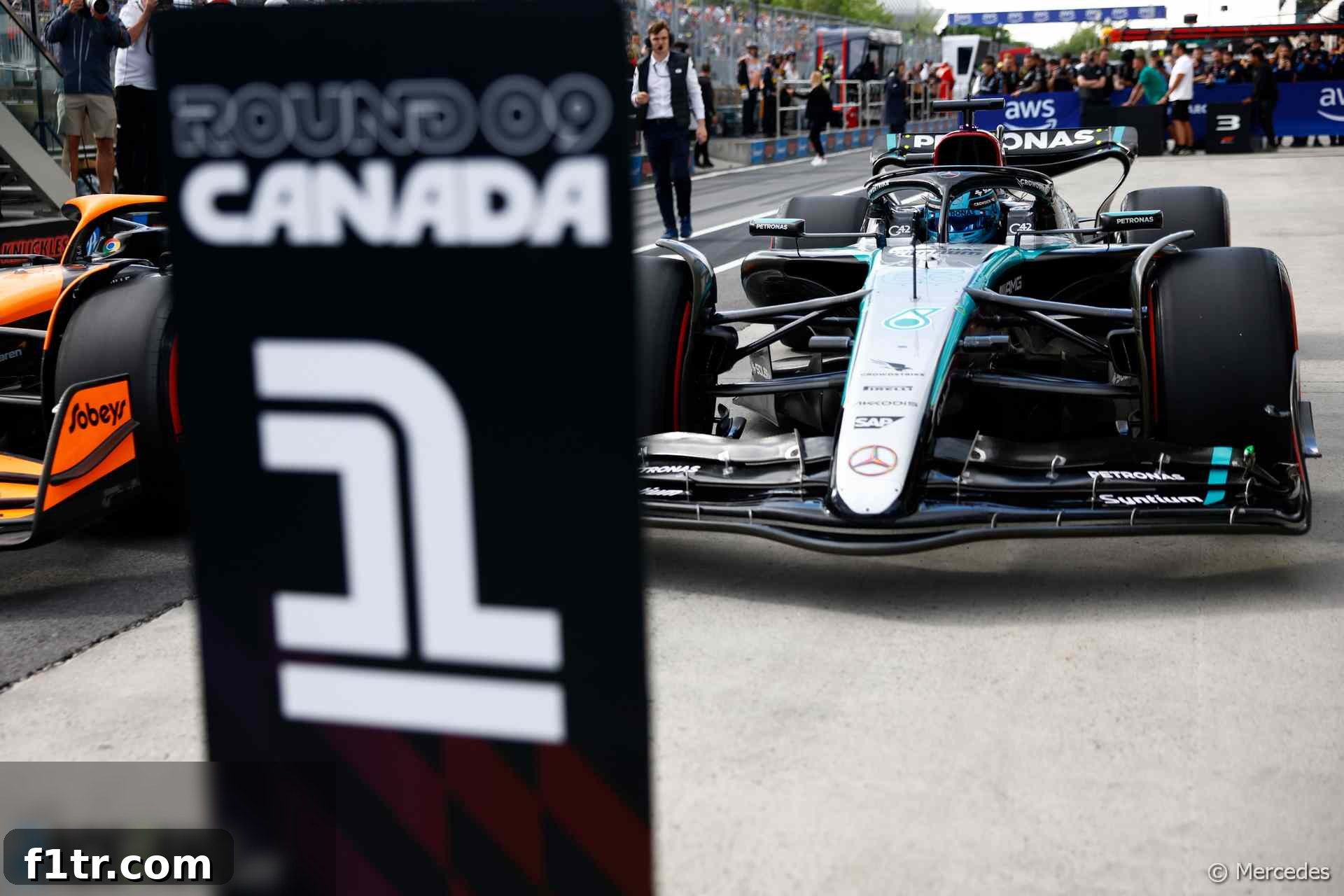
The qualifying session for the Canadian Grand Prix delivered a breathtaking spectacle, culminating in an incredibly rare occurrence: two drivers setting identical pole position times. While Max Verstappen heroically pulled out a lap to match the very best George Russell and Mercedes could offer when it truly counted, the reigning world champion expressed a surprising humility. Despite securing a joint pole, Verstappen didn’t believe he could have genuinely matched Mercedes’ quickest times of the weekend, hinting at a potential shift in the competitive landscape.
The Pole Position Showdown: A Tie at the Top
George Russell claimed pole position for the Canadian Grand Prix with a blistering lap of 1 minute 12.000 seconds. In a remarkable twist of fate, Max Verstappen then equalled that exact time on his final run, creating a moment of pure drama and statistical anomaly in Formula 1 history. This equalled effort marked Red Bull’s quickest time of the entire weekend, a testament to Verstappen’s ability to extract every ounce of performance from his car under immense pressure.
However, the underlying pace throughout qualifying told a more nuanced story. Both Mercedes drivers had already demonstrated superior speed earlier in the session. Russell had topped Q2 with an impressive 1’11.742, while his teammate Lewis Hamilton produced a swift 1’11.979. These laps were not just quicker; for both Mercedes drivers, these represented their best laps and the best three-sector times they managed to achieve. Critically, neither driver was able to get within a quarter of a second of these earlier benchmark times during the climactic Q3 session, where track conditions had seemingly shifted, preventing them from replicating their ultimate pace.
Reflecting on the outcome, Verstappen candidly admitted his surprise at Mercedes’ raw speed. “Being on the exact same lap time is great, but in hindsight, I think when you look at their pure pace, I’ll take second,” said Verstappen after qualifying. “After Q2 I saw their lap times and I was like ‘there is no way that I can do something like that’.” This admission underscores a growing concern for Red Bull and suggests that Mercedes might finally be turning a corner in their quest to challenge for race victories.
Mercedes’ Resurgence and the Battle for the Front Row
Mercedes’ strong showing in Canada wasn’t a one-off Q3 fluke; they had consistently looked like contenders for pole position throughout the entire weekend. This performance suggests that recent upgrades or simply the characteristics of the Circuit Gilles Villeneuve may be suiting their W15 car far better than previous venues. The Silver Arrows’ ability to maintain such competitive pace against the dominant Red Bull provides a fresh dynamic to the 2024 championship, hinting at a tighter fight at the front. The strong performance of both Russell and Hamilton indicates a broader team improvement, not just an individual standout lap.
Beyond Mercedes, McLaren also confirmed their status as consistent front-runners, locking out the second row of the grid with Oscar Piastri and Lando Norris demonstrating the speed of the MCL38. Their sustained challenge against Red Bull and now Mercedes points to a highly competitive three-way battle at the pinnacle of Formula 1. Daniel Ricciardo also put in a stellar performance for RB, qualifying a very respectable sixth, further highlighting the competitive nature of the mid-field.
Ferrari’s Unexpected Struggles: A Strategic Misstep
The most significant surprise of the Canadian Grand Prix qualifying session was undoubtedly the stunning failure of Ferrari to get either of their cars into Q3. A week after Charles Leclerc celebrated a famous victory on home soil in Monaco, the Scuderia experienced a dramatic reversal of fortunes. Leclerc himself clearly had the pace to advance further, but a critical strategic error saw him left out on used tyres in Q2, severely compromising his performance. This oversight cost him dearly, leaving him frustrated and unable to demonstrate the true potential of his SF-24. As a result, the pole-winners of the last race found themselves out-qualified not only by both RBs but even one of Williams’ drivers, Alexander Albon, who put in an impressive lap.
Carlos Sainz Jnr also failed to make it into the final qualifying segment, underscoring a collective struggle for Ferrari at the Canadian circuit. Whether this was due to difficulty generating tyre temperature, car balance issues on the specific track characteristics, or indeed strategic miscalculations remains to be fully analyzed. However, this unexpected setback provides a harsh reality check for Ferrari and adds an intriguing layer to the championship narrative, particularly as their main rivals appear to be finding strong form.
Sector by Sector Analysis: Unpacking the Pace
A closer look at the sector times reveals the granular details of driver performance across the Circuit Gilles Villeneuve. The ability to extract pace through specific corners and straights often dictates overall lap time, and in Canada, it highlighted distinct strengths and weaknesses across the grid.
| P. | # | Driver | S1 | S2 | S3 | Ultimate lap (deficit) |
|---|---|---|---|---|---|---|
| 1 | 63 | George Russell | 20.057 (2) | 22.714 (2) | 28.971 (1) | 1’11.742 |
| 2 | 1 | Max Verstappen | 19.987 (1) | 22.902 (6) | 29.09 (3) | 1’11.979 (+0.021) |
| 3 | 44 | Lewis Hamilton | 20.121 (5) | 22.642 (1) | 29.216 (10) | 1’11.979 |
| 4 | 81 | Oscar Piastri | 20.155 (7) | 22.792 (4) | 29.056 (2) | 1’12.003 (+0.100) |
| 5 | 4 | Lando Norris | 20.149 (6) | 22.776 (3) | 29.096 (4) | 1’12.021 |
| 6 | 3 | Daniel Ricciardo | 20.115 (4) | 22.932 (7) | 29.131 (6) | 1’12.178 |
| 7 | 14 | Fernando Alonso | 20.108 (3) | 22.972 (11) | 29.148 (7) | 1’12.228 |
| 8 | 22 | Yuki Tsunoda | 20.234 (8) | 22.88 (5) | 29.126 (5) | 1’12.240 (+0.063) |
| 9 | 18 | Lance Stroll | 20.258 (11) | 22.963 (8) | 29.21 (9) | 1’12.431 (+0.228) |
| 10 | 16 | Charles Leclerc | 20.249 (10) | 23.037 (13) | 29.159 (8) | 1’12.445 (+0.246) |
| 11 | 23 | Alexander Albon | 20.239 (9) | 22.967 (10) | 29.279 (12) | 1’12.485 |
| 12 | 2 | Logan Sargeant | 20.368 (12) | 22.99 (12) | 29.267 (11) | 1’12.625 (+0.111) |
| 13 | 55 | Carlos Sainz Jnr | 20.377 (13) | 22.965 (9) | 29.386 (16) | 1’12.728 |
| 14 | 20 | Kevin Magnussen | 20.431 (14) | 23.164 (15) | 29.321 (13) | 1’12.916 |
| 15 | 10 | Pierre Gasly | 20.445 (15) | 23.1 (14) | 29.395 (17) | 1’12.940 |
| 16 | 11 | Sergio Perez | 20.678 (18) | 23.3 (17) | 29.348 (14) | 1’13.326 |
| 17 | 31 | Esteban Ocon | 20.674 (17) | 23.231 (16) | 29.436 (18) | 1’13.341 (+0.094) |
| 18 | 77 | Valtteri Bottas | 20.605 (16) | 23.377 (18) | 29.384 (15) | 1’13.366 |
| 19 | 27 | Nico Hulkenberg | 20.713 (19) | 23.428 (19) | 29.594 (19) | 1’13.735 (+0.243) |
| 20 | 24 | Zhou Guanyu | 20.934 (20) | 23.588 (20) | 29.77 (20) | 1’14.292 |
George Russell’s ultimate lap of 1’11.742, set in Q2, highlights his remarkable consistency across all three sectors, securing the fastest third sector time and the second-fastest in the first two. This showcases a well-balanced car and a driver in supreme form. Max Verstappen, while matching Russell’s Q3 time, had his quickest ultimate lap calculated at 1’11.979, with his strength notably in Sector 1, where he was the fastest. This suggests the Red Bull excelled in the initial, faster sections of the track.
Lewis Hamilton’s data is particularly interesting. His Q2 ultimate lap was also 1’11.979, but he recorded the fastest Sector 2 time of any driver, indicating the Mercedes’ strong performance through the mid-section of the track which includes the hairpins and chicanes. McLaren’s Oscar Piastri demonstrated impressive pace, especially in Sector 3 where he was second fastest, just behind Russell, leading to a strong 1’12.003 ultimate lap. His teammate Lando Norris was equally competitive, underlining McLaren’s consistent performance across the circuit.
Further down the grid, the table reveals the struggles of drivers like Sergio Perez, whose ultimate lap was significantly slower, and the underperformance of the Ferrari drivers. Charles Leclerc, despite his Q2 issues, still managed a respectable eighth fastest Sector 3 time, suggesting pockets of pace that went unutilized. The data provides a comprehensive overview of where each team and driver found or lost time, critical information for race strategy.
The Transformed Circuit Gilles Villeneuve: Faster Than Ever
The Circuit Gilles Villeneuve underwent significant changes ahead of the 2024 Canadian Grand Prix, most notably a complete resurfacing of the track. This new asphalt, combined with a year of relentless car development across the F1 grid, resulted in dramatically quicker lap times compared to the previous year. Almost every team managed to lap more than a second faster than they did in 2023, showcasing the immense advancements in car performance and the benefits of a smoother, grippier surface.
Beyond the fresh tarmac, some of the track boundaries were also reportedly eased, potentially allowing drivers to attack certain corners with greater confidence and slightly wider lines, contributing to the overall increase in speed. These combined factors created a high-speed challenge for the drivers, pushing the limits of both machinery and human skill. The improved surface also often leads to more consistent lap times and potentially reduces tyre degradation, which could play a crucial role in the Grand Prix.
Sauber’s Persistent Struggles and Development Woes
Amidst the widespread gains, one team stood out for its lack of improvement: Sauber. For the fourth consecutive weekend, the C44s proved to be the slowest cars in the field. The team seems to have assumed the unenviable position Alpine occupied at the beginning of the year, but with an even greater average deficit to the pace-setters. While most teams were celebrating significant year-on-year lap time gains, Sauber and Ferrari were among those who gained the least, highlighting a clear disparity in development progression.
This persistent underperformance points to fundamental issues within Sauber’s development programme. In a sport where constant evolution is key, falling so far behind is a major concern. The team’s inability to extract performance from upgrades or to adapt their car to different track characteristics suggests a deeper problem that needs urgent attention. Their struggles underscore the cut-throat nature of Formula 1, where even minor missteps in development can have profound consequences on track performance.
Chasing History: Sebastian Vettel’s Enduring Lap Record
Despite the substantial gains witnessed in 2024, the teams still need to find almost as much time again to rival the fastest-ever lap seen on this configuration of the Circuit Gilles Villeneuve. That record, a stunning 1’10.240, was set five years ago by Sebastian Vettel during qualifying for the 2019 Canadian Grand Prix. Vettel’s legendary lap stands as a testament to the raw speed of the cars from that era and his exceptional talent.
Formula 1 is set to visit the Circuit Gilles Villeneuve only once more before a major overhaul of its technical regulations comes into effect in 2026. Details of these new regulations were revealed just this week, and they are widely expected to produce much slower cars initially, designed with a greater emphasis on sustainability and closer racing. This means that Sebastian Vettel’s 2019 qualifying record may well stand for a considerable while longer, cementing its place in the circuit’s history as an almost untouchable benchmark for the current generation of F1 machinery.
Looking Ahead to Race Day
The Canadian Grand Prix qualifying has set the stage for what promises to be an enthralling race. With Max Verstappen and George Russell starting from the front row with identical times, the battle for the lead will be intense from the outset. Mercedes’ rediscovered pace, coupled with McLaren’s consistent threat, suggests a multi-team fight at the front. Ferrari will be looking to recover from their qualifying disappointment, hoping for strategic opportunities or adverse conditions to move up the field. The unique challenges of the Circuit Gilles Villeneuve, including its unforgiving walls and unpredictable weather, mean that anything can happen on race day, promising an unforgettable spectacle for fans.
2024 Canadian Grand Prix
- “He needs to be more careful”: Unheard radio messages from the Canadian Grand Prix
- Marko contradicts stewards’ reason for Red Bull and Perez penalties
- Only one F1 championship looks like a worthwhile fight in 2024
- Red Bull can fix kerb-riding without losing RB20’s major strengths – Verstappen
- Mercedes suspect Montreal track layout ‘made us look quicker’
Browse all 2024 Canadian Grand Prix articles