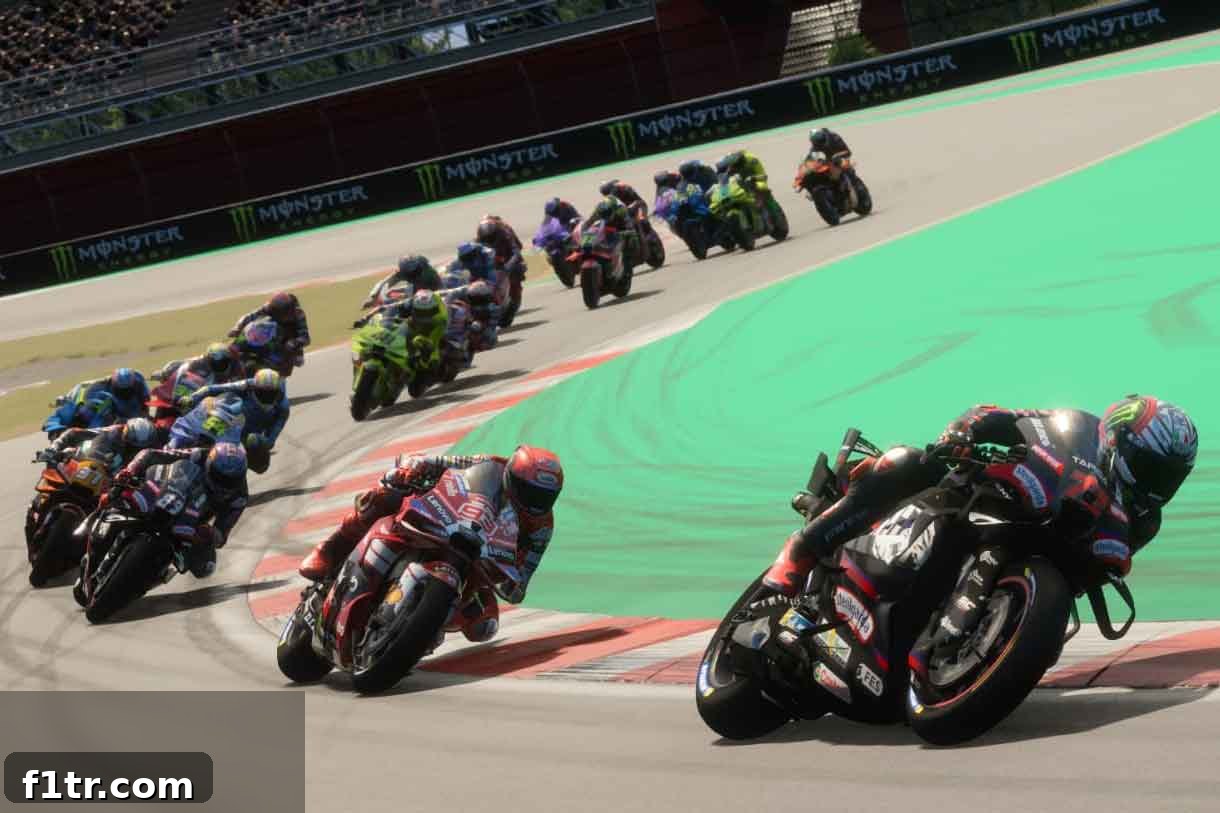
It’s been a busy 12 months for Milestone, the Italian developers known for motorcycle simulation games.
Advert | Become a Supporter & go ad-free
Over the past year the studio released an AMA Supercross title, the sixth entry in the RIDE series, and a successful reboot of the 1990s arcade racer Screamer, while still finding time to complete the 2026 edition of the official MotoGP game. Impressively, Milestone met the usual spring release window without delay.
With so many projects on the go, the question for long-time fans is whether this year’s MotoGP game justifies a full-price purchase.
A new dynamic?
As veteran players of the series, RaceFans has often rated Milestone’s MotoGP releases more kindly than some critics. Like EA’s annual Formula 1 franchise, MotoGP 26 aims for a middle ground between accessibility and authenticity rather than an uncompromising hardcore simulation. The series rarely dominates in a single area such as visuals, handling, AI, or depth, but it consistently delivers above-average results across the board.
Built in Unreal Engine 5, the game offers attractive visuals: bikes look glossy, circuits are vivid, and grandstands are packed. The title includes the full roster for MotoGP, Moto2 and Moto3, with 2026 liveries for the lower classes to arrive after launch, and all circuits from this season’s championship, including Goiânia, which returns to the calendar after nearly 40 years.
Advert | Become a RaceFans supporter andgo ad-free
To enjoy all 22 circuits properly, the handling model must do the sport justice. That is the biggest change in this year’s edition. Previously the series’ handling was nuanced but could be punishing on MotoGP-class machines. For 2026, Milestone rebuilt their approach: you no longer control bike and rider as a unified entity. Instead you control the rider, whose movements influence the motorcycle.
Translating the sensation of piloting a 350 km/h motorcycle through a controller is inherently difficult, and this new system will likely divide existing players. The overall effect is a noticeably easier feel compared with previous years. While the model is more complex beneath the surface, the learning curve has softened: players can build confidence on MotoGP bikes faster than before.
Older entries often encouraged newcomers to start in Moto3 because the smaller bikes were more forgiving. MotoGP-class machines used to convey every kilogram of mass and every kilowatt of power. This edition reduces that sense of weight, partly because the rider’s movement now plays the primary role. Players gain greater control on corner entry and mid-corner, allowing more correction when they misjudge lean or throttle. That precision makes consistency and mistake reduction easier. Braking, acceleration management and tyre wear still matter, but the overall handling in Pro mode will feel more accessible to a broader audience.
Advert | Become a RaceFans supporter andgo ad-free
While this accessibility benefits many players, it narrows the skill gap between elite virtual racers and the wider player base. A tougher-to-master model makes mastering complex sequences—such as Maggots and Becketts or COTA’s opening sector—especially satisfying, and that reward is reduced here.
The increased steering sensitivity also improves how AI opponents feel in traffic, since it’s easier to adjust line and avoid sudden lunges into corners. Overall AI remains aggressive, but a new rider-rating system assigns attributes—race pace, qualifying pace, wheel-to-wheel skill and crash tendency—to make opponents behave more like their real-world counterparts.
What else is new
All the expected single-player modes return: Grand Prix, Championship and Career. Visual enhancements such as paddock scenes and pre-race press conferences aim to deepen immersion, but these are largely cosmetic. The core structure of Career mode is very similar to last year’s, with animated backgrounds and the same underlying systems.
Dialogue choices let you respond politely, arrogantly, or provocatively to rivals, much like the social features from recent entries. In practice these choices make little tangible difference beyond minor visual indicators.
The Career mode remains enjoyable and this year adds the option to play as a real-life rider rather than a custom character. However, for players of MotoGP 24 or 25 the differences may feel minor; the new elements won’t maintain a “new game” sheen for long.
Side activities such as flat track, motard and minibike racing return with an extra track added this year, and production bikes become a new playable format. Their implementation is restrictive: you can ride production bikes like the Yamaha YZF-R1 GYTR, but only against Yamaha riders and only on three selected circuits. That limitation makes the mode feel like a brief novelty rather than a lasting addition.
Advert | Become a RaceFans supporter andgo ad-free
Milestone also added collectible virtual cards awarded for in-game tasks, delivered as packs. While that design choice may trigger concern, these packs are cosmetic rewards only and Milestone has stated there are no plans to introduce paid microtransactions. The feature’s purpose feels odd, but it does not impact gameplay balance.
Spinning its wheels?
This is a game clearly made by people who respect MotoGP as a championship and spectacle. Details such as Jorge Martin retaining number 89 if he wins a second title in Career mode, or Pecco Bagnaia reverting to number 1 after claiming another crown, show that care. Given their resources, Milestone arguably produces a strong MotoGP product for its size.
However, MotoGP 26 is an incremental evolution rather than a revolution. It offers enough new content to justify a standalone release rather than being mere season DLC, but owners of MotoGP 25—or even 24—won’t miss anything essential by waiting. Unless having the current season’s riders, teams and circuits immediately is a priority, a day-one purchase is hard to justify.
For players new to the series, MotoGP 26 is likely the best entry point yet, particularly thanks to the more forgiving handling model. For long-term fans, the improvements are welcome but modest, and familiar systems remain largely untouched.
Advert | Become a RaceFans supporter andgo ad-free
The core issue—that annual licensed racing games tend to evolve rather than transform—remains. Those hoping for a dramatic change beyond the revised handling will likely have to wait another year.
RaceFans rating
Read all the RaceFans book reviews.
Platform(s): PS5, Xbox Series S, Xbox Series X, Nintendo Switch 1 and 2, PC (Steam and Epic Game Store)
Developer: Milestone
Publisher: Milestone
Published: April 29 2026
Price: £59.99
Advert | Become a RaceFans supporter andgo ad-free
Reviews
- “Moto GP 26”: Does an all-new handling model make the 2026 edition a must-play?
- Controversies, Norris, Newey and more: Five new motorsport books reviewed
- Next new F1 game to arrive in 2027, EA to offer 2026 season as paid DLC
- “F1 Insider: Notes from the Pit Lane” – Ted Kravitz’s new F1 book reviewed
- “Rennsport”: The RaceFans review
Browse all Reviews