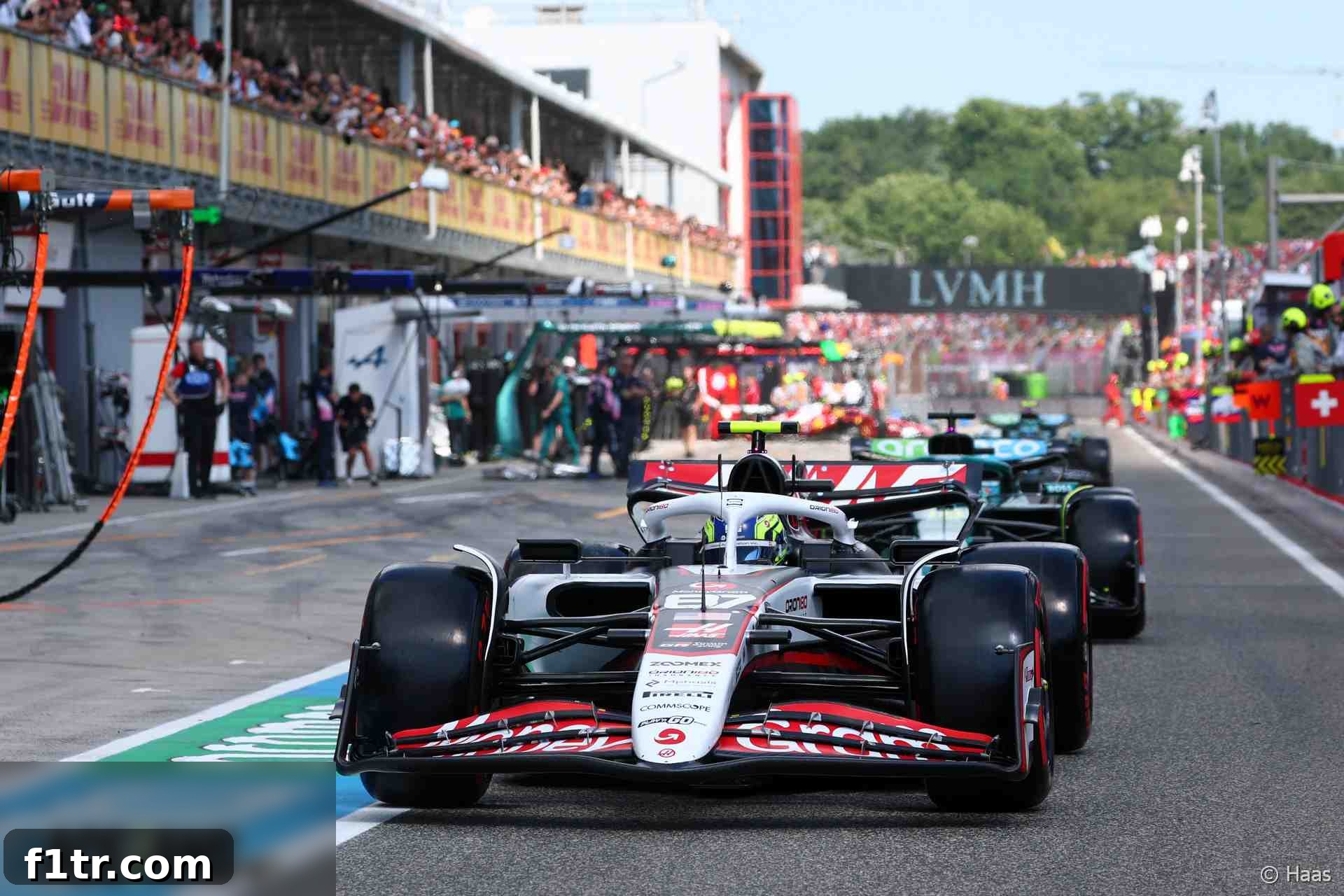
Haas Demands FIA Clarity Over Oliver Bearman’s Controversial Imola Q1 Elimination
The Haas Formula 1 team is refusing to let go of the contentious issue surrounding Oliver Bearman’s elimination from the first round of qualifying at the Imola Grand Prix. In a move highlighting deep-seated concerns over sporting fairness and procedural clarity, the American outfit has formally requested additional detailed information from the FIA regarding the decision-making process that led to Bearman’s lap being invalidated. This incident has ignited a wider debate within the paddock about the precise application of regulations during critical moments in motorsport, especially when safety interventions intersect with competitive performance.
The Imola Incident: A Red Flag Shrouds Bearman’s Qualifying Dream
Qualifying for a Formula 1 Grand Prix is an intense crucible of speed and strategy, where fractions of a second can determine a driver’s fate. Q1, in particular, is a frantic dash as drivers battle to set a competitive lap time and avoid the dreaded cut-off. At the recent Imola Grand Prix, this pressure cooker environment was amplified by an unforeseen incident involving young British talent, Oliver Bearman, who was making a highly anticipated appearance for Haas.
During the closing stages of the Q1 session, as drivers pushed their cars to the absolute limit in pursuit of a slot in Q2, an unfortunate crash occurred. Franco Colapinto, competing in a different category, suffered an incident at the challenging Tamburello corner, prompting race control to wave the red flag. A red flag is the most severe signal in motorsport, immediately halting all on-track activity due to safety concerns. In qualifying, this typically means that any laps completed after the red flag is shown are immediately invalidated, regardless of the sector times achieved.
Bearman, in what appeared to be a heroic final attempt, seemingly completed his flying lap just as the incident unfolded. From his perspective, he had done enough to secure a place in the next qualifying segment, crossing the finish line and believing his time was safe. However, the subsequent analysis by the FIA determined otherwise. After a period of review and deliberation, his lap time was ultimately ruled invalid. This decision had immediate and significant consequences: Bearman, who had briefly seen himself progress, was demoted, and Gabriel Bortoleto inherited his place in Q2.
Unpacking the FIA’s Stance: A Matter of Milliseconds and Strict Timing
The FIA, the sport’s governing body, provided an explanation for its decision on Saturday evening, aiming to clarify the sequence of events. According to an official spokesperson, the red flag was officially activated and set at “16:32.17.6 seconds.” Crucially, Bearman’s car crossed the start/finish line at “16:32.20.9 seconds.” This precise timing indicates a difference of 3.3 seconds between the official activation of the red flag and Bearman completing his lap.
The FIA’s statement further clarified that “the abort signal / red flag [was] showing on the start gantry” when Bearman crossed the line. This detail is pivotal. It implies that the visual cues – the red lights on the gantry above the start/finish line – were already active when Bearman completed his lap. For race control and the FIA, the rules are often interpreted with absolute rigidity, especially concerning safety protocols. If the red flag is active, any subsequent completion of a lap is deemed invalid, primarily to ensure drivers reduce speed immediately and head back to the pits, minimizing risk on a potentially hazardous track.
The challenge for drivers in such situations is immense. While the official timing system records events with millisecond precision, a driver inside a high-speed racing car, navigating the limit, has only a fraction of a second to react to visual or audio cues. The time it takes for a driver to perceive the signal, process it, and then act (e.g., abort the lap, slow down) can easily exceed the narrow window between the official red flag activation and their crossing the line. This strict interpretation, while technically correct by the rulebook, often leaves teams and drivers feeling that the “spirit” of competition has been undermined by the “letter” of the law.
Haas’s Persistent Quest for Clarity and Future Safeguards
Despite the FIA’s initial explanation, the Haas team clearly remains unsatisfied. On Sunday morning, prior to the main race, the team publicly indicated that they still harbored significant questions regarding how the FIA arrived at its determination of the facts. A spokesperson for Haas stated: “After discussions last night with the FIA, we have subsequently asked for further written clarification on the decision-making concerning Ollie Bearman’s final Q1 lap in order for us to review more comprehensively.”
This request for “further written clarification” goes beyond a mere query; it suggests that Haas believes the initial explanation lacked sufficient detail, transparency, or perhaps failed to address certain aspects of the incident. It signals a desire to understand the full audit trail of the decision, including, perhaps, the exact moment the red flag signal was transmitted to the cars, the specific data points used, and the methodology applied in timing the crucial moments. Such meticulous scrutiny is not uncommon in Formula 1, where every competitive advantage and disadvantage is fiercely contested.
Furthermore, Haas’s inquiry extended beyond the immediate incident. The team also asked: “We similarly asked what measures the FIA / Race Control can put in place moving forward to ensure that this situation is avoided in the future to the benefit of F1.” This proactive stance shifts the focus from merely disputing a past decision to seeking systemic improvements. It highlights a concern that if the current procedures are prone to such contentious outcomes, they could lead to similar, unfair situations for other teams and drivers in the future. By pushing for future measures, Haas is advocating for greater clarity, improved communication protocols, and potentially more nuanced rule application in high-stakes, time-sensitive scenarios within Formula 1.
The Ripple Effect: Bearman’s Grid Position and Team Strategy
For Oliver Bearman, the immediate and most tangible consequence of the FIA’s decision was his starting position for the Grand Prix. Instead of potentially lining up higher up the grid, he was relegated to 19th place. Starting almost at the back of the pack in Formula 1 is a significant disadvantage, severely limiting a driver’s strategic options and making the prospect of scoring points considerably harder. Overtaking opportunities can be scarce on many F1 circuits, and a compromised grid position means fighting through traffic from the outset.
For the Haas F1 Team, Bearman’s demotion had broader implications for their weekend strategy and overall points potential. Every point is crucial in the Constructors’ Championship, and having a car start further down the grid reduces the team’s collective chances of a strong points finish. This not only affects their current standings but also their budget and prestige within the sport. Moreover, for a young talent like Bearman, who is eager to impress and secure a permanent F1 seat, such an incident, while not his fault, can be a frustrating setback, impacting his confidence and the narrative around his performance.
The Broader Debate: Sporting Fairness vs. The Letter of the Law
The Imola incident involving Oliver Bearman and Haas reignites a perennial debate within motorsport: how strictly should rules be applied, especially when the consequences are so severe for competitive outcomes? On one hand, the FIA must uphold the “letter of the law” to ensure consistency, prevent arbitrary decisions, and, crucially, maintain safety. A red flag is a safety signal, and its immediate and unambiguous application is paramount. Deviating from strict timing rules could open a Pandora’s box of subjective interpretations, leading to greater controversy.
However, the counter-argument centers on “sporting fairness” and the “spirit of the rules.” When a driver perceives they have completed a lap, and the margin of error between their finish and the official red flag activation is so minuscule (as little as 3.3 seconds), it begs the question of whether there should be more leniency or a clearer system for communicating these critical cutoff points. Drivers operate on instinct and immediate visual/audio cues; if these cues are not perfectly synchronized with the official timing, then the current system may inadvertently punish drivers who are acting in good faith. The challenge for Race Control is immense, balancing the need for rapid safety interventions with the imperative to ensure fair competition. This balancing act is a constant source of tension and requires ongoing refinement.
Towards a Clearer Future: Preventing Future Controversies
Haas’s proactive request for measures to prevent similar situations in the future is a critical step towards improving the sport’s operational procedures. Several potential solutions could be explored by the FIA and Race Control. One avenue could be the enhancement of in-car warning systems, providing drivers with instant and unambiguous notifications of a red flag that are seamlessly integrated into their dashboard displays and audio communication. This could supplement, or even precede, trackside gantry lights, which a driver might miss in the heat of battle.
Another consideration could be an automated system that immediately invalidates specific sectors or full laps based on the red flag’s precise activation time, with real-time feedback to the teams. This could remove any ambiguity or delay in communicating the decision. Furthermore, a broader discussion on the protocol surrounding red flag deployment in qualifying, potentially including a very short “grace period” for drivers already significantly into their final flying lap when the flag is deployed, might be warranted, provided safety is not compromised. Standardizing these procedures across all FIA-sanctioned events would also ensure consistency and prevent confusion.
Ultimately, these incidents, while frustrating for those involved, often serve as catalysts for necessary improvements in motorsport regulations and operational protocols. The ongoing dialogue between teams, drivers, and the FIA is essential for the continuous evolution of Formula 1, ensuring that while the sport remains thrilling and competitive, it also upholds the highest standards of safety, transparency, and fairness.
Conclusion: An Unresolved Question Mark Over Imola
The Haas F1 Team’s unwavering stance on Oliver Bearman’s Q1 elimination at Imola has cast an unresolved question mark over the precision and clarity of current Formula 1 qualifying procedures. Their demand for further written clarification and proactive suggestions for future preventative measures underscore a broader desire within the paddock for greater transparency and consistency in the application of regulations, particularly during high-pressure, time-sensitive moments.
While the FIA’s interpretation of the rules regarding red flags is technically sound, the incident highlights the complex interplay between instantaneous technical timing, driver perception, and the ultimate goal of sporting fairness. As Oliver Bearman prepares to start the race from a challenging 19th position, the ramifications of this decision extend beyond a single qualifying session, prompting a critical examination of how Formula 1 can better manage such occurrences to the benefit of all competitors. The Imola controversy will undoubtedly serve as a crucial case study, influencing future discussions and potential refinements to the sport’s ever-evolving rulebook.
2025 Emilia Romagna Grand Prix
- Antonelli was tiring from home race at Imola attention by Friday – Wolff
- Ferrari struggling to recreate set-up which “worked well” in Shanghai – Hamilton
- Verstappen told Red Bull to use Tsunoda before “hold him up” call
- ‘Saturdays have been mine for years but for some reason it’s drifted away’ – Norris
- “Plan C?”: Why McLaren only got their strategy right for one driver at Imola
Browse all 2025 Emilia Romagna Grand Prix articles