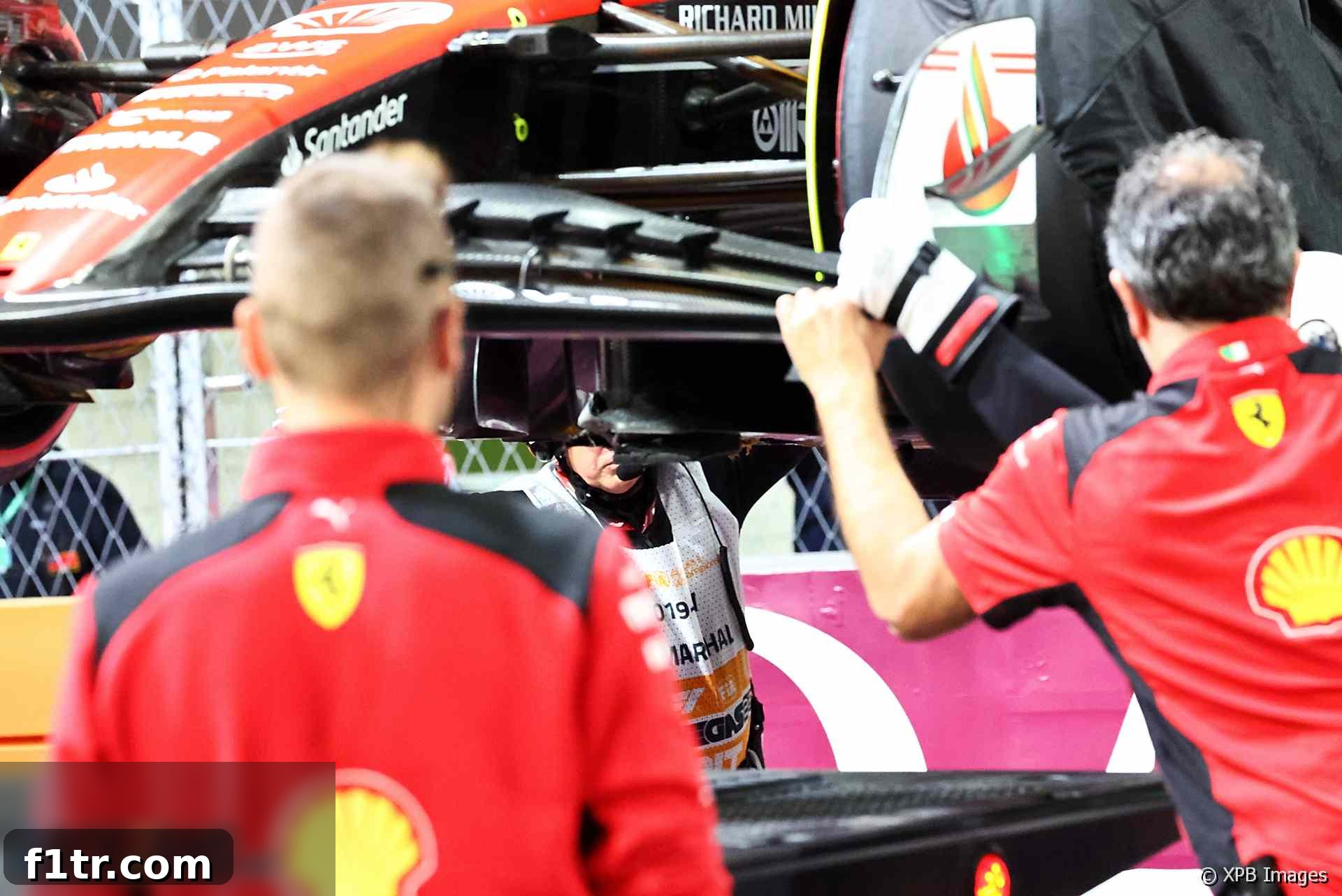
The eagerly anticipated debut of the Las Vegas Grand Prix was unfortunately overshadowed by a highly unusual and dramatic incident involving Carlos Sainz Jnr during the opening practice session. What promised to be an electrifying start to Formula 1’s grand return to Las Vegas quickly transformed into a significant safety concern and a logistical challenge, all triggered by a dislodged water valve cover on the city’s iconic Strip circuit. The scale and severity of the impact suffered by the Ferrari driver were vividly captured and quickly spread through fan-shot videos, sparking immediate widespread discussion and concern across the global motorsport community.
Advert | Become a Supporter & go ad-free
Las Vegas GP: A High-Stakes Debut Marred by Unforeseen Hazard
The incident unfolded during the initial exploratory laps of Free Practice 1, held under the Friday night sky (Thursday local time) with ambient temperatures uncharacteristically cold for a Formula 1 session. The new 6.2-kilometer Las Vegas Street Circuit, designed to showcase the city’s famous landmarks through high-speed straights and challenging corners, was poised to deliver a unique spectacle. However, beneath the smooth tarmac of the racing line, a critical vulnerability lay hidden.
As Carlos Sainz piloted his Ferrari SF-23 down a high-speed stretch of The Strip, his car unexpectedly made violent contact with a water valve cover. This crucial piece of urban infrastructure, which should have been securely fastened and flush with the road surface, had somehow become dislodged, creating a dangerous and unforeseen obstruction. The immediate aftermath was visually spectacular yet terrifying: a massive shower of sparks erupted from beneath the car, followed by debris, indicating a catastrophic impact to the advanced machinery.
The Critical Pre-Incident Sequence: Yellow Flags and Near Misses
The moments leading up to Sainz’s accident revealed a concerning escalation of events on track. The area was already under yellow flag conditions, signaling a potential hazard. Sainz, unfortunately, became the fourth driver to traverse this compromised section of track after the yellow flags had been deployed and waved:
- Firstly, Esteban Ocon had passed through Turn 14 under green flag conditions, indicating a clear track ahead at that specific point.
- Immediately following Ocon, his Alpine teammate Pierre Gasly encountered yellow flags as he approached the same sector, a clear warning of a developing situation.
- Alexander Albon then navigated the section, also under yellow flag warnings.
- Crucially, veteran driver Fernando Alonso was the next to be alerted by his team about the yellow flags. Onboard footage and trackside observations later suggested Alonso, with his acute track awareness, appeared to visually detect something on the circuit and instinctively swerved left, narrowly avoiding the precise location where Sainz would impact the dislodged drain cover. His quick thinking likely averted a similar, potentially equally damaging, incident for himself.
This rapid sequence underscored the perilous nature of the situation, culminating in Sainz’s unavoidable and devastating collision just moments after others had either passed safely or narrowly avoided the hazard.
Catastrophic Impact: Unpacking the Damage and Visual Drama
The full force and impact of the incident were graphically captured from multiple perspectives, including amateur fan footage and high-definition closed-circuit television cameras positioned trackside. As Sainz approached the now-exposed cover at an estimated speed of around 300 kilometers per hour (approximately 186 mph), the collision was not merely a scrape but a violent interaction that fundamentally compromised the car’s structure. The consequences were instant and severe:
- **Compromised Survival Cell:** The impact was of such magnitude that it inflicted damage upon the car’s survival cell. This monocoque chassis is the core safety structure of an F1 car, meticulously engineered to protect the driver from severe impacts. Any damage to this critical component is a profound concern, typically necessitating an immediate and complete chassis replacement for safety reasons.
- **Total Power Unit Loss:** The underside impact also resulted in catastrophic damage to Sainz’s power unit. This sophisticated assembly, comprising the internal combustion engine, turbocharger, MGU-H, MGU-K, and control electronics, is a meticulously regulated and expensive component. Damage of this nature almost invariably leads to the complete write-off of the unit, triggering penalties for subsequent replacements under F1’s stringent allocation rules.
- **Spectacular Visuals:** From a visual standpoint, the incident was terrifyingly dramatic. A huge plume of bright sparks erupted from beneath the Ferrari, illuminating the nighttime circuit. This vivid display was a stark indicator of metal grinding against the track and debris flying, underscoring the sheer violence and destructive force of the collision.
While the visual spectacle was undeniable and captivated global attention, the underlying and primary concern remained for driver safety and the structural integrity of the advanced F1 machinery. It was a immense relief that despite the catastrophic damage to his car, Carlos Sainz emerged from the cockpit physically uninjured, a resounding testament to the advanced safety standards inherent in modern Formula 1 car design.
Eyewitness Accounts and Viral Footage
The incident immediately became a viral sensation, with numerous fan-captured videos and official CCTV footage providing graphic evidence of the event’s severity:
Things are not going great for @F1 in Las Vegas: pic.twitter.com/v5bPXGVkzp
— Paloma Villicana (@PalomaFOX5News) November 17, 2023
Video sent to @8NewsNow shows Carlos Sainz’s car with sparks flying after he hit a loose manhole cover on the Las Vegas Strip during Thursday’s F1 practice. https://t.co/rhg5JYQEu7
🎥: Debbie Swink-Radil pic.twitter.com/Dt2MWSSp9I
— David Charns (@davidcharns) November 17, 2023
These powerful visual records not only confirmed the severity of the incident but also fueled widespread debate and significant concern across the global motorsport community regarding track integrity.
The Controversial Grid Penalty: Ferrari’s Frustration and F1’s Rulebook
While Sainz himself was miraculously unhurt – a testament to the robust safety measures in F1 – and was able to participate in the second practice session, which commenced two-and-a-half hours later than originally scheduled after extensive track repairs and safety inspections, the incident had a lasting and highly controversial consequence for his race weekend. The severe damage sustained by his car compelled Ferrari to replace multiple crucial components, including the entire survival cell (chassis) and critical elements of the power unit. Under Formula 1’s stringent sporting regulations, exceeding the season’s allocated quota for these components automatically results in a grid penalty.
Despite the unequivocal nature of the incident as a “force majeure” event, entirely beyond the control of both Ferrari and Sainz, the stewards ultimately ruled that the regulations did not provide for an exemption in such circumstances. Consequently, Carlos Sainz was handed a significant 10-place grid penalty for the Las Vegas Grand Prix. This decision sparked considerable outrage, frustration, and debate within the paddock, among rival teams, and across the fan base.
The “Force Majeure” Debate and the Stewards’ Ruling
Ferrari vehemently argued against the penalty, contending that it was fundamentally unjust given the extraordinary and uncontrollable circumstances. They asserted that a penalty for component changes directly necessitated by a failure in the track infrastructure should not be applied. However, the FIA’s sporting regulations, particularly concerning power unit and gearbox allocations, are deliberately strict. These rules are primarily designed to manage costs, prevent teams from gaining unfair performance advantages through excessive component changes, and ensure an equitable playing field.
The stewards’ decision, while strictly adhering to the letter of the law, unmistakably highlighted a perceived inflexibility within the regulations. This inflexibility proved unable to account for truly unforeseen external circumstances that directly compromised a team’s ability to comply with component usage limits. The outright rejection of the force majeure argument for grid penalties was widely criticized for unfairly punishing a driver and team for an event entirely beyond their control, effectively undermining Sainz’s competitive prospects for the inaugural Las Vegas race even before it officially began.
Broader Implications: Track Safety, F1’s Reputation, and Future Proofing
The Carlos Sainz incident quickly transcended a simple racing mishap; it evolved into a significant discussion point regarding Formula 1’s readiness for new, high-profile events and the absolute paramount importance of track safety. The Las Vegas Grand Prix represented a colossal investment for F1 and Liberty Media, meticulously designed to be a show-stopping global spectacle. Yet, its highly anticipated opening day was unfortunately overshadowed by this serious and preventable infrastructure failure.
Intense Scrutiny on Track Safety Protocols
The incident immediately brought Formula 1’s track inspection protocols into sharp focus. Fundamental questions arose: How could such a critical flaw in the circuit infrastructure be overlooked? Pre-event inspections by the FIA are a standard and rigorous practice for every Grand Prix, and they are especially crucial for a brand-new temporary street circuit. The dislodged manhole cover necessitated an immediate and comprehensive re-inspection of all 1,200 covers across the entire 6.2-kilometer circuit. Track workers toiled for hours, meticulously welding down or reinforcing every single cover, a massive logistical undertaking that significantly delayed the second practice session and, regrettably, led to many fans being turned away due to the unforeseen logistical challenges.
This was not the first instance where a manhole cover had caused issues in Formula 1; previous incidents at events like the 2017 Azerbaijan Grand Prix and the 2019 Monaco Grand Prix served as stark reminders of the latent dangers. The Las Vegas incident underscored the urgent need for even more stringent, perhaps technologically innovative, inspection methods, particularly for temporary street circuits where existing urban infrastructure is adapted for racing at extreme speeds.
Impact on the Event’s Debut and Formula 1’s Image
The drama surrounding FP1 and the subsequent operational challenges, including limited spectator access for FP2, undeniably cast a long shadow over the eagerly awaited Las Vegas Grand Prix debut. While the race itself ultimately delivered moments of excitement and competitive racing, the events of the opening day raised uncomfortable questions about the meticulous planning and flawless execution expected from a global sporting giant like Formula 1. It served as a potent, albeit harsh, reminder that even with billions invested in creating a grand spectacle, fundamental aspects of safety, operational readiness, and fan experience remain absolutely non-negotiable.
Concluding Thoughts: Lessons Learned from Las Vegas
The Carlos Sainz manhole cover incident at the 2023 Las Vegas Grand Prix will undoubtedly be etched into Formula 1 history as one of the most unusual, impactful, and controversial events of the season. It starkly highlighted the unpredictable nature of motorsport at its highest level and the critical intersection where meticulous engineering, stringent regulations, and robust infrastructure must flawlessly converge.
While the immediate aftermath focused heavily on Sainz’s severely damaged car and the highly debated grid penalty, the broader and more enduring legacy of the incident lies in the profound lessons learned regarding circuit safety and event management. It is highly probable that this event will prompt a global review of procedures for securing and inspecting temporary street circuits and will potentially even influence future discussions on the application of “force majeure” clauses within Formula 1’s sporting regulations. The incident, ultimately, served to reinforce the fundamental truth that while Formula 1 consistently strives for the ultimate spectacle and entertainment, the paramount importance of driver safety and fair sporting competition must always remain unequivocally at its core.
Don’t miss anything new from RaceFans
Follow RaceFans on social media to stay updated on all the latest F1 news, analyses, and exclusive content:
- Join RaceFans on Facebook
- Follow RaceFans on Twitter
- Get daily email updates from RaceFans
Advert | Become a RaceFans supporter andgo ad-free
2023 Las Vegas Grand Prix Related Articles
For more in-depth insights, reactions, and updates on the 2023 Las Vegas Grand Prix, explore our comprehensive coverage below:
- Tost blames track inspection oversight for Sainz’s damage in Las Vegas
- Hard to repeat “rare” combination of factors behind Vegas shunt – Norris
- Las Vegas Grand Prix “got a lot more hate than it deserved” – Sargeant
- Williams’ “incredible” Vegas qualifying made us “poor” in race – Vowles
- Piastri is first rookie to take two fastest laps in a season since Hamilton
Browse all 2023 Las Vegas Grand Prix articles