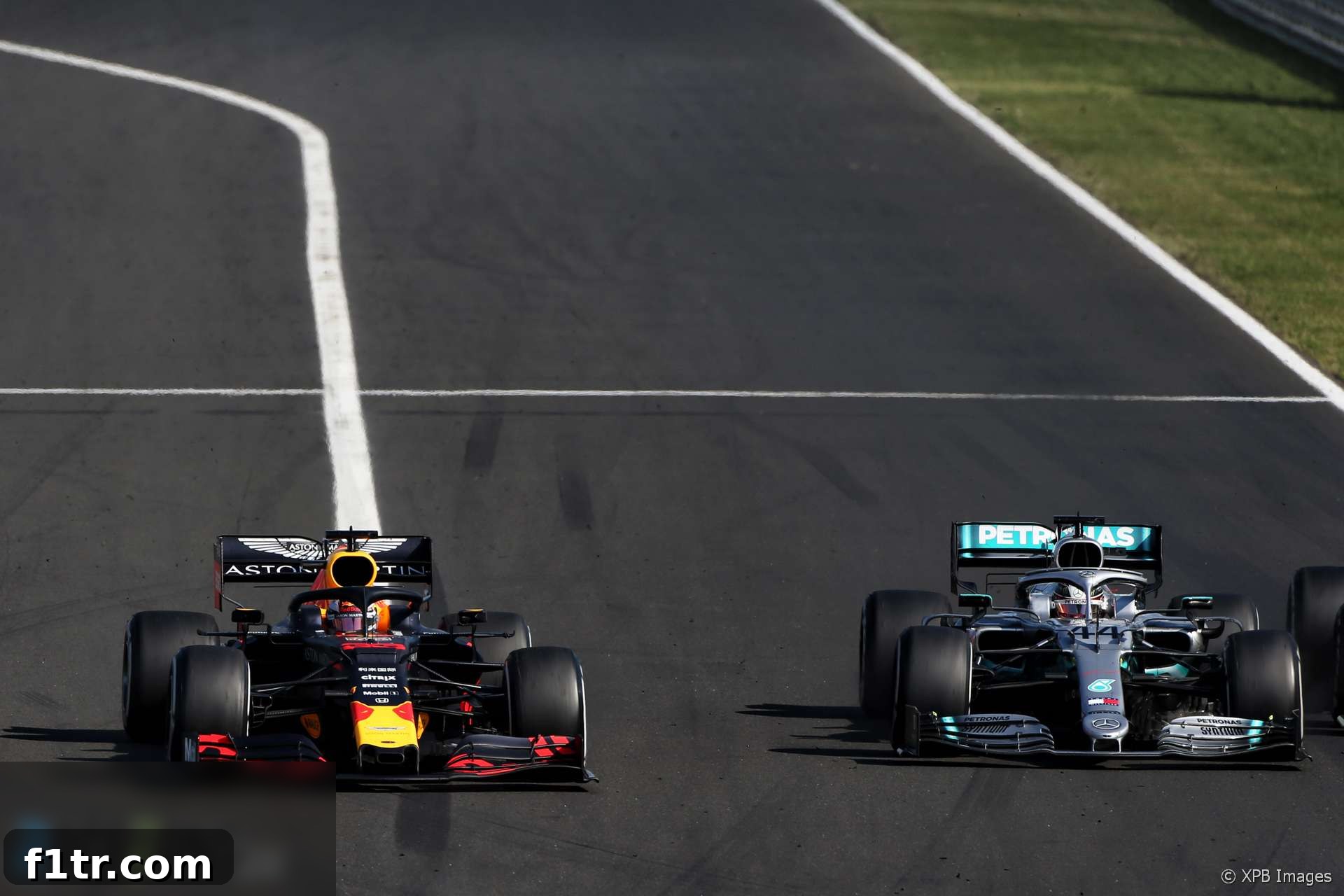
The 2019 Hungarian Grand Prix delivered a captivating spectacle of strategic warfare, culminating in a triumph for Mercedes and Lewis Hamilton over the formidable challenge posed by Red Bull and Max Verstappen. Christian Horner, Red Bull Racing’s team principal, candidly admitted after the race that his team found themselves utterly defenseless against Mercedes’ decisive tactical maneuver, a move that ultimately paved the way for Hamilton’s victory at the Hungaroring.
The race had been a tense affair, with Verstappen initially holding a strong lead. However, the tide dramatically turned in the closing stages when Hamilton, armed with a fresh set of medium tyres following an unexpected second pit stop, launched an relentless assault on Verstappen. Red Bull’s inability to counter this strategic gamble left them vulnerable, showcasing the razor-thin margins that often dictate success in Formula 1.
Horner recounted the initial belief within the Red Bull garage that Verstappen had the situation under control. “It felt like Max had enough to have him just under control,” Horner stated, reflecting on the mid-race tension. He also highlighted the pressure Hamilton was exerting, noting, “We could hear that as soon as Lewis was getting close his car was overheating or brakes and issues like that.” This observation underscores the sheer intensity of the battle, where both drivers were pushing their machinery to the absolute limit, with performance and component temperatures teetering on the edge.
However, the pivotal factor that enabled Mercedes’ strategic masterclass was the significant gap their two front-running drivers had established over the rest of the field. This substantial buffer provided Hamilton with a crucial “free pit stop” – the ability to pit for new tyres without relinquishing his track position to any car beyond Verstappen. This scenario is a strategist’s dream, offering a low-risk, high-reward opportunity to reset tyre performance and launch a late-race offensive. Horner perfectly articulated this unique advantage: “With the two guys so far ahead of the rest of the field and the pace that they had in the Mercedes, strategically it was the obvious thing to do to roll the dice and take a pit stop.” It was a bold move, yes, but one underpinned by meticulous data analysis and a clear understanding of the race dynamics.
The execution of Hamilton’s second pit stop was nothing short of flawless, setting the stage for the dramatic conclusion. His pit crew performed with lightning speed, and Hamilton himself delivered an exceptional out-lap, immediately putting Red Bull on the back foot. The data coming into the Red Bull pit wall was instantaneous and damning. “By halfway round [Hamilton’s] out-lap he was already neck-and-neck,” Horner explained, emphasizing the speed with which Hamilton was gaining. This rapid gain meant that if Red Bull had attempted a reactionary pit stop with Verstappen on the subsequent lap, it would have been too late; they would have conceded track position outright. “So we didn’t have the ability to then cover with Max by stopping him on the next lap because it would have conceded track positions,” Horner confirmed, highlighting the profound strategic trap they had fallen into.
Advert | Become a Supporter & go ad-free
At that critical juncture, Red Bull found themselves in an unenviable position. As Horner succinctly put it, their “bed was made.” Verstappen was committed to finishing the race on his existing, increasingly worn tyres. This left him with no option but to push harder on his degrading rubber than he would have preferred, relinquishing any hope of careful tyre management. The strategic decision was out of their hands; it was a race of endurance against a car with superior grip and renewed vigor. Verstappen’s challenge was to somehow maintain the gap, a task made exponentially more difficult with each passing lap as Hamilton’s fresh tyres came into their optimal operating window.
Initially, Verstappen managed to hold his ground, particularly through traffic, which provided momentary respite from Hamilton’s relentless pursuit. Backmarkers often complicate racing lines and can momentarily neutralize a pace advantage. However, as soon as both cars emerged into clear air, the true disparity in tyre performance became brutally evident. “Then as soon as they got into clear air that’s when Lewis Hamilton really started coming,” Horner described, painting a vivid picture of the inevitable closing of the gap. With only a handful of laps remaining, Hamilton’s superior grip transformed Max Verstappen into “a little bit of a sitting duck.” The metaphor perfectly captured the helplessness of Verstappen’s situation – despite his formidable talent and defensive prowess, he simply could not counteract the overwhelming tyre advantage possessed by his rival. The overtake, when it eventually came, was almost a foregone conclusion, a testament to Mercedes’ strategic foresight and Hamilton’s execution.
While Red Bull managed to snatch the fastest lap of the race by pitting Verstappen for a set of soft tyres in the dying moments – a small consolation prize and a strategic decision aimed at securing an extra championship point – Horner remained realistic about the overall performance hierarchy that day. He conceded that Mercedes had simply been the quicker package in Hungary. “We had the opportunity to get the fastest lap. But I think today Mercedes probably did have a car that was slightly quicker than ours in race conditions,” Horner reflected. This honesty highlights that while strategy played a crucial role, Mercedes also held a fundamental performance edge. “And whilst we had track position they had the ability to execute a free stop and that worked out for them today,” he concluded, perfectly encapsulating the synergy of raw pace and strategic brilliance that secured Mercedes and Hamilton the Hungarian Grand Prix victory.
The 2019 Hungarian Grand Prix stands as a classic example of how Formula 1 races are not just won on track speed, but equally, if not more so, in the high-stakes chess match played out by strategists on the pit wall. Mercedes’ audacious decision to opt for a two-stop strategy, made possible by their significant pace advantage over the rest of the field, showcased a masterclass in race management. For Red Bull, it was a painful lesson in strategic vulnerability, reinforcing the idea that in the world of F1, complacency is never an option and every millisecond, every tyre compound, and every gap to a rival carries immense significance. This race not only added another thrilling chapter to the storied rivalry between Hamilton and Verstappen but also underscored the complex interplay of driver skill, car performance, and strategic acumen that defines the pinnacle of motorsport.
Advert | Become a RaceFans supporter andgo ad-free
2019 F1 season: A Look Back at Key Moments
The 2019 Formula 1 season was packed with memorable races and developing narratives, of which the Hungarian Grand Prix was just one highlight. The strategic battle at the Hungaroring was indicative of the fierce competition seen throughout that year. From emotional career lows to significant financial reports and driver achievements, the season offered a diverse range of stories that captivated fans worldwide.
- Crying in the Melbourne car park at 2019 grand prix was my career low – Ocon
- McLaren Racing reports reduced £71 million loss in 2019
- Kvyat: Hockenheim podium last year was “my biggest achievement” so far
- How the FIA’s new encrypted fuel flow meter targets Ferrari’s suspected ‘aliasing’ trick
- “He smashed my office door”: 23 must-see moments from ‘Drive to Survive’ season two
Browse all 2019 F1 season articles