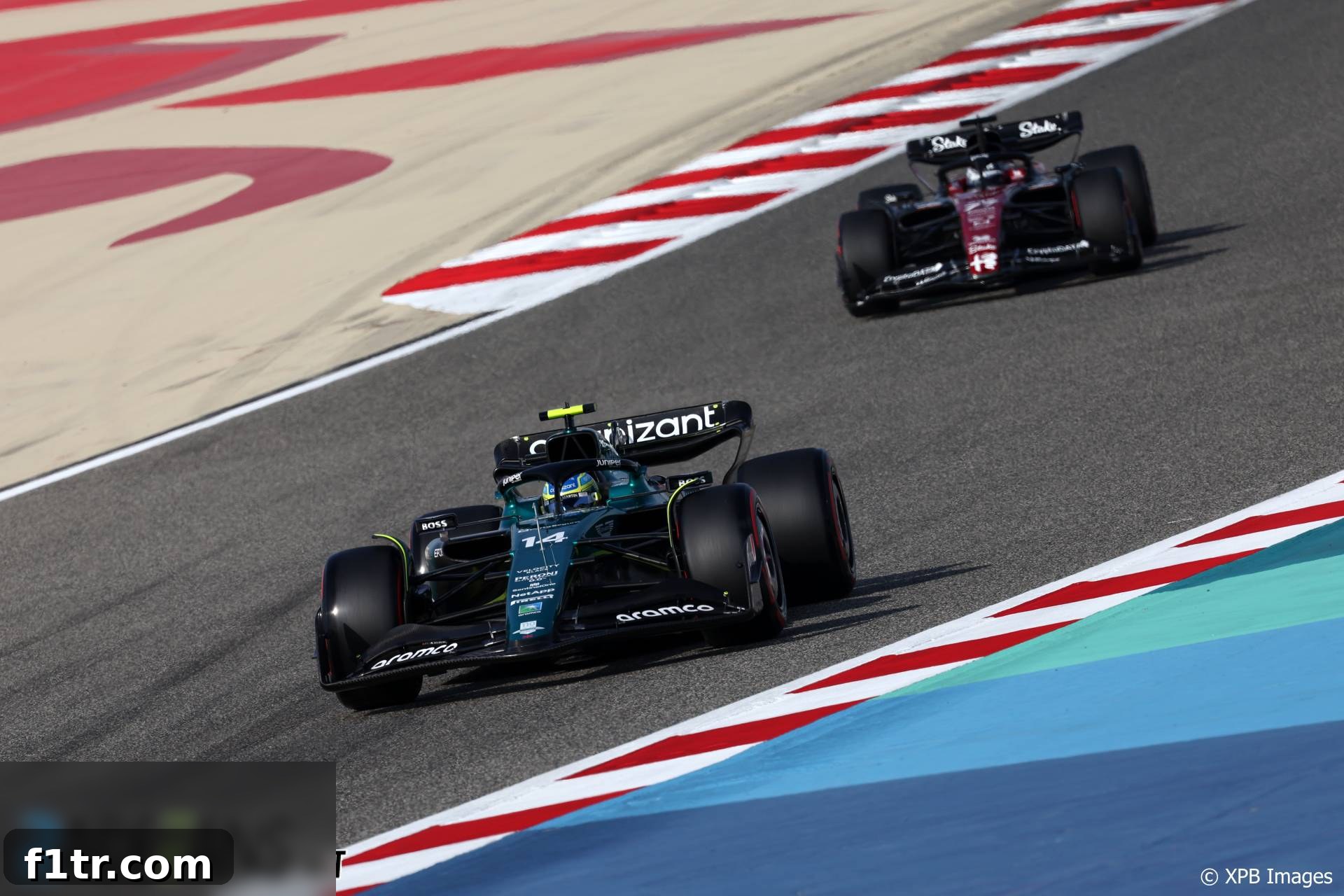
The 2022 Formula 1 season concluded with a thrilling and incredibly tight battle for sixth place in the Constructors’ Championship between Aston Martin and Alfa Romeo. The contest went down to the very final lap of the season, with Alfa Romeo ultimately prevailing by the slimmest of margins. Both teams were tied on points, but Alfa Romeo secured the coveted position through a count-back of their best finishing positions, a testament to the fierce competition within the midfield.
Advert | Become a Supporter & go ad-free
Just three months later, as the 2023 season commenced, the landscape of Formula 1 has undergone a drastic transformation, particularly for Aston Martin. The Silverstone-based outfit emerged as the undisputed talk of pre-season testing, consistently showcasing impressive pace. This strong form translated directly into the opening race weekend, where they topped two practice sessions and largely delivered on that promising display in qualifying. The palpable excitement around their newfound speed was undeniable.
Fernando Alonso, the two-time world champion, and his teammate Lance Stroll were set to line up fifth and eighth respectively on the grid for the opening race. This remarkable achievement truly puts Aston Martin’s progress into perspective. To illustrate the magnitude of this leap, consider their performance in 2022: neither of the team’s cars managed to progress beyond Q1 in qualifying at last year’s season opener. Their highest qualified driver at that time was Nico Hulkenberg, who placed 17th, two spots ahead of Stroll. This stark contrast highlights a phenomenal turnaround, transforming them from back-of-the-midfield contenders to a team challenging at the sharper end.
It’s no small wonder that Lance Stroll was so incredibly eager to return from injury to get behind the wheel of the AMR23. His enthusiasm is clearly rooted in the car’s performance capabilities, which he describes as a significant step forward from its predecessor in every conceivable area. “It’s everywhere,” Stroll affirmed, detailing the comprehensive improvements. “Balance, grip, we’ve just improved everything.” This holistic enhancement underscores a deep understanding and successful implementation of the new technical regulations, allowing the team to unlock substantial performance gains across the chassis and aerodynamic package.
While Aston Martin has surged forward, their former rivals, Alfa Romeo, present a contrasting picture of stagnation. Data from the opening race weekend suggested that Alfa Romeo’s cars were barely any quicker than they had been at the same track the previous year. Valtteri Bottas, their most experienced driver, managed to lap just a tenth of a second quicker than his 2022 qualifying time. This minimal progress is concerning, especially when viewed against the backdrop of other teams making significant advancements. The situation was so precarious that had Alexander Albon been able to complete his Q2 run without incurring damage on his Williams, Alfa Romeo could very well have found themselves as the slowest team on the track, a daunting prospect for any Formula 1 competitor.
Bottas’ teammate, Zhou Guanyu, also echoed similar sentiments, clocking a time just three-hundredths of a second slower than Bottas. While he acknowledged that the team had indeed made some progress, it was clearly not on the same scale as their direct competitors. “We obviously made a step in terms of performance compared to the last few races last year,” said Zhou, reflecting on the C43’s development. However, he quickly added, “But I feel like it’s quite clear some people made a huge step.” This sentiment highlights the brutal reality of Formula 1 development: incremental gains can be overshadowed if rivals find breakthrough performance.
The F1 calendar is long, and while there are some striking changes compared to last year’s performance levels, the latest generation of cars has only truly appeared in public on a single track so far – Bahrain. It remains to be seen whether the significant gains produced by teams like Aston Martin in the unique conditions of Bahrain will be consistently replicated elsewhere on the calendar. In Alfa Romeo’s specific case, the team had anticipated making their greatest gains in high-speed corners. However, the Bahrain International Circuit features relatively few of these high-speed sections, which might have masked their potential strengths or exacerbated their weaknesses in other areas. The true test of their development will come as the season progresses to circuits with a more diverse range of corner types.
Aston Martin’s dramatic improvement wasn’t solely the result of winter development. The team strategically introduced a significant upgrade package to its launch car early in the 2022 season. This mid-season evolution began to reap substantial dividends in the latter half of the year, providing a strong foundation upon which to build the AMR23. This proactive and aggressive development strategy, coupled with key personnel additions like Dan Fallows from Red Bull, has clearly paid off, indicating a fundamental shift in the team’s operational and design philosophy.
Consequently, Aston Martin’s midfield rivals of 2022, such as AlphaTauri, McLaren, and Alpine, can probably forget about directly challenging them this year. The gap has seemingly widened considerably. AlphaTauri’s Yuki Tsunoda candidly admitted that their performance “is miles away, I think, from top midfield.” He further elaborated on the challenges facing his team, stating, “It’s not consistent yet, still I was lacking a bit of grip as well. So we need to find this performance as soon as possible.” This candid admission underscores the new pecking order and the significant gap that other midfield teams now face in catching up to Aston Martin’s impressive pace. Many other drivers across the grid found themselves in a similar position after the first serious day of running in 2023, grappling with underperforming machinery and the need to extract more potential.
Advert | Become a RaceFans supporter andgo ad-free
Teams Performance: A Comprehensive Look at the 2023 F1 Grid Dynamics
The 2023 Formula 1 season marks the second year since the sport underwent a radical overhaul of its technical regulations, aimed at promoting closer racing and allowing cars to follow each other more effectively. As teams gain more experience and understanding of these rules, they have naturally begun to find more performance, pushing the boundaries of car design and engineering. The initial testing and the first race weekend of 2023 have provided crucial insights into which teams have adapted most effectively and which are still grappling with the complexities of the ground-effect era.
The rise of Aston Martin, as detailed, is undoubtedly the most compelling story of this early phase. Their ability to make such a significant leap, both in outright pace and consistency, has dramatically reshaped the midfield battle. Historically, it’s challenging for any team to make such a substantial jump in a single off-season, highlighting the efficacy of their development program and strategic hires. This level of progress suggests a deep understanding of the regulatory framework and a successful application of cutting-edge aerodynamic principles. Their AMR23 appears to be a well-balanced machine, offering drivers confidence and a wider operating window for tire management, critical factors for success in modern F1.
Conversely, teams like Alfa Romeo illustrate the unforgiving nature of F1 development. Even small gains can seem insignificant if competitors find larger steps. The budget cap, designed to level the playing field, also means that resources must be allocated with extreme precision. A misstep in design philosophy or a less effective upgrade path can set a team back significantly, making it harder to recover throughout the season. The challenge for teams making less progress is not just about finding pace, but about understanding where they lost ground and how to pivot their development strategy effectively, especially when early season performance dictates the trajectory for the entire year.
Advert | Become a RaceFans supporter andgo ad-free
Field Performance: A Look at Overall F1 Lap Time Evolution
The overall performance of the F1 field has undoubtedly improved in the second year of these technical regulations. This natural evolution sees teams optimizing their packages, refining their understanding of the aerodynamic characteristics, and extracting more from the power units and Pirelli tires. For instance, Max Verstappen’s pole position time at the Bahrain Grand Prix in 2023 was a significant 0.85 seconds quicker than his 2022 pole time at the same circuit. This acceleration across the grid is a clear indicator that teams are harnessing the potential within the current rule set more effectively.
However, despite these impressive gains, it’s worth noting that the current generation of cars still hasn’t matched the outright speed of the “downforce monsters” from the pre-2022 regulation era. Verstappen’s 2023 pole time, while fast, was still 2.4 seconds off the quickest time ever produced around the Bahrain International Circuit by the previous generation of F1 cars just two years prior. This gap highlights the fundamental shift in car design philosophy imposed by the new regulations, which prioritize closer racing over ultimate single-lap speed.
To put this into further perspective, for a team like Red Bull, currently at the pinnacle of performance, to stand a chance of matching those blisteringly quick times from 2021 within the next 12 months, they would need to emulate the kind of dramatic leap forward that Aston Martin has achieved over the most recent winter break. Such an improvement would require another significant step in aerodynamic efficiency, mechanical grip, and potentially even power unit optimization – a monumental task even for the most dominant teams in the sport.
NB. 2004 and 2010: Different track configuration used; 2011: Race cancelled
Become a RaceFans Supporter and Go Ad-Free
RaceFans is an independent platform that thrives thanks in part to the generous support of its dedicated readers. By contributing a modest £1 per month or £12 per year (or the equivalent in your local currency), you can play a crucial role in helping us cover the ongoing costs of creating high-quality content, hosting our services, and continually developing RaceFans today and into the future.
Become a RaceFans Supporter today to not only contribute to our mission but also enjoy an enhanced browsing experience completely ad-free. Sign up or find out more about the benefits via the links below:
- Become a RaceFans Supporter
- RaceFans Supporter FAQ
2023 Bahrain Grand Prix: Related Articles and Further Reading
Delve deeper into the events and analyses surrounding the 2023 Bahrain Grand Prix with our collection of related articles:
- FIA no longer applying its limit on F1 cars ‘porpoising’
- Why F1’s 2023 tyres are requiring drivers to change their management style
- The familiar and unfamiliar problems holding McLaren back at the start of 2023
- ‘Not like a rookie’: How McLaren glimpsed Piastri’s potential in curtailed debut
- “I’m a shouty guy”: Tsunoda told to rein in “emotional” radio chatter
Browse all 2023 Bahrain Grand Prix articles