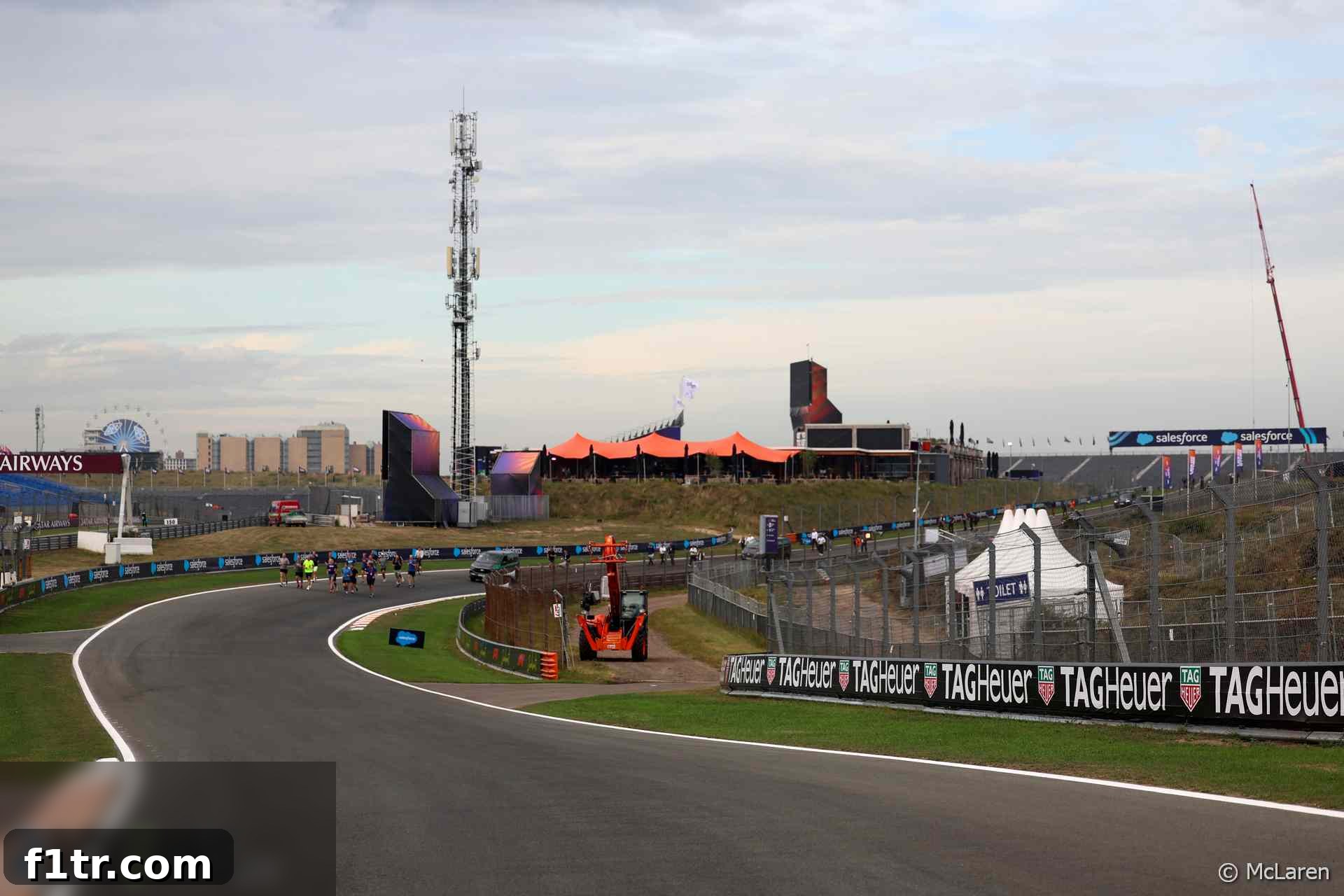
The highly anticipated Dutch Grand Prix at Zandvoort is poised for a dramatic twist this weekend, as Formula 1 teams and drivers brace themselves for the strong possibility of rain across all three days of track action. This meteorological uncertainty introduces an exhilarating layer of unpredictability to what is already one of the sport’s most challenging and atmospheric events.
Advert | Become a Supporter & go ad-free
“It’s difficult to say what to predict,” commented Sauber’s Gabriel Bortoleto, highlighting the collective uncertainty pervading the paddock. “This weekend could be quite crazy with the weather.” His sentiment echoes the thoughts of many up and down the pit lane, as strategists begin to recalibrate their plans for varying conditions on the unique seaside circuit.
The Zandvoort Challenge: Where Rain Amplifies the Drama
Zandvoort is renowned for its thrilling layout, featuring high-speed sections, challenging corners, and distinctive banked turns that demand immense precision and bravery from drivers. Its proximity to the North Sea also makes it particularly susceptible to sudden weather shifts. Rain on this circuit isn’t just a challenge; it’s a game-changer. The narrow track, combined with the often abrasive surface and the ever-present threat of sand blowing onto the tarmac, means that wet conditions can dramatically reduce grip and elevate the risk of incidents. Even a slight drizzle can make the difference between a heroic performance and an early exit.
The track, having dried out on Thursday after earlier rainfall, is expected to receive further downpours. This fluctuating state of the circuit will be a key factor in how teams approach their car setups and how drivers manage their tyres, making every session a critical learning opportunity for the race ahead.
A Day-by-Day Weather Outlook: Navigating the Elements
Friday: From Sunshine to Showers – The Practice Gauntlet
The opening day of practice on Friday is forecast to begin with intermittent sunshine, offering drivers a chance to establish a baseline setup on a relatively dry track. However, the skies are expected to cloud over early in the day, signaling the impending change. Overcast conditions are predicted to persist through Sunday evening, but it is the three hours of practice sessions that are most likely to feel the full impact of the rain.
The risk of rain is projected to rise steadily from midday. By the time the first practice session is due to commence at 12:30 PM local time, drivers will already be on alert. This risk is set to increase to approximately 40% as the afternoon progresses, peaking around the second practice session at 4 PM. This means teams will need to be agile, ready to switch between dry and intermediate tyres, and adapt their setups on the fly. Mastering a wet Zandvoort in practice will be crucial for any team hoping to contend for strong results.
Saturday: Qualifying on a Damp Edge
The threat of rain will loom large throughout Saturday morning, potentially affecting the final crucial hour of practice before qualifying. This session is vital for fine-tuning setups and practicing qualifying runs. Should rain make an appearance, it could significantly disrupt team preparations and force drivers to adapt their strategies at short notice.
While no rain is currently forecast during the high-stakes qualifying session itself, the track may still be damp or partially wet from earlier showers. This scenario, known as “crossover conditions,” presents a unique challenge, making tyre choice incredibly difficult. Drivers might gamble on slicks on a drying track or opt for intermediates, creating a thrilling and unpredictable qualifying battle where strategy and nerve are as important as raw pace. The smallest error on a damp Zandvoort can have massive consequences, adding to the drama.
Sunday: Race Day – Anticipating the Grand Prix Shower
The forecast for Sunday mirrors the pattern of the preceding days, albeit with a higher chance of wet conditions earlier in the day. The F1 Academy and Porsche Supercup support races, which provide excellent entertainment, are more likely to experience the full force of the rain. These races often serve as a prelude to the main event, giving teams and drivers an indication of how the track might behave in wet conditions.
Crucially, the rain is expected to dissipate and stop before the Dutch Grand Prix officially begins at 3 PM local time. However, this doesn’t guarantee a dry race. Even if the rain ceases, a damp or even fully wet track from earlier downpours could still heavily influence tyre strategy, pit stop windows, and driver performance. The lingering moisture will keep everyone on their toes, from the drivers fighting for every tenth to the strategists making split-second decisions from the pit wall.
Historical Context: A Recent History of Wet and Dry Extremes
Since its highly anticipated return to the Formula 1 calendar four years ago, Zandvoort has hosted some memorable races, but only one Dutch Grand Prix has been run in truly wet conditions. That was the 2023 edition, a race that added another chapter to the legend of Max Verstappen. Rain began to fall halfway through the opening lap, throwing the field into disarray and prompting immediate strategic choices. Verstappen expertly navigated the treacherous conditions, securing a home victory that showcased his unparalleled skill in adverse weather.
In stark contrast, last year’s race, which saw Lando Norris claim a sensational victory, was held under brilliant sunny skies, with ambient temperatures soaring to a scorching 31°C. This presented an entirely different challenge, focusing on tyre degradation management and driver endurance in the heat.
This year, the ambient temperature forecasts suggest a significant departure from last year’s sweltering heat, with temperatures unlikely to break into the low twenties across all three days of track action. Cooler, potentially wetter conditions will dramatically alter car setup priorities, tyre performance, and the physical demands on the drivers, making recent historical data only partially relevant for the upcoming race.
Implications for Drivers and Teams: Strategy is Key
The prospect of a rain-affected Dutch Grand Prix elevates the importance of strategy, adaptability, and driver skill. Wet weather racing often levels the playing field, creating opportunities for midfield teams to challenge the established front-runners and allowing drivers with exceptional car control to shine. Tyre management becomes paramount, as teams must decide between full wet tyres for heavy rain, intermediates for damp or drying conditions, and slicks if the track dries completely. These choices, often made under immense pressure, can win or lose a race.
Furthermore, the increased likelihood of safety car periods or even red flags in wet conditions means that pit stop windows and track position become even more critical. Teams will run through countless scenarios in their simulations, but ultimately, real-time decisions on the pit wall will dictate outcomes. For drivers, the mental challenge is immense, demanding razor-sharp focus, precise car placement, and the ability to find grip where others cannot. Gabriel Bortoleto’s assessment of a “crazy” weekend truly encapsulates the high stakes and the potential for a memorable, chaotic race.
Advert | Become a RaceFans supporter andgo ad-free
The Fan Experience: Embracing the Unpredictability
For the thousands of passionate fans flocking to Zandvoort, and millions watching worldwide, the prospect of rain only adds to the excitement. Wet races are often considered some of the most thrilling in Formula 1, renowned for their unpredictable nature, dramatic overtakes, and unexpected heroes. The unique atmosphere of the Dutch Grand Prix, combined with the potential for ever-changing conditions, promises a spectacle where every lap could bring a new leader, a daring move, or a heart-stopping moment. Spectators should come prepared for all weathers, ready to witness a truly unforgettable chapter in Formula 1 history.
Miss nothing from RaceFans
Get a daily email with all our latest stories – and nothing else. No marketing, no ads. Sign up here:
2025 Dutch Grand Prix
- Williams’s Sainz penalty review success “will open the door to more challenges”
- Lawson now accepts Sainz collision was a “racing incident” after stewards’ U-turn
- Stewards’ U-turn over Zandvoort penalty shows ‘how far the FIA have come’ – Sainz
- The FIA’s stewards grabbed the chance to correct their mistake – unlike last time
- Sainz’s Dutch GP penalty points cancelled as stewards accept Williams’ request for review
Browse all 2025 Dutch Grand Prix articles