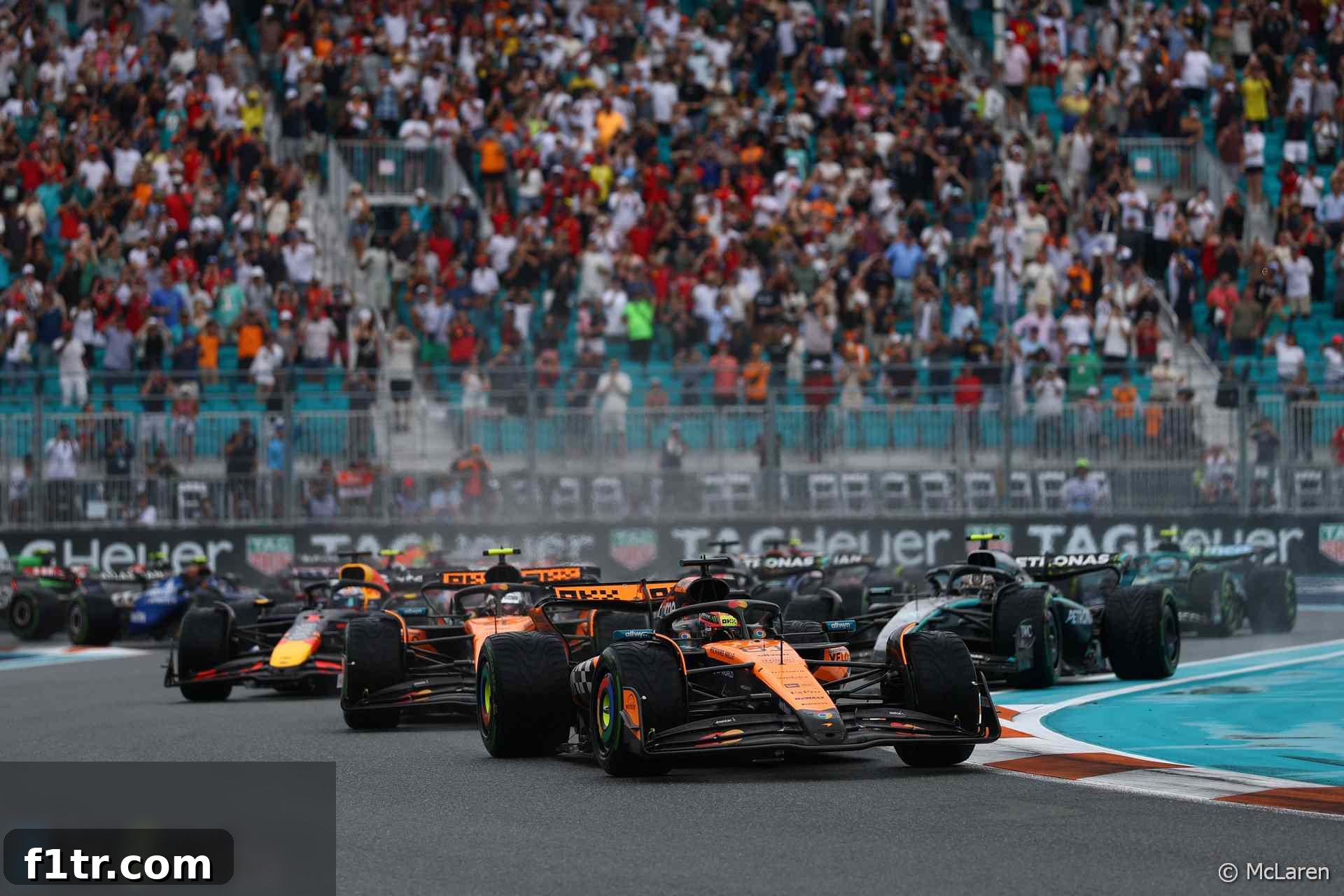
The highly anticipated Miami Grand Prix is set to ignite the Formula 1 circuit, with Red Bull Racing’s reigning champion Max Verstappen once again commanding the crucial pole position. Verstappen’s recent performances have undeniably showcased his unwavering determination to convert a prime starting spot into victory, especially when it comes to maintaining a dominant lead in clear air. His tactical prowess and relentless pursuit of clean track conditions were vividly on display in the previous outing, leaving rivals scrambling to find an answer.
As the grid lines up under the Florida sun, the fundamental question looms: Can Verstappen replicate his past successes and effectively safeguard his hard-won advantage? Or will the notorious unpredictability of Miami’s weather introduce an element of chaos, potentially throwing a wrench into the meticulously crafted strategies of every team and driver on the grid? This detailed preview delves into the critical factors that are poised to shape the narrative of this weekend’s thrilling race.
From the ever-looming threat of rain to the intricate dance of tire strategy and the fiercely contested opening laps, every aspect will play a pivotal role. Here’s a comprehensive look at the key data, strategic considerations, and potential pitfalls awaiting the drivers at the Miami International Autodrome.
Weather Dynamics: A Gamble with the Elements
Weather has been a disruptive force throughout the Miami Grand Prix weekend, particularly impacting Saturday’s sprint race which saw significant delays due to a sudden downpour. Looking ahead to Sunday, there remains a substantial possibility that Formula 1 will once again grapple with the challenge of rain. While the exact timing and intensity are notoriously difficult to predict, local forecasts indicate a 40-50% risk of thunderstorms developing in the hours leading up to and during the main Grand Prix event. Should rain materialize, it is anticipated to be as heavy and impactful as the deluge that led to the half-hour postponement of the sprint race.
This meteorological uncertainty forces teams into a high-stakes strategic dilemma. Pit walls will be meticulously monitoring their weather radars, deploying staff up the road to provide real-time updates on changing conditions. The decisions made under such pressure are not always straightforward or immediately logical, as evidenced by last year’s dramatic Brazilian Grand Prix. In situations where the track is already wet and expected to become even wetter, a pit stop to switch from intermediate to full wet weather tires, or even to fresh intermediates, carries significant risk. Drivers who choose to stay out and gain crucial track position might find themselves in a vastly superior situation if the race is red-flagged, allowing them to change tires without losing precious time in the pit lane. Such complex, multi-layered strategic scenarios are precisely what could unfold, making weather a decisive factor in Miami.
The Critical Opening Lap: Navigating Turn One
The standing start in Miami has already proven to be a crucible of opportunity and peril this weekend. The sprint race offered a stark illustration of this, as pole-sitter Andrea Kimi Antonelli lost his advantage almost immediately. Oscar Piastri, demonstrating an exceptional getaway, outmaneuvered Antonelli off the line, asserted his right to the first corner, and ultimately forced the Mercedes wide, dropping Antonelli to fourth place. This incident underscores the immense importance of a clean start and aggressive yet controlled driving in the opening seconds of the race.
The run to Turn 1 at the Miami International Autodrome is relatively short, and the corner itself is notoriously narrow. This combination creates a high-pressure scenario where the driver starting second often has an excellent chance to capitalize on any hesitation or slight misstep from the pole-sitter. Being forced wide at Turn 1 is a severe disadvantage, as it compromises exit speed and often leads to a loss of multiple positions. However, seasoned drivers like Max Verstappen are well aware of these risks and will have meticulously planned their defense. Verstappen himself demonstrated this proactive approach in Jeddah, where he used the run-off area to maintain his lead after being passed by Piastri. While this maneuver resulted in a penalty, Red Bull team principal Christian Horner later confirmed it was a calculated tactical decision to prioritize track position and clean air over avoiding a minor infraction, highlighting the extreme value placed on leading the race.
Historical data also provides valuable insights. At last year’s Miami Grand Prix, Verstappen started from pole, but Charles Leclerc alongside him had a poor getaway. The drama intensified as Sergio Perez arrived at Turn 1 with excessive speed, nearly colliding with Verstappen and forcing Carlos Sainz Jnr wide in the other Ferrari, which inadvertently allowed Leclerc to regain the second position he had initially lost. These past events serve as a powerful reminder that the first few corners of the Miami Grand Prix are often where the race is won or lost, characterized by high tension, aggressive maneuvers, and rapid shifts in the pecking order. Furthermore, the starting performance of drivers like Lando Norris, which has historically been weaker compared to Verstappen’s, appears to be improving, adding another layer of intrigue to the initial dash for the lead.
A graphical representation, traditionally provided by sources like Mercedes, illustrates the distance from pole position to the first braking zone, a crucial metric for understanding the dynamics of the initial sprint. This visual data often reveals how quickly drivers must commit to their braking points and line choices, further emphasizing the split-second decisions required at the start.
Tire Strategy: The Pirelli Puzzle
Pirelli has opted for a slightly softer compound selection for this year’s Miami Grand Prix compared to 12 months ago, bringing tires that are one stage softer across the range. Last year, the majority of drivers initiated their race on the medium compound, which corresponds to this year’s hard compound. This strategic shift in tire allocation demands a re-evaluation of race strategy, although the underlying principles of tire management remain paramount.
Reviewing the starting tire choices from last year’s event offers a benchmark:
| Pos. | Driver | Team | Tyre compound |
|---|---|---|---|
| 1 | Max Verstappen | Red Bull-Honda RBPT | Medium |
| 2 | Charles Leclerc | Ferrari | Medium |
| 3 | Carlos Sainz Jnr | Ferrari | Medium |
| 4 | Sergio Perez | Red Bull-Honda RBPT | Medium |
| 5 | Lando Norris | McLaren-Mercedes | Medium |
| 6 | Oscar Piastri | McLaren-Mercedes | Medium |
| 7 | George Russell | Mercedes | Medium |
| 8 | Lewis Hamilton | Mercedes | Hard |
| 9 | Nico Hulkenberg | Haas-Ferrari | Medium |
| 10 | Yuki Tsunoda | RB-Honda RBPT | Medium |
| 11 | Lance Stroll | Aston Martin-Mercedes | Medium |
| 12 | Pierre Gasly | Alpine-Renault | Medium |
| 13 | Esteban Ocon | Alpine-Renault | Medium |
| 14 | Alexander Albon | Williams-Mercedes | Medium |
| 15 | Fernando Alonso | Aston Martin-Mercedes | Hard |
| 16 | Valtteri Bottas”>Valtteri Bottas | Sauber-Ferrari | Soft |
| 17 | Logan Sargeant | Williams-Mercedes | Medium |
| 18 | Kevin Magnussen | Haas-Ferrari | Hard |
| 19 | Zhou Guanyu | Sauber-Ferrari | Medium |
| 20 | Daniel Ricciardo | RB-Honda RBPT | Hard |
For the current race, the tire availability for each driver highlights potential strategic variations:
| Tyres available for the race | Hard | Medium | Soft | |||
|---|---|---|---|---|---|---|
| Driver | New | Used | New | Used | New | Used |
| Max Verstappen | 2 | 0 | 1 | 1 | 0 | 3 |
| Lando Norris | 2 | 0 | 1 | 2 | 0 | 2 |
| Andrea Kimi Antonelli | 2 | 0 | 1 | 1 | 0 | 3 |
| Oscar Piastri | 2 | 0 | 1 | 1 | 0 | 3 |
| George Russell | 2 | 0 | 1 | 1 | 0 | 3 |
| Carlos Sainz Jnr | 2 | 0 | 0 | 2 | 0 | 3 |
| Alexander Albon | 2 | 0 | 1 | 1 | 0 | 3 |
| Charles Leclerc | 2 | 0 | 1 | 2 | 0 | 2 |
| Esteban Ocon | 2 | 0 | 1 | 1 | 0 | 3 |
| Yuki Tsunoda | 2 | 0 | 2 | 0 | 0 | 3 |
| Isack Hadjar | 1 | 0 | 2 | 1 | 0 | 3 |
| Lewis Hamilton | 2 | 0 | 1 | 2 | 1 | 1 |
| Gabriel Bortoleto | 2 | 0 | 2 | 0 | 0 | 3 |
| Jack Doohan | 2 | 0 | 2 | 1 | 0 | 2 |
| Liam Lawson | 1 | 0 | 2 | 1 | 1 | 2 |
| Nico Hulkenberg | 2 | 0 | 1 | 1 | 2 | 1 |
| Fernando Alonso | 1 | 1 | 0 | 2 | 2 | 1 |
| Pierre Gasly | 2 | 0 | 1 | 1 | 3 | 0 |
| Lance Stroll | 1 | 1 | 1 | 1 | 3 | 0 |
| Oliver Bearman | 2 | 0 | 2 | 0 | 3 | 0 |
Notably, Carlos Sainz Jnr faces a potential disadvantage among the front-runners as he has no new sets of medium tires remaining. This could force him into a less flexible strategy, possibly starting on used mediums or needing to make an early switch to hards, which might compromise his pace or track position depending on race developments. Despite the use of softer compounds this year, a single-stop strategy, typically involving a switch from medium to hard tires, is widely expected to be the optimal approach in dry conditions. This was the predominant strategy in previous Miami Grand Prix editions. However, this projection is heavily contingent on the absence of rain and the deployment of the Safety Car. A pit stop in dry conditions at the Miami International Autodrome costs approximately 20 seconds, making strategic timing and minimizing pit stops crucial for a strong finish.
Overtaking Opportunities: The DRS Zone Extension
The Miami International Autodrome features three DRS zones, and significantly, one of these has been extended for this year’s race. Drivers can now activate their rear wings 75 meters earlier on the approach to Turn 11. This modification aims to enhance overtaking opportunities at what is already considered one of the circuit’s more promising spots for wheel-to-wheel action. The longer DRS activation point provides a greater speed differential, allowing drivers to get closer to their rivals before the braking zone, setting the stage for more aggressive and potentially successful passes.
The sprint race, however, already provided a contentious incident at this very corner, offering a critical insight into how stewards will adjudicate successful overtakes there. Liam Lawson was issued a five-second time penalty following a collision with Fernando Alonso. The stewards’ ruling was precise: Lawson had not positioned his car sufficiently alongside the Aston Martin to be entitled to racing room on the outside of Turn 11. Their detailed assessment stated: “Although being able to pull fully alongside, the front axle of car 30 [Lawson] was not ahead of the front axle of car 14 at the apex as required per the Driving Standards Guidelines. Therefore car 30 was not entitled to be given room at the exit. Due to the layout of the track, the car which has the right to the racing line in Turn 11 also has the right to the racing line in Turn 12.” This ruling highlights the strict interpretation of racing guidelines and will undoubtedly influence how drivers approach overtaking in this crucial section during the main Grand Prix. Lawson also received a penalty point for the incident, bringing his total to six, halfway towards an automatic one-race ban. Only Max Verstappen has accumulated more penalty points, currently standing at eight, emphasizing the tightrope walk drivers must perform between aggressive racing and adherence to the regulations.
Speed Trap Analysis: Power vs. Downforce
While Red Bull team principal Christian Horner has suggested that Max Verstappen’s car is running a higher downforce level compared to some of his competitors, this strategy does not appear to have significantly compromised his straight-line speed. This delicate balance between maximizing downforce for cornering grip and minimizing drag for straight-line velocity is a continuous engineering challenge in Formula 1. However, Verstappen may still find himself under threat from rivals who might possess superior straight-line pace.
Intriguingly, the six drivers immediately behind Verstappen on the grid have all benefited from fresh Mercedes power units for this weekend’s event. A new power unit can offer a noticeable performance boost, particularly in terms of horsepower and efficiency, which directly translates to higher top speeds on the long straights of the Miami circuit. This factor could create intense battles, especially in the DRS zones, where these Mercedes-powered cars might leverage their fresh engines to launch overtakes.
A closer look at the qualifying maximum speeds provides a clearer picture:
| P. | # | Driver | Car | Engine | Model | Max kph (mph) |
|---|---|---|---|---|---|---|
| 1 | 16 | Charles Leclerc | Ferrari | Ferrari | SF-25 | 343.5 (213.4) |
| 2 | 44 | Lewis Hamilton | Ferrari | Ferrari | SF-25 | 341.8 (212.4) |
| 3 | 27 | Nico Hulkenberg | Sauber | Ferrari | C45 | 341.4 (212.1) |
| 4 | 5 | Gabriel Bortoleto | Sauber | Ferrari | C45 | 341.2 (212.0) |
| 5 | 1 | Max Verstappen | Red Bull | Honda RBPT | RB21 | 341.0 (211.9) |
| 6 | 55 | Carlos Sainz Jnr | Williams | Mercedes | FW47 | 341.0 (211.9) |
| 7 | 12 | Andrea Kimi Antonelli | Mercedes | Mercedes | W16 | 340.5 (211.6) |
| 8 | 18 | Lance Stroll | Aston Martin | Mercedes | AMR25 | 340.0 (211.3) |
| 9 | 22 | Yuki Tsunoda | Red Bull | Honda RBPT | RB21 | 339.7 (211.1) |
| 10 | 23 | Alexander Albon | Williams | Mercedes | FW47 | 339.0 (210.6) |
| 11 | 6 | Isack Hadjar | Racing Bulls | Honda RBPT | 02 | 338.9 (210.6) |
| 12 | 4 | Lando Norris | McLaren | Mercedes | MCL39 | 338.8 (210.5) |
| 13 | 63 | George Russell | Mercedes | Mercedes | W16 | 338.7 (210.5) |
| 14 | 31 | Esteban Ocon | Haas | Ferrari | VF-25 | 338.3 (210.2) |
| 15 | 30 | Liam Lawson | Racing Bulls | Honda RBPT | 02 | 338.0 (210.0) |
| 16 | 14 | Fernando Alonso | Aston Martin | Mercedes | AMR25 | 337.9 (210.0) |
| 17 | 7 | Jack Doohan | Alpine | Renault | A525 | 337.0 (209.4) |
| 18 | 10 | Pierre Gasly | Alpine | Renault | A525 | 337.0 (209.4) |
| 19 | 87 | Oliver Bearman | Haas | Ferrari | VF-25 | 336.9 (209.3) |
| 20 | 81 | Oscar Piastri | McLaren | Mercedes | MCL39 | 336.6 (209.2) |
While Verstappen’s top speed is competitive, he is not at the very top of the speed trap charts, suggesting that his setup prioritizes cornering performance. This could be a critical point during the race, as drivers like Charles Leclerc and Lewis Hamilton, who recorded higher speeds, might have an edge in launching attacks down the straights. The interplay between raw power and aerodynamic efficiency will be a captivating element of the race dynamics.
Safety Car Impact: A Double-Edged Sword
The Safety Car has historically played a significant role in the Miami Grand Prix, appearing in two of the last three races at this circuit – yesterday’s sprint race and last year’s Grand Prix. On both occasions, the timing of the Safety Car deployments proved particularly advantageous for Lando Norris, allowing him to benefit from ‘cheap’ pit stops or close gaps to his rivals. This recurring pattern highlights how crucial it is for teams to react swiftly and strategically when the Safety Car is deployed, as it can completely reset the race order and shift momentum.
However, it’s worth noting that dry races at this track can sometimes become processional and relatively uneventful, with the 2023 race running from start to finish without any interruptions. This stark contrast underscores the binary nature of racing at Miami: either a straightforward, high-speed procession or a chaotic, unpredictable spectacle dictated by external factors. The Safety Car also made an appearance in the inaugural 2022 event, though on that occasion, Norris was not in a position to benefit, as he was the cause of its deployment, crashing out at Turn 8 following contact with Pierre Gasly. This demonstrates that while the Safety Car can offer immense opportunities, it can also be triggered by misfortune, highlighting the fine margins between heroics and hazards in Formula 1 racing. The likelihood of a Safety Car remains a key strategic consideration, influencing fuel loads, tire strategies, and pit stop windows for every team.
The Starting Grid: Final Positions
The grid for this year’s Miami Grand Prix is set to deliver an enthralling competition. Any final changes or penalties applied between now and the race start will be updated to reflect the definitive lineup:
- Detailed 2025 Miami Grand Prix Grid
Anticipating the Race: Your Insights
With all these variables in play – from Max Verstappen’s pole position advantage and the looming threat of Miami’s weather to the intricacies of tire strategy, the extended DRS zones, and the ever-present potential for Safety Car interventions – the Miami Grand Prix is poised to be an enthralling spectacle. The balance between driver skill, engineering brilliance, and tactical foresight will ultimately determine the outcome. How do you foresee the drama unfolding at the Miami International Autodrome? Share your predictions and race insights in the comments below.
Don’t Miss a Single RaceFans Update
Get a daily email with all our latest stories – no marketing, no ads, just pure F1 content. Sign up here to stay fully informed:
Experience RaceFans Ad-Free for Just £1 Per Month!>> Discover the benefits and sign up today
More on the 2025 Miami Grand Prix
- Nothing for Ferrari to learn from Miami team orders episode – Vasseur
- Hamilton proud of Ferrari as ‘we’re taking a beating from media and people’s comments’
- McLaren legality never in doubt says Piastri as FIA’s post-race check clears car
- Albon did not disobey team orders in Miami says Vowles after Sainz’s complaint
- McLaren score their their most emphatic win since Hamilton’s 2008 Silverstone triumph
Browse all 2025 Miami Grand Prix articles