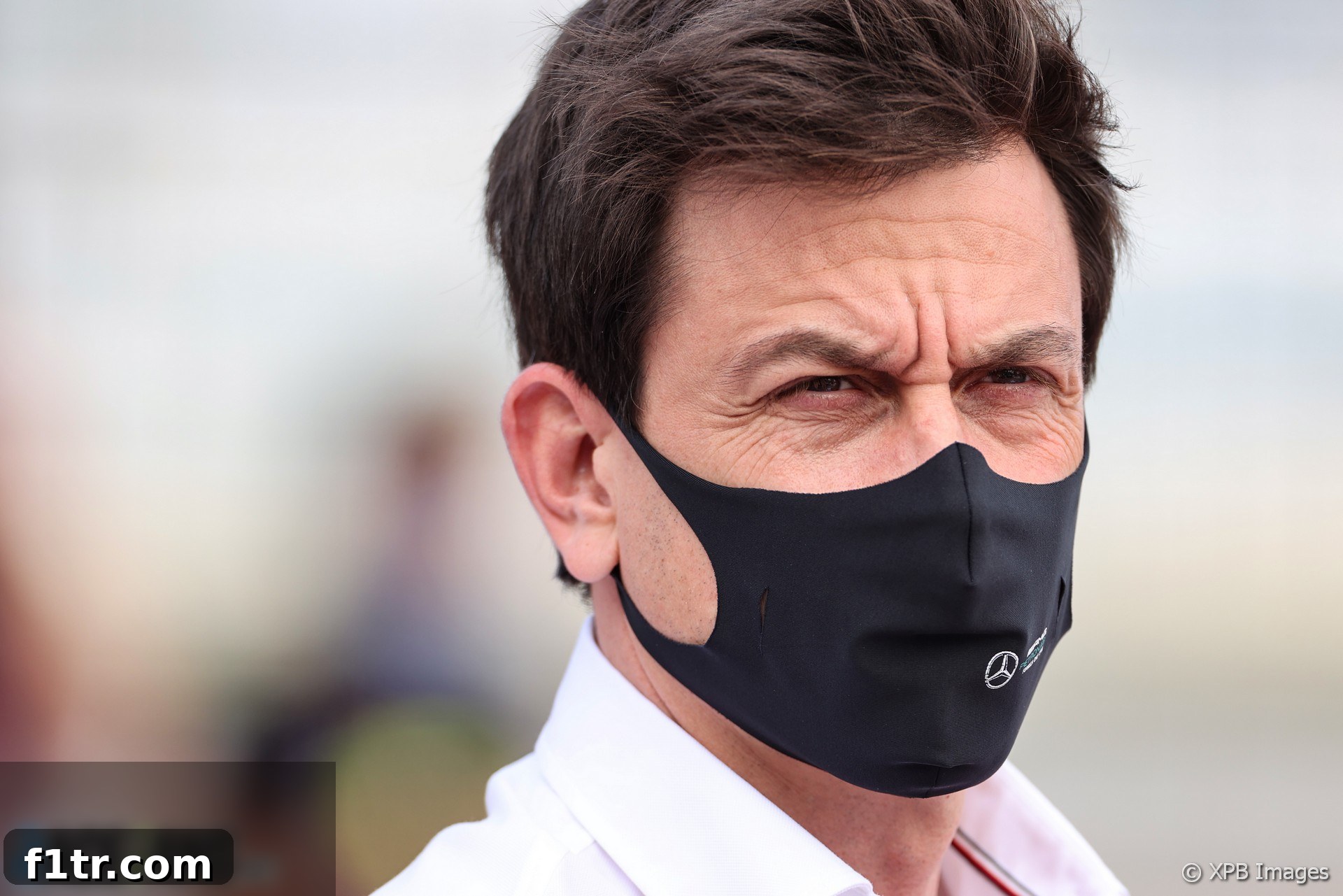
In the high-stakes world of Formula 1, where every tenth of a second can decide a championship, accusations and counter-accusations regarding performance gains are a regular feature. The 2021 season, marked by an intense rivalry between Mercedes and Red Bull Racing, has seen its fair share of such exchanges. At the heart of a recent debate lies the performance of Red Bull’s Honda power unit, a topic that has drawn sharp commentary from Mercedes team principal Toto Wolff. Wolff has pointedly questioned the fervent defense offered by Red Bull regarding their engine’s capabilities, particularly after perceived gains in straight-line speed.
The controversy ignited following the French Grand Prix, where Red Bull introduced its second power unit of the season. Under Formula 1’s stringent regulations, manufacturers are generally prohibited from making performance-enhancing modifications to their engines once they have been homologated at the start of the season. The only permissible changes are those necessary for reliability reasons. This rule creates a delicate balance, as any reliability upgrade could, in theory, unlock previously unattainable performance modes.
After the race at Circuit Paul Ricard, Mercedes’ seven-time world champion Lewis Hamilton was quick to suggest that Red Bull had benefited from “upgraded” power units, implying a performance boost beyond mere reliability fixes. This assertion naturally drew a swift response from the Red Bull camp. Team principal Christian Horner robustly countered Hamilton’s claims, stating unequivocally that their new engines were “the same specification as the first unit.” Horner attributed Red Bull’s superior straight-line performance not to engine upgrades, but to their strategic decision to “run a much smaller rear wing” at the French Grand Prix, a setup that reduces drag and increases top speed.
Asked to comment on the possibility that Honda might have made changes to their engines for reliability reasons, which in turn allowed them to deploy higher-performance modes, Toto Wolff expressed his bemusement and skepticism. “I wonder why that is such a topic when we all know that the power units need to be homologated,” Wolff remarked, hinting at the transparent nature of F1’s technical regulations. He further added, with a clear note of suspicion, “I’m really surprised that the Red Bull guys keep protesting so loudly on the power unit story. So that is a bit weird.”
Wolff reiterated the clarity of the regulatory framework governing engine development. “The rules are very clear,” he emphasized. “It’s homologated, you can come up with reliability fixes and that’s it.” He explained the technical reality: “Obviously there are certain things you can clean up, but you have your tokens and you need to use them, and that’s it, so there shouldn’t be any power advantage as such.” The “token system” in Formula 1 is designed to limit in-season engine development, ensuring that once an engine specification is approved, major performance improvements are restricted. While minor tweaks for reliability or drivability are permitted, any changes that significantly alter power output without consuming a development token would typically be viewed as a breach of the rules.
Despite his pointed questions about the Honda power unit, Wolff was careful to acknowledge that engine performance is just one facet of Red Bull’s overall competitive advantage. He recognized that their current margin over Mercedes stems from a sophisticated interplay of various elements. “It’s always the interaction between a strong power unit, lots of downforce, and making the tyres work,” Wolff explained, outlining the complex recipe for success in modern F1. He praised Red Bull’s holistic approach: “And I think they are just doing a very good job. We’ve already seen it in Ricard where they were able to run a smaller wing whilst not losing a lot through the twisty bit. So overall, just a very strong package.” This comprehensive assessment by Wolff highlights the nuanced understanding required to analyze F1 performance, where aero efficiency, mechanical grip, tire management, and engine power must all converge optimally.
The debate spilled over into the following race weekend, the Styrian Grand Prix. During the post-qualifying press conference, Max Verstappen, Red Bull’s star driver, was directly confronted with a question about his Honda power unit’s performance, specifically concerning its purported prowess at higher altitudes. Verstappen, visibly frustrated by the persistent line of questioning, firmly reiterated his team’s explanation, attributing their significant margin over Mercedes primarily to their aerodynamic setup.
“We’ve always been quite good with altitude,” Verstappen began, dismissing the altitude factor as a sole reason for their speed. He then humorously, yet pointedly, conveyed his exasperation: “But I think next time I’m going to bring a printout of the rear wing difference we’re running and then I’m going to hand it over to every single journalist. I get this question now like two, three weeks that we are really quick on the straight.” His comment underscored the team’s consistent narrative and their belief that the evidence clearly points to their car’s aerodynamic configuration.
Verstappen continued his robust defense, directly addressing the core of the accusation. “And yes, we are [quick on the straight]. But look at our rear wing, I don’t think it’s exactly the same,” he asserted, drawing a stark comparison to Mercedes’ setup. While acknowledging Honda’s commendable efforts, he clarified the nature of the power unit’s evolution. “For sure, Honda did a great job, I mean, compared to last year. But from our first engine to the engine we have in the car now, it’s all about reliability improvements and no clear advantage on pure power.” This statement from the driver himself directly contradicted the notion of performance upgrades, reinforcing Horner’s earlier comments. Verstappen’s playful threat to distribute evidence further highlighted the team’s confidence in their explanation. “So, I’m going to fire up my printer next time and I’m going to hand over a few shots,” he concluded, signaling his impatience with the ongoing speculation.
This back-and-forth between Mercedes and Red Bull underscores the intense psychological warfare that is as much a part of Formula 1 as the technical battle on track. Both teams are fighting for every advantage, not just in terms of car performance but also in shaping the narrative and influencing public perception. The debate around engine legality and performance gains touches on the fundamental principles of F1’s sporting and technical regulations. Homologation ensures a level playing field, preventing an unsustainable arms race of engine development throughout the season. However, the ‘reliability fix’ clause often becomes a grey area, allowing teams to argue that improvements necessary for durability might inadvertently (or intentionally) unlock more aggressive engine maps or higher performance ceilings.
The 2021 Formula 1 season, which saw Max Verstappen and Lewis Hamilton engage in one of the most memorable championship battles in recent history, was defined by such subtle and not-so-subtle digs. Every perceived advantage was scrutinized, and every regulatory loophole explored. For Red Bull, the ability to run a smaller rear wing without significant compromise in corners indicated a highly efficient aerodynamic package, possibly allowing them to achieve competitive lap times with less drag on the straights. This flexibility in setup is a critical performance differentiator. For Mercedes, questioning the legality or nature of Red Bull’s power unit development was a tactical move, aiming to put pressure on their rivals and potentially prompt scrutiny from the FIA, Formula 1’s governing body.
As the season progressed, such controversies continued to fuel the rivalry, adding another layer of intrigue to an already gripping championship fight. The exchange between Wolff, Horner, and Verstappen exemplifies the blend of technical acumen, strategic communication, and competitive spirit that defines Formula 1. Ultimately, in a sport where the smallest detail can swing the balance of power, every component, every regulation, and every statement becomes a battleground in the relentless pursuit of victory.
2021 Styrian Grand Prix
Browse all 2021 Styrian Grand Prix articles