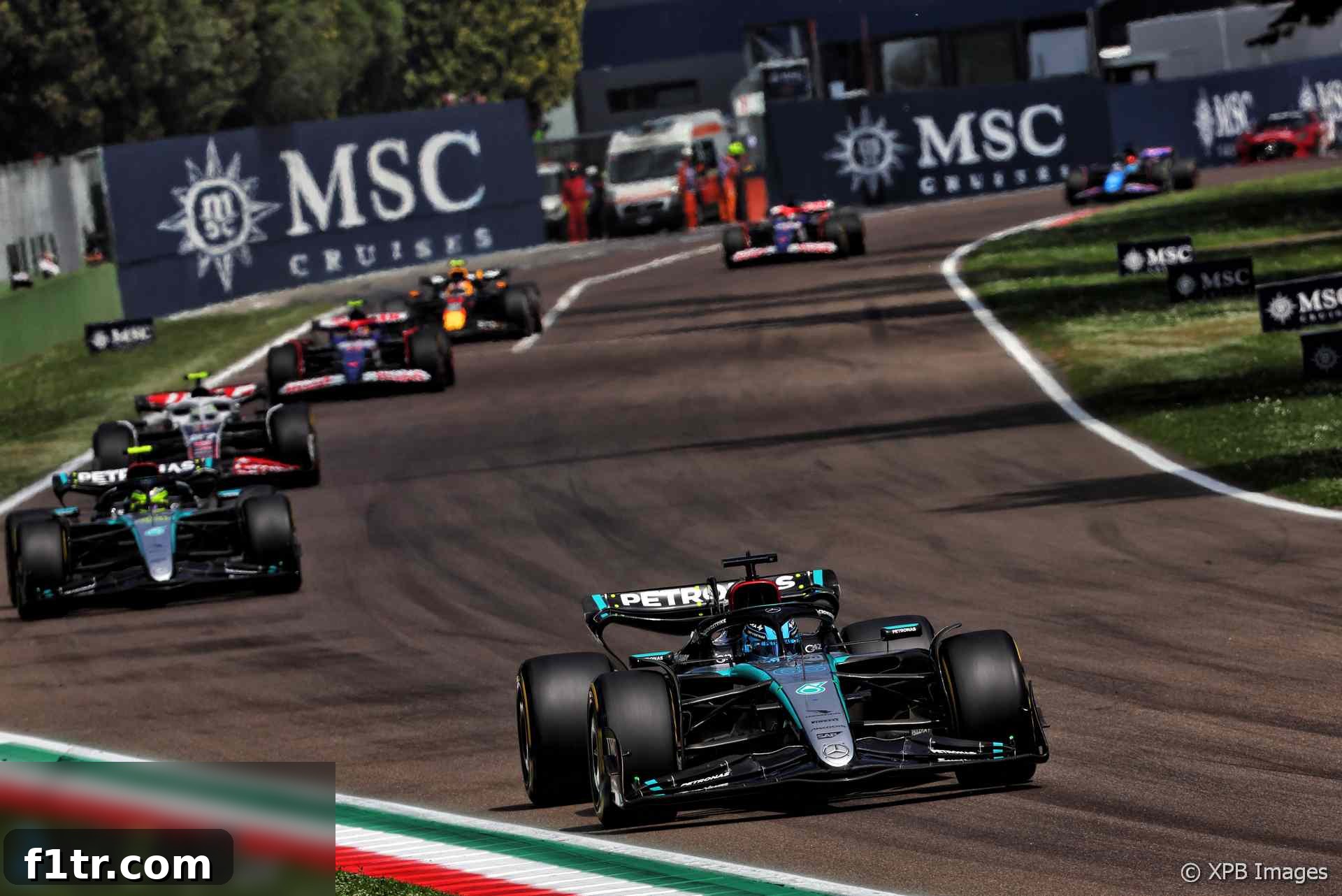
Mercedes-AMG Petronas Formula One Team has been on a relentless quest to return to the pinnacle of motorsport, and the recent Emilia-Romagna Grand Prix at Imola offered a glimpse of their dedicated efforts. While the W15’s performance at the storied Italian circuit showed tangible progress, this improvement wasn’t fully reflected in the final finishing positions of their drivers, Lewis Hamilton and George Russell. According to Team Principal Toto Wolff, this paradox underscores the intensely competitive nature of modern Formula 1, where every team is pushing the boundaries of development.
Advert | Become a Supporter & go ad-free
Lewis Hamilton and George Russell crossed the finish line in sixth and seventh places, respectively, a result that, on the surface, might not excite a team accustomed to championship contention. However, beneath the raw numbers, there was a palpable sense of cautious optimism within the Mercedes garage. Following the checkered flag, Hamilton communicated a significant message to his race engineer, Peter Bonnington, stating, “The car’s coming good.” This brief but potent statement resonated with the team’s ongoing development narrative, hinting at a positive shift in the W15’s characteristics.
Hamilton’s message continued with a call to action: “Still some work to do, though. Let’s keep pushing, guys, thanks for the upgrades this weekend.” This sentiment perfectly encapsulates the continuous cycle of innovation and refinement that defines Formula 1. The Imola weekend saw Mercedes introduce a significant package of aerodynamic upgrades, focusing primarily on the rear of the car, alongside modifications to its floor and brake ducts. These changes were not merely minor tweaks but fundamental adjustments aimed at improving the W15’s balance, downforce, and overall efficiency, addressing some of the underlying issues that have plagued the team since the introduction of the current ground-effect regulations.
Toto Wolff elaborated on the team’s assessment of these new components. He affirmed that the changes had indeed improved the car’s fundamental performance and handling characteristics. However, the true impact of these gains was largely obscured by the equally rapid development pace of their closest rivals. Teams like McLaren and Ferrari, who have also been aggressively pursuing upgrades, found their own performance enhancements, effectively moving the goalposts even as Mercedes took a step forward. This constant arms race in F1 means that even substantial improvements can sometimes appear static in the public eye if competitors are making similar, or even greater, strides.
“It’s not possible to see it in terms of the result, but we have taken a small step forward this weekend,” Wolff acknowledged, highlighting the nuanced reality of performance measurement in F1. “Our closest competitors have also done so recently, but we have closed the gap to the front a little.” This “closing the gap” is a critical indicator for Mercedes. While the immediate race outcome might not scream success, the underlying data suggested a reduced deficit to the leading pack. The team is not just focusing on outright victories but on consistently chipping away at the performance delta that separates them from the front-running Red Bull, and increasingly, the revitalized McLaren and Ferrari squads.
To put this into perspective, Hamilton concluded the 63-lap Imola Grand Prix a total of 35 seconds behind the dominant race winner, Max Verstappen, in a race devoid of any Safety Car interventions. This direct comparison under uninterrupted green flag conditions offers a clear benchmark of performance. In contrast, at the previous race in Suzuka, which also concluded under extended green flag conditions, the first Mercedes car to finish was a more significant 48 seconds adrift of the winner. This 13-second reduction in deficit over a comparable race distance represents a noteworthy improvement and provides empirical evidence of the upgrades’ effectiveness, even if it wasn’t enough to challenge for podiums at Imola.
Despite these promising internal metrics, the overarching sentiment within the team remains one of ambition tempered by frustration. “We still have a lot of work to do and of course, we are all frustrated finishing P6 and P7,” Wolff candidly admitted. For a team with Mercedes’ pedigree, these positions are not where they aspire to be. Yet, he quickly pivoted to the forward-looking mindset that is essential in Formula 1: “There is more to come though and it is all about making incremental gains. These are what we need to keep delivering if we are to get ourselves in the fight with the three teams ahead of us.” The emphasis on “incremental gains” underscores the painstaking process of F1 development, where success is built brick by brick, through continuous iteration and optimization.
This commitment to persistent development was echoed by the team’s Trackside Engineering Director, Andrew Shovlin. His technical assessment reinforced Wolff’s observations, stating that it was “clear we have made progress this weekend, but our nearest competitors are also pushing hard.” Shovlin’s perspective, grounded in engineering data, confirms that the team’s upgrades yielded the expected improvements in correlation with their simulations and wind tunnel data. However, he also highlighted the fierce competition, emphasizing that merely improving is not enough; one must improve faster than the opposition to genuinely move up the order. The race at Imola served as a crucial validation point for the new package, providing valuable data to further refine the W15.
“The race today confirmed that we need to continue to make these gains to be in the fight with the top-three teams,” Shovlin continued. “We are continuing to work on that, with the factory flat-out on development.” This dedication from the factory is vital. Formula 1 is not just a battle on the track; it’s an engineering marathon that plays out in design offices, simulation labs, and manufacturing facilities. The constant flow of new parts and design philosophies from the factory to the track is the lifeblood of competitive development. Mercedes’ infrastructure and human talent are being pushed to their limits to ensure that the incremental gains mentioned by Wolff translate into more significant performance leaps in the coming races.
The journey back to the top for Mercedes is a complex one, involving not just raw pace but also optimizing strategy, pit stops, and driver performance. While Imola represented a step in the right direction, the team understands that sustained effort and a faster development curve than their rivals are paramount. The upcoming races will be crucial in determining if Mercedes can consistently build on this foundation and truly challenge the current front-runners. The aspiration remains clear: to return to fighting for victories and championships. The path is challenging, but the progress at Imola offers a hopeful sign that the Silver Arrows are indeed turning a corner, piece by painstaking piece.
Advert | Become a RaceFans supporter andgo ad-free
2024 Emilia-Romagna Grand Prix: Further Insights
- Ferrari expect qualifying gain after spotting rivals’ power strategy tactics
- How Alonso and Stroll copied Verstappen’s tactic plus more unheard Imola radio
- Verstappen beats Hamilton’s winning rate with Emilia-Romagna GP victory
- How Russell resisted losing position to Hamilton “for no reason” with extra stop
- “Lando’s found some pace”: Unheard radio from Verstappen-Norris Imola duel
Browse all 2024 Emilia-Romagna Grand Prix articles