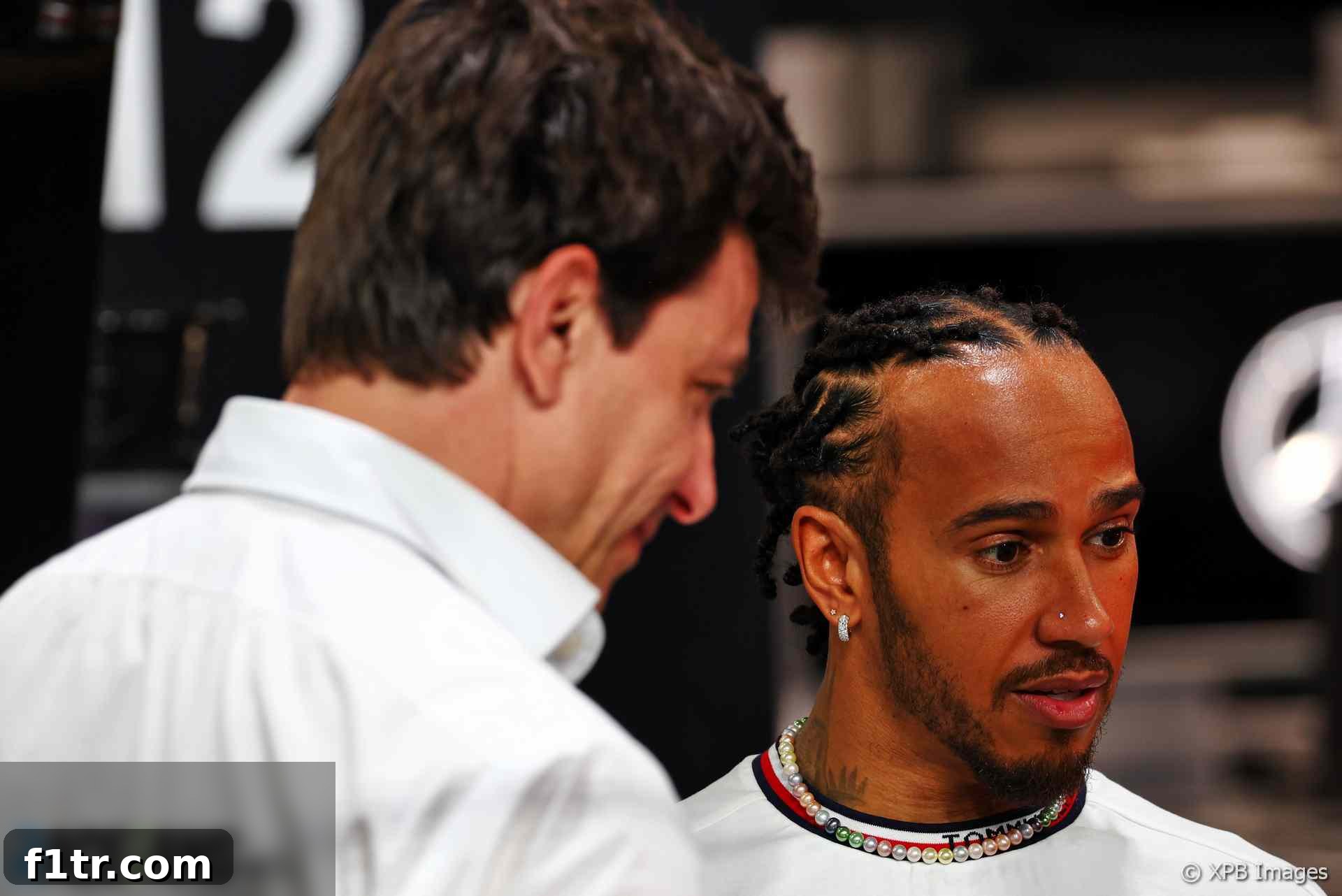
Toto Wolff Clarifies “Shelf Life” Comments Amid Lewis Hamilton’s Historic Ferrari Move
Mercedes-AMG Petronas Formula 1 Team Principal, Toto Wolff, has moved to definitively clarify recent comments regarding a driver’s “shelf life,” asserting that his remarks were not a direct or indirect critique of seven-time world champion Lewis Hamilton. This clarification arrives at a pivotal and emotionally charged moment for the Mercedes team, as Hamilton prepares to conclude his illustrious tenure before embarking on a new and highly anticipated chapter with Scuderia Ferrari in 2025.
Advert | Become a Supporter & go ad-free
The initial comment, which stated, “I believe everyone has a shelf life,” was published in a new book by the team and quickly sparked debate within the Formula 1 community. Many observers interpreted the phrase as a veiled reference to Hamilton’s current performance, especially considering his age of 39 and a season that has delivered a challenging mix of exceptional highs and conspicuously poor weekends, most notably in Austin. However, Wolff is resolute in his stance that his original statement was intended as a broad, philosophical observation about professional careers, rather than a specific assessment of Hamilton’s current capabilities.
Wolff’s Broader Perspective: The Universal Challenge of Sustained Excellence
In a direct response to the swirling speculation, Wolff explained to the BBC that his reference to a “shelf life” had been “taken a little bit out of context” regarding Lewis Hamilton. He elaborated on his true meaning, stating, “What I was referring to is that, all of us, we age, whether it is in being in a car or on a pitch or as a manager or an entrepreneur. And this is what I’m trying to do with myself, to understand am I going from great to good, because good is not in Formula 1 any more.” This explanation clearly positions Wolff’s comments as a reflection on the relentless demands of maintaining elite performance across all high-pressure fields, emphasizing a personal and universal quest for continuous improvement, rather than a specific doubt about his star driver.
Wolff unequivocally asserted his belief that Lewis Hamilton remains at the peak of his formidable powers. “Contrary to my own self-assessment, I think we see with Lewis that he’s very much there when the car is right and we haven’t been able to give him that car for him to perform best. And that is a frustration that we equally have in the team and for himself,” Wolff declared. This robust defense not only clears Hamilton’s name but also candidly acknowledges Mercedes’ own struggles to provide a consistently championship-contending car in recent seasons. It highlights the symbiotic relationship between driver and machinery in Formula 1, where even a talent as immense as Hamilton’s can be limited by the performance of his equipment.
Further elaborating on Hamilton’s enduring capabilities, Wolff added, “But he’s very sharp. He’s different to when he was a 20-year-old, that’s certainly clear, but his experience and his racecraft is tremendous.” This statement underscores the evolution of Hamilton’s driving style and mental approach. While the raw, youthful aggression of his early career might have matured, it has been replaced by an unparalleled depth of experience, strategic insight, and refined racecraft – qualities that are arguably even more crucial for navigating the complex demands of modern Formula 1. Hamilton’s ability to adapt, his tactical prowess, and his unwavering determination continue to make him one of the most formidable competitors on the grid.
The End of an Era: Lewis Hamilton’s Monumental Shift to Ferrari
These discussions take place against the backdrop of one of Formula 1’s most significant driver transfers in history: Lewis Hamilton will conclude his remarkable journey with Mercedes to join Scuderia Ferrari in 2025. This move marks the end of an extraordinary 12-year partnership that saw Hamilton secure six of his seven world titles with the Silver Arrows, cementing Mercedes’ place as a dominant force in the hybrid era. Hamilton’s decision to seek a fresh challenge, particularly with a team as iconic and storied as Ferrari, has reverberated throughout the motorsport world, igniting unparalleled excitement and anticipation for the coming seasons.
Wolff provided insight into the private conversation where Hamilton first revealed his decision. “We met in my house in Oxford and he basically said ‘this is a step I feel is good for all of us, it’s good for me to reinvent myself’.” This candid disclosure reveals Hamilton’s profound drive for personal and professional renewal. Despite having achieved almost every conceivable milestone in the sport, the allure of Ferrari – a team steeped in racing history and unparalleled passion – presents a unique opportunity for Hamilton to write a final, legendary chapter in his illustrious career, potentially pursuing an unprecedented eighth world championship.
Hamilton’s rationale, as conveyed by Wolff, extended beyond mere personal ambition: “Every driver wants to be in Ferrari and it’s good for the Mercedes team, too, because we’ve been with each other for 12 years, so maybe we’re kind of reinvigorating ourselves.” This perspective reframes the departure not as a significant loss for Mercedes, but rather as a mutual opportunity for revitalization. For Hamilton, it’s a chance to fulfill a long-held dream and embrace a new culture; for Mercedes, it offers the space to re-evaluate, strategically pivot, and cultivate emerging talent, potentially leading to a renewed competitive vigor and a fresh era of success.
The timing of the announcement, occurring early in the 2024 season, was initially “a bit of a surprise,” according to Wolff. However, he quickly understood the underlying intent behind Hamilton’s early disclosure: “But also I think where he came from was a sense of fairness to say listen, I’m going to tell you very early, it may be awkward during the season, but so you can position the team and yourself for the years to come.” This act of transparency, while potentially creating a unique dynamic for the remainder of the current season, ultimately allowed Mercedes invaluable time to plan for their future, secure a successor, and manage the transition with strategic foresight. It speaks volumes about the deep professional respect and enduring bond that has characterized the Hamilton-Wolff relationship for over a decade.
Advert | Become a RaceFans supporter andgo ad-free
Mercedes’ Next Chapter: Embracing Youth with Andrea Kimi Antonelli
With Lewis Hamilton’s departure confirmed and his final races with Mercedes approaching, the team swiftly moved to chart its future course. The bold decision was made to promote 18-year-old Italian prodigy Andrea Kimi Antonelli. This strategic move signals Mercedes’ unwavering commitment to investing in prodigious youth and nurturing the next generation of Formula 1 talent. Antonelli, a highly-touted junior driver from the prestigious Mercedes academy, has consistently impressed throughout his rapid ascent through the junior categories, showcasing exceptional raw speed, remarkable adaptability, and a maturity well beyond his years. His anticipated Formula 1 debut is one of the most keenly watched in recent memory, as he takes on the immense challenge of stepping into the shoes of arguably the sport’s greatest driver.
The decision to place such a young talent directly into a top-tier team like Mercedes underscores Toto Wolff’s profound confidence in Antonelli’s immense potential and the team’s readiness to embark on a new developmental cycle. While the pressure on Antonelli will undoubtedly be immense, his accelerated progress through Formula Regional and Formula 2 championships has demonstrated a consistent ability to not only adapt but to excel under the most demanding circumstances. This youth-centric strategy also aligns perfectly with Mercedes’ long-standing philosophy of identifying and nurturing emerging talent, a successful approach that has previously seen drivers like George Russell ascend through their ranks to reach the pinnacle of motorsport.
The Evolving Dynamics of Change and Renewal in Formula 1
The forthcoming Formula 1 seasons are poised to deliver a fascinating period of profound transition and evolution across the sport. Lewis Hamilton’s move to Ferrari, combined with Andrea Kimi Antonelli’s highly anticipated arrival at Mercedes, represents a significant shake-up at the highest echelons of Formula 1. For Mercedes, the primary challenge will extend beyond merely developing their promising young driver; they must also engineer a return to the championship-winning form that characterized their dominant hybrid era. The team has openly acknowledged its struggles in recent years to provide a consistently competitive car, a factor that undoubtedly played a role in Hamilton’s decision to seek a new challenge.
Toto Wolff’s leadership during this transformative period will be absolutely crucial. His ability to adeptly manage the high-profile departure of a living legend while simultaneously integrating a highly promising but inherently inexperienced rookie will serve as a definitive test of the Mercedes organization’s strength, resilience, and adaptability. The early announcement of Hamilton’s move, while perhaps creating a brief period of ‘awkwardness’ as Wolff described, has ultimately empowered the team principal and his strategic team to meticulously plan for the future, effectively mitigating potential disruptions and focusing their collective efforts on building a robust new foundation for sustained success.
The Hamilton-Mercedes partnership, spanning over a remarkable decade, stands as one of Formula 1’s most iconic and profoundly successful collaborations. It ushered in an unprecedented era of dominance and forged a deep bond between driver and team principal that transcended a typical professional relationship, evolving into a profound mutual respect. While the impending separation will undoubtedly be an emotional moment for both parties, all indications suggest that it is being approached with mutual understanding, professional respect, and a shared recognition that change, even for historically successful entities, can often serve as a powerful catalyst for new achievements, fresh perspectives, and reinvigorated ambition. Hamilton’s quest for an elusive eighth world title with Ferrari, alongside Mercedes’ fervent pursuit of future glories with Antonelli, are set to define the compelling narrative of Formula 1 for many years to come.
Advert | Become a RaceFans supporter andgo ad-free