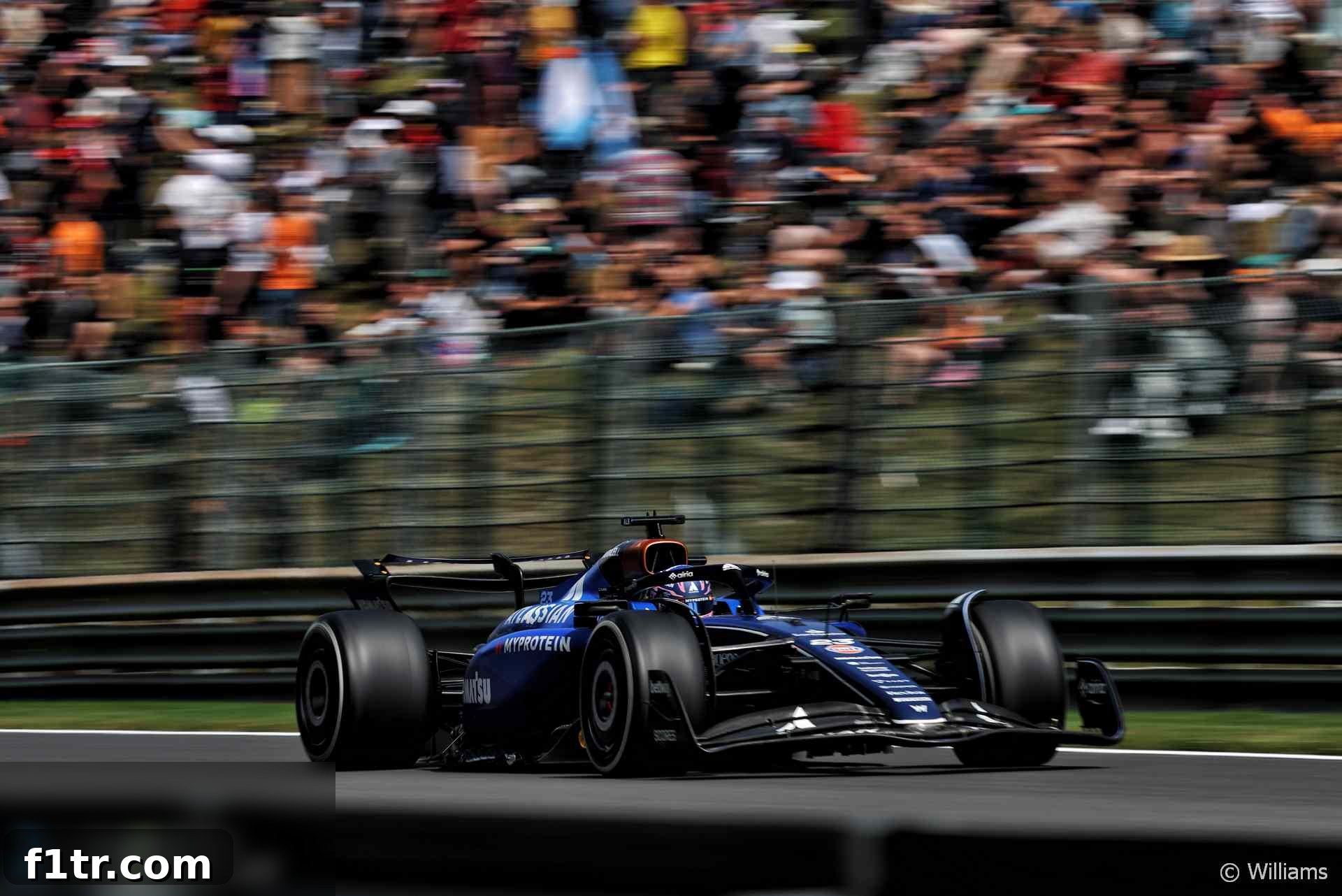
Alexander Albon’s Engine Woes Cast Shadow Over Williams at Spa-Francorchamps
Williams Racing driver Alexander Albon found himself grappling with familiar frustrations at the Spa-Francorchamps circuit, as persistent engine problems once again hampered his progress during qualifying for this weekend’s sprint race. The Thai-British driver revealed that an ongoing power unit issue prevented him from advancing beyond the first round of qualifying, highlighting a recurring technical Achilles’ heel for the Grove-based team.
The venerable Spa circuit, renowned for its long straights and challenging corners, demands peak performance from every component of a Formula 1 car. For Williams, however, their power unit has been a consistent source of setbacks, with difficulties extending beyond mere engine power to encompass critical cooling system vulnerabilities. These issues have not only impacted Albon but also compromised his former teammate, Carlos Sainz Jnr, in previous instances, demonstrating a systemic problem within the team’s technical package. Albon, himself, had to endure consecutive retirements in Canada and Austria earlier in the season, both attributed to these deeply rooted power unit complications.
A Narrow Miss and Deep-Seated Frustration
During the sprint race qualifying session, Albon’s hopes of progressing were dashed as he missed the cut for Q2 by a mere four hundredths of a second. This razor-thin margin underscored the critical impact of the power unit deficiency, particularly on Spa’s notorious long straights – prime hunting grounds for top speed and raw engine power. The loss of precious lap time in these crucial sections proved insurmountable, leaving Albon and the team reflecting on what could have been.
Speaking candidly to the official F1 channel after the session, Albon articulated the severity of the situation. “We have an engine issue on our car,” he stated. “We had it in FP1 and then we thought we’d fixed it for qualifying, and we didn’t. We were losing a lot of lap time down all the straights so we need to fix it.” His words conveyed a palpable sense of frustration, stemming from a problem that the team had seemingly attempted, but failed, to resolve between practice sessions and competitive qualifying.
The Pervasive Power Unit Predicament
Williams Team Principal James Vowles has previously acknowledged the team’s ongoing struggle with power unit reliability and performance. He had stated that the team has been forced to compromise the overall setup and operation of the car in an effort to mitigate these persistent problems. This concession often means sacrificing optimal performance in other areas to ensure the engine simply survives a race distance, a testament to the magnitude of the challenge faced by the engineering department.
Albon’s latest comments suggest that the current fault is far from a minor tweak. “It’s a fundamental issue,” he explained, hinting at the potential for a significant intervention. “It will either be a PU change or something [else]. So we’ll get to the bottom of it and hopefully we’ll be better.” A full power unit change during a race weekend or even between events typically incurs grid penalties, further complicating an already difficult scenario for Williams, a team perpetually fighting for every championship point.
Navigating Unforeseen Obstacles and Underlying Strengths
Adding another layer to Albon’s challenging qualifying session was a late-lap yellow flag incident caused by Lewis Hamilton’s car coming to a stop at the chicane. Albon was forced to back off, momentarily disrupting his final flying lap. However, the Williams driver remained pragmatic, stating that he didn’t believe this incident significantly altered his Q1 outcome. “Of course [with] the Lewis thing maybe [I] ‘could have, would have’ but I was on [course to set] the same lap time,” he reasoned, implying that the engine issue was the predominant factor, overshadowing any marginal loss from the yellow flag.
Despite the prevailing power unit woes, Albon maintains a strong belief in the inherent capabilities of the Williams chassis. He pointed to glimpses of competitive pace when the car isn’t compromised by engine limitations. “In FP1 we were [third] in sector two. We were actually okay in sector two also in qualifying just now, which is where all the corners are,” he noted. This observation is crucial, highlighting that the team’s technical package possesses genuine strengths in the aerodynamic and mechanical grip departments, particularly evident through the twisty, high-speed sections of Spa.
The contrast is stark: the car performs commendably through corners, but its Achilles’ heel remains the straight-line speed. “We just have an issue where we were very slow in sectors one and three with our engines. I think we’re fine, we actually have a good car, we just need to fix the issue.” Albon’s assessment paints a picture of a team with a solid foundation, held back by a single, yet critical, component. The frustration is magnified by the knowledge that without these recurring engine problems, Williams could be consistently challenging higher up the grid and converting their cornering prowess into tangible results.
The Broader Implications for Williams’ Season
This latest setback at Spa is more than just a qualifying disappointment; it’s a symptom of deeper challenges confronting Williams in their ongoing quest to climb the Formula 1 constructors’ standings. The team, under James Vowles’ leadership, has been working tirelessly to modernize its infrastructure, streamline its operations, and push its technical boundaries. Yet, persistent issues with the power unit, supplied by Mercedes-AMG High Performance Powertrains, underscore the complex interdependencies within modern F1 machinery and the constant battle for reliability and performance.
For Albon, who has often punched above the car’s weight this season, these engine issues are particularly demoralizing. He consistently extracts maximum performance, often delivering stellar qualifying laps and race craft that defy the team’s position. The fact that fundamental power unit problems are negating his efforts not only impacts his individual results but also the team’s ability to secure vital championship points, which are crucial for financial stability and future development. The pressure on the technical team to diagnose and rectify this “fundamental issue” before the Grand Prix, or indeed for the remainder of the season, is immense.
Looking ahead to the sprint race and the main Grand Prix at Spa, Albon will face an uphill battle. Starting further down the grid due to qualifying struggles, he will need to rely on shrewd strategy, opportunistic overtakes, and perhaps a degree of luck with safety cars or weather conditions to make progress. However, the core issue of straight-line speed disadvantage will remain, making overtakes particularly challenging on a circuit where power reigns supreme.
Conclusion: A Fight Against Adversity
Alexander Albon’s experience at Spa-Francorchamps serves as a poignant reminder of the fine margins and relentless technical demands of Formula 1. While the Williams car shows promising signs of competitive pace in its aerodynamic and mechanical design, the persistent and fundamental power unit issues are proving to be an insurmountable hurdle. Albon’s resilience and belief in the team remain strong, but the recurring nature of these problems calls for a definitive solution. The coming races will undoubtedly test Williams’s resolve and ingenuity as they strive to overcome these deep-seated technical challenges and unlock the full potential of their package, hopefully allowing Albon to showcase his considerable talent without the burden of engine woes.
Further Reading:
- Williams Racing: Technical Updates and Challenges
- Understanding F1 Power Unit Regulations
- Alexander Albon: A Season of Determination
- Spa-Francorchamps: A Driver’s Guide