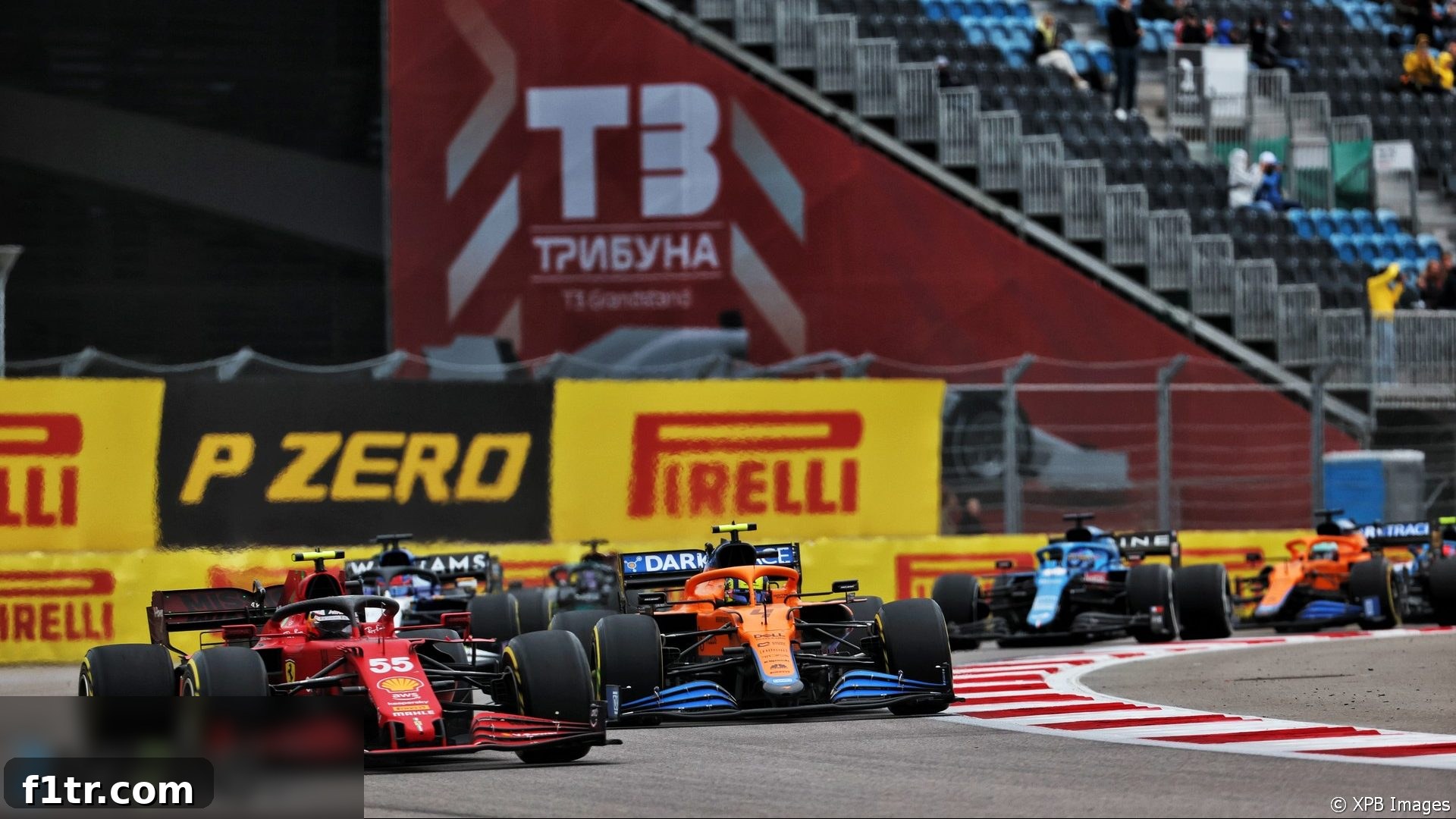
The recent Formula 1 Russian Grand Prix at the Sochi Autodrom was an extraordinary event, delivering a captivating blend of historic milestones, dramatic comebacks, and the emergence of new talent. This pivotal weekend generated an exceptional array of statistics and noteworthy moments that will undoubtedly be etched into the sport’s illustrious history, underscoring the evolving narratives of the 2021 championship season.
Advert | Become a Supporter & go ad-free
Among the many talking points, the race will forever be remembered as the occasion of Lewis Hamilton’s monumental 100th career victory. In an unparalleled achievement, the Mercedes-AMG Petronas driver became the first person ever to reach a century of wins in Formula 1, further cementing his status as one of the greatest drivers the sport has ever seen. This incredible feat followed his 100th career pole position, which he secured earlier in the season at the Circuit de Catalunya, highlighting a year of unparalleled statistical achievements for the seven-time world champion.
Hamilton’s relentless pursuit of records continues to redefine what is possible in Formula 1. His current winning rate stands at an impressive 35.6%, a testament to his consistent excellence throughout his career. While Max Verstappen’s ascendance and Red Bull Racing’s strong challenge have somewhat tempered his winning frequency this season, Hamilton’s overall rate remains staggeringly high, ranking him among the elite. To put this into perspective, only a handful of drivers in F1 history boast a higher percentage, typically from earlier eras with fewer races or dominant periods. For instance, legends like Juan Manuel Fangio achieved an extraordinary 47% winning rate, albeit in a different era with different competitive dynamics.
The significance of a 35.6% winning rate truly comes to light when considering other respected figures in the paddock. If Kimi Raikkonen, who holds the record for the most Grand Prix starts, had mirrored Hamilton’s winning rate, his tally would skyrocket to 121 victories from his 342 career starts, instead of his actual 21 wins. However, such direct comparisons, while statistically intriguing, often fail to account for the nuances of Formula 1, particularly the critical role of machinery. It would be fundamentally unfair to suggest that Raikkonen, throughout his extensive career, consistently had access to championship-winning cars on par with the equipment Hamilton has often commanded. Car performance is paramount in F1, shaping the trajectory and statistical output of even the most talented drivers.
Hamilton’s triumph in Russia was made even more remarkable by his starting position. He took his landmark victory from fourth on the grid, marking only the seventh time in his illustrious career that he has won from lower than third. This demonstrates his exceptional race craft and strategic acumen, proving he can conquer challenges even when not starting from the very front row. The last such occasion came at Istanbul Park, scene of the next round in Turkey, where he famously secured his seventh world championship by winning from sixth place last year in challenging wet conditions, showcasing his mastery over adverse circumstances.
Beyond Hamilton’s record-breaking heroics, the Russian Grand Prix also celebrated a significant moment for the McLaren F1 Team and its young prodigy, Lando Norris. Norris secured his maiden career pole position, ending McLaren’s protracted eight-year, 306-day wait for a pole start. The team’s last pole had been at the 2012 Brazilian Grand Prix, courtesy of none other than Lewis Hamilton during his final race weekend with the Woking outfit before his move to Mercedes. Norris’s achievement was a poignant reminder of McLaren’s rich heritage and a clear indicator of their resurgence as a competitive force in the constructors’ championship. For the young Briton, it marked a significant personal milestone, confirming his status as one of Formula 1’s brightest emerging talents and the 102nd different driver to start a Grand Prix from pole position in F1 history.
The front row for the Russian Grand Prix presented a truly unique statistical anomaly, reflecting a potential shift in the sport’s landscape. Norris led Carlos Sainz Jnr and George Russell on the grid – a trio of highly talented drivers who, at that point, had never previously won a Formula 1 race. This configuration was a first since the 1975 Swedish Grand Prix at Anderstorp, an extraordinary 46-year gap. That historic grid featured Vittorio Brambilla on pole, flanked by Patrick Depailler and Jean-Pierre Jarier, all of whom were chasing their maiden victories. Brambilla would later go on to take his sole F1 victory in Austria later that year, while Depailler secured two wins with Tyrrell and Ligier, and Jarier, despite his talent, never placed higher than third in his career. The 2021 Russian GP grid, therefore, offered a thrilling glimpse into the future, with a new generation of drivers poised to make their mark.
Advert | Become a RaceFans supporter andgo ad-free
The race itself lived up to the anticipation generated by such an intriguing grid. Sainz, Norris, and Russell impressively held the top three places for the first 12 laps of Sunday’s contest, battling fiercely at the front. Ultimately, only one of them featured on the podium: Carlos Sainz, who expertly navigated the chaotic closing stages to secure his fifth career top-three finish, a testament to his consistent performance with Ferrari. Lando Norris, after taking his first career lap led at the previous race in Monza, went on to lead a significant portion of the Russian Grand Prix, pacing the field for over 30 laps – more than half the race distance. His performance was masterful, and it seemed a maiden victory was within his grasp until a late rain shower led to a strategic misstep, snatching away what would have been a momentous triumph.
Sainz’s stint at the front marked his first time leading a race this year, making him the 11th different driver to do so during the 2021 season. This statistic is particularly illuminating, as it means more than half the current 20-car field has led at least one lap in a Grand Prix, highlighting the competitive depth and unpredictability that has defined the season. This represents the highest number of different race leaders in a single F1 season since the current V6 hybrid turbo engine formula was introduced in 2014. For comparison, the final two years of the V8 engine era, 2012 and 2013, saw 13 different leaders each year, while the period from 2016 to 2019 often featured just six leaders annually, largely dominated by one or two teams. The surge in different leaders in 2021 is a welcome sign for fans, signifying closer racing and strategic variety.
While Hamilton celebrated his century, Max Verstappen delivered an equally impressive performance that significantly boosted his championship aspirations. Starting from last on the grid due to a power unit penalty, the Red Bull Racing driver executed a spectacular comeback drive to finish second. This astonishing 18-place climb, the second-highest possible with today’s 20-car field, was the most significant gain seen in a Grand Prix since Sebastian Vettel achieved the same at the Hockenheimring two years prior. In a neat twist of symmetry, the winner of that very German Grand Prix was Max Verstappen himself, underscoring both drivers’ prowess in making their way through the field under pressure.
Verstappen’s charge was a masterclass in overtaking and tire management, demonstrating why he is a formidable championship contender. Only three drivers on the current grid have ever managed to achieve a greater gain in positions. Lewis Hamilton showcased his recovery skills with a 19-place climb at the 2014 Hungarian Grand Prix, while Kimi Raikkonen achieved an identical 19-place gain at the 2006 Bahrain Grand Prix. Perhaps the most extraordinary modern-era comeback belongs to Sebastian Vettel, who made up an incredible 21 places when he started from the pit lane to finish third in the 2012 Abu Dhabi Grand Prix, a feat made possible by a larger 24-car grid at the time. These instances highlight the exceptional talent required to carve through the field in Formula 1.
Looking further back into the annals of motorsport history, the records for places gained stand as almost mythical achievements, largely unbreakable in the context of modern F1. The most places ever gained in a World Championship round was a staggering 30, accomplished by Jim Rathmann, who finished second in the 1957 Indianapolis 500 after starting 32nd. Within races run to Formula 1 rules, Roberto Mieres holds the record with a 26-place climb to sixth at the 1954 British Grand Prix at Silverstone, having started 28th. Interestingly, the second-highest gain in an F1 rules race occurred in the very same event, with Onofre Marimon moving from 28th to third. These remarkable records from earlier eras are, of course, virtually unbreakable with today’s much smaller F1 grids, which typically feature 20 cars. This makes the achievements of Verstappen, Hamilton, Raikkonen, and Vettel even more commendable within the contemporary sporting landscape, showcasing their unparalleled skill in a highly competitive and technically demanding environment.
Go ad-free for just £1 per month>> Find out more and sign up
The 2021 Russian Grand Prix was a race that delivered on all fronts, from Hamilton’s historic centennial victory to Verstappen’s determined charge and Norris’s near-miss. It was a weekend that not only provided thrilling on-track action but also offered profound statistical insights into the current state and rich history of Formula 1. The championship battle intensified, and new narratives emerged, setting the stage for an exhilarating conclusion to the season.
2021 Russian Grand Prix
- Norris says he missed few chances to win in 110-race wait for first F1 victory
- Sochi disappointment will make Norris and McLaren stronger, says Seidl
- F1 race start times could be brought forward to avoid Spa-style wash-outs
- New technology in Ferrari’s power unit update vital for 2022 – Binotto
- Mercedes have left too many points on the table, admits Wolff
Browse all 2021 Russian Grand Prix articles