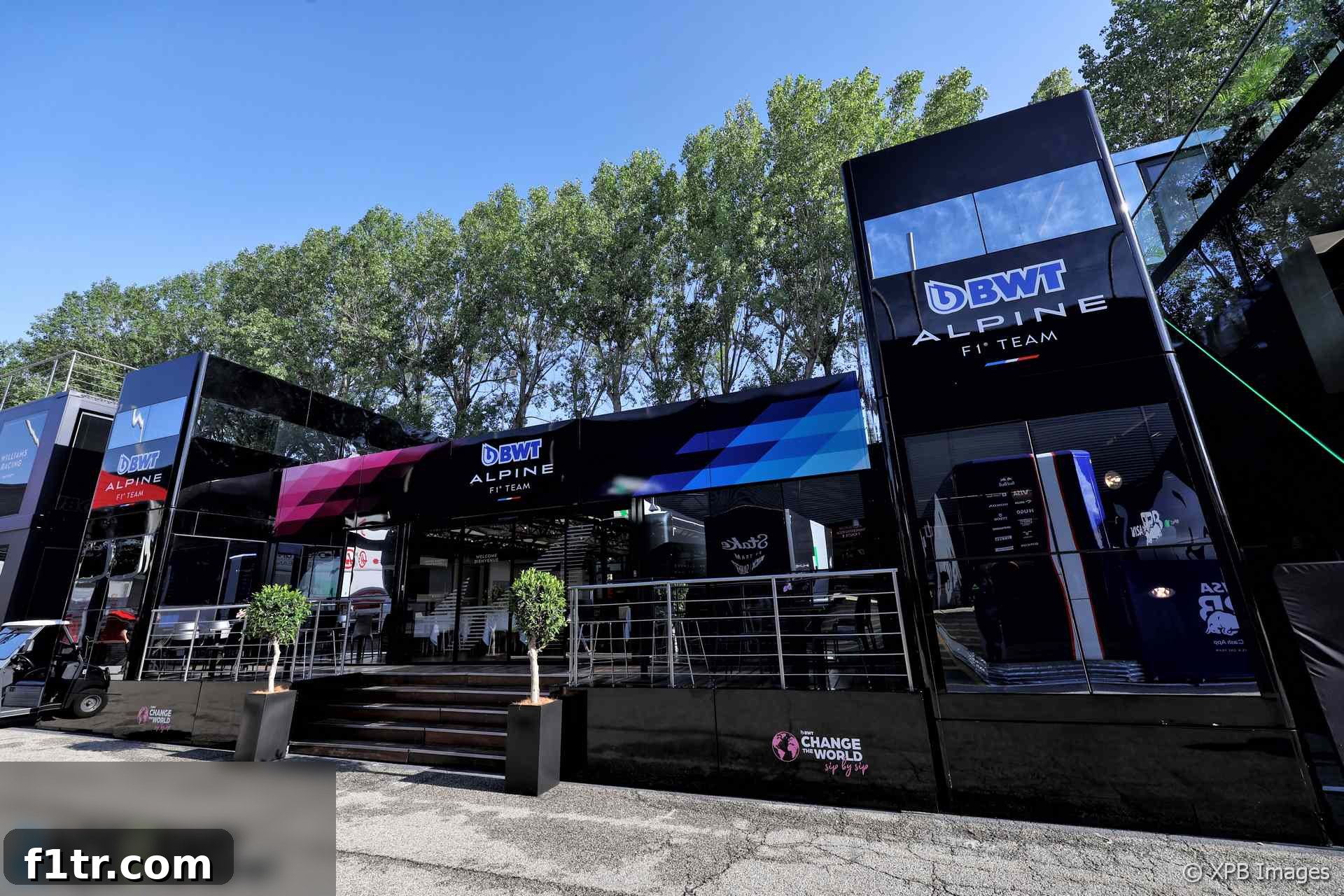
Rob White’s Departure Marks the End of a Two-Decade Era Amidst Alpine F1’s Major Restructuring
In a significant development for the Alpine Formula 1 team, long-serving operations director Rob White has concluded his 20-year tenure with the Enstone-based squad. His departure, confirmed by a team spokesperson, signifies the latest high-profile exit from Alpine’s technical leadership, underscoring a turbulent period of change and strategic realignment for the French manufacturer.
A Veteran’s Legacy: Two Decades at the Heart of Renault F1 and Alpine
Rob White’s career in Formula 1 is marked by an illustrious two decades deeply intertwined with the team now known as Alpine. Joining Renault in 2004 from Cosworth, White quickly became a pivotal figure, instrumental in leading the development of their highly competitive V10 and subsequent V8 engine programs. His technical prowess and leadership were key components in Renault’s golden era, where the team secured back-to-back drivers’ and constructors’ world championships in 2005 and 2006 with the formidable Fernando Alonso. This period cemented his reputation as one of the sport’s most respected engine specialists.
Throughout his extensive career at Enstone and Viry-Chatillon, White navigated numerous transformations. The team transitioned through various ownership and identity changes – from the factory Renault F1 team to Lotus F1, then back to a factory Renault outfit in 2016, and eventually rebranding as Alpine for the 2021 season. Through each evolution, White remained a consistent and guiding force, contributing to engine development, operational strategy, and technical oversight. His longevity and commitment to the team are testaments to his dedication and integral role in shaping its engineering philosophy over two decades.
Alpine acknowledged White’s profound contributions in a statement, expressing gratitude for his tireless efforts. “The team is thankful for Rob’s efforts during his long career both at Enstone and at Viry-Chatillon, where he led the championship-winning engine project in 2005 and 2006,” Alpine communicated. “We wish him the best in his future endeavours.” This statement underscores the team’s appreciation for a figure who was not just an employee but a foundational pillar of their technical success.
Alpine’s Tumultuous Twelve Months: A Period of Unprecedented Leadership and Technical Exodus
White’s departure does not occur in isolation but rather as the latest chapter in a series of significant personnel changes that have swept through Alpine over the last 12 months. This period has been characterized by an extensive operational restructuring, seemingly driven by a determination to improve on-track performance and reshape the team’s long-term trajectory. The transformation began in July last year with the replacement of Alpine CEO Laurent Rossi, signaling the start of a comprehensive overhaul.
The summer break saw a further exodus of key leadership figures, including team principal Otmar Szafnauer and long-serving sporting director Alan Permane, both stalwarts whose departures sent ripples through the paddock. Adding to the list, chief technical officer Pat Fry moved to Williams, taking his invaluable experience to a rival team. The changes extended to the racing side as well, with Davide Brivio, Alpine’s racing director, leaving the team at the end of the season to return to his roots in Moto GP.
Such a rapid succession of high-profile departures within a single year is highly unusual for a Formula 1 team and naturally raises questions about stability and continuity. The leadership vacuum created by these exits presented significant challenges, demanding swift and decisive action to re-establish direction. Each individual held critical responsibilities, and their absence required not just replacements but a re-evaluation of the entire technical and operational framework, often impacting ongoing car development projects and team morale.
Technical Reorganisation: Navigating Challenges on and Off the Track for the A524
In response to the extensive leadership changes, Alpine announced at the beginning of the year that interim team principal Bruno Famin would assume the role permanently. This decision aimed to bring a degree of stability and clear leadership amidst the ongoing restructuring. Famin inherited a complex situation, with the immediate challenge of improving the team’s competitiveness on the grid while simultaneously rebuilding its technical foundations.
The 2024 season began with high hopes but quickly proved challenging. Alpine unveiled a heavily revised design for their A524 chassis, signifying a bold new direction and an aggressive approach to car development. However, the initial performance of the car was notably slower than their rivals, leading to a difficult start to the championship. This underperformance inevitably led to further scrutiny and, subsequently, more personnel adjustments within the technical department.
The struggles with the A524 chassis were swiftly followed by the departures of technical director Matt Harman and aerodynamics chief Dirk de Beer. These roles are fundamental to a Formula 1 team’s ability to design, develop, and optimize a competitive car, especially in the era of complex aerodynamic regulations. Their exits necessitated another significant reshuffle. Bruno Famin responded by reorganizing the technical team, notably bringing in David Sanchez from McLaren to head the restructured technical department. Sanchez’s arrival is seen as a crucial step in injecting new perspectives and expertise into Alpine’s engineering efforts, tasked with steering the team towards a more competitive future and maximizing the potential of both current and future car designs.
On-Track Performance: Signs of Life Amidst the Struggle
Despite the substantial personnel changes and the initial struggles with the A524 chassis, Alpine’s on-track performance has shown glimmers of improvement over the opening eight rounds of the championship. The team’s perseverance began to pay off, with Esteban Ocon scoring Alpine’s first point of the season in Miami, securing a commendable tenth place. This crucial point provided a much-needed boost in morale and signaled that the team was beginning to unlock some performance from their challenging package.
Building on this momentum, last weekend saw Pierre Gasly achieve his first top-ten finish of the season in the demanding streets of Monaco. Such results, though modest, are vital for a team undergoing significant internal changes, demonstrating a capacity to fight for points even when the underlying performance is not consistently at the desired level. These recent performances suggest that the immediate technical reorganizations, coupled with the drivers’ efforts, are starting to yield tangible, albeit incremental, results.
Currently, Alpine sits ninth in the constructors’ championship, sharing points with Williams. However, due to Williams having a higher best finish with Alexander Albon’s ninth place in Monaco, Alpine is placed lower. This tight battle at the lower end of the midfield highlights the fierce competition in Formula 1 and the critical importance of every single point. While ninth place is far from the manufacturer team’s long-term ambitions, the recent points finishes offer a foundation upon which to build, providing hope that the extensive restructuring efforts will eventually translate into sustained improvements up the grid.
The Road Ahead for Alpine F1: Stability, Strategy, and Success
The departure of Rob White signifies not just the end of an era but also a firm indicator of Alpine’s commitment to a new strategic direction. The continuous stream of high-profile exits and subsequent appointments, particularly within the technical hierarchy, underscores a profound reset. Bruno Famin now bears the significant responsibility of fostering stability, integrating new talent like David Sanchez, and ensuring that the internal restructuring translates into tangible improvements on the racetrack. For Alpine to achieve its stated ambition of competing at the front of Formula 1, it must now consolidate its leadership, empower its new technical team, and refine its car development philosophy to consistently deliver a competitive package.
The path forward will undoubtedly be challenging, requiring patience, significant investment, and a clear, unified vision from top to bottom. The recent points scored by Ocon and Gasly, while small victories, are crucial for team morale and validate the arduous efforts behind the scenes. The journey to the top of Formula 1 is long and arduous, but with a new leadership structure and renewed technical direction, Alpine aims to turn the page and embark on a more stable and ultimately successful chapter in its storied history.
Further Reading on Formula 1
- Controversies, Norris, Newey and more: Five new motorsport books reviewed
- One of F1’s greatest races happened 15 years ago today. Or did it?
- “Overtaking is overtaking”: Domenicali denies F1’s yo-yo racing is “artificial”
- The crashes F1 is trying to prevent may be rare – but the danger is obvious
- F1 returning to India soon after 2027 sounds like wishful thinking
Browse all Formula 1 articles