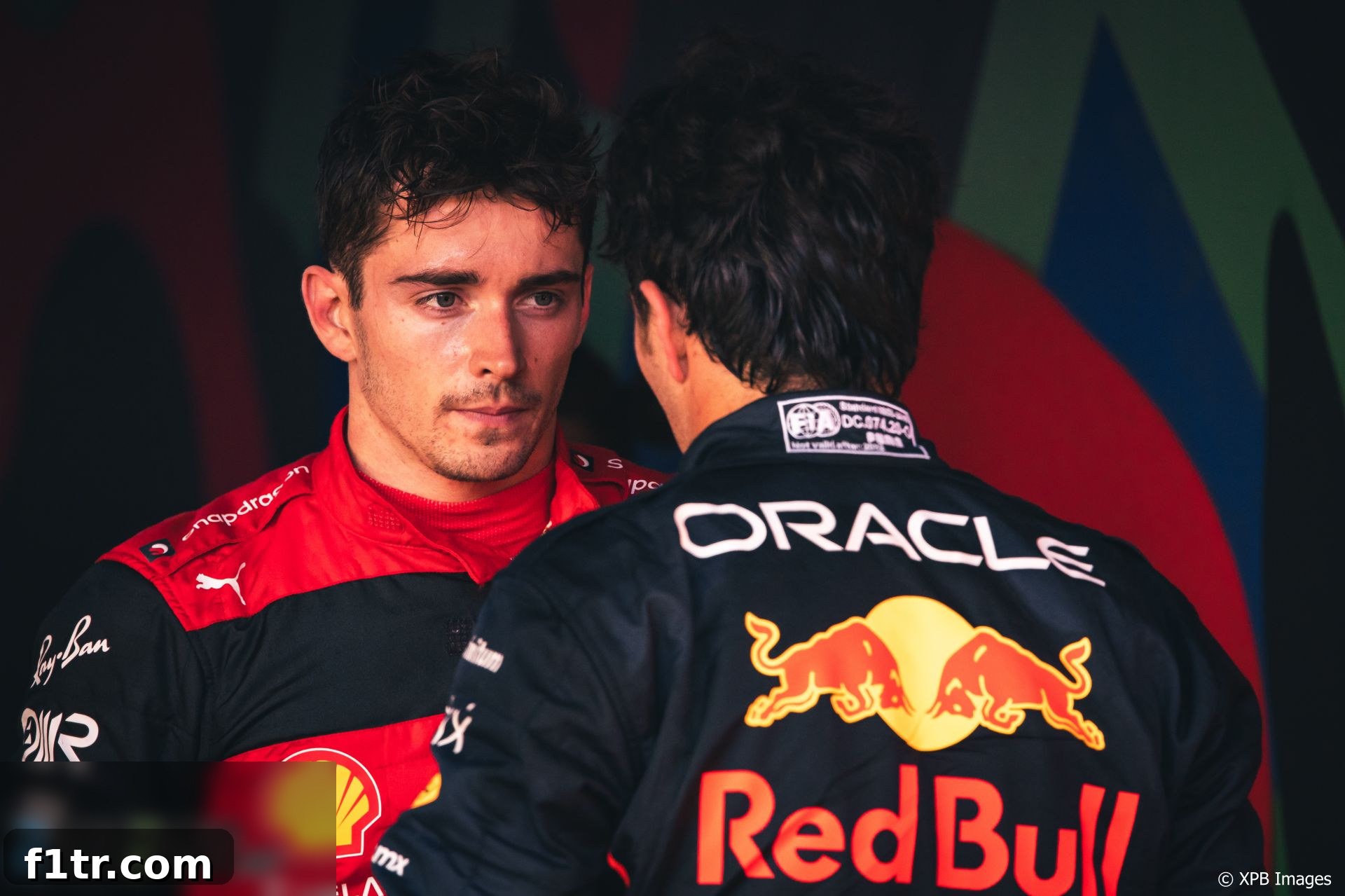
Charles Leclerc Sounds Caution on Ferrari’s Development Pace Against Red Bull
Leclerc Navigates Early Championship Lead with Strategic Focus on F1-75 Upgrades
Monaco’s own Charles Leclerc, the prodigious talent leading the Scuderia Ferrari charge, finds himself in an enviable position at the helm of the 2022 Formula 1 Drivers’ Championship. After three thrilling rounds, Leclerc has established a commanding 34-point lead, a testament to his exceptional driving and the formidable performance of Ferrari’s F1-75 challenger. While such a lead would typically invite unbridled optimism, Leclerc, ever the pragmatist, has acknowledged a significant hurdle on Ferrari’s path to potential glory: the intense development race against formidable rivals, particularly Red Bull Racing.
Leclerc, reflecting on his current standing, drew parallels with his past successes in junior categories. “I’ve been in this situation in the junior categories, but then to be in this situation in Formula 1 means a lot,” he shared, underscoring the profound significance of leading the premier motorsport series. This feeling is further amplified by the context of recent years, which saw Ferrari navigating a challenging period, and the immense prestige associated with driving for a team of Ferrari’s stature. “Especially after the last few years, and especially with a team like Ferrari. So it feels incredible.”
A Transformed Mindset: The Confidence of a Winning Car
The most striking difference for Leclerc this season, compared to his previous campaigns in Formula 1, is a palpable shift in his mindset. With a car demonstrably capable of winning races, the pressure to “overdo things” or perform “extremely special and spectacular” maneuvers to gain positions has significantly diminished. He now operates with a profound trust in the F1-75’s capabilities.
“Obviously, the mindset is a bit different compared to the last two years because now I know that underneath me I’ve got a car that is capable of winning,” Leclerc explained. “And I don’t really have to overdo things or to do something extremely special and spectacular to actually get one or two positions because I know that it’s in the car and I just have to do the job. So the mindset is a little bit different this year.” This new approach allows him to drive more cleanly, focus on maximizing the car’s potential consistently, and execute race strategies with greater precision, knowing that the raw pace is inherent in the machinery.
This newfound confidence is a double-edged sword. While it liberates Leclerc from the burden of perpetual over-driving, it simultaneously places a spotlight on the team’s ability to maintain and extend this performance advantage. The early season dominance, while encouraging, serves as a crucial foundation, but the true test lies in the relentless pace of development that defines modern Formula 1.
The Looming Shadow of Red Bull: A Development Race
Despite Ferrari’s strong start, Leclerc is acutely aware of the formidable challenge posed by Red Bull Racing. The Austrian outfit proved to be a close match for Ferrari’s pace in the initial two races, with Max Verstappen securing a thrilling victory in Saudi Arabia. This demonstrated Red Bull’s raw speed and their capacity to fight at the very front, even with early reliability issues hindering their championship tally.
Leclerc did not mince words about the impending development battle. “To keep up with Red Bull in terms of development is going to be difficult,” he admitted. This statement highlights a common perception within the Formula 1 paddock: Red Bull, under the guidance of technical maestro Adrian Newey, possesses a historical reputation for relentless and effective in-season car development. Their ability to bring significant upgrades throughout a season and consistently improve their machinery is well-documented, making them a perennial threat even when starting slightly behind.
Navigating the Demands of a New Regulatory Era
The 2022 season’s new technical regulations, designed to promote closer racing and reshape the cars’ aerodynamic philosophy, add another layer of complexity to the development race. With teams exploring entirely new concepts, the rate of learning and improvement is expected to be steep. A single innovative upgrade package could potentially unlock significant performance gains, dramatically altering the competitive landscape.
For Ferrari, the challenge is not only to maintain their current performance benchmark but also to out-innovate and out-develop a rival known for its aggressive and often successful mid-season upgrade strategies. This necessitates a flawless execution of their own development roadmap, ensuring that every update brought to the F1-75 delivers the expected performance gains and enhances the car’s overall package.
Ferrari’s Internal Strength: Trust in Maranello’s Expertise
Despite acknowledging Red Bull’s developmental prowess, Leclerc remains resolutely confident in his own team’s capabilities. He firmly believes that the same dedicated individuals who crafted the championship-leading F1-75 are more than capable of sustaining its competitive edge through subsequent development cycles. “But it’s the same team that did this car, that will work on the development for this year’s car, so I am confident,” Leclerc affirmed, expressing deep trust in the engineers and strategists back at the Maranello factory.
“There is no reason for us to be on the back foot because we’ve done a great job, the guys at Maranello have done a great job, building up this car for this year,” he added. This sentiment reflects a reinvigorated spirit within the Scuderia, a stark contrast to the challenges faced in previous seasons. The belief stems from the exceptional groundwork laid during the extensive development period for the new regulations, which clearly paid dividends with the F1-75’s impressive debut.
A Refined Approach to Analysis and Reaction
A key factor underpinning Leclerc’s confidence is Ferrari’s evolved approach to data analysis and problem-solving. He noted a significant improvement in how the team dissects each race weekend and identifies areas for enhancement. “Since the last two years, I really see a jump in the way we’ve analysed every weekend in the way we have identified also our weaknesses and how quick we were to react to try and get better in the places where we were struggling,” Leclerc observed.
This newfound efficiency in pinpointing and addressing weaknesses is critical in a sport where marginal gains can make a substantial difference. It suggests a more agile and responsive technical department, capable of translating track data into effective design solutions and bringing targeted upgrades online rapidly. “So I am confident that the team can do a great job with development this year,” he concluded, reinforcing the belief in Ferrari’s internal processes.
The strategy is clear: focus inwardly on their own strengths and development roadmap rather than becoming overly preoccupied with rival teams. “There are some developments coming and I’m confident that it will go in the right direction,” Leclerc stated. “So I wouldn’t focus too much on the others. I think we need to focus on ourselves.” This disciplined approach is vital for maintaining momentum and ensuring that Ferrari’s development trajectory remains aligned with their ambitious championship goals.
Championship Dynamics: Ferrari’s Early Lead and Red Bull’s Setbacks
The early championship standings paint a promising picture for Ferrari, yet one that masks the true underlying competitiveness. In the Constructors’ Championship, Ferrari currently holds a strong lead with 104 points. This healthy advantage is largely attributed to their consistent performance and reliability across the first three races, with both Charles Leclerc and Carlos Sainz consistently scoring valuable points.
Conversely, Red Bull Racing, despite demonstrating blistering pace at times, finds itself in third position in the constructors’ standings with 55 points. The significant gap of 49 points is primarily a consequence of three frustrating retirements suffered across the opening rounds – two for Max Verstappen and one for Sergio Pérez. These DNF (Did Not Finish) results, while unfortunate, do not fully reflect Red Bull’s raw speed, which has often been on par with, or even superior to, Ferrari’s at various points during race weekends. The performance parity means that without these reliability woes, the championship picture could look considerably different, underscoring the potential threat Red Bull still poses.
The Long Game: Why an Early Lead Isn’t a Guarantee
Leclerc’s measured perspective on his 34-point individual lead reflects a deep understanding of Formula 1’s marathon nature. While “Thirty-four points is always good to take wherever you are in the calendar,” he stated, he’s keen not to let this early advantage breed complacency. The season is long, with many races still to come, and the points available are immense.
History is replete with examples of early leaders being reeled in by relentless competitors who found a development breakthrough or capitalized on rivals’ stumbles. Therefore, for Ferrari, the focus remains firmly on the immediate task at hand: maximizing performance at each event, continuing the meticulous development of the F1-75, and ensuring operational excellence without succumbing to the pressure of defending a lead that is still relatively nascent in the grand scheme of a 23-race calendar.
The Imola Challenge: Managing Home Race Expectations
As the Formula 1 circus prepares to descend upon Imola for the Emilia Romagna Grand Prix, the first of two home races for Ferrari this season, the atmosphere will undoubtedly be electric. The passionate Tifosi will be out in full force, eager to witness their beloved Scuderia continue its winning ways on Italian soil. For Charles Leclerc, however, the approach remains steadfastly pragmatic, focused on consistency rather than succumbing to the immense pressure of a home crowd.
“Italy will be incredible,” Leclerc acknowledged, undoubtedly aware of the emotional significance of racing in front of Ferrari’s loyal supporters. Yet, he emphasized the critical need to maintain the same professional detachment and disciplined approach that has characterized their successful start to the season. “But we need to approach the race weekend, just like we approached the first three weekends. I think it’s extremely important not to put on ourselves extra pressure and not try to overdo things.”
Sticking to the Winning Formula: Consistency and Teamwork
The strategy for Imola, and indeed for the rest of the season, revolves around preserving the current working dynamic within the team. Leclerc highlighted the collaborative and effective nature of Ferrari’s operations since the very beginning of the season. “Because we are working, I think, as a team extremely well since the beginning of the season and we just need to keep doing our job, just like we did in the first three weekends,” he asserted.
This emphasis on continuity and avoiding unnecessary internal pressure is a hallmark of a mature championship contender. Over-driving, taking undue risks, or deviating from a proven strategy in the pursuit of glory at a home race can often lead to mistakes. Ferrari’s current strength lies in its harmonious operation – from the strategists on the pit wall to the mechanics in the garage and the drivers in the cockpit. Preserving this unity and focus will be paramount as the championship battle intensifies.
Imola represents a unique blend of opportunity and challenge. While a victory would undoubtedly send the Tifosi into raptures and further solidify Ferrari’s championship credentials, the team’s primary objective will be to execute a clean, strong race weekend, accumulate maximum points, and continue learning about the F1-75 in varying conditions. The development battle, as Leclerc suggests, will be fought not just on the track, but equally in the factories and simulation centers, making every race a data-gathering opportunity.
The Strategic Outlook: A Long Season of Evolution and Adaptation
The 2022 Formula 1 season is shaping up to be a captivating battle, defined not only by the sheer pace of the new generation of cars but also by the relentless pursuit of performance through in-season development. Charles Leclerc’s candid assessment of Ferrari’s position underscores the strategic intelligence now ingrained within the Scuderia.
Ferrari’s journey this year is a delicate balance between exploiting their initial advantage and continuously evolving the F1-75 to counter rival advancements. The budget cap, a relatively new constraint in Formula 1, adds another layer of complexity, requiring teams to be exceptionally efficient and strategic with their upgrade packages. Every modification, every new aero element, must deliver tangible performance gains, as resources for wholesale redesigns are limited. This environment rewards precision engineering and a deep understanding of the car’s nuanced characteristics.
The psychological aspect of a championship fight cannot be overstated. Leclerc’s calm and focused demeanor, coupled with his emphasis on internal team cohesion, indicates a matured approach to title contention. Maintaining this level-headedness throughout a gruelling season, especially when facing intense pressure from competitors and passionate supporters, will be crucial.
Ultimately, the 2022 season for Ferrari and Charles Leclerc will hinge on their ability to translate confidence into consistent execution, and their development plans into on-track performance. The early lead is a powerful statement, but the true champions are those who can adapt, innovate, and perform under sustained pressure. The development race against Red Bull is set to be one of the defining narratives of the year, with every upgrade package and every race weekend offering a fresh chapter in this thrilling championship story. Ferrari has laid a strong foundation, and now the challenge is to build upon it, brick by meticulous brick, towards a potential championship triumph.
2022 Australian Grand Prix
- Aston Martin’s porpoising “does not allow us to exploit the progress the guys have made”
- Wolff puts Mercedes’ odds of championship victory at “two to eight”
- FIA responds to Verstappen’s criticism of Safety Car performance
- “So this is the end of our race, I guess?” How Alonso’s luckless Australian GP unfolded
- Two-degree temperature rise led to Hamilton’s “difficult position” radio message
Browse all 2022 Australian Grand Prix articles