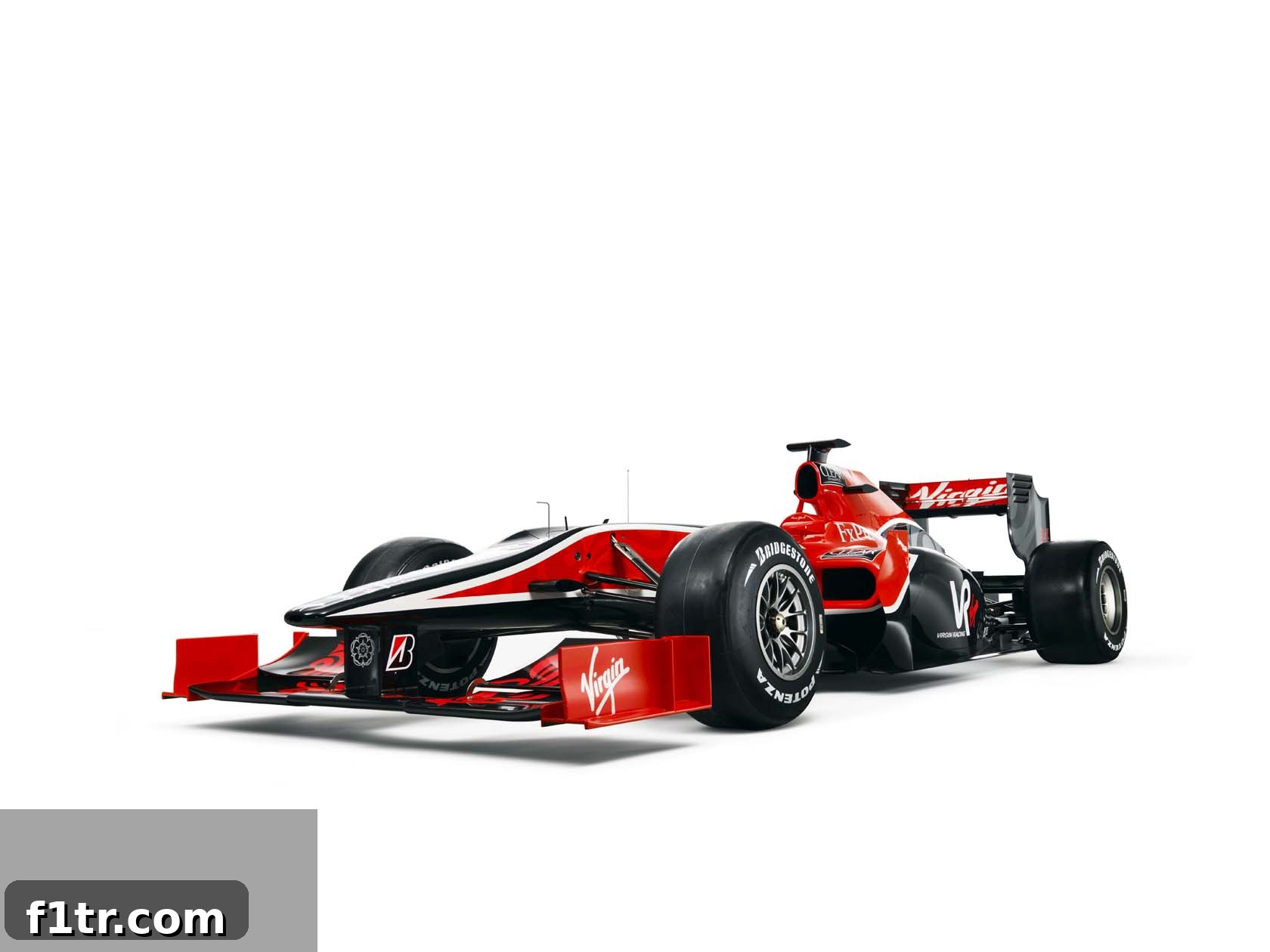
Virgin Racing marked a significant moment in the 2010 Formula 1 season by becoming the first of the newly formed teams to officially launch their contender, the innovative VR-01. This highly anticipated unveiling provided the motorsport world with its first glimpse of a machine designed to challenge conventions and redefine the boundaries of engineering within the sport, setting a brave new precedent for how F1 cars could be conceived and developed.
Advert | Become a Supporter & go ad-free
Virgin Racing Pioneers F1 Design with the All-CFD VR-01
The 2010 Formula 1 season heralded a fresh wave of competition, with several new teams joining the grid, each bringing their unique approach and ambitions to the pinnacle of motorsport. Among them, Virgin Racing, with its distinctive livery and a bold design philosophy, captured immediate attention. Their launch of the VR-01 was not just a car unveiling; it was a statement about the future of F1 engineering and a testament to innovative thinking in a sport renowned for its technological prowess.
At the heart of the VR-01’s groundbreaking design lies its genesis: it was conceived and developed entirely using Computational Fluid Dynamics (CFD) computer modelling. This methodology, while not entirely new to Formula 1, represented a radical departure from the traditional reliance on physical wind tunnels for aerodynamic development. For Virgin Racing, choosing CFD as the sole design tool was a deliberate and strategic decision, aiming to demonstrate its viability and efficiency in an era of tightening resource restrictions within the sport.
Embracing Digital Innovation: The All-CFD Philosophy
The man behind this audacious design strategy is Nick Wirth, the visionary technical director of Virgin Racing. Wirth has long been a proponent of digital engineering, and he firmly believes that CFD offers a superior, more cost-effective, and ultimately more innovative pathway for Formula 1 teams, especially under the sport’s evolving financial and technical regulations.
Speaking passionately about the VR-01’s development, Nick Wirth underscored the profound significance of this all-CFD approach:
“Today is a very proud day for everyone involved with Virgin Racing. However, on this occasion, where the car is the star, I want to pay tribute to all the amazing people at Wirth Research who deserve so much of the credit for the VR-01. Putting together an F1 team, assembling an engineering group, and designing a new car from scratch is an epic task in the timeframe we have been working to.
I have been fortunate to have worked with the very best designers in F1, and I am well aware of exactly what it takes to be successful in this sport. When you see what the existing teams have achieved using the conventional but proven design approach, it is unsurprising that there is a great deal of scepticism about our all-CFD approach. But we are competing in a sport that is undergoing significant change, having come face to face with today’s harsh economic realities. Under resource restriction, convention will become too costly, and necessity really will be the mother of invention. I have absolute belief in the digital design process, and the opportunity to put the all-CFD approach to the test at the highest level – to demonstrate that this could be the way for the future of F1 – is very, very exciting.”
– Nick Wirth
Wirth’s statement eloquently articulates the rationale behind Virgin Racing’s pioneering spirit. In an increasingly financially constrained Formula 1 landscape, the traditional model of extensive wind tunnel testing, with its associated massive infrastructure and operational costs, was becoming unsustainable for many. CFD, by contrast, offers the promise of a leaner, more agile development cycle, potentially democratizing access to high-level aerodynamic design for teams operating on tighter budgets. Virgin Racing aimed not just to compete but to validate a new paradigm for F1 car development.
Team Aspirations and Preparations for the 2010 Season
Advert | Become a RaceFans supporter andgo ad-free
The team, initially established as Manor Motorsport before the Virgin Group’s involvement, entered the 2010 season with a clear vision and a commitment to innovation. Powering their VR-01 chassis would be Cosworth’s CA2010 V8 engines, marking a return for the legendary engine manufacturer to a significant role in Formula 1. This combination of a groundbreaking chassis design and a proven engine supplier set the stage for an intriguing debut.
Team Principal John Booth conveyed the palpable excitement within the team ahead of their competitive debut:
“Not only do we have a great bunch of people at Virgin Racing, we also have a great-looking car. We are delighted with our fantastic new livery which provides a fitting integration of our racing brand with our important commercial partnerships. All in all, we have a lot to look forward to as we progress towards our racing debut in Bahrain next month.”
– John Booth
Booth also provided clarity on the team’s initial testing schedule, addressing why the VR-01 was not present at the first all-team test in Valencia. Strategic planning dictated a more measured approach to their initial track evaluation:
“The first stage in our on-track evaluation programme is our two-day shakedown at Silverstone on Thursday and Friday this week, where we will conduct systematic testing and confidence-building of all car parts and on-car systems. It was always intended that we would miss the first all-team test in Valencia this week, and very early on we targeted the second Jerez test in two weeks’ time for our public testing debut. It is a testament to our methodical approach and the sheer hard work of the team that we are heading to Spain a week earlier than planned to take part in the first Jerez test next week.”
– John Booth
This careful ramp-up highlighted Virgin Racing’s commitment to thorough preparation, ensuring that the VR-01 was meticulously checked and validated before its public debut. The decision to bring their Jerez test forward further underscored the team’s efficiency and dedication to getting their innovative machine onto the track and gathering crucial data as quickly as possible.
Sir Richard Branson’s Vision: Beyond the Track Performance
The presence of Virgin Group chairman Sir Richard Branson added an extra layer of entrepreneurial spirit and global recognition to the new F1 team. Known for his disruptive approach across various industries, Branson viewed Virgin Racing’s entry into Formula 1 as more than just a sporting endeavor; it was an “exploration” into new possibilities and a challenge to established norms.
“I’m sure we will be measured by how fast the car is on the track in Jerez next week, but I hope that doesn’t overshadow the far bigger achievement of pulling an entire racing team together and taking a brave step that defies convention. In many ways, this is an exploration, but given the absolute self-belief we have seen, I can’t help but feel very excited about what we can go on to achieve in the years ahead.
For now though, I’m looking forward to seeing the VR-01 on track in testing in the coming weeks as we prepare for Virgin Racing’s very first grand prix.”
– Richard Branson
Branson’s words perfectly encapsulated the ethos of Virgin Racing: a blend of high-performance ambition and a pioneering spirit. While acknowledging the ultimate measure of success on the racetrack, he emphasized the significant accomplishment of building a complete F1 operation from the ground up and, more importantly, daring to challenge conventional wisdom with the all-CFD design. This innovative approach aligned perfectly with the Virgin brand’s reputation for innovation and for taking calculated risks to disrupt established markets. The 2010 season represented not just a racing campaign but a grand experiment, with Virgin Racing hoping to prove that agility, smart technology, and a forward-thinking mindset could allow a new team to compete effectively at the highest levels of motorsport.
Advert | Become a RaceFans supporter andgo ad-free
VR-01 Technical Specifications
The Virgin VR-01, a product of cutting-edge digital design, presented a compact yet potent package tailored for the demands of Formula 1. Its key dimensions were:
- Length: 5,500mm
- Height: 950mm
- Width: 1,800mm
- Wheelbase: 3,200mm
These specifications reflect the regulatory framework of the 2010 season, which aimed to encourage closer racing and manage car performance. The precise measurements were the result of countless hours of CFD simulation, optimizing every curve and surface for aerodynamic efficiency without the aid of a physical wind tunnel model.
Virgin VR-01 Unveiling: A Glimpse into the Future
The launch of the VR-01 provided a highly anticipated visual reveal of Virgin Racing’s challenger. Its distinctive livery and sleek lines, honed entirely through digital processes, were a testament to the potential of the all-CFD design philosophy. These early images allowed fans and competitors alike to scrutinize the car that aimed to rewrite the rules of F1 development.
As the 2010 season progressed, the world would watch with keen interest to see if Virgin Racing’s bold gamble on Computational Fluid Dynamics would pay off. The VR-01 represented not just a new car, but a profound statement on the potential for technological innovation and cost-efficiency to reshape the competitive landscape of Formula 1, challenging established methodologies and paving the way for a more digitally-driven future in motorsport engineering.