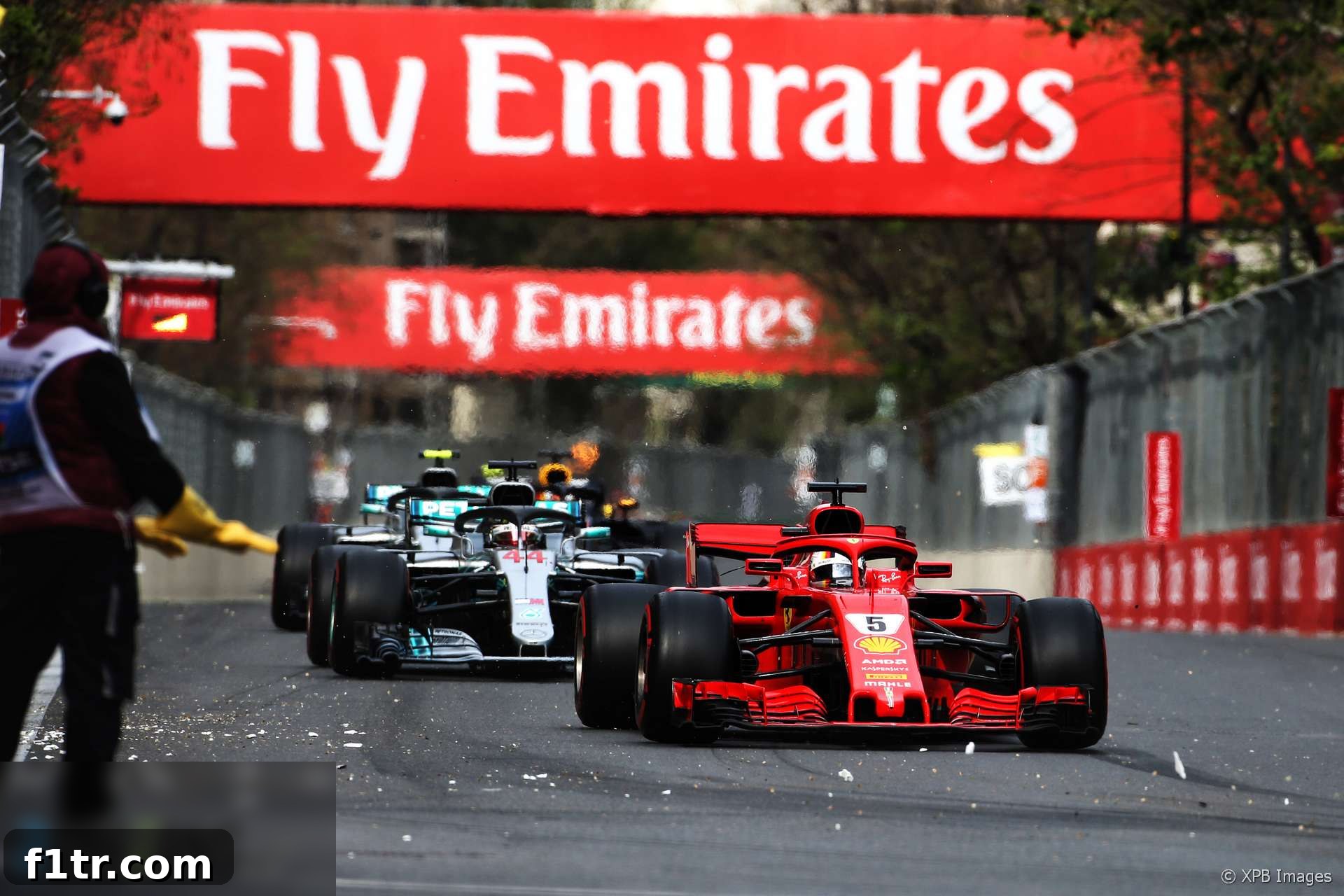
Azerbaijan Grand Prix: Unpacking Vettel’s Strategic Dilemma Between Hamilton and Bottas
The Azerbaijan Grand Prix has long been a fixture on the Formula 1 calendar known for its thrilling unpredictability, high-speed drama, and strategic gambles. In a particularly pivotal race, Sebastian Vettel, then at the helm of Ferrari, found himself locked in a strategic battle that would shape the outcome of the Grand Prix and potentially influence the championship narrative. His immediate priority was to nullify the formidable threat posed by Lewis Hamilton. However, a crucial question emerged from his strategic choices: did this focused defense against Hamilton inadvertently expose him to a cunning attack from his Mercedes stablemate, Valtteri Bottas?
The Early Exchanges: Vettel’s Vigilance Against Hamilton
Advert | Become a Supporter & go ad-free
Vettel, leading the race, was acutely aware of the pace and pressure Hamilton was exerting. Even before their scheduled pit stops, the Mercedes driver had begun to close the gap. While Hamilton momentarily lost precious seconds due to a significant lock-up and running wide at Turn 1, this momentary reprieve did little to ease Vettel’s strategic anxieties. The four-time world champion’s focus remained squarely on Hamilton, whom he perceived as his primary rival for both the race victory and the championship.
Following Hamilton’s pit stop, Vettel wasted no time urging his Ferrari team to respond swiftly. His instruction was clear: ensure he maintained a comfortable margin over his competitor, preventing Hamilton from exploiting the potent slipstream effect on Baku’s exceptionally long main straight. This particular characteristic of the Baku City Circuit, with its monumental straight, makes the ‘tow’ a hugely influential factor. Even a seemingly distant car can rapidly gain ground, pulling into the drag reduction system (DRS) zone and launching an overtake.
“I was happy to pit where we pitted because there was always a headwind down the main straight,” Vettel elaborated after the race. “I think you saw when Lewis was behind, even though he was three, three-and-a-half seconds behind, he gained massively in the last sector because with the tow the car in front, even if it’s far away, still makes a difference.” His rationale underscored his concern: “So I spoke with the team and said let’s not stay out too long, let’s not wait until Lewis on the fresh tyres eventually catches up and we come out only two or three seconds in front and then he might get in the tow window.” This preemptive strike was designed to quash any potential for Hamilton to use his fresh tyres and the tow to mount a challenge.
The Pit Stop Decision: A Question of Timing and Margin
When Sebastian Vettel ultimately rejoined the track after his pit stop, the immediate data revealed an interesting paradox. Far from the narrow two or three-second margin he had feared, he emerged with a substantial lead of almost eight seconds over Hamilton. This significant buffer immediately raised questions about the prudence of his pit stop timing. Could Vettel have extended his first stint for several more laps, potentially gaining a strategic advantage later in the race, while still comfortably maintaining his lead over Hamilton?
The eight-second gap suggests that Vettel’s concern, while understandable given Hamilton’s formidable reputation, might have led to an overly conservative call. Such a substantial margin indicates that Ferrari had more flexibility than initially perceived. Was the focus on Hamilton so intense that it overshadowed other strategic considerations, potentially sacrificing a more aggressive or opportunistic approach that could have solidified his position even further against the entire field?
Bottas’s Calculated Gamble: Extending the Stint
While Vettel and Hamilton engaged in their direct strategic duel, Valtteri Bottas, the other Mercedes driver, was executing a distinctly different and ultimately highly impactful strategy. Instead of mirroring the leaders, Bottas extended his first stint significantly. This tactic was a calculated gamble, designed to achieve one of two primary outcomes: either to position himself to use a softer, faster set of tyres in the closing stages of the race to launch an assault on the frontrunners, or to capitalize on a potential Safety Car deployment, which is a common occurrence on the tight streets of Baku.
The decision to run long on his initial set of tyres was a testament to Bottas’s understanding of the race dynamics and his team’s strategic foresight. By extending his stint, he preserved the opportunity to fit a faster compound – specifically, the ultrasoft tyres – for a shorter, aggressive final push. This strategy also placed him perfectly to benefit from a Safety Car, as it would allow him to pit under caution, losing less time, and emerge with fresh tyres, effectively gaining ‘free’ track position and an immense performance advantage over those who had already pitted.
The Crucial Factor: Tyre Degradation and Performance Delta
Vettel’s decision to pit was not solely driven by his apprehension regarding Hamilton. There was another, equally compelling reason: his tyres were at the end of their life, and his lap times were noticeably suffering. As the first stint wore on, the performance of his tyres had diminished significantly, causing his pace to drop off. This degradation was a critical factor, as not only was Hamilton quicker on fresh rubber, but Bottas was also demonstrating exceptional pace on his *older* supersoft tyres.
Advert | Become a RaceFans supporter andgo ad-free
This performance delta was stark: Bottas was consistently up to seven-tenths of a second per lap faster than Vettel. Leaving Vettel out on his increasingly worn tyres would have been detrimental, costing him precious time and track position, especially with Bottas rapidly closing in. Before the race, Bottas himself had shrewdly commented on what he perceived as Ferrari’s poorer tyre life towards the end of a stint, a weakness he exploited brilliantly. After Vettel pitted, Bottas pushed his supersoft tyres even harder, managing to reduce his lap times by almost two seconds. This blistering pace was a level that neither Vettel nor Hamilton could match, even on their newer sets of tyres.
Bottas’s masterful management of his tyres and his ability to extract performance even from degrading rubber was a key differentiator. He showcased not just raw speed, but also an impressive understanding of the Pirelli compounds and the Baku circuit’s demands. This sustained pace meant he was not merely lurking in the background; he was actively carving into the lead, pushing Hamilton out of his Safety Car ‘window’ – meaning he was reaching a point where he would have been able to pit and emerge ahead of his teammate without a safety car, purely through pace and gap management. Furthermore, he had run late enough in the race to be able to switch to ultra-soft tyres for a final, aggressive stint, setting himself up for a direct charge at Vettel.
The Safety Car’s Interruption and What Might Have Been
The crucial turning point arrived in the form of a Safety Car deployment. This incident, while bringing an unexpected twist to the race, perfectly validated Bottas’s extended-stint strategy. The Safety Car effectively neutralized the gaps, bringing all the frontrunners together and providing Bottas with the ultimate opportunity. He could now pit under caution, fit the grippiest ultrasoft tyres, and emerge in the lead, poised to claim victory.
While the Safety Car ultimately set Bottas on course for what would have been a well-deserved win (only for a subsequent puncture to cruelly snatch it away), it’s striking to consider how the race would have unfolded without it. The raw pace displayed by Bottas on older tyres, combined with his strategic position for a late tyre change, suggested that the real race, before the Safety Car disrupted the picture, was not just Vettel versus Hamilton, but increasingly, Vettel versus Bottas. For the third Grand Prix in a row, Bottas was proving to be a genuine contender, challenging the established hierarchy and asserting his presence at the sharp end of the grid.
Strategic Re-evaluation: Shifting Threats in the Championship
The Azerbaijan Grand Prix served as a stark reminder of the complexities of Formula 1 strategy and the ever-shifting landscape of competition. Vettel’s initial focus on Hamilton, while tactically sound given the championship context, seemingly overlooked the potent and nuanced threat emerging from Bottas. It gives the impression that Vettel’s strategy might have been based on assessing the greater long-term championship rival, rather than the immediate, on-track threat for that specific race victory.
Advert | Become a RaceFans supporter andgo ad-free
However, as the detailed analysis reveals, Vettel’s pit stop was a multifaceted decision, heavily influenced by his rapidly degrading tyres. Yet, Bottas’s performance throughout the race, his ability to manage his tyres, and his shrewd strategic gambles underscored his emergence as a formidable force. Perhaps, from this race forward, the strategic thinking of Sebastian Vettel and Ferrari would need to incorporate Bottas more prominently into their threat assessment. In the intricate dance of Formula 1 strategy, overlooking any competitor can prove to be a costly oversight, particularly when that competitor is executing a brilliant race from the shadows.
Quotes: Dieter Rencken
2018 F1 season
- F1 feared “death knell” for Drive to Survive after Ferrari and Mercedes snub
- McLaren staff told us we were “totally crazy” to take Honda engines in 2018 – Tost
- ‘It doesn’t matter if we start last’: How Red Bull’s junior team aided Honda’s leap forward
- Honda’s jet division helped F1 engineers solve power unit problem
- McLaren Racing losses rise after Honda split
Browse all 2018 F1 season articles