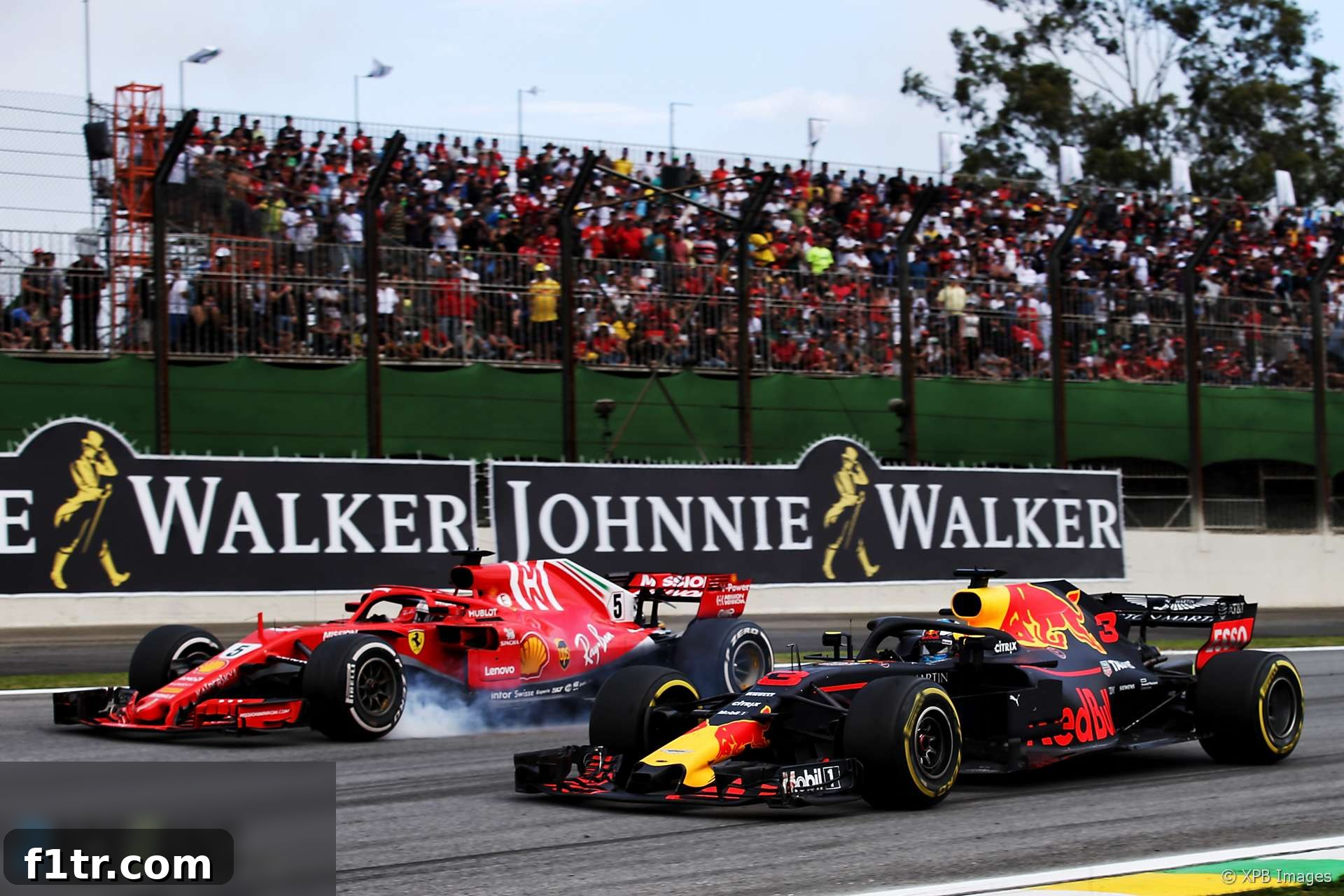
Sebastian Vettel’s F1 Race Derailed by Sensor Glitch and Failed Tire Strategy
The Grand Prix weekend presented significant challenges for Scuderia Ferrari and its lead driver, Sebastian Vettel. What promised to be a crucial race for their championship aspirations ultimately unfolded into a compromised performance, primarily due to an unforeseen sensor problem and a strategic tire gamble that failed to deliver the anticipated dividends. This dual setback not only hampered Vettel’s individual pace but also forced a difficult team order, casting a shadow over Ferrari’s operational efficiency on race day.
Ferrari team principal Maurizio Arrivabene was quick to address the underlying mechanical issue that plagued Vettel’s car from the outset. He revealed that a critical sensor problem was detected on the SF71H even before the race officially commenced, specifically during the formation lap. This early detection, while crucial for understanding the limitations, meant that the team had to react in real-time to mitigate its impact. Arrivabene detailed the gravity of the situation, stating, “Right from the formation lap, we became aware of a problem with a sensor on Seb’s car. This meant that for the whole race he had to run different settings to those we would have normally used and that made the car difficult to drive.”
Advert | Become a Supporter & go ad-free
The implications of such a sensor malfunction in the highly sophisticated world of Formula 1 are profound. Modern F1 cars rely on hundreds of sensors to monitor every aspect of performance, from engine parameters and gearbox temperatures to suspension loads and tire pressures. A faulty sensor can provide incorrect data, leading the engine control unit to operate sub-optimally, or it can force the driver to manually compensate for missing information. In Vettel’s case, having to run “different settings” likely meant foregoing pre-optimized engine maps or energy recovery system strategies, forcing him to adapt his driving style to an uncooperative machine. This undoubtedly impacted the car’s balance, power delivery, and overall responsiveness, turning what should have been a high-performance driving experience into a constant battle against an unpredictable car.
The cumulative effect of this mechanical handicap quickly manifested on track. Vettel, who had started with high hopes, found himself steadily losing ground to rivals. His struggle for pace was evident, culminating in him slipping to sixth place. In a clear sign of the team’s desperation to salvage points and optimize their race strategy, Vettel was instructed to let his team mate, Kimi Raikkonen, pass him at one stage. This team order underscored the severity of Vettel’s difficulties, as such instructions are rarely issued unless one driver is demonstrably struggling or a strategic imperative demands it.
Beyond the technical glitch, Ferrari’s strategic gamble on tire choice further exacerbated their predicament. Both Ferrari drivers began the race on the soft compound tires, a decision made with the expectation that it would provide them with a distinct advantage over their primary rivals, Mercedes and Red Bull, who opted for the faster but less durable super-soft compound. The rationale behind such a choice is typically to gain track position later in the race when rivals on softer tires might struggle with degradation or be forced into earlier pit stops. However, as Vettel candidly admitted post-race, this calculated risk simply did not pay off.
Vettel’s assessment of the tire strategy was unequivocal: “I don’t think it was an advantage today to start with the tyres that we had. We thought it was, it turned out not to be the case.” His frustration was palpable as he elaborated on the lack of performance from the soft tires. “
[We] struggled to get the tyres to work properly and [were] sliding quite a bit so not a good race.” For an F1 driver, “sliding quite a bit” signifies a critical lack of grip and stability, making it impossible to attack corners with confidence or maintain optimal speed. This meant Vettel was constantly fighting the car, further draining his concentration and exacerbating the impact of the sensor issue.
Ferrari’s pre-race analysis had seemingly predicted that Mercedes and Red Bull, on their softer rubber, would not be able to sustain a competitive pace for long. They anticipated a significant drop-off in performance from the super-softs, creating a window for their soft-shod cars to capitalize. Vettel explained their reasoning, albeit with a hint of hindsight, saying, “I thought [our tyres] were OK straight away but they were just not fast enough in comparison. The super-soft didn’t struggle enough, let’s put it that way.”
The reality on track, however, starkly contradicted Ferrari’s projections. The super-soft tires demonstrated remarkable durability and consistent performance, confounding the Maranello-based squad’s expectations. Vettel further elaborated on this miscalculation: “You could see that they had maybe two or three laps where they would get some pain, where I thought now we are quids in. After that, they were fast before and fast after that phase.” This observation highlights a crucial strategic misjudgment. While the super-softs might have experienced a brief period of higher degradation, their overall performance window was much broader and more resilient than Ferrari had anticipated. This allowed Mercedes and Red Bull to maintain competitive lap times, negating any potential long-term advantage Ferrari hoped to gain from their soft tires.
“The super soft was fast, faster arguably, and they lasted also long enough. I don’t think before the race anybody thought that super-soft/soft strategy was feasible but it was actually not a problem,” Vettel concluded. This statement is a damning indictment of Ferrari’s strategic planning for the race. The prevailing wisdom might have suggested that a super-soft to soft strategy was overly aggressive or simply unfeasible due to high degradation, yet Mercedes and Red Bull proved otherwise. Their ability to manage the super-softs effectively, combined with their superior pace, exposed the flaws in Ferrari’s conservative approach. The soft tires, while durable, simply lacked the outright speed required to challenge the front-runners, turning a supposed advantage into a significant handicap.
Advert | Become a RaceFans supporter andgo ad-free
This race served as a stark reminder of the unpredictable nature of Formula 1, where meticulous planning can be undone by unforeseen technical issues and strategic miscalculations. For Sebastian Vettel, the sensor problem introduced an unavoidable mechanical disadvantage, forcing him to wrestle with an ill-handling car. Concurrently, the tire strategy, intended to be a masterstroke, backfired spectacularly, leaving Ferrari at a pace deficit compared to their main rivals. The combination of these two factors created a perfect storm, relegating Vettel to a disappointing finish and raising questions about Ferrari’s ability to execute under pressure.
The repercussions of such a race are multifaceted. For Vettel, it represented lost points in what was likely a tight championship battle during the 2018 F1 season. For Ferrari, it necessitated a deep dive into both their technical reliability and their strategic decision-making processes. Learning from such experiences is crucial for any team aspiring for championship glory. The ability to quickly identify and rectify mechanical faults, alongside developing a more agile and accurate race strategy, remains paramount in the fiercely competitive world of Formula 1. This particular race served as a painful but important lesson for the Scuderia, highlighting areas that required immediate attention and improvement to maintain their title challenge.
Looking ahead, such setbacks often galvanize teams to redouble their efforts. Ferrari would undoubtedly analyze every data point from Vettel’s car, scrutinizing the sensor data and cross-referencing it with the team’s initial tire compound performance models. The goal would be to understand precisely why their predictions diverged so significantly from reality and how to avoid similar pitfalls in future races. The incident also highlighted the importance of driver feedback; Vettel’s insights into the car’s handling and tire performance would be invaluable in refining future setups and strategies. In the high-stakes environment of Formula 1, every race offers lessons, and this challenging Grand Prix certainly provided Ferrari with plenty of food for thought.
2018 F1 Season Insights
- F1 feared “death knell” for Drive to Survive after Ferrari and Mercedes snub
- McLaren staff told us we were “totally crazy” to take Honda engines in 2018 – Tost
- ‘It doesn’t matter if we start last’: How Red Bull’s junior team aided Honda’s leap forward
- Honda’s jet division helped F1 engineers solve power unit problem
- McLaren Racing losses rise after Honda split
Browse all 2018 F1 season articles