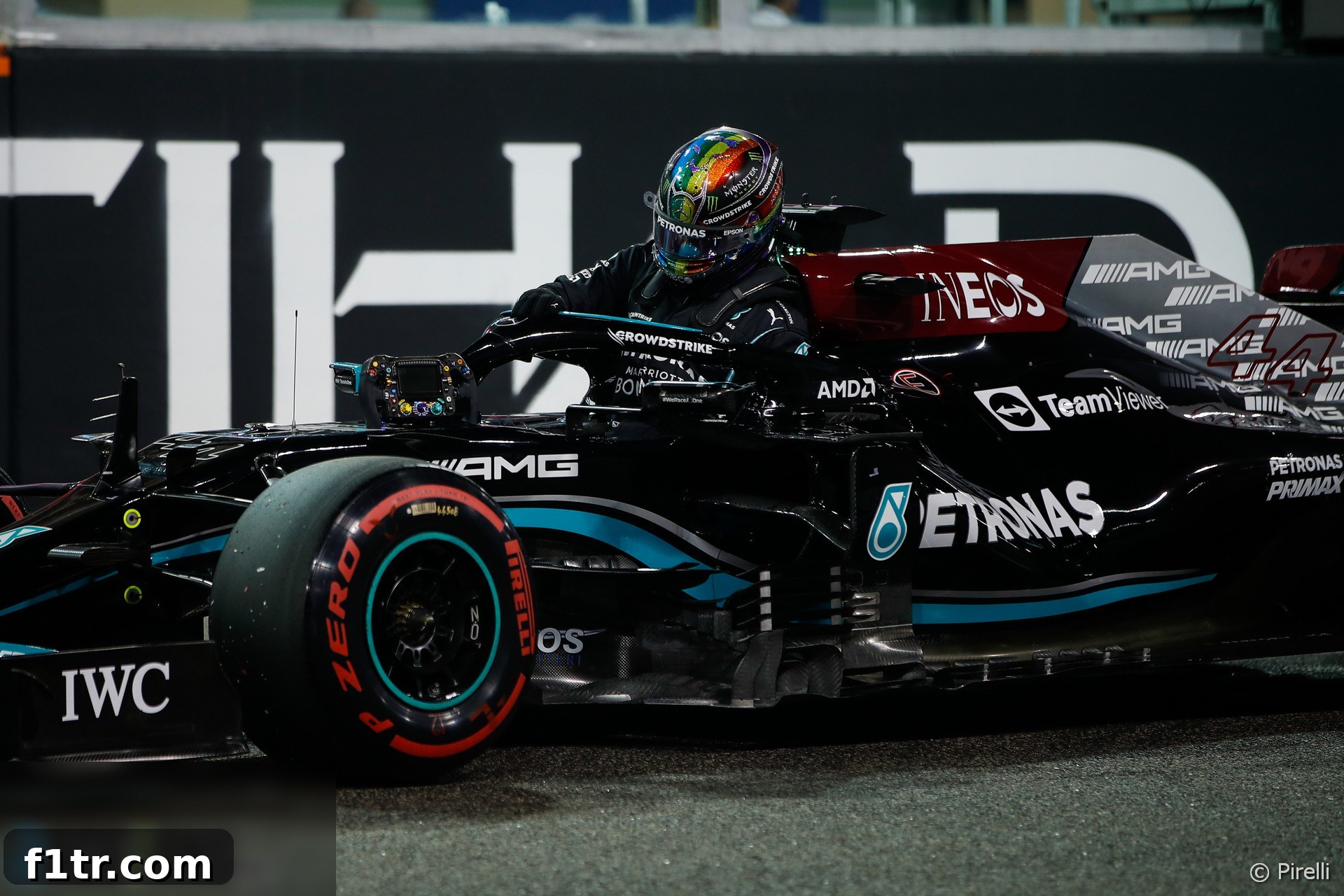
The stage is set for an epic conclusion to one of Formula 1’s most electrifying seasons. As the sun begins to set over the glittering Yas Marina Circuit, the tension is palpable for the Abu Dhabi Grand Prix, the ultimate championship decider. Despite securing a crucial second place on the grid, Lewis Hamilton expressed a quiet confidence, feeling strategically well-positioned to challenge his fierce rival, Max Verstappen, who clinched pole position. The seven-time world champion’s decision to start on the medium tyre compound is a calculated gamble, a strategic divergence from Verstappen’s soft-tyre choice, designed to potentially swing the advantage in his favor during the relentless 58-lap race.
Hamilton’s optimism stems from the belief that the medium tyres will offer a longer first stint, providing tactical flexibility and mitigating the immediate pressure to overtake Verstappen at the start. While the initial grip of the softs might give Verstappen an early lead, the mediums could prove more durable, allowing Hamilton to extend his first stint and potentially gain an advantage as the race unfolds. This strategic play is a testament to Mercedes-AMG Petronas F1 Team’s meticulous planning, banking on tyre degradation and race management to outmanoeuvre Red Bull Racing.
Advert | Become a Supporter & go ad-free
The qualifying session itself was not without its drama, featuring a moment that raised Hamilton’s eyebrows. Verstappen’s mid-Q2 lock-up, which forced him to abandon his medium tyre run and switch to softs for his final attempt, became a key talking point. Hamilton, ever the astute observer, harbored suspicions. “I’m always kind of sceptical with everything, so it’ll be interesting when we go back and look at the information and onboard laps,” he remarked. Seated beside Verstappen in the post-qualifying press conference, Hamilton pointed out, “It’s very rare that people lock up in Turn 1.” He openly speculated that Red Bull might have always intended to start the race on the soft compound, suggesting the lock-up could have been a deliberate ruse or a fortunate accident that played perfectly into their strategic hand. Whether it was a genuine mistake or a tactical masterstroke, it set the stage for a compelling tyre battle, with Hamilton believing, “I think we’ve got the right tyre but I guess we’ll see tomorrow.”
Pirelli, the sport’s exclusive tyre supplier, brought their three softest compounds – the C3 (hard), C4 (medium), and C5 (soft) – to the reconfigured Yas Marina circuit. This selection emphasizes speed and grip, but also introduces the critical element of degradation, especially for the ultra-soft C5 compound. The grid offers a fascinating mix: Verstappen on pole with softs, Hamilton directly behind on mediums, and then Lando Norris in third, also on soft tyres. Norris’s position on the racing line presents another layer of complexity for Hamilton. The Mercedes driver will be acutely aware of the McLaren, anxious to prevent it from sweeping past and creating a buffer between him and his championship rival. Furthermore, the presence of Sergio Perez in the second Red Bull, starting fourth on softs, adds another strategic dimension. Failing to overtake Verstappen early might be an inconvenience, but falling behind both Red Bulls, with Perez potentially acting as a strategic shield for Verstappen, could prove disastrous for Hamilton’s championship aspirations.
The changes implemented at the Yas Marina circuit further amplify the strategic possibilities. The revamped layout, featuring a new, faster sector one and a redesigned hairpin, has been engineered to promote closer racing and more overtaking opportunities. Where drivers previously funneled into a single-file procession, the new and more flowing early sequence should allow cars to stay alongside each other for longer, creating multi-car battles. This was evident in the Formula 2 support races, which showcased exciting three- and even four-wide action in the opening laps. While the considerably faster and more complex F1 cars might not replicate such manoeuvres with the same ease, the potential for two cars to run wheel-to-wheel through the entire first sector is very real, particularly with the powerful advantage of slip-streaming down the circuit’s long back straight. These track modifications add an unpredictable element, making the initial laps even more critical for securing track position.
The specter of a collision between the two championship contenders looms large, a scenario that FIA F1 Race Director Michael Masi preemptively addressed. Masi issued a clear reminder to all stakeholders, including drivers and teams, that points deductions remain an option for the stewards if any driver is found guilty of unsporting conduct. Given the monumental stakes of this final race – the Formula 1 Drivers’ Championship – it would be incredibly unwise for either Verstappen or Hamilton to risk a retirement through an aggressive or illicit manoeuvre. The pressure to win is immense, but the consequences of a disqualification or penalty are even greater, ensuring a cautious yet fierce battle.
If Max Verstappen can successfully navigate the initial laps and maintain his lead on the softer tyres, Red Bull will be confident in their strategy. However, Mercedes will be anticipating that their medium tyre choice for Hamilton will bring them into strong contention later in the race, banking on the softs degrading. The key question revolves around how far Verstappen can push his soft tyres. Few drivers extensively explored their limits during practice, but Esteban Ocon provided a valuable case study. In the second practice session, Ocon completed a 16-lap stint on soft tyres, demonstrating remarkably consistent lap times, albeit at a somewhat pedestrian 1’30 range. Crucially, there was no significant drop-off in Ocon’s performance, with his final lap being one of his faster ones. While the exact fuel load of his Alpine car remains unknown, making a direct correlation to race pace challenging, it did suggest that the C5 compound might be more resilient than anticipated. Verstappen himself completed an eight-lap soft tyre stint, lapping considerably quicker (closer to 1’28), albeit over a shorter distance and potentially with a lighter fuel load. Ocon’s data, however, indicates that Pirelli’s softest tyres may not represent as significant a disadvantage over a race stint at Yas Marina as they might at other circuits. The cooler track temperatures during the dusk sessions in Abu Dhabi are also expected to aid tyre longevity and performance, potentially playing into Verstappen’s hands.
The intensity of the championship battle means that Verstappen’s ability to manage his soft tyres will be critical. If Lewis Hamilton is filling his mirrors from the very start, Verstappen may be unable to “relax” and conserve his tyres, forced to push harder and risk early degradation. Conversely, if he finds himself with a gap, or if Norris or – in a best-case scenario for Red Bull – Perez is behind him, he could more easily coax the soft rubber to last longer. This tyre management will be a delicate balancing act, a high-stakes poker game played out at over 200 mph.
Verstappen may also need to exercise particular restraint at the exit of Turns 5 and 9 – two quick left-handers where robust kerbs await. These “pyramid” kerbs have been a point of concern, even after partial adjustments in response to Pirelli’s warnings, given their similarity to those that caused multiple punctures at the Losail circuit earlier in the season. A tyre failure for either championship contender would be catastrophic, adding another layer of risk to an already high-pressure race. The scenario of Verstappen on soft tyres being relentlessly chased by Hamilton on harder, more durable rubber brings back memories of their nail-biting battle at the Saudi Arabian Grand Prix in Jeddah. In that fraught contest, Hamilton ultimately prevailed, repeatedly using his superior straight-line speed to pressure Verstappen into concessions. However, Hamilton doesn’t appear to have the same outright top-end speed advantage this weekend at Yas Marina. As the speed trap data below clearly indicates, Verstappen has opted for a lower downforce configuration, prioritizing straight-line speed. This setup choice wasn’t without its challenges for Red Bull, as Verstappen’s rear wing required adjustments and repairs ahead of final practice and qualifying, highlighting the fine margins at play.
Nevertheless, Lewis Hamilton approaches this championship decider with a resolute conviction. He must out-score Max Verstappen to secure his record-breaking eighth world title, and he is confident that he is on the right tyres and has the optimal strategy to achieve this monumental feat. The final chapter of this thrilling and often controversial Formula 1 season will soon be written. Whether Hamilton’s strategic gamble pays off, or if Red Bull Racing has pulled off a championship-clinching masterstroke with Verstappen’s aggressive soft-tyre choice, the world will soon know. The 2021 Abu Dhabi Grand Prix promises to be an unforgettable climax to an extraordinary year of motorsport.
Go ad-free for just £1 per month>> Find out more and sign up
Quotes: Dieter Rencken
Advert | Become a RaceFans supporter andgo ad-free
Qualifying times in full
| Driver | Car | Q1 | Q2 (vs Q1) | Q3 (vs Q2) | |
| 1 | Max Verstappen | Red Bull | 1’23.322 | 1’22.800 (-0.522) | 1’22.109 (-0.691) |
| 2 | Lewis Hamilton | Mercedes | 1’22.845 | 1’23.145 (+0.300) | 1’22.480 (-0.665) |
| 3 | Lando Norris | McLaren | 1’23.553 | 1’23.256 (-0.297) | 1’22.931 (-0.325) |
| 4 | Sergio Perez | Red Bull | 1’23.350 | 1’23.135 (-0.215) | 1’22.947 (-0.188) |
| 5 | Carlos Sainz Jnr | Ferrari | 1’23.624 | 1’23.174 (-0.450) | 1’22.992 (-0.182) |
| 6 | Valtteri Bottas | Mercedes | 1’23.117 | 1’23.246 (+0.129) | 1’23.036 (-0.210) |
| 7 | Charles Leclerc | Ferrari | 1’23.467 | 1’23.202 (-0.265) | 1’23.122 (-0.080) |
| 8 | Yuki Tsunoda | AlphaTauri | 1’23.428 | 1’23.404 (-0.024) | 1’23.220 (-0.184) |
| 9 | Esteban Ocon | Alpine | 1’23.764 | 1’23.420 (-0.344) | 1’23.389 (-0.031) |
| 10 | Daniel Ricciardo | McLaren | 1’23.829 | 1’23.448 (-0.381) | 1’23.409 (-0.039) |
| 11 | Fernando Alonso | Alpine | 1’23.846 | 1’23.460 (-0.386) | |
| 12 | Pierre Gasly | AlphaTauri | 1’23.489 | 1’24.043 (+0.554) | |
| 13 | Lance Stroll | Aston Martin | 1’24.061 | 1’24.066 (+0.005) | |
| 14 | Antonio Giovinazzi | Alfa Romeo | 1’24.118 | 1’24.251 (+0.133) | |
| 15 | Sebastian Vettel | Aston Martin | 1’24.225 | 1’24.305 (+0.080) | |
| 16 | Nicholas Latifi | Williams | 1’24.338 | ||
| 17 | George Russell | Williams | 1’24.423 | ||
| 18 | Kimi Raikkonen | Alfa Romeo | 1’24.779 | ||
| 19 | Mick Schumacher | Haas | 1’24.906 | ||
| 20 | Nikita Mazepin | Haas | 1’25.685 |
Sector times
| Driver | Sector 1 | Sector 2 | Sector 3 |
|---|---|---|---|
| Max Verstappen | 16.842 (2) | 35.643 (1) | 29.613 (1) |
| Lewis Hamilton | 16.834 (1) | 35.783 (4) | 29.795 (2) |
| Lando Norris | 16.967 (3) | 35.844 (6) | 30.120 (7) |
| Sergio Perez | 16.976 (4) | 35.696 (3) | 30.047 (5) |
| Carlos Sainz Jnr | 17.113 (12) | 35.837 (5) | 30.040 (4) |
| Valtteri Bottas | 17.024 (7) | 35.871 (7) | 29.986 (3) |
| Charles Leclerc | 17.071 (10) | 35.693 (2) | 30.115 (6) |
| Yuki Tsunoda | 17.011 (6) | 35.974 (8) | 30.165 (9) |
| Esteban Ocon | 17.053 (9) | 36.049 (11) | 30.226 (11) |
| Daniel Ricciardo | 17.076 (11) | 35.977 (9) | 30.210 (10) |
| Fernando Alonso | 16.985 (5) | 36.169 (16) | 30.249 (12) |
| Pierre Gasly | 17.038 (8) | 35.999 (10) | 30.156 (8) |
| Lance Stroll | 17.290 (18) | 36.117 (13) | 30.597 (15) |
| Antonio Giovinazzi | 17.236 (15) | 36.152 (15) | 30.514 (13) |
| Sebastian Vettel | 17.257 (16) | 36.143 (14) | 30.729 (16) |
| Nicholas Latifi | 17.281 (17) | 36.465 (19) | 30.592 (14) |
| George Russell | 17.130 (13) | 36.401 (18) | 30.766 (17) |
| Kimi Raikkonen | 17.136 (14) | 36.112 (12) | 30.941 (18) |
| Mick Schumacher | 17.419 (19) | 36.340 (17) | 31.114 (19) |
| Nikita Mazepin | 17.522 (20) | 36.741 (20) | 31.295 (20) |
Speed trap
| Pos | Driver | Car | Engine | Speed (kph/mph) | Gap |
|---|---|---|---|---|---|
| 1 | Max Verstappen | Red Bull | Honda | 328.3 (204.0) | |
| 2 | Sergio Perez | Red Bull | Honda | 327.7 (203.6) | -0.6 |
| 3 | George Russell | Williams | Mercedes | 325.7 (202.4) | -2.6 |
| 4 | Antonio Giovinazzi | Alfa Romeo | Ferrari | 325.3 (202.1) | -3.0 |
| 5 | Fernando Alonso | Alpine | Renault | 325.0 (201.9) | -3.3 |
| 6 | Esteban Ocon | Alpine | Renault | 325.0 (201.9) | -3.3 |
| 7 | Nikita Mazepin | Haas | Ferrari | 324.9 (201.9) | -3.4 |
| 8 | Mick Schumacher | Haas | Ferrari | 324.6 (201.7) | -3.7 |
| 9 | Yuki Tsunoda | AlphaTauri | Honda | 324.5 (201.6) | -3.8 |
| 10 | Pierre Gasly | AlphaTauri | Honda | 323.9 (201.3) | -4.4 |
| 11 | Charles Leclerc | Ferrari | Ferrari | 323.6 (201.1) | -4.7 |
| 12 | Kimi Raikkonen | Alfa Romeo | Ferrari | 323.1 (200.8) | -5.2 |
| 13 | Lando Norris | McLaren | Mercedes | 322.8 (200.6) | -5.5 |
| 14 | Nicholas Latifi | Williams | Mercedes | 322.7 (200.5) | -5.6 |
| 15 | Carlos Sainz Jnr | Ferrari | Ferrari | 322.7 (200.5) | -5.6 |
| 16 | Lewis Hamilton | Mercedes | Mercedes | 322.7 (200.5) | -5.6 |
| 17 | Daniel Ricciardo | McLaren | Mercedes | 322.6 (200.5) | -5.7 |
| 18 | Valtteri Bottas | Mercedes | Mercedes | 322.2 (200.2) | -6.1 |
| 19 | Lance Stroll | Aston Martin | Mercedes | 321.7 (199.9) | -6.6 |
| 20 | Sebastian Vettel | Aston Martin | Mercedes | 321.7 (199.9) | -6.6 |
Advert | Become a RaceFans supporter andgo ad-free
Over to you
Who will win the 2021 drivers’ championship? Share your views on the Abu Dhabi Grand Prix in the comments below.
2021 Abu Dhabi Grand Prix
- Masi ‘basically gifted the championship’ to Verstappen says 2021 FIA steward Sullivan
- Norris called out F1 over its farcical 2021 finale. Will it get it right this time?
- Why Mercedes put ‘a reminder of joy and pain’ on display in their factory lobby
- Hamilton would be an eight-time champion if Whiting was still alive – Steiner
- Verdict on error in GT race suggests Mercedes would have lost 2021 Abu Dhabi GP appeal
Browse all 2021 Abu Dhabi Grand Prix articles