In the fiercely competitive realm of Formula 1, every strategic maneuver by a top team like Ferrari is placed under an uncompromising microscope. This relentless public and media scrutiny, according to four-time world champion Sebastian Vettel, significantly hinders the Scuderia’s capacity for swift, “reactive” decision-making during races. His candid observations followed the 2019 Spanish Grand Prix, an event marked by intricate team orders and a challenging performance for Ferrari, which saw their cars finish fourth and fifth, trailing the dominant Mercedes-AMG Petronas F1 Team.
Advert | Become a Supporter & go ad-free
The 2019 Spanish Grand Prix: A Strategic Minefield for Ferrari
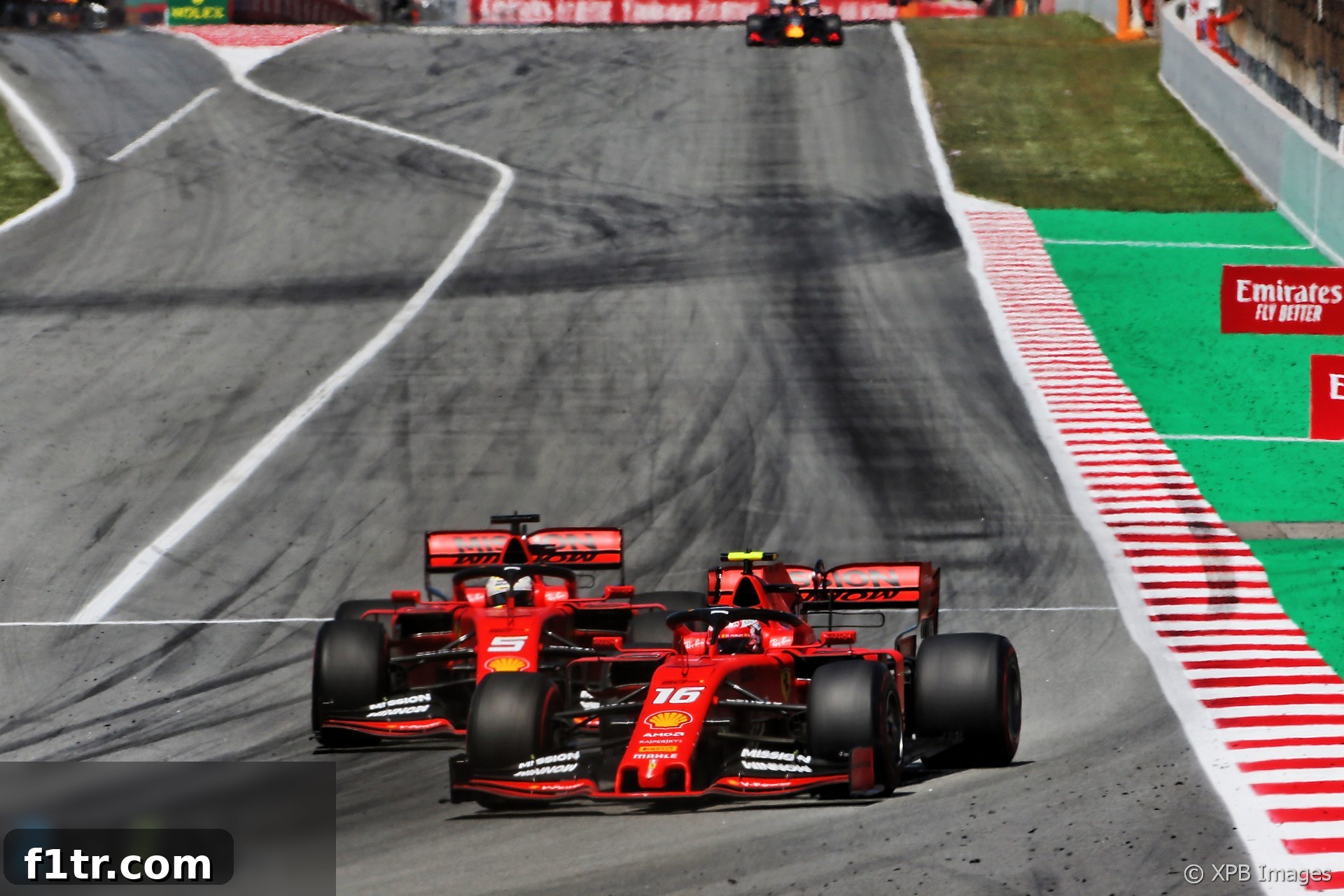
The Circuit de Barcelona-Catalunya provided the backdrop for another display of Mercedes’ formidable superiority in 2019, as they clinched their fifth consecutive one-two finish of the season. For Ferrari, however, the race was a labyrinth of strategic choices and on-track battles, notably involving their two star drivers. Sebastian Vettel and Charles Leclerc found themselves in a dynamic, evolving situation that led to their positions being swapped not once, but twice, over the course of the 66-lap Grand Prix.
The initial moments of the race set the tone for Vettel’s afternoon. Starting from third, he executed an aggressive lunge into Turn 1, a move intended to disrupt the Mercedes pairing. However, this bold attempt resulted in a lock-up, causing a significant flat spot on his tires. This damage profoundly compromised his first stint, forcing him to contend with severe vibrations and a noticeable loss of aerodynamic performance. Recognizing Leclerc’s unhindered pace and healthier tires, Ferrari’s strategists made the call to switch positions, allowing the Monegasque driver to pass Vettel. The aim was clear: enable Leclerc, who was on a slightly different tire strategy, to push harder and potentially challenge the Silver Arrows or at least create a defensive buffer against Max Verstappen in the Red Bull, who was showing strong pace.
However, the fluid nature of Formula 1 racing, particularly its strategic elements, meant that the situation was far from static. Following the first round of pit stops, a critical turning point arrived with the deployment of a Safety Car. The incident, involving Lance Stroll and Lando Norris, effectively neutralized any strategic advantages Leclerc might have been building. As Vettel himself put it, Leclerc’s initial strategy was “thrown to bits” by the Safety Car period, which bunched up the entire field. It was during this phase that Vettel, having found a renewed rhythm on a different tire compound, began to rapidly close the gap to his teammate. Sensing a distinct pace advantage and believing he could make more progress, Vettel communicated his desire to swap positions once again with the team.
After internal deliberation on the pit wall, the instruction was relayed to Leclerc to allow Vettel past. This second driver swap was designed to optimize the team’s chances, yet it inevitably fuelled further discussion and controversy among fans and pundits. Despite the time lost in these intricate maneuvers, Vettel maintained a pragmatic outlook. He expressed his belief that the team had, “more or less maximised the points” available to them given the challenging circumstances of the weekend, acknowledging the underlying performance deficit of the Ferrari SF90 compared to its rivals.
The Weight of Scrutiny: Hitting Ferrari’s Strategic Reactivity
Vettel’s comments regarding the post-race analysis of Ferrari’s strategic decisions resonated deeply within the Formula 1 community. His observation that “every time we try to do something there’s a lot of talk afterwards which maybe doesn’t help to be a bit more reactive on the fly” highlights a profound challenge faced by elite Formula 1 teams, particularly one as globally scrutinized as Ferrari. In a sport where outcomes can hinge on decisions made in fractions of a second, the constant threat of intense public criticism and media dissection can undeniably influence a team’s willingness to make unconventional or aggressive strategic plays.
The scrutiny often extends beyond mere performance statistics, delving into the nuanced realm of team orders, perceived favoritism, and the intricate internal dynamics between drivers. For Ferrari, a marque steeped in racing history with a passionate, worldwide fanbase, the pressure to consistently perform and to manage driver relationships with absolute perfection is immense. This relentless external pressure can inadvertently foster a conservative approach within the strategy department, where avoiding potential controversy might, at times, take precedence over optimizing every tactical opportunity. While Formula 1 ideally demands agile, data-driven decisions executed in real-time, Vettel’s remarks suggest that the external narrative can indeed impede this crucial reactivity.
The complexity is further amplified by the task of managing two highly competitive drivers, especially a multi-time world champion like Vettel alongside a burgeoning talent such as Leclerc. In such a pairing, clear communication, mutual trust, and a shared understanding of overarching team objectives are paramount. However, when every single radio message and on-track position change is meticulously examined for underlying agendas or potential injustices, it can make race engineers and strategists hesitant to act decisively. The fear of public backlash, even for sound strategic reasoning, can stifle the proactive, quick-thinking ethos essential for success in F1. This dynamic presents a double-edged sword: while transparency can be beneficial, excessive external pressure might, paradoxically, hinder truly optimal strategic thinking.
Maximizing Points Amidst Challenges: A Pragmatic Assessment
Despite the strategic complexities and the fact that Ferrari was unable to realistically challenge Mercedes for race victory, Vettel’s assessment that they “more or less maximised the points” reveals a pragmatic acceptance of their competitive standing at the time. Finishing fourth and fifth meant securing a respectable haul of 22 points for the Constructors’ Championship. While this was a substantial deficit compared to Mercedes’ dominant 43 points from their one-two finish, it was arguably the best possible outcome given the Ferrari SF90’s inherent pace disadvantage against the W10 and the various on-track events.
Vettel’s personal ambition, however, remained unwavering and visibly higher. Reflecting on his aggressive Turn 1 maneuver, he explained, “I think I had a shot at the podium but obviously in turn one with the flat spot in the first stint compromised my own race. But I wanted to try something to mix things up. I knew that I won’t win the race in turn one but at least I thought we can mix things up with Mercedes and then have a bit more of a fight with everybody.” This insightful glimpse into his mindset demonstrates a driver unequivocally willing to take calculated risks, even if they don’t always yield immediate rewards, in a desperate attempt to break Mercedes’ vice-like grip on the front of the grid. His early aggression, though ultimately costly due to the flat spot, was a clear testament to his drive to inject unpredictability into a race that otherwise threatened to be a predictable Mercedes procession.
Championship Outlook: A Long Road Ahead and Ferrari’s Path Forward
The 2019 Spanish Grand Prix saw Lewis Hamilton further extend his commanding lead in the Drivers’ Championship. For Sebastian Vettel, the result meant slipping to fourth in the standings, now behind the surging Max Verstappen, and a significant 46 points adrift of Hamilton. Despite this growing chasm, Vettel maintained a cautious approach, advising against making premature judgments on the championship battle so early in the season.
“I think at this point there is for nobody any point looking at the championship so early, you need to go race by race. We will see. Obviously a disappointing weekend for us. We were hoping to be a lot faster. Now we find ourselves not so fast. But I think we can only come back to where we are now.” His words succinctly captured the prevailing somber mood within the team but were also tinged with a resolute determination to concentrate on immediate performance improvements rather than getting bogged down by the ever-increasing points deficit.
Ferrari’s performance in Barcelona unequivocally underscored a critical and urgent need for fundamental car development. While the SF90 demonstrated impressive straight-line speed, it consistently struggled with aerodynamic efficiency and, crucially, tire management when compared to its Mercedes counterpart. Addressing these core technical deficiencies would be paramount to unlocking the car’s full potential and enabling both Vettel and Leclerc to compete consistently at the very front of the grid. The overarching challenge for Ferrari in 2019 was not solely about optimizing strategy or managing driver dynamics, but fundamentally about enhancing their overall package to genuinely contend for race victories and, ultimately, the coveted world championship title.
Advert | Become a RaceFans supporter andgo ad-free
Voices from the Cockpit: Team Radio Insights
The intense pressures and real-time critical decision-making inherent in a Formula 1 race are often best captured through the unfiltered exchanges on team radio. The Spanish Grand Prix provided several revealing glimpses into Ferrari’s cockpit, shedding light on the drivers’ and team’s thought processes amidst dynamic strategic adjustments.
| Vettel: | Are we on different strategies? |
|---|---|
| To Vettel: | Yep. |
| Vettel: | Well what are we doing then? |
| To Vettel: | How fast can you go? |
| Vettel: | Faster than I’m currently going. |
This sequence of exchanges vividly illustrates Sebastian Vettel’s active and assertive engagement in the strategic planning. His direct questioning of the team’s approach and confident assertion of his pace reflects a driver who not only executes instructions but actively contributes to the tactical dialogue, constantly pushing for optimal performance from both himself and the car.
| To Leclerc | Let Sebastian by. |
The concise directive issued to Charles Leclerc was the culmination of the team’s decision to prioritize Vettel at that specific juncture, a choice predicated on his current pace and tire situation. Such definitive calls, while strategically sound from a team perspective, frequently ignite considerable public debate and scrutiny outside the cockpit, precisely underscoring Vettel’s earlier point about external pressures impacting team dynamics.
Advert | Become a RaceFans supporter andgo ad-free
Further Reading: Exploring the 2019 F1 Season
To gain a broader perspective on Ferrari’s challenges and the unfolding narrative of the 2019 Formula 1 season, delve into these related articles and analyses that capture key moments and developments from that year:
- Crying in the Melbourne car park at 2019 grand prix was my career low – Ocon
- McLaren Racing reports reduced £71 million loss in 2019
- Kvyat: Hockenheim podium last year was “my biggest achievement” so far
- How the FIA’s new encrypted fuel flow meter targets Ferrari’s suspected ‘aliasing’ trick
- “He smashed my office door”: 23 must-see moments from ‘Drive to Survive’ season two
Browse all 2019 F1 season articles