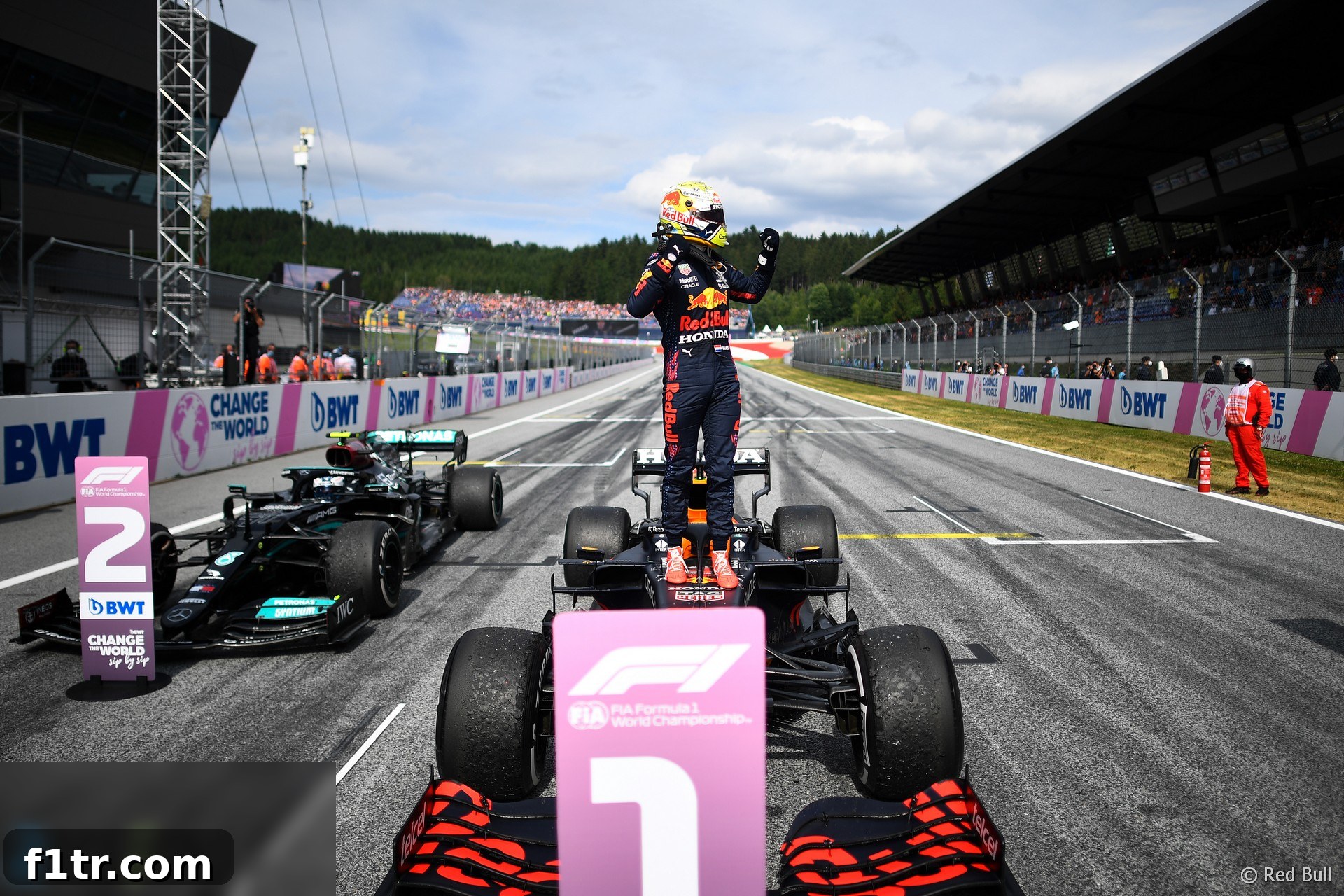
The 2021 Austrian Grand Prix served as a stark reminder of the shifting power dynamics in Formula 1, culminating in a commanding victory for Max Verstappen. This dominant performance propelled the Red Bull Racing star further ahead in the championship, marking a significant milestone: Lewis Hamilton now finds himself more than a win’s worth of points adrift of the championship lead for the first time since the challenging 2016 season. The seven-time world champion has only once before managed to claw back such a substantial deficit to claim the coveted title, underscoring the formidable task that lies ahead for Mercedes-AMG F1.
Recalling 2016, Hamilton faced a 43-point gap to then-Mercedes teammate Nico Rosberg, a lead he managed to overcome, only for Rosberg to re-establish a 33-point advantage later in the season. Crucially, in that era, Hamilton possessed a car demonstrably capable of matching and often exceeding his main rival’s pace. This time, the sentiment from the British driver is markedly different, tinged with a sense of resignation. “These past races have been difficult, and he’s pretty much just cruising ahead, so there’s not really much I can do about that,” a candid Hamilton admitted to RaceFans after finishing a distant fourth, a staggering 46 seconds behind Verstappen in Austria.
Verstappen’s Austrian Masterclass: Unyielding Dominance
Verstappen’s victory at the Red Bull Ring was a demonstration of raw pace, strategic brilliance, and exceptional race craft. From the moment the lights went out, the Dutchman was in a league of his own, setting an unmatchable pace on both new and older tyres. His team principal, Toto Wolff, suggested that Hamilton’s Mercedes might have had the pace to challenge Verstappen during the initial stint. However, this theoretical pace was never truly realized, largely due to a series of events and strategic decisions that continuously favored Red Bull.
Verstappen showcased his racing acumen twice within the first four laps, skillfully navigating past McLaren’s Lando Norris, whose car possessed a higher top speed. After a clean getaway at the original start, he replicated this feat following an early Safety Car restart two laps later. His timing was impeccable, returning to racing pace as late as possible to minimize Norris’s slipstream advantage and scamper clear. “I just had to be awake in the restart,” Verstappen explained. “I had a little bit of a gap and I knew that if I could go past lap one, or the restart, I could do my own race. But you always have to do that first.”
The extent of Verstappen’s dominance was evident in his lap-by-lap accumulation of time. From the Safety Car restart until his first pit stop on lap 32, he built an astonishing 29-second lead over his nearest rivals in just 29 laps. This incredible cushion provided Red Bull with immense strategic flexibility, allowing them to ‘undercut’ any competitor without fear of losing track position. Instead, Verstappen was the last of the leading quartet to swap his starting medium tyres for the more durable hards, a move that further cemented his control over the race. His strategic freedom even permitted a second pit stop late in the race, securing the extra point for the fastest lap and prudently guarding against any unforeseen tyre issues, a painful lesson learned from the Baku-style tyre blowout earlier in the season.
Mercedes’ Strategic Dilemmas and Hamilton’s Setback
While Verstappen cruised to victory, Mercedes faced a series of challenges, both tactical and technical, that ultimately hampered their efforts. Analysis of the second stint of the race revealed that Mercedes may have had a stronger underlying pace than initially appeared, particularly with Valtteri Bottas. From the moment Verstappen exited the pits to when Bottas (who eventually finished second) was instructed to hold position behind his teammate Hamilton 12 laps later, the gap between the leader and Bottas expanded by a mere 1.4 seconds. This suggests Bottas had the potential to maintain pressure on Verstappen, potentially altering Red Bull’s strategic calculus.
However, a combination of running in Hamilton’s ‘dirty air’ and the temporary team order cost Bottas a crucial three seconds. Once Bottas was finally allowed to pass Hamilton, his pace was remarkably similar to Verstappen’s. Yet, by then, those three lost seconds had provided Red Bull with the confidence needed to commit to Verstappen’s second pit stop. Had Mercedes released Bottas earlier, the strategic landscape might have shifted considerably. A slow stop for Verstappen could have placed him behind Bottas, though with fresher tyres, it’s highly probable he would have re-passed the Finn with relative ease. This moment underscored Mercedes’ difficult balancing act in managing their drivers and their championship aspirations.
Red Bull team principal Christian Horner later confirmed that Bottas never posed a genuine threat to Verstappen’s lead. However, the ghost of the Azerbaijan Grand Prix, where Verstappen’s rear tyre failed while leading, loomed large. “One stop, after Azerbaijan, when you’ve got a 25-second lead with a free pit stop – why take the risk?” Horner reasoned, explaining the decision for the late second stop. Minor damage was indeed spotted on one of Verstappen’s tyres after his first pit stop, a small cut that, while not significant, was enough to catch the team’s attention and justify the cautious approach.
For Hamilton, the race took a decisive turn around halfway through when his car sustained damage. Mercedes team principal Toto Wolff estimated this damage, primarily to the left-rear of the car, cost him approximately 30 points of downforce. This not only sapped rear-end grip and lap time but also accelerated tyre graining, forcing Hamilton to drive slower to make his tyres last until the end. The team later quantified the loss at around seven-tenths of a second per lap due to this unforeseen damage. Ultimately, Hamilton opted for a second pit stop himself, with enough of an advantage over the fifth-placed car (after being passed by Norris for fourth) to do so without losing a position. His fresher tyres somewhat masked the extent to which the damage had compromised his car’s pace.
Even before the damage, Hamilton was unable to match Verstappen’s blistering pace. It took him until lap 20 to pass Norris for second place. While he did rapidly pull away from the McLaren driver thereafter, he only managed to close the gap to Verstappen on two laps, and by a total of less than a tenth of a second. Shortly after his second pit stop, Hamilton set his personal best lap, a 1’08.126. On that very same lap, Verstappen, despite running on 22-lap old tyres, was just 0.021s slower. Verstappen was also demonstrably faster on the in- and out-laps for their respective pit stops, further underlining the overwhelming fact that in Austria, he had no true rival.
Perez’s Penalties and Midfield Skirmishes
Verstappen’s sheer dominance meant that Sergio Perez, Red Bull’s second driver, was not required to act as a strategic pawn, despite starting in a theoretically perfect position ahead of both Mercedes to serve as a rear-gunner. However, his race quickly unraveled. On lap four, during the Safety Car restart, Perez attempted an audacious overtake on Norris for second place around the outside of Turn Four. This bold move ended with him taking a trip through the gravel, dropping him to a disappointing 10th position.
Although Horner initially deemed the incident a racing one, Red Bull still inquired with Formula 1 race director Michael Masi about potential action. This eventually led to Norris being slapped with a five-second time penalty some 20 laps later. In his subsequent recovery drive, Perez found himself in two similar battles with Ferrari’s Charles Leclerc. On both occasions, Perez left Leclerc little room at the exit of Turns Four and Six, resulting in the SF-21 ploughing through the gravel. Consequently, Perez himself received two five-second penalties. Ferrari, having seen the precedent set by Norris’s penalty, also contacted Masi after these incidents, leading Horner to surmise that the initial sanction for Perez set a precedent for future similar incidents.
Having to battle his way back up the order meant Perez had to push his medium tyres hard, limiting their longevity. This compromised his race, as he dropped back into traffic after his pit stop. A few tenths lost during the stop further exacerbated his situation, forcing him to spend a considerable portion of the race running behind McLaren’s Daniel Ricciardo.
Ricciardo’s Redemption and Sainz’s Strategic Masterstroke
Daniel Ricciardo, after a challenging qualifying session that saw him start 13th, found solace and points in the race. He felt comfortable on the hardest tyre compound – a choice only shared by Ferrari and McLaren drivers in practice – and his car’s top speed advantage made it difficult for Perez to make progress. Despite starting 10 positions apart, Ricciardo finished sixth, ahead of Perez in seventh, after the Red Bull driver’s penalties cost him fifth place, dropping him behind Ferrari’s Carlos Sainz Jnr.
Sainz’s performance was a masterclass in tyre management and strategic execution. Cooler race day conditions, with track temperatures around 35C, aided his strategy. Having qualified further down the grid, he had a free choice of starting tyre and opted for the hard compound with the intention of taking it as far as possible. “Lower temperatures normally exposes you more to front graining. In this case, it would be negative for us,” he had said pre-race. “But also lower temperatures obviously means more grip at the rear, which could help our car balance and go the right way if there is no front graining.”
Sainz, by his own admission, “played by eye” with his tyre choice and got it perfectly right. His car balance allowed him to be incredibly consistent throughout the race. Over a 10-lap segment in the first half of the race, his lap times exhibited a standard deviation of just 0.096 seconds – a minuscule variance considering the fluctuating pace during wheel-to-wheel battles. He stretched his hard tyres all the way to lap 48 before making his sole pit stop. After this stop, he became the only driver other than Verstappen to lap sub-1’08, and this blistering pace on low fuel was crucial in him snatching fifth place from the penalized Perez by a mere 0.771 seconds. Ricciardo followed three seconds further back.
Ricciardo reflected on his race, stating, “I was always in some battles, mostly defending. But it’s because we got a good start. I think two positions on the start, and then two on the restart. So we put ourselves in a good position.” It was a much-needed redemption after a disappointing qualifying session where his teammate secured his maiden front-row start. Like Sainz, Ricciardo benefited from a free tyre choice and started on a new set of mediums, which he had saved during practice. “We at least put ourselves back in the fight. And I was trying to hold on to Perez, Charles, Carlos for as long as I could, and then probably the last eight laps started to run out of rear tyres.”
Ricciardo also benefited from Leclerc’s mirrors being full of AlphaTauri’s Pierre Gasly. Gasly was the highest-placed driver who committed to a two-stop strategy from the outset. The AlphaTauri proved to be one of the fastest cars over a single lap, with Gasly even trading fastest laps with Verstappen at times. However, starting on the softest tyre meant he could only manage 13 laps before pitting, condemning him to spend a significant portion of his race in traffic. His impressive bursts of pace ultimately served as a source of strategic regret rather than encouragement due to the tyre choice and subsequent traffic entanglement.
Alonso’s Point, Williams’ Heartbreak and Late Race Incidents
Fernando Alonso expressed frustration over his qualifying session, believing his P14 starting position was compromised by drivers slowing at the penultimate corner, suggesting a top-six potential. Like Ricciardo, Alonso enjoyed the advantage of starting on fresh rubber, a luxury most of his competitors did not have, as they began on used sets of tyres.
The veteran Spaniard earned a crucial point for Alpine by expertly managing his tyres through the second half of the Grand Prix while locked in a battle with Williams’ George Russell. Alonso ensured there was enough life left in his tyres for a late push, while Russell appeared to hit the point of no return with his rubber approximately 15 laps from the end, subsequently falling into Alonso’s clutches. It took a few attempts and some lock-ups before Alonso successfully executed the overtake for 10th place with just four laps remaining, leaving Williams to extend their agonizing wait for their first point since 2019.
Yuki Tsunoda mirrored his AlphaTauri teammate Gasly’s two-stop strategy but unfortunately picked up penalties for crossing the white line at the pit entry, ultimately finishing 12th. The race concluded with late drama as Alfa Romeo’s Kimi Raikkonen and Aston Martin’s Sebastian Vettel collided at Turn Five on the final lap while battling for what would have been Russell’s 11th place.
Vettel had enjoyed a strong opening stint, charging from 11th to fifth on used softs in the first 14 laps. However, those tyres quickly faded, necessitating an early pit stop. He only briefly returned to the top 10 after that, as he experienced a repeat of his qualifying struggles where, despite the car “feeling okay,” consistent pace was elusive for both himself and teammate Lance Stroll, who inherited 13th following the crash. Raikkonen, conversely, climbed 10 places to sixth in the race’s first half, being the only driver other than Sainz to start on the hard compound. While his ‘overcut’ strategy didn’t gain him places early on, taking those tyres as long as he did enabled him to push harder after switching to mediums, particularly in the closing laps when many drivers around him were on the slower hard compound, showcasing smart strategic foresight.
In 14th was Raikkonen’s teammate Antonio Giovinazzi, whose race began with light contact with Esteban Ocon – enough to force the Alpine out of the race – and a subsequent pit stop at the end of lap two. This early stop freed him from the medium tyre, placing him on hards for the remainder of the race. This decision was influenced by rising grid temperatures, suggesting a one-stop strategy on the softer, faster-wearing tyres nominated for the weekend would not be feasible. Nicholas Latifi finished almost a minute behind Williams teammate George Russell but notably completed the race on the same lap as the five cars ahead of him. He also finished a lap ahead of the Haas duo of Nikita Mazepin and Mick Schumacher, who, like Latifi, primarily contended with blue and yellow flags rather than direct battles for position.
Verstappen’s Championship Lead Swells: A Defining Moment
For Mercedes, the Austrian Grand Prix offered only crumbs of comfort after Red Bull’s sixth win from nine races, and Verstappen’s fifth consecutive victory. While the track and tyre combination at the Red Bull Ring may not have optimally suited the W12s, and Hamilton’s car damage undeniably cost him valuable points, their underlying pace was, by Toto Wolff’s admission, “not uncompetitive.”
Wolff attempted to put a positive spin on their latest defeat, pointing out that Verstappen was “only a DNF” (Did Not Finish) ahead of Hamilton in the points standings. However, the relentless and inexorable growth in Verstappen’s championship lead is painting an increasingly clear picture: with every passing race, he looks more and more like a champion in the making. The Austrian Grand Prix served as a definitive moment in the 2021 Formula 1 season, a clear indicator that the championship momentum has firmly swung towards Red Bull. Mercedes must find a decisive response, and quickly, as the battle heads to Silverstone – a critical juncture in this enthralling title fight.
2021 Austrian Grand Prix: Further Analysis & Insights
- Vasseur on Alfa’s “huge step forward” and why he’s vexed by technical directives
- How Ricciardo “got some enjoyment back” after “really low” first race in Austria
- F1’s penalty points are not “harsh” and won’t be reviewed this year – Masi
- Austrian double showed Sainz found his feet faster than 2021’s other big-name moves
- 2021 Austrian Grand Prix Star Performers
Browse all 2021 Austrian Grand Prix articles